

Sitting through mandated training sessions does not always mean an employee has learned everything they need to know. Even if the knowledge has been retained, it does not mean that the employees will be ready to apply the theory to their everyday work approach.
In FY22, Infosys employees logged more than 39.5 million hours of learning on the company’s Lex platform, with roughly 30,000 of them signing in on any given weekday. Numbers like that get celebrated in annual reports and quietly mistaken for a workforce that has become measurably better at its job.
Those are two different claims. Hours spent in training describe effort. Whether anyone can now do something they couldn’t before describes learning, and most L&D dashboards can’t tell the two apart. This is where the core debate of training vs learning comes in and why training doesn’t lead to learning in every case.
Training vs Learning: The Gap Between Lessons Delivered and Skills Gained
Training measures activity. Learning measures change.
The distance between them is where a lot of L&D budget disappears without anyone noticing. A completed course, a full attendance sheet, a high satisfaction score. Each confirms that training happened. None confirms that a skill now exists that didn’t before.
Donald Kirkpatrick’s four-level model named this problem decades ago: Level 1 captures how learners felt about a session; Level 4 captures whether the business actually changed.
TCS, Wipro, and Cognizant all run dedicated learning platforms and campuses, and they report participation at enormous scale. Though the coverage at that scale answers a question about reach, it says very little on its own about capability.
What Completion Rates and Learning Hours Miss
Completion rates and learning hours stay popular because they’re easy to pull and easy to present, and because a rising number looks like progress even when nothing on the job has changed.
LinkedIn’s 2025 Workplace Learning Report found that engagement and retention remain the most common ways teams gauge development impact, while far fewer connect learning to whether the business makes money, saves money, or lowers risk.
Activity metrics fill the space because outcome metrics are harder to build. Data analytics is starting to reshape corporate training in India, yet the underlying question stays the same. What changed in the work after the course ended?
A side-by-side view makes the distance obvious.
| What L&D Metrics Count | What It Does and Does Not Measure |
| Training hours logged | Effort, with no read on skill gained |
| Course completion rate | Content consumed; application untested |
| Post-session satisfaction | Mood in the room, not behaviour at the desk |
| Modules assigned per employee | Programme reach, ahead of any result |
None of the numbers is useless. They’re just inputs wearing the costume of outcomes with no real evaluation of training effectiveness.
Why Learning Fades After the Session Ends
Most of what gets taught starts leaking away within days unless something pulls it back.
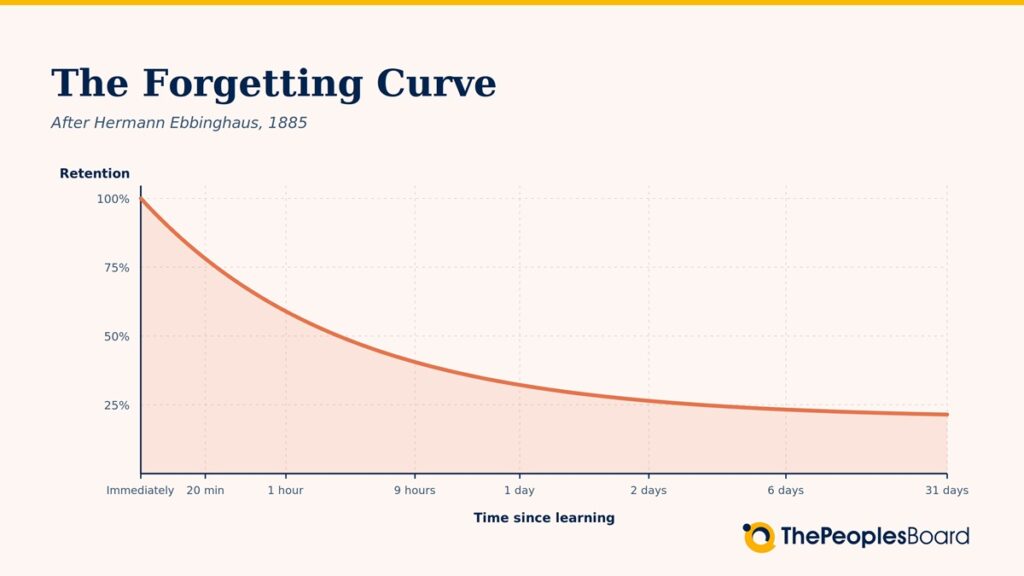
The forgetting curve, first mapped by Hermann Ebbinghaus and replicated in 2015, shows memory of freshly learned material dropping sharply soon after study and continuing to fade without reinforcement. A two-day workshop with no follow-up is fighting that curve, and usually losing.
Application matters even more than memory. Decades of research on the training transfer find that whether a skill reaches the actual job depends heavily on the work environment, the learner’s motivation, and manager support, rather than on the training event by itself.
An employee who returns from a course to a manager who never mentions it again, and a workload that leaves no room to practise, will slide back to the old way of working. When companies and managers forget the difference between training and learning, training effectiveness naturally takes a dive.
What Turns Training Into Learning
Learning sticks when the design assumes forgetting and plans around it. The programmes that genuinely move capability tend to share a set of features, and none of them is a longer course.
Spaced reinforcement
Short, repeated touchpoints beat a single intensive session, because they interrupt the forgetting curve instead of ignoring it. Breaking the study or training material into smaller, bite-sized pieces and then reviewing them at gradually increasing time intervals ensures that the information is retained by the learner
Real work as the practice ground
Skills applied to a live project within days of learning transfer far better than skills parked for “later.” The actual application of a fresh concept in the workflow not only provides a real-life example of the intended purpose of the information but it also lets the learner judge the merits and demerits of the skill on their own rather than relying on second-hand experiences/
Managers inside the loop
When a manager sets the expectation, models the skill, and asks about it afterwards, transfer climbs. When they don’t, it stalls. A manager’s involvement also signals their faith in the new concepts and how they might help the learner and the team.
Behaviour as the measure
Tracking what people do differently, checked against clear competency mapping requirements, tells a truer story than any completion rate. It highlights the difference between what the employee has been taught and what they are applying in their working style. What they learn is knowledge. What they apply is the actual capability.
The shift is from counting what goes into training to observing what comes out of it. That work is slower, messier, and far harder to put on a slide. It’s also the difference between Infosys logging 39.5 million learning hours and Infosys being able to show which of those hours changed how the work gets done.
In the End…
The organisations getting real return on L&D treat the training session as the start of a process rather than the finish line. They design for reinforcement, hand managers a role in what happens after the course, and measure the behaviour that follows instead of the attendance that came before.
A team sitting on impressive learning-hour totals can start by choosing one recent programme and tracing it forward, asking what people are doing differently now and whether anyone can point to it. When the honest answer is a completion rate, the number was never measuring learning in the first place. Building a culture of continuous learning begins with that admission.
FAQs
What is the difference between training and learning?
Training measures activity: hours logged, courses completed, sessions attended. Learning measures change in capability: whether an employee can now do something on the job they couldn’t do before. A full attendance sheet confirms the first, not the second.
Why are completion rates and learning hours poor measures of L&D impact?
They track consumption, not application. An employee can finish every assigned module and still work the same way they did before. LinkedIn’s 2025 Workplace Learning Report found most teams gauge impact through engagement and retention, while far fewer tie learning to revenue, cost savings, or risk reduction.
What is the forgetting curve and why does it matter?
Mapped by Hermann Ebbinghaus and replicated in 2015, the forgetting curve shows that memory of freshly learned material drops sharply within days of a session and keeps fading without reinforcement. A standalone workshop with no follow-up is working against this curve, which is why most of the content leaks away before it can be used.
What makes training actually stick on the job?
Four design choices tend to show up together: spaced reinforcement through short repeated touchpoints, applying the skill to live work within days, visible manager involvement before and after the session, and tracking observable behaviour change against a competency map rather than attendance.
What role do managers play in turning training into learning?
Managers decide whether a new skill gets used. When they set the expectation, model the behaviour, and ask about it in the weeks that follow, transfer rates climb. When they stay silent and workloads leave no room to practise, employees slide back to the old way of working.
What should L&D teams measure instead of training hours?
Behaviour change tied to clear competency requirements, business outcomes the skill was meant to influence (quality, cycle time, error rates, revenue), and the gap between what was taught and what is being applied. The shift is from counting what goes into training to observing what comes out of it.