
Family-owned businesses are the quiet backbone of Indian enterprise. They employ millions, carry decades of institutional memory, and run on a texture of trust that no HRIS can replicate. Yet the moment they begin to scale, the very systems and processes that built them- warm informality, decisions made at the dinner table, loyalty earned over generations- start to collide with the demands of a larger and more complex organisation. The question is rarely whether to professionalise. It is how to do it without hollowing out what made the business worth professionalising in the first place.
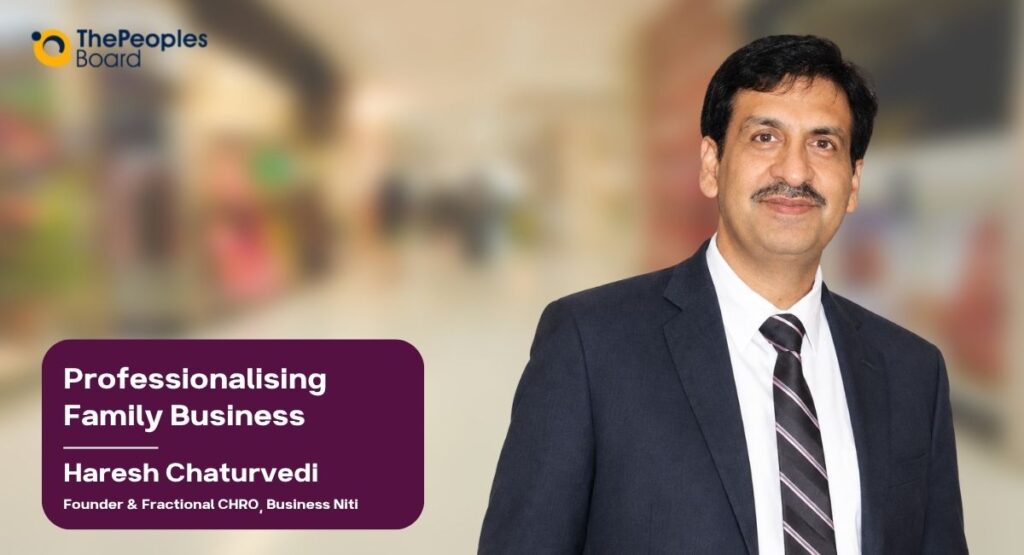
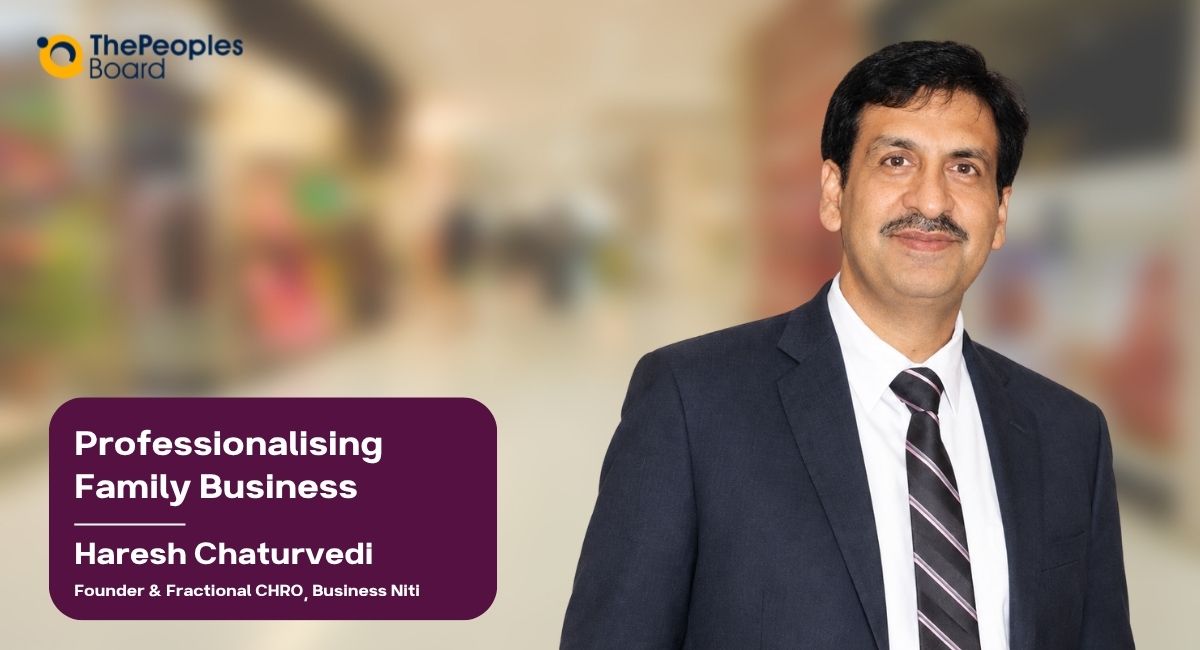
That tension sits at the heart of this conversation with Haresh Chaturvedi, Founder and Fractional CHRO at Business Niti. The view that emerges across the exchange is unsentimental but affectionate. Professionalising family business, in Haresh’s telling, is not about replacing warmth with process, or installing a borrowed multinational manual over an old family rhythm. It is about building the quiet scaffolding that lets a business keep its character once it outgrows the room it was born in. The analogies land easily: cholesterol for nepotism, a chandelier before the roof is on, culture as a slow cooker rather than a microwave, because the thinking underneath them is drawn from actual Indian shop floors rather than any conference deck.
TPB Team: What does “professionalising” a family business actually mean beyond hiring professional managers?
Haresh: Many owners think professionalising means hiring a CEO with an impressive CV and an even more impressive wristwatch. I have watched that movie many times. The climax is usually the same: six months later, the CEO resigns, and the family says, “See? Professionals don’t understand our business.”
In most cases, the professional was perfectly capable. The problem was that nothing around him had changed. Decisions still went to the family WhatsApp group. Budgets were still approved “after discussing at home.” He had a title, a cabin and a nameplate but no real authority.
Professionalising is not about who you hire. It is about how the business runs. It means clear roles, so people know what they own. It means written decision rights: who can approve a purchase, a hire or a salary change, and up to what limit. It means performance is discussed with numbers rather than moods, and family members in the business meet the same role expectations as everyone else.
My favourite test is simple. If the founder went on a three-week pilgrimage without his phone, would the company still know what to do? If the honest answer is “Bhagwan bharose,” there is professionalising work to be done.
TPB Team: Where should family businesses draw the line between family influence and professional management?
Haresh: The line is not between “family” and “outsiders.” It is between ownership and management.
As owners, the family has every right to decide the big things: vision, values, where capital goes, which businesses to enter or exit, and who sits on the board. No professional should try to take those away. But choosing a vendor, hiring an HR executive, or setting a sales target belongs to whoever holds that role, whatever their surname.
I usually suggest families think of three rooms. The family room: a family council or family meeting; it handles family matters, inheritance and who joins the business. The boardroom handles strategy and major policy. The operations room handles running the day-to-day business.
Trouble starts when the rooms leak. The classic symptom is what I call the “bypass”: a supervisor who dislikes a decision walks into Chachaji’s cabin, and the decision is reversed before lunch. Let that happen three times, and every manager learns that their authority is decorative.
Another familiar scene: the eldest son is CEO on paper, but the real decisions happen when Papa, officially retired, nods his approval over morning tea. Influence is fine. Invisible veto power is not.
TPB Team: How can family-owned businesses introduce formal HR systems without making the culture feel corporate?
Haresh: Owners have a genuine fear here. They imagine that once HR policies arrive, the office will fill with forms and formats, the morning “Jai Shri Krishna” will disappear, and the canteen chai will be replaced by a vending machine that only accepts exact change.
It doesn’t have to be that way. A policy is simply a promise written down so it can be kept fairly. Warmth comes from how people are treated, and good systems can protect that warmth.
The most useful lesson I have learnt is that in a family business, how you introduce something matters more than what you introduce. I once saw an HR head send an email calling senior managers to discuss “structural changes.” Within an hour, the owner had four panicked phone calls and one resignation. The content was fine; the channel, timing and framing were all wrong.
Compare that with an HR manager I admired, who needed approval for a new performance system. She didn’t present it to the owner first. She mentioned it casually to his wife during Diwali. The wife raised it at the next family gathering. By the time the formal presentation happened, the family had already digested it. I call this the pre-sell. It is slower, but it works.
A few other things help: Involve at least one family member in drafting, and brief the family privately before announcing anything. A two-page leave policy in simple Gujarati or Hindi beats a 40-page English manual nobody opens. If the owner has always helped with an employee’s wedding or hospital bill, make it a welfare scheme. Now it is a right, not a favour that depends on Babu-ji’s mood. AND the Diwali pooja and the annual picnic are culture, not inefficiency.
TPB Team: Which HR processes should a growing family business professionalise first?
Start with the policy most likely to succeed, not the one most likely to impress. Your first policy matters more than any other, not for its content, but because a failed first policy poisons the well for everything after it.
A good first policy solves a problem the family already recognises, is easy to run, shows results quickly, doesn’t threaten family authority or pay, and can be enforced for everyone. Attendance and leave management usually fit perfectly. They are objective, non-threatening and produce useful data.
Once trust is built, this is the sequence I generally recommend:
- Roles and structure: I have walked into companies where three people each believed they headed the same department. Clarity comes first.
- Hiring: A job description, an interview panel, reference checks and a written offer. This quietly closes the “my friend’s son needs a job” pipeline.
- Pay structure: Even rough salary bands. Nothing destroys trust faster than two people doing the same job at very different pay for reasons nobody can explain.
- Performance and KRAs: Three to five measurable goals per person, reviewed twice a year, is plenty to begin with.
- Compliance: Appointment letters, PF, ESI, gratuity, POSH. Unglamorous but one labour dispute can cost more than the whole HR budget.
- Delegation of authority: One page stating who approves what, and up to what amount. I have seen founders still signing every cheque above ₹10,000. This page sets them free.
Engagement apps, competency dictionaries and 360-degree feedback can wait. You don’t install a chandelier before the roof is on.
TPB Team: How can organisations preserve their founding values while changing outdated people practices?
Haresh: By remembering one distinction: values are permanent; practices are not.
“We take care of our people” is a value. “Increments depend on who the owner likes” is a practice and an outdated one. “We are honest with customers” is a value. “Only family can see the accounts” is a practice.
Most outdated practices were sensible shortcuts when the company had 30 people. At 300, the same shortcut becomes unfair. So, when a practice is questioned, I ask one thing: does this still serve our values, or has it started working against them? Changing it is not betraying the founder. It is honouring what the founder actually cared about.
The trick is to argue in the family’s own language. Don’t say, “Best practice requires a performance review system.” Say, “Our tradition values excellence and keeping our word. This system helps us find and support our best people.” Reframing through the family’s values works far better than confronting them.
One more piece of advice from experience: before judging a tradition, separate observation from evaluation. “The owner consults his astrologer before big decisions”, is an observation. “This is irrational” is an evaluation. Get very good at the first before you attempt the second. Your change will go much further if it starts from understanding rather than ridicule.
TPB Team: What happens when family traditions conflict with merit-based hiring or promotions?
Haresh: An owner once told a new HR manager, “Please don’t use that word in front of the family. It makes them uncomfortable.” The word was nepotism. At that moment, his three children ran operations, finance and business development; his nephew ran the warehouse; and his wife’s cousin supervised HR.
I like to say nepotism is like cholesterol. Your body needs some, but too much blocks the arteries. Family members can show extraordinary commitment. I know of an export business where the professional managers left during the 2008 slowdown, but the cousins stayed and took no salary for six months. You cannot hire that.
The cost of too much is equally real. A finance manager who saved ₹2 crore and trained half his team watched the owner’s son, who had failed CA twice, become CFO. He was offered a 10% raise to stay. He left and never looked back.
You cannot remove family preference from a family business. You can manage it:
- Be honest. Employees forgive a family preference. They never forgive pretending it was merit.
- Set an entry bar. Some families I respect require the next generation to work elsewhere for three years and join at a junior level.
- Separate entry from advancement. Family may come through the family door, but promotions follow the same criteria as everyone else.
- Channel, don’t block. If not, every family member is suited to operations; find roles where their strengths help and their gaps can’t hurt.
- Protect professionals’ growth. Otherwise, your best people leave quietly, and your average people stay loudly.
And please be careful with “you are one of the family.” It sounds generous until succession day, when the “family member” discovers he is not one.
TPB Team: How should family businesses approach succession when family expectations and business requirements differ?
Haresh: First, start talking about it. I have met founders who have been “about to retire” for eight years. Every year, someone gently raises succession at the family gathering. Every year the answer is, “Soon, beta, soon. Maybe next year.” Next year, as we all know, is a very busy year.
Succession is hard because it isn’t really about a role. It touches mortality, power and identity. So, families delay it with four comfortable myths: “The business needs me” (usually true, because the founder built it that way), “Blood equals competence,” “We have time” (until a heart attack at 68), and “Equal means fair.” I once saw siblings rotate the top job every year. The business changed direction so often that customers got blown away.
When expectations and requirements differ, separate two questions:
- Who will own the business? That is a family decision.
- Who will run it? That is a business decision, based on capability.
The owner and the CEO need not be the same person. Some of the healthiest family businesses I know have the family on the board, focused on governance and strategy, with a capable professional running operations.
Agree on the leadership criteria as a family, before any names are discussed. Then the debate stays about the business, not about who loves whom more. And don’t let tradition quietly overrule capability, whether that is a more able younger sibling, or a daughter who has outperformed for twelve years while competitors keep calling her.
Finally, begin early. Good succession takes three to five years, not three to five months.
TPB Team: How can HR establish accountability without creating friction with family leadership?
Haresh: By making sure HR is never the one making up the rules.
Get the family to approve the performance system, the code of conduct and the authority matrix first. Then, when HR applies them, nobody is being judged by HR. HR is simply applying what the family itself signed. That one step removes half the friction.
The other half comes from how you have the conversation:
- Use data, not adjectives. “Sales in your region fell 18% against target” is a conversation. “You are not serious about work” is a fight.
- Ask before you accuse. “I have noticed meetings are starting late – what’s driving that?” invites reflection. “You’re always late” invites defensiveness.
- Affirm, then challenge. Start with a genuine strength. It is context, not flattery.
- Always talk privately. Never correct a family member in front of their team.
- Bring a solution. A problem without a way forward sounds like criticism; with one, it sounds like support.
Also, plan for exceptions, because there will be some. Make them documented and justified, so they are acknowledged rather than pretended away. Selective enforcement is worse than no policy at all. If staff are tracked to the minute while the founder’s nephew rises from “learning the business” to “Vice President- New Initiatives” in 18 months without a review, your code of conduct has become a code of comedy.
The day the founder’s son breaks the attendance policy, that private conversation will feel terrifying. Have it anyway or accept that the policy is decorative. HR’s job is to be the honest friend of the business, not the policeman of the family.
TPB Team: What role should HR play when family relationships begin affecting workplace decisions?
Haresh: HR is not the family therapist but it cannot pretend nothing is happening either.
In a family business, the stated reason for a conflict is rarely the real one. I recall two brothers who stopped speaking at 11 AM one Monday. By 2 PM, employees were taking sides; by evening, the HR manager was updating her resume. The trigger was credit to a slow-paying customer. The real issue was a rivalry that began when they were seven and nine – over who got the front seat in their father’s car.
A corporate conflict is a campfire; a family business conflict is a forest fire. It usually escalates in five stages: a business trigger, then history (“this is just like that time when…”), then emotion (“you always do this”), then coalitions as relatives and employees take sides, and finally entrenchment, where winning matters more than solving anything. By the time it reaches HR, it is usually at stage four or five.
What HR can do:
- Name the business impact, not the family issue. “The two plants haven’t shared production data for six weeks” is HR’s sentence. “Your cousins are fighting” is not.
- Listen before solving. Meet each person separately, more than once. Beneath the positions are interests – usually respect and recognition.
- Never take visible sides. The moment you do, you become part of the fight.
- Win small first. Resolve one piece, build goodwill, then the next.
- Protect the people in the middle. No employee should have to choose between two family members to keep their job.
- Know when to call outside help – a mediator, advisor or independent director.
The rule I recommend to every family: argue at home, decide at the office, and never argue in front of employees.
TPB Team: When should a family business bring in external leadership rather than develop family members internally?
Haresh: Bringing in an outsider is not an admission of defeat. Very often, it is the most mature decision a family can make. In my experience, it makes sense when:
- The business has outgrown the family’s expertise– exports, technology, a new plant, private equity or a bank loan with serious covenants.
- The next generation is not ready– too young, still learning, or honestly not interested. More and more of today’s heirs are asking whether they even want the business, and that is a fair question.
- The family is in conflict and needs a neutral leader to keep the ship steady while relationships heal.
- The company is preparing for investors or a listing, where independent professional leadership builds credibility.
It need not be either-or. A professional can run the business for five to ten years while the next generation develops, then hand over or the family can stay in governance permanently while professionals manage.
But a word of caution, learnt the hard way by many families. If you bring in an outsider, give them real authority, a clear mandate and time. I have seen capable CEOs leave within six months because every decision still went to a family council that met irregularly, by rules nobody had written down. Hiring a CEO and then second-guessing every decision is like buying an expensive car and pushing it.
TPB Team: What mistakes do family businesses commonly make when trying to professionalise too quickly?
Haresh: Some families, once convinced, want to go from zero to Fortune 500 in a single board meeting. The results are rarely pretty. The mistakes I see most often:
- Copy-pasting a multinational’s HR manual. A policy written for 50,000 employees in 30 countries will choke a 250-person company in Surat. Borrow ideas, not documents.
- Hiring a big-brand CHRO and expecting magic. Someone used to large teams may struggle where HR is two people and a filing cabinet. Hire for fit and stage, not logos on the CV.
- Changing everything in one quarter. New structure, appraisals, attendance system and salary bands all at once is a recipe for panic.
- Buying technology before solving a problem. I once found an expensive HRIS gathering dust while the HR manager ran payroll queries on WhatsApp from his personal phone. Start where it hurts – payroll is often best; pilot in one department, then expand.
- Sidelining the old-timers. The people who built the business hold its real knowledge. Treat them as obstacles, and you lose their wisdom and everyone else’s trust.
- Owners exempting themselves. If the travel policy applies to everyone except the family, nobody takes it seriously, not even the family.
- Professionalising on paper only. Beautiful, laminated policies while real decisions still happen over dinner. Employees spot this within a week.
A realistic rhythm is simple.
Year one: build relationships and deliver two or three credible wins.
Year two: add the bigger pieces, such as a real performance system and a family employment policy.
Year three onwards: make it stick through leadership changes and the inevitable family pushback.
Evolution, not revolution. Culture is a slow cooker, not a microwave.
TPB Team: How can family businesses prepare the next generation for leadership without assuming they are automatically ready?
Haresh: Being born into a business no more makes you ready to run it than being born near a hospital makes you a surgeon.
I think of a young man who was 28 when his father had a heart attack. He had spent three years in the business, mostly observing, attending meetings without contributing, visiting clients without owning relationships. Bright and decent, but untested. The next two years were the hardest of his life and the most expensive in the company’s history.
A practical preparation path:
- Work outside first: two to five years where your surname carries no weight and your boss is not your uncle.
- Start in a real role, not a title: at a level where results are visible.
- Rotate across functions: sales, operations, finance and HR.
- Report to a non-family manager who is free to give honest feedback.
- Have two mentors : one from the family for context, one from outside for candour.
- Assess honestly: anonymous 360-degree feedback and external assessors, not just Babuji’s opinion.
- Hand over in stages: one division first, then the business with the founder on call, then the founder on long leave, then full handover.
The antidote to entitlement is real accountability. Results that matter, failure that is visible and success that is genuinely earned. And the founder must allow the successor to make decisions, including mistakes. A father who vetoes every new idea isn’t preparing a leader. He is training someone to ask permission.
When there are gaps, frame them forward. “These are the capabilities that will matter most for your success, and here is the path.” It lands very differently from “You are not ready”, even when the message is the same. In my experience, the next generation welcomes this. Most of them would rather be respected than merely obeyed.
TPB Team: What should family businesses retain from their traditional culture even after formalising their HR systems?
Haresh: Almost everything that made them successful in the first place. Professionalising should make a family business stronger; not make it look like everyone else. I would protect these fiercely:
- Speed of decision: In a family business, a good idea can be approved over one cup of tea. Keep approval layers lean.
- Long-term thinking: Corporates chase quarters; families think in generations. That patience is a real competitive edge.
- Personal care for people: Owners who know employees by name, attend their family functions and help in a crisis build loyalty that no engagement survey can buy.
- Loyalty in bad times. Many family businesses have employees with 25 or 30 years of service, three- to four-generation working together. That is rare today, and precious.
- Purpose and community: A business that can say “we have served this community for fifty years, and your work continues that” offers something most corporates can’t and exactly what younger employees are looking for.
- Values and reputation: The family name is on the gate. That personal accountability for quality and honesty should never be outsourced to a policy.
The goal is rigour without rigidity, structure without sterility and accountability without alienation. Strong families don’t lose authority by building structure; they secure it for the next generation.
Logic doesn’t need to run the whole show in a family business. It just shouldn’t be allowed to retire completely.
What stays with you from this conversation with Haresh is a simple reframing. The choice in a family business is not between family warmth and professional structure, but between an organisation that depends entirely on who is in the room and one that keeps functioning when the founder goes on a three-week pilgrimage.
The habits worth protecting- speed of decision, long-term thinking, personal care for people, generations of loyalty- are not threatened by clear roles, written authority limits or honest performance conversations. They are protected by them. Done with patience and in the family’s own language, professionalising is less an act of modernisation than an act of inheritance. It is what allows the next generation to receive something worth running.