

Here’s the one insight that changed how I think about the CHRO role.
When I started researching HR leadership in India, I thought the CHRO story in India was about AI. About technology. About the future of work.
I was only partly right.
The deeper I went across 25,000+ CHRO profiles from Josh Bersin, 350 CHRO profiles from Spencer Stuart, BSE 100 data from Russell Reynolds, 1,670+ talent leaders surveyed by Korn Ferry, and dozens of conversations with HR leaders, the more I realised that the real story isn’t about any single trend. It’s about a fundamental shift in what the CHRO role actually is.
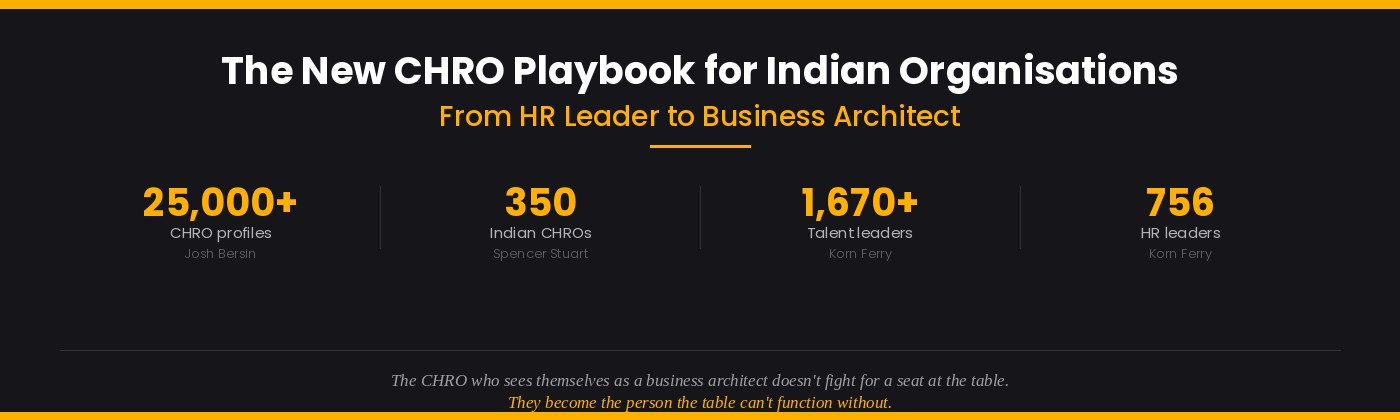
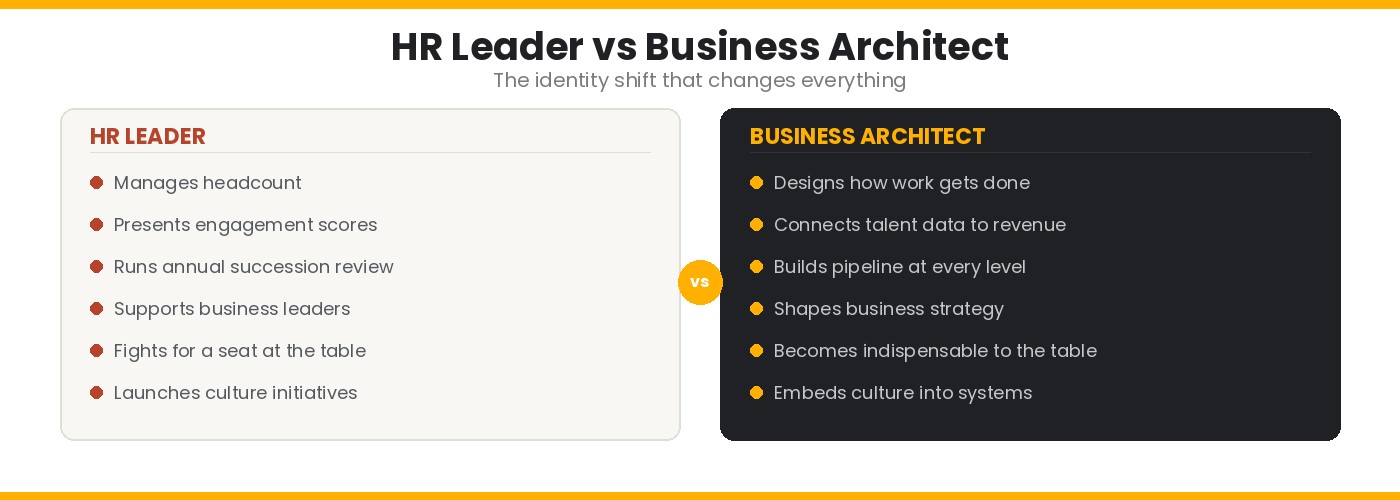
The CHRO is no longer an HR leader. The CHRO is becoming a business architect.
And Indian organisations, whether they recognise it or not, are at the centre of this transformation.
The Evidence is Overwhelming
Every layer of research we’ve published at ThePeoplesBoard over recent weeks points to the same conclusion. Let me connect the threads.
The CHRO Has Become a Business Leader
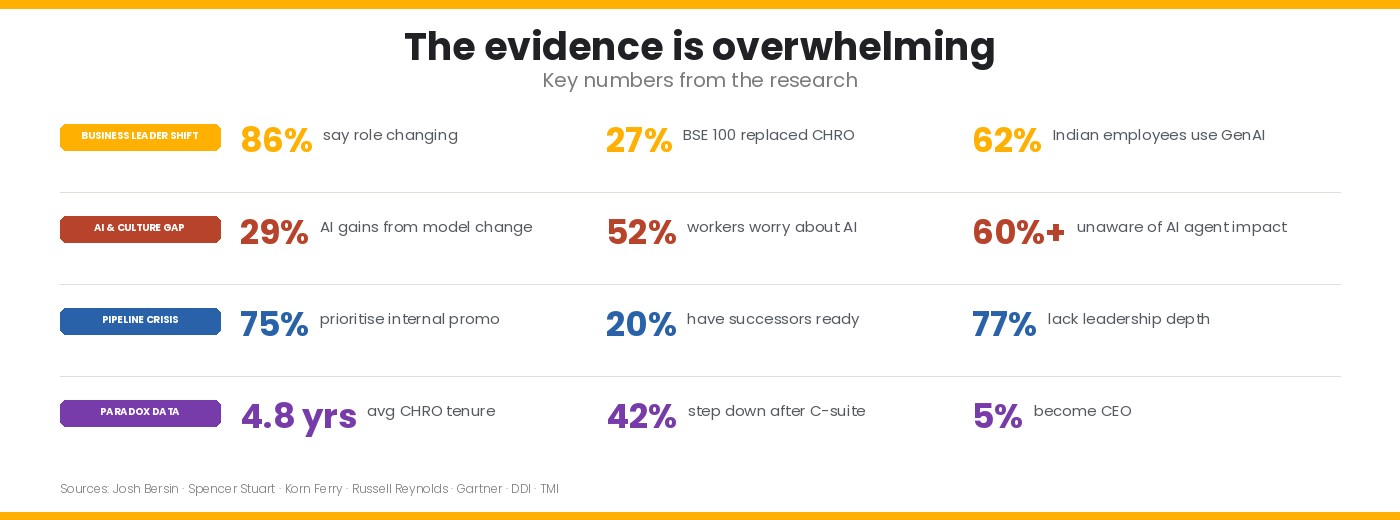
The data is unambiguous. 86% of CHROs say their role is changing dramatically (Josh Bersin). 27% of BSE 100 companies replaced their CHRO in 2024, three times the global average (Russell Reynolds). And the appointments weren’t traditional HR moves. Pidilite hired for cultural transformation. Bajaj Finserv promoted for scale. Adventz hired for a cross-business strategy.
Three forces are driving this in India specifically: AI adoption at a pace that leads the global index (62% of Indian employees use GenAI at work), a labour code transition that demands regulatory foresight no global playbook provides, and a multigenerational workforce with a median age of 28 that has no Western precedent.
The takeaway: the CHRO role in India has crossed an inflexion point. The question is no longer whether CHROs belong in business strategy. It’s whether organisations will give them the authority to execute.
AI is a People Problem, Not a Technology Problem
Five leadership lessons emerged from what India’s best CHROs are doing differently with AI. The most important one? Start with work redesign, not tool selection. Gartner’s research found that 29% of AI-driven productivity gains come from changing the HR operating model itself.
But the lesson that stuck with me most: own the culture-AI intersection, because no one else will. Every other C-suite executive can contribute to the AI strategy. Only the CHRO can ensure it doesn’t destroy the culture. And in India, where 52% of workers worry about AI’s job impact and 60%+ of employees remain unaware of how AI agents will affect their work, cultural stewardship isn’t optional. It’s existential.
When I interviewed Asma Shaikh for ThePeoplesBoard, this tension was front and centre. Her insight that Agentic AI isn’t taking humans out of HR, but HR isn’t always at the table where AI decisions get made, captures the influence paradox in one sentence.
The Leadership Pipeline is Broken
The succession planning gap asks uncomfortable questions. 75% of organisations prioritise internal promotion. But only 20% have successors actually ready for critical roles (DDI 2025). 77% lack sufficient leadership depth at all levels.
In India, the numbers tell a sharper story: 56% of BSE 100 CHRO appointments were external hires. The pipeline isn’t leaking in many organisations; it was never built to hold pressure.
Five practices differentiate the best Indian CHROs: building pipelines at every level, replacing nine-box grids with evidence, solving the diversity pipeline leak (76% of BSE 100 CHROs are men), preparing leaders for AI, and making pipeline reviews a quarterly business discipline.
The Infosys CEO succession question made this concrete: nine senior exits in twelve months, and the internal bench had thinned precisely when continuity mattered most.
Five Paradoxes Define the Role
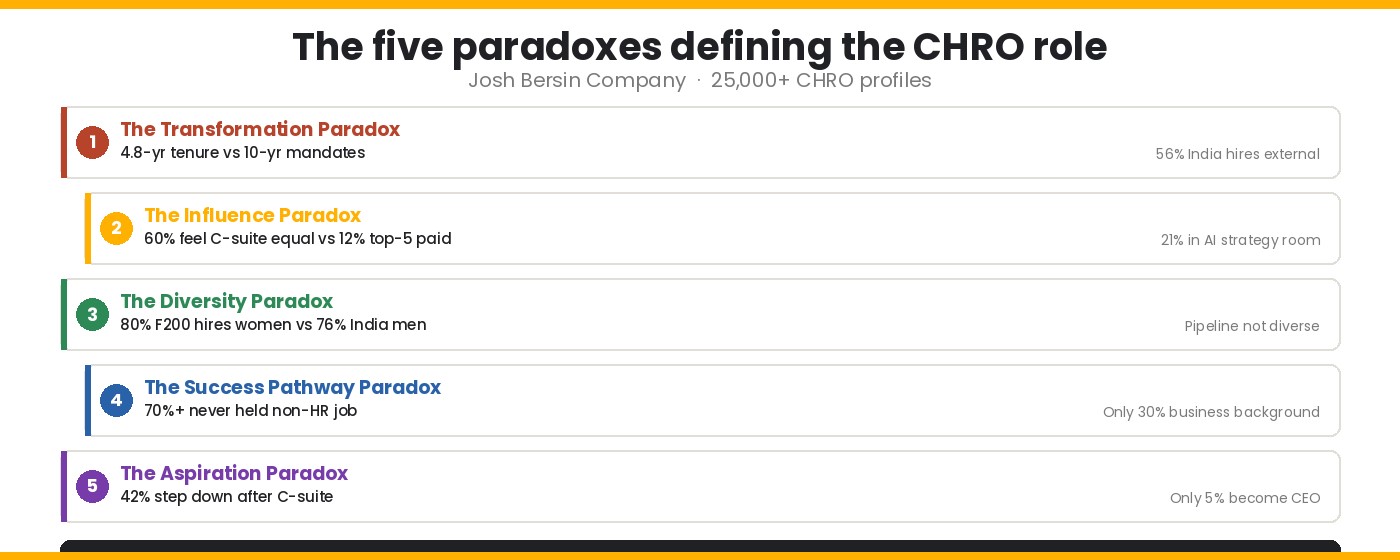
The Josh Bersin Company identified five interconnected paradoxes that define the modern CHRO:
The Transformation Paradox: 4.8-year tenure, 10-year mandates. In India, 56% external hires mean a quarter of tenure lost to onboarding alone.
The Influence Paradox: 60% see themselves as C-suite equals. Only 12% are in the top-5 paid. Only 21% are in the room where AI strategy gets decided.
The Diversity Paradox: 80% of Fortune 200 CHRO hires globally were women. 76% of India’s BSE 100 CHROs are men. Progress at the top. A filter in the pipeline.
The Success Pathway Paradox: Organisations want business leaders. But 70%+ of CHROs have never held a non-HR job. Only 30% have a business background. The pipeline is overwhelmingly HR-deep.
The Aspiration Paradox: This one changed my mind. 42% of CHROs move to lower-level HR positions after the C-suite. Only 5% become CEOs. We celebrate CHROs for driving transformation, but the system doesn’t know where to put them afterwards.
When Priyam Agrawal shared her journey on ThePeoplesBoard from 14 years in HR to founding her own business, she described the exact success pathway paradox in personal terms. The shift from people partner to profit owner requires thinking about HR decisions with commercial urgency. That perspective is exactly what the CHRO role now demands, but the HR pipeline rarely builds it.
The New CHRO Playbook for Indian Organisations
So what does “business architect” actually look like in practice? Based on the data, the interviews, and the patterns emerging across our coverage at ThePeoplesBoard, here’s the playbook that Indian organisations need and that the most effective CHROs are already running.
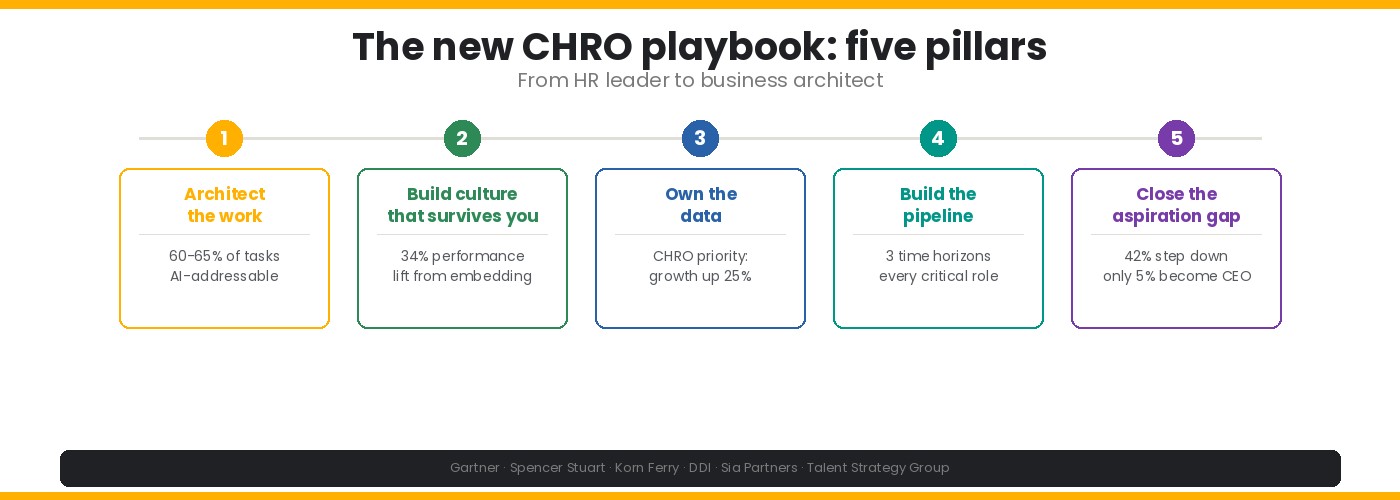
Pillar 1: Architect the Work, Not Just the Workforce
The old CHRO managed headcount. The business architect designs how work gets done. That means deconstructing jobs into tasks, determining where AI adds value and where human judgment is irreplaceable, and continuously redesigning roles as technology evolves.
Lakshmi Chandrasekharan at Accenture India demonstrated this at scale AI adoption there began not with a tool rollout but with a systematic analysis of what work actually consists of. A Sia Partners analysis found that 60-65% of a recruiter’s activities are AI-addressable today. The role doesn’t disappear. It expands, but only if someone architects the expansion. That someone is the CHRO.
Indian organisations can see this in action: AI is already transforming six HR processes beyond recruitment, from payroll anomaly detection to exit feedback mining. The CHROs who own this redesign own the future.
Pillar 2: Build the Culture That Survives You
With a 4.8-year average tenure and 56% external hiring in India, the CHRO who builds a culture dependent on their personal leadership is building on sand. The business architect builds culture into processes, not presentations.
Gartner’s 2026 research found that organisations embedding culture into day-to-day work see up to a 34% increase in employee performance. And Spencer Stuart’s study of 350 CHROs across India found that the CHROs’ priorities have shifted decisively toward future-proofing and growth enablement.
This is what separates a culture initiative from culture architecture. The initiative needs a champion. The architecture needs a system. The CHRO who embeds culture into onboarding workflows, performance rhythms, decision-making frameworks, and leadership development criteria leaves behind something that persists after they’re gone.
In my conversation with Priyanka Vanjari Nair for ThePeoplesBoard, she described exactly this at PNG Jewellers, how observing employees who voluntarily stepped up during peak seasons led to “Udaan,” a leadership development programme that turned support staff into store managers. That’s culture architecture: spotting patterns, building systems, and creating pathways that work independently of any single leader.
Pillar 3: Own the Data That Drives Decisions
The business architect doesn’t present engagement scores. They connect talent data to business outcomes, revenue impact, productivity gains, attrition cost, and skills gap risk.
Korn Ferry’s 2025 CHRO Survey of 756 HR leaders across 50+ countries found that growth and market expansion have increased as a CHRO priority by 25% over the past two years. More than a third of CHROs now spend the majority of their time on transformation, not operations. But transformation without data is just an activity.
The ET NexTech Human Capital Summit (February 2026) revealed that 30-40% of organisations are now using AI in HR beyond pilots, while HRIS adoption exceeds 75% across regions globally. The infrastructure exists. The question is whether CHROs are using it to influence business decisions or just to generate dashboards.
Understanding how people analytics and automation are redefining talent management is no longer optional. It’s the difference between a CHRO who reports to the business and one who shapes it.
Pillar 4: Build the Pipeline Before You Need It
The business architect thinks in time horizons: emergency succession (0-6 months), ready-in-one (6-18 months), and ready-in-three (18-36 months). Not just for the CEO for every critical role.
DDI’s research shows that high-potential talent is 3.7 times more likely to leave without development. And Korn Ferry warns that 43% of companies plan to replace roles with AI, with 37% targeting entry-level positions. Cutting entry-level hires today means the leadership pipeline dries up tomorrow.
The Indian CHRO as business architect isn’t just filling roles. They’re designing the system that produces leaders at the volume and velocity that India’s growth demands 109 million skilled workers needed across high-growth industries by 2026 (Taggd). And they’re doing it while solving the diversity pipeline leak, because a pipeline where 76% of BSE 100 CHROs are men isn’t a pipeline. It’s a filter.
Pillar 5: Close the Aspiration Gap
The aspiration paradox, 42% stepping down, only 5% becoming CEO, won’t be solved by individual ambition. It requires a systemic rethink of what the CHRO role leads to.
Business architects close this gap by building a track record that speaks the board’s language: revenue impact, not engagement scores. Productivity gains, not programme launches. Skills architecture that connects directly to competitive advantage.
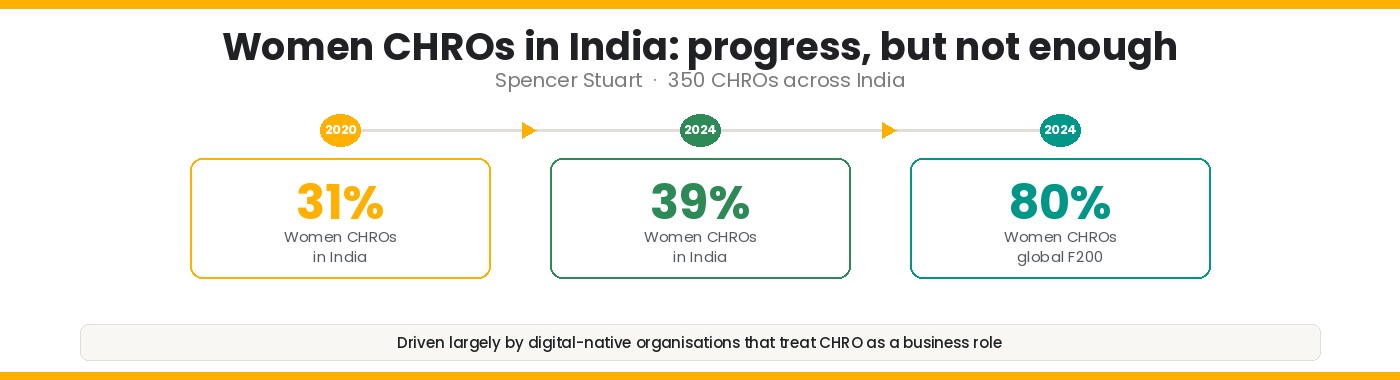
Spencer Stuart’s India research points the way: the proportion of women CHROs in India rose from 31% in 2020 to 39% in 2024, driven largely by digital-native organisations. The shift is happening, but primarily in companies that treat the CHRO as a business role, not an HR role.
For every HR professional building their career path toward the CHRO seat, the message is clear: build cross-functional experience now. The Talent Strategy Group’s data shows that 47% of successful CHROs held roles outside HR. That’s not a coincidence. That’s the success pathway that actually works.
The One Insight That Changed My Mind
I started this research thinking the CHRO story was about transformation. It is, but not the kind I expected.
The transformation isn’t about AI adoption, or reskilling programmes, or succession planning software. Those are tools. The real transformation is identity.
The CHRO who sees themselves as an HR leader will always be fighting for influence, managing paradoxes, and wondering why the system doesn’t reward them the way it rewards the CFO or the CTO. The CHRO who sees themselves as a business architect who designs work, builds culture systems, owns talent data, constructs leadership pipelines, and connects every people decision to a commercial outcome doesn’t fight for a seat at the table. They become the person the table can’t function without.
That’s the shift happening in India right now. Not everywhere. Not evenly. But unmistakably.
TPB’s International HR Day coverage captured it well: Indian HR isn’t waiting for the headline or the playbook. It’s doing the work. Quietly. Confidently. At scale.
The evidence across everything we’ve published recently, from how Indian CHROs are becoming business leaders, to the five CHRO paradoxes, to the leadership pipeline crisis, to what CHROs are doing differently with AI, tells one story: Indian CHROs are building something new. Not a better version of the old HR function. A new kind of leadership role that India’s fastest-growing companies will be built around.
4.8 years. Five paradoxes. One playbook. And the Indian CHROs who run it won’t just have a seat at the table. They’ll be the ones who decide what the table looks like.
FAQs
What is a “business architect” CHRO?
A business architect CHRO designs how work gets done across the organisation, builds culture into systems rather than depending on personal leadership, connects talent data to business outcomes, constructs leadership pipelines at every level, and ties every people decision to commercial impact. It’s a fundamental shift from managing HR operations to shaping business strategy through people.
What are the five pillars of the new CHRO playbook?
The five pillars are: (1) Architect the work, not just the workforce, redesign jobs around AI and human strengths. (2) Build a culture that survives you by embedding it into processes, not presentations. (3) Own the data that drives decisions and connect talent metrics to revenue. (4) Build the pipeline before you need it, three time horizons, every level, diversity accountability. (5) Close the aspiration gap and build a track record in the board’s language.
How does the CHRO playbook apply specifically to India?
India’s context makes this playbook uniquely urgent: 62% GenAI adoption (world-leading), median workforce age of 28, four new labour codes patchily notified, 109 million skilled workers needed by 2026, and CHRO turnover three times the global average. Indian CHROs who can architect work, build culture systems, and connect people’s decisions to business outcomes at this scale and speed will define the next decade of corporate India.
What skills does a future CHRO need in India?
AI fluency (not coding, but judgment), data literacy to connect talent metrics to business outcomes, cross-functional experience outside HR (47% of successful CHROs had non-HR roles), regulatory foresight across India’s multi-state framework, and the ability to build institutional capability that persists beyond any single leader’s tenure.
What are the five CHRO paradoxes?
The Josh Bersin Company identified five paradoxes: the Transformation Paradox (4.8-year tenure vs 10-year mandates), the Influence Paradox (60% feel like C-suite equals but 12% are paid like it), the Diversity Paradox (80% global hires are women vs 76% of India BSE 100 CHROs are men), the Success Pathway Paradox (70%+ never held a non-HR job), and the Aspiration Paradox (42% move to lower-level roles, only 5% become CEO).



