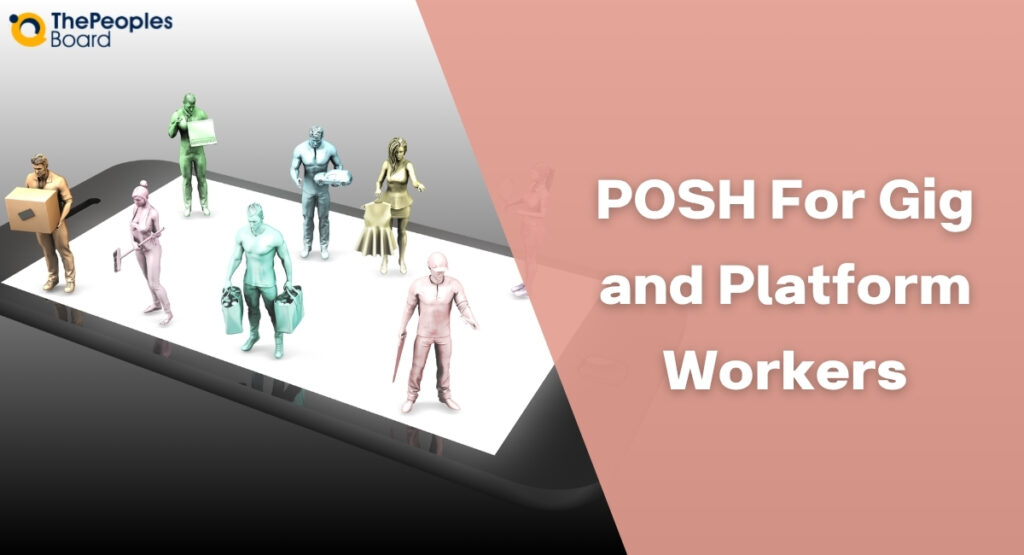
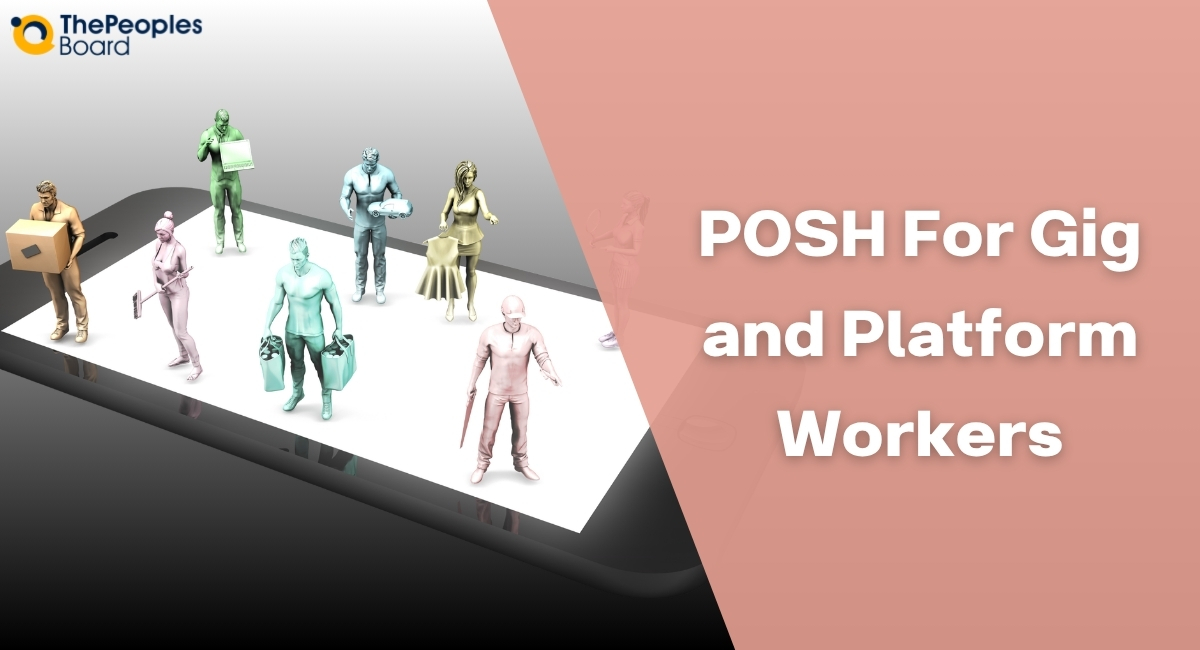

India’s gig and platform workforce is projected to grow from 7.7 million in 2020-21 to 23.5 million by 2029-30, according to NITI Aayog’s 2022 report on the sector. Yet none of the country’s four new labour codes, except the Code on Social Security, formally recognises gig workers, and even that code’s protections remain discretionary rather than mandatory.
Sexual harassment sits in a separate, older statute altogether: the POSH Act, 2013. The question of whether that law actually reaches a Swiggy delivery rider, a Zomato customer waiting at a doorstep, or a freelance consultant logging in from home has no clean, single answer yet. It depends on the worker’s relationship to the platform, the specific judge interpreting that relationship, and increasingly, on emerging state legislation.
What The POSH Act Actually Covers
The POSH Act in India was deliberately written with broader definitions than most Indian labour legislation. Two sections do the heavy lifting:
| Provision | What It Says | Why It Matters For Gig Work |
| Section 2(a): Aggrieved Woman | Covers any woman, “whether employed or not,” who alleges sexual harassment at a workplace | Does not require a formal employment contract to qualify for protection |
| Section 2(f): Employee | Includes regular, temporary, ad hoc, or daily wage workers, “with or without the knowledge of the principal employer,” whether paid or working voluntarily | Drafted wide enough that legal experts argue it already extends to gig and platform workers |
| Section 2(o): Workplace | Includes any place visited during employment, including transportation provided by the employer | Has been read by courts to cover taxis, delivery routes, and even virtual spaces |
On paper, the statute does not confine itself to people on a company payroll. Vendors, suppliers, and delivery staff who interact with an organisation in the course of business are also entitled to protection if harassed during that interaction.
The Delhi High Court’s 2008 ruling in Saurabh Kumar Mallick v. Comptroller & Auditor General of India expanded “workplace” beyond the physical office. The Calcutta High Court went further in 2016, in Ayesha Khatun v. State of West Bengal, holding that contractual and temporary workers are covered because their work environment remains within the employer’s control regardless of contract type.
So the statutory language is broad. The practical problem is enforcement, because gig platforms structure their entire business model around denying that an employer-employee relationship exists at all.
The Ola Ruling: A Test Case For Platform Liability
The clearest judicial test of this question so far came from the Karnataka High Court. In Ms. X v. Internal Complaints Committee, ANI Technologies Pvt Ltd, a woman who had booked an Ola cab in Bengaluru was sexually harassed by the driver during her ride. When she filed a complaint, Ola’s Internal Committee refused to investigate, arguing the driver was an independent contractor and not an Ola employee.
On September 30, 2024, a single judge of the Karnataka High Court rejected that defence. The court examined Ola’s subscription agreement and found that the company controlled fares, payments, commission structures, and dispute resolution, all hallmarks of an employer relationship, while simultaneously labelling drivers as contractors to limit its own liability.
The judgment held that the driver qualified as an “employee” under Section 2(f) of the POSH Act and ordered Ola’s Internal Committee to investigate the complaint within 90 days, along with ₹5 lakh in compensation to the petitioner.
Ola appealed. A division bench of the same court stayed the single judge’s order in October 2024, and the matter remains pending. That stay means the ruling carries no binding force for now, but its reasoning continues to shape the legal conversation around gig work.
As legal commentary on the case has pointed out, the judgment cannot be read as settling the employment status question under other labour statutes, most of which apply a narrower definition of “employee” than POSH does. It is, at most, a signal of how one court read POSH’s specific, intentionally wide language when applied to a ride-hailing relationship.
Freelancers, Consultants, And Vendors: A Slightly Clearer Picture
Where gig delivery and ride-hailing work sits in a grey zone, the Act’s coverage of freelancers, consultants, and vendors is comparatively well established. Section 2(a)’s “whether employed or not” language was always meant to reach people outside a payroll relationship. In practice, this extends to:
- Consultants and freelancers engaged temporarily on a project
- Vendors, suppliers, and delivery staff who visit a workplace for business
- Interns and trainees, paid or unpaid
- Clients, customers, and visitors present for official purposes
The obligation runs the other way too. If a freelancer or vendor representative is harassed by someone inside the client organisation, the employer’s Internal Committee is expected to receive and act on that complaint, even though the freelancer was never on its payroll.
Several POSH advisory practices now recommend that organisations write explicit POSH clauses into freelance and vendor contracts, train Internal Committee members to handle complaints from non-traditional categories, and brief gig and contract staff on how to reach the Local Committee in workplaces too small to require an Internal Committee of their own.
The Accountability Gap Platforms Have Not Closed
The legal ambiguity around employment status compounds an existing safety gap that disproportionately affects women. Fewer than 1% of India’s delivery workers are women, according to an April 2026 analysis published by East Asia Forum, and platform algorithms tend to concentrate peak earning windows in evening hours, when isolation and customer-facing risk both increase.
Because gig workers are classified as independent contractors rather than employees, platforms have historically argued they bear no liability for a customer’s misconduct toward a worker, leaving women gig workers to absorb that risk without an institutional safety net.
Fairwork India, a research initiative that scores platforms annually on labour standards, found in its 2024 assessment that no platform scored above six out of ten. Where platforms have introduced safety features, they remain voluntary rather than statutory.
Some, including Uber and Urban Company, have built in-app SOS buttons, emergency contact lines, and the option for women delivery executives to decline assignments in areas they consider unsafe without facing a ratings penalty. These mechanisms help, but they are not a substitute for a binding grievance redressal structure, and their quality and consistency vary widely from one platform to the next.
The Code on Social Security, 2020, which formally defines “gig worker” and “platform worker” in Indian law for the first time, does not address workplace harassment at all. It limits itself to social security measures such as accident insurance, health benefits, and maternity protection, and even those are written as benefits the government “may” introduce through future schemes rather than entitlements it must guarantee.
States are Moving Faster Than The Centre
In the absence of central legislation specifically addressing gig worker safety, individual states have begun filling the gap, though their focus remains tilted toward wages and social security rather than harassment redressal specifically.
| State | Law | Key Mechanism |
| Rajasthan | Platform Based Gig Workers (Registration and Welfare) Act, 2023 | First state law in India to create a dedicated welfare board and social security fund for gig workers |
| Karnataka | Platform Based Gig Workers (Social Security and Welfare) Act, 2025 | Mandates a welfare fee of 1 to 5% of worker payouts, a two-tier grievance redressal system through an Internal Dispute Resolution Committee, and occupational safety and health obligations on aggregators |
| Telangana | Draft Gig and Platform Workers (Registration, Social Security and Welfare) Bill, 2025 | Modelled on the Karnataka framework, still in draft stage |
Karnataka’s law is the most detailed so far. It requires aggregators to register every gig worker, generate a portable worker ID across platforms, and resolve grievances through an Internal Dispute Resolution Committee within 45 days, with an appeal route to the state Welfare Board. It also gives workers the explicit right to refuse a task without penalty, a provision neither Rajasthan’s nor Telangana’s draft framework currently includes.
None of these state laws, however, are POSH-specific. They address grievances arising from pay, deactivation, and working conditions; sexual harassment redressal would still have to be pursued separately through whichever POSH forum, Internal Committee or Local Committee, a court eventually decides applies to that worker category.
As POSH and DEI strategist Aparna Gonate told ThePeoplesBoard in an earlier conversation on Internal Committee design, “the process should feel fair, kind and serious, not cold or scary.” That standard is difficult to meet for a workforce that, in most cases, does not know which committee, if any, is supposed to hear its complaint.
What HR and Compliance Teams Should Do Now
Until the Ola appeal is resolved or Parliament amends central labour law to explicitly define gig worker status under POSH, organisations that rely on platform labour, including companies that engage delivery aggregators, freelance talent, or vendor staff on their premises, face a compliance choice that is more conservative than the current legal minimum requires:
- Extend POSH policy language to explicitly name freelancers, consultants, vendor staff, and gig workers who interact with the organisation’s premises or operations, rather than relying on the Act’s default coverage.
- Brief Internal Committee members on how to receive and triage complaints from non-traditional worker categories, since most ICs are trained primarily on employee-to-employee scenarios.
- Where the organisation is itself a platform or aggregator, build a grievance channel for harassment specifically, separate from operational grievance systems addressing pay or deactivation, since the latter are not designed to meet POSH’s confidentiality and inquiry-timeline requirements.
- Track state-level gig worker legislation in every state of operation; Karnataka’s grievance and registration obligations carry penalties for non-compliance independent of any POSH exposure.
- Document any voluntary safety features, SOS lines, area-decline options, and so on, as supplementary measures, not as a substitute for a clear POSH redressal pathway.
For a wider view of how Internal Committees are expected to function and where most fail in practice, TPB’s guide to POSH Internal Committee red flags and the breakdown of Local Committee versus Internal Committee jurisdiction are useful starting points.
In The End…
The POSH Act’s drafters wrote definitions wide enough to anticipate work arrangements well beyond the regular office, but the gig economy has still managed to outpace them. A single High Court ruling said a cab driver counts as an employee for POSH purposes, but that ruling was stayed on appeal. State governments are racing ahead of Parliament to regulate gig work, but mostly on pay and registration, not harassment.
Many platforms continue to build safety features one app update at a time, with no statutory floor under any of it. Until the Ola appeal is decided, or until Parliament amends the law to settle the question directly, the safest compliance posture for any organisation touching gig, freelance, or vendor labour is to assume POSH already covers these workers, and build the grievance infrastructure accordingly, rather than wait for a court to confirm it.
FAQs
Does the POSH Act cover gig and platform workers in India?
The POSH Act, 2013 uses deliberately broad definitions. Section 2(a) covers any woman “whether employed or not,” and Section 2(f) includes temporary, ad hoc, and daily wage workers. Legal experts argue this language already extends to gig and platform workers, but enforcement is contested because platforms classify workers as independent contractors to limit liability. No central law has settled the question definitively.
What did the Karnataka High Court rule in the Ola POSH case?
On September 30, 2024, a single judge of the Karnataka High Court held in Ms. X v. Internal Complaints Committee, ANI Technologies that an Ola driver qualified as an “employee” under Section 2(f) of the POSH Act. The court found Ola controlled fares, payments, and commissions, all hallmarks of an employer relationship. It ordered Ola’s Internal Committee to investigate within 90 days plus ₹5 lakh compensation. A division bench stayed the order in October 2024, so it carries no binding force while the appeal remains pending.
Are freelancers and vendors protected under the POSH Act?
Yes. The POSH Act’s coverage of freelancers, consultants, and vendors is comparatively well established. Section 2(a)’s “whether employed or not” language reaches people outside a payroll relationship, including consultants engaged on projects, vendors and suppliers visiting a workplace, interns, and clients or visitors present for official purposes. If a freelancer is harassed by someone inside a client organisation, that organisation’s Internal Committee is expected to receive and act on the complaint.
Do state gig worker laws cover sexual harassment?
No. State laws in Rajasthan, Karnataka, and Telangana focus on wages, registration, and social security rather than harassment redressal. Karnataka’s 2025 Act is the most detailed, mandating a welfare fee, a two-tier grievance system, and the right to refuse tasks. But none are POSH-specific. Sexual harassment complaints must still be pursued through a POSH forum, Internal Committee or Local Committee, that a court decides applies to that worker category.
What should HR and compliance teams do about POSH for gig workers?
Organisations should extend POSH policy language to explicitly name freelancers, consultants, vendor staff, and gig workers, rather than relying on default coverage. They should brief Internal Committee members to handle complaints from non-traditional categories, build a dedicated harassment grievance channel if they operate a platform, track state-level gig legislation, and document voluntary safety features as supplementary rather than as a substitute for POSH redressal.