

The Sexual Harassment of Women at Workplace (Prevention, Prohibition and Redressal) Act, 2013, more commonly called the POSH Act, is India’s principal law on workplace sexual harassment. It applies across every Indian workplace, public and private, organised and unorganised, formal corporate offices and informal arrangements alike.
The law has its roots in the 1992 gang-rape of Bhanwari Devi, a Rajasthan state government social worker who was attacked while attempting to prevent a child marriage. The case exposed the absence of any formal workplace protection for women in India. In 1997, the Supreme Court issued the Vishaka guidelines, which gave employers binding directions on workplace harassment but no statutory backing.
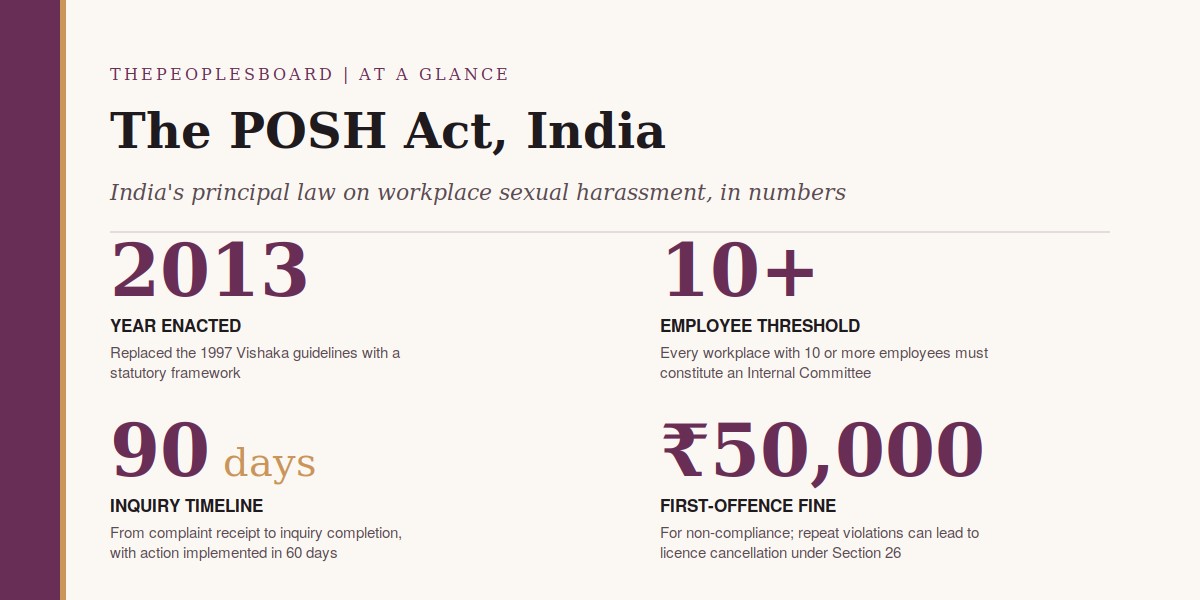
The POSH Act, passed by Parliament in 2013, replaced those guidelines with a comprehensive legislative framework, including definitions, procedures, penalties, and designated institutional roles.
What the POSH Act Actually Says
The POSH Act is a women-protective statute, not a gender-neutral one. It defines who it protects, where it applies, and what behaviours it prohibits. Each of these definitions matters because the protections only extend as far as the definitions reach.
Who the Act covers
The Act protects every woman who works in a workplace, regardless of her age or employment status. The definition of “aggrieved woman” under Section 2(a) is deliberately broad and does not require an employer-employee relationship in the conventional sense.
Women covered under the Act include:
- Full-time and part-time employees
- Interns and apprentices
- Daily-wage and contract workers
- Women working from home in connection with the workplace
- Clients, customers, and vendors visiting the workplace
The Act does not protect: men, transgender employees, and non-binary employees.
Workplace sexual harassment complaints from these groups currently fall outside the POSH Act’s statutory pathway. Several Indian companies have voluntarily adopted gender-neutral internal policies that mirror the POSH structure, but the Act itself remains women-specific.
Where it applies
“Workplace” under the POSH Act is interpreted expansively. It covers:
- Corporate offices, factories, and government establishments
- Hospitals, educational institutions, and sports facilities
- Domestic workers’ workplaces (a private dwelling counts)
- Locations visited during the course of employment, including client sites
- Transport provided by the employer for the journey to and from work
- Remote work environments and digital communication platforms are used for work
This last point matters more now than it did in 2013. Work-from-home setups, Slack channels, video calls, and after-hours WhatsApp groups all fall under the definition of the workplace once they’re tied to employment.
What counts as sexual harassment
Section 2(n) of the POSH Act lists five categories of conduct that constitute sexual harassment. The Act covers physical contact and advances, demands or requests for sexual favours, sexually coloured remarks, showing pornography, and any other unwelcome physical, verbal, or non-verbal conduct of a sexual nature.
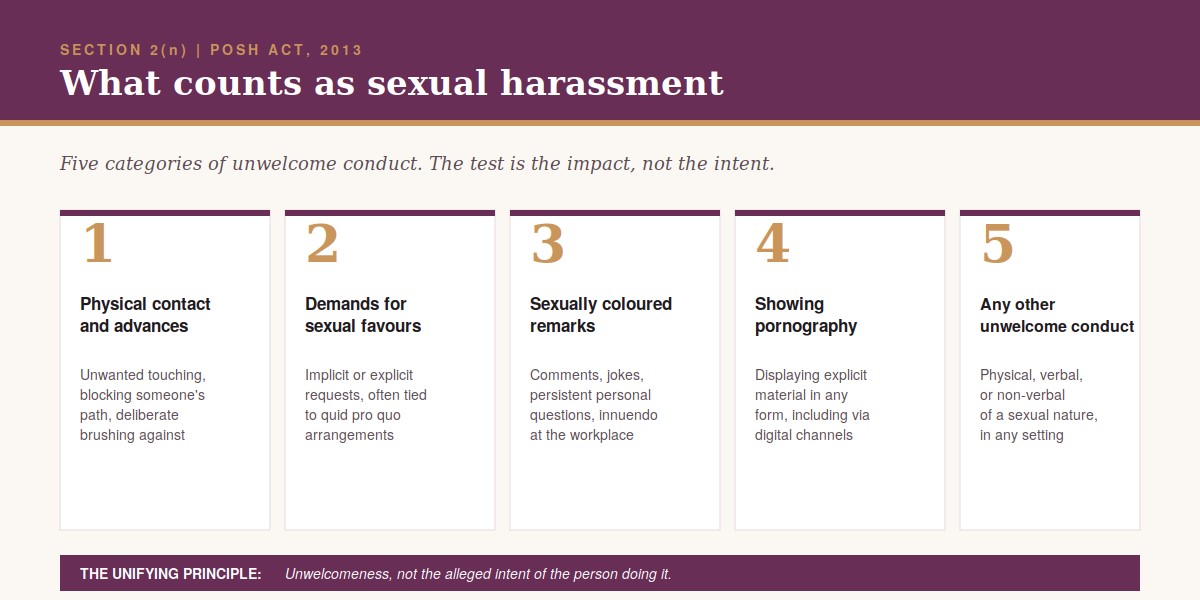
The unifying principle is “unwelcomeness,” not the alleged intent of the person doing it.
The list isn’t limited to physical or in-person behaviour. It includes:
- Physical: unwanted touching, blocking someone’s path, deliberate brushing against
- Verbal: sexually coloured comments, jokes, persistent personal questions
- Non-verbal: gestures, prolonged staring, intrusive proximity
- Written or digital: sexually explicit messages, emails, social media posts, image sharing
- Quid pro quo: implied or explicit promises of preferential treatment, or threats of detrimental treatment, linked to sexual demands
Quick test: If the conduct creates a hostile, intimidating, or offensive work environment for the woman, and she finds it unwelcome, it likely qualifies as sexual harassment under the POSH Act. The test is the impact on her, not what the other person believed or intended.
The Building Blocks: Key Provisions
The POSH Act doesn’t run on principles alone. It runs on a small set of structural requirements that every employer above a certain threshold must put in place. These provisions are the building blocks that make the rest of the law operational.
The Internal Committee (IC)
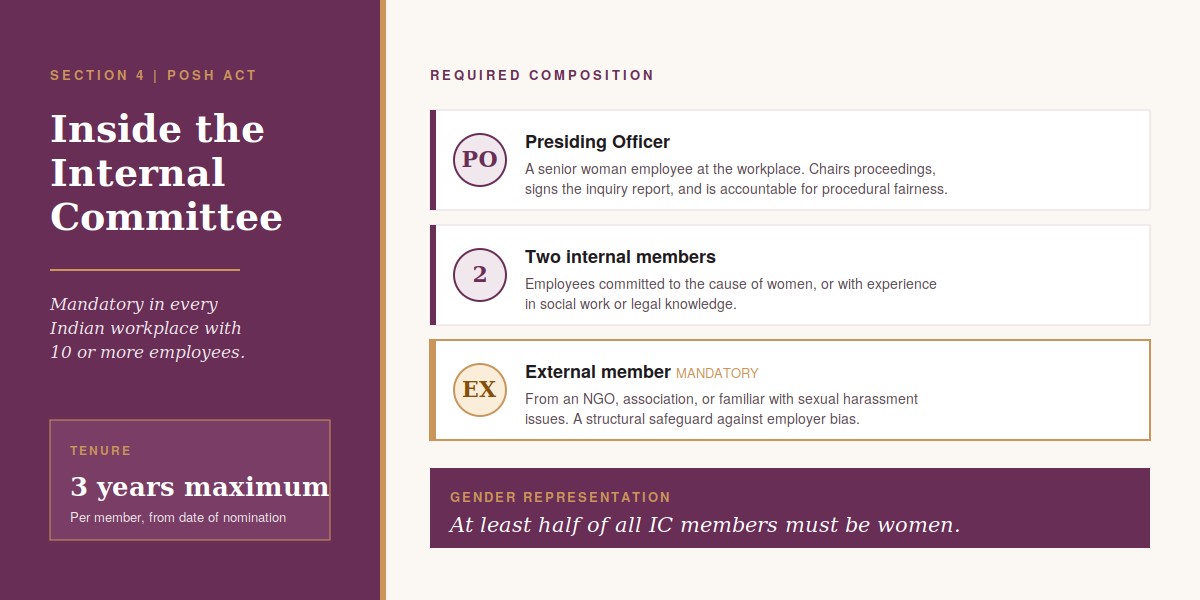
Every workplace with ten or more employees must constitute an Internal Committee under Section 4 of the POSH Act. The IC is not a discretionary body. Its absence makes an employer non-compliant, exposed to penalties, and operationally vulnerable, because there is no lawful body to receive complaints.
The Act prescribes a specific composition:
| Role | Requirement |
| Presiding Officer | A senior woman employee at the workplace. If no senior woman is available, the employer can nominate one from another office or another organisation. |
| Two members | Employees committed to the cause of women, or with experience in social work or legal knowledge. |
| External member | One member from an NGO, association, or person familiar with sexual harassment issues. This is mandatory, not optional. |
| Gender representation | At least half the members of the IC must be women. |
Members are appointed for a term of up to three years. They can be disqualified for disclosing confidential information about an inquiry, for a conviction for any offence, for abuse of position, or for conduct prejudicial to the public interest.
The presiding officer holds particular weight. She chairs proceedings, signs the inquiry report, and is accountable for procedural fairness. The external member serves as a structural safeguard against employer bias, which is why their independence matters.
The Local Committee (LC)
The Local Committee is the parallel mechanism for workplaces that don’t qualify for an IC, organisations with fewer than ten employees, or in cases where the complaint is against the employer themselves. Each district has a designated District Officer (typically the District Collector or Magistrate) responsible for constituting the LC.
The LC also handles complaints from the unorganised sector, which is where most of India’s workforce actually sits. Its functioning has been notoriously uneven.
In Aureliano Fernandes v. State of Goa (2023, with follow-up directions in 2024 and August 2025), the Supreme Court ordered all states and union territories to conduct district-wise surveys verifying whether ICs and LCs had even been constituted. The Court called the implementation of the POSH Act “lamentable,” particularly in the private sector and the informal economy.
Complainants can also approach the central government’s SHe-Box portal run by the Ministry of Women and Child Development, which routes a complaint to the appropriate IC or LC.
The complaint and inquiry process
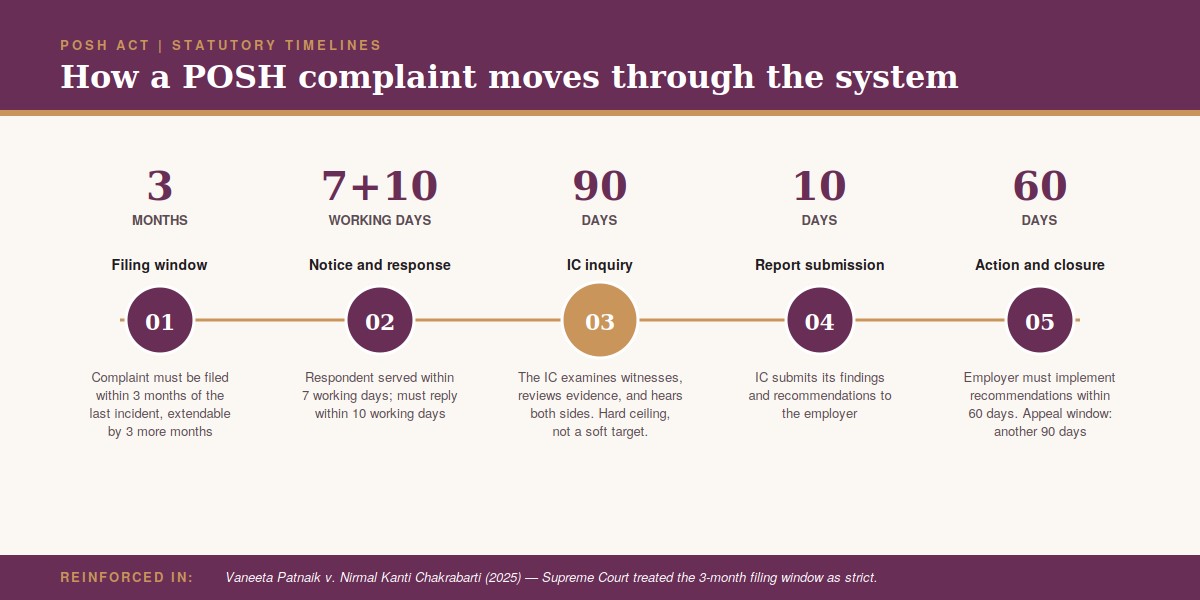
A complaint must be filed within three months of the last incident, with the IC empowered to extend the limitation by another three months for sufficient reason.
The Supreme Court reinforced the strictness of this timeline in Vaneeta Patnaik v. Nirmal Kanti Chakrabarti (2025), dismissing a complaint as time-barred even while acknowledging that the underlying allegations were serious.
The inquiry must follow principles of natural justice. Both the complainant and the respondent must be heard. The IC has powers similar to a civil court for summoning witnesses, requiring documents, and recording statements. The whole inquiry is to be completed within 90 days, with the report submitted to the employer within 10 days of conclusion.
During the inquiry, the IC can recommend interim relief, including transferring the complainant or the respondent to another workplace, granting the complainant up to three months of leave (in addition to her regular leave entitlement), or restraining the respondent from reporting on the complainant’s work performance. Employers must implement IC recommendations within 60 days.
Employer responsibilities
Section 19 of the POSH Act lists employer duties in plain terms. Each one is auditable, and each one is now central to the post-2025 enforcement environment:
- Provide a safe working environment
- Display the consequences of sexual harassment at conspicuous places
- Organise workshops and awareness programmes at regular intervals
- Provide assistance to the complainant if she chooses to file a criminal complaint
- Cause to initiate action under the Indian Penal Code (now the Bharatiya Nyaya Sanhita, 2023) when a complaint involves criminal conduct
- Treat sexual harassment as misconduct under service rules
- Facilitate the IC in conducting inquiries
- File an annual report with the District Officer
Failure to comply attracts a fine of up to ₹50,000 for the first offence, with repeat or aggravated violations potentially leading to higher penalties and even cancellation of business licences.
After the Companies (Accounts) Second Amendment Rules, 2025, were notified by the Ministry of Corporate Affairs, companies are also required to disclose POSH data, complaints received, complaints disposed of, and complaints pending beyond 90 days, in their Board Reports.
From Law to Policy: What a POSH Policy Should Cover
A POSH policy is the bridge between statutory text and daily workplace practice. The Act doesn’t mandate a particular template, but it does specify outcomes the policy must achieve. A well-built POSH policy creates a safe workplace environment one step at a time.
A standard POSH policy in an Indian workplace should cover nine elements. Each one is straightforward to list, but the difference between a policy that works and a policy that sits on a shared drive is in how each element is framed.
| Policy element | What it should do |
| Definition of sexual harassment | Draw directly from Section 2(n) of the Act and translate each category into India-relevant illustrations. Reference the unwelcomeness test and clarify that intent does not override impact. |
| Scope of coverage | Spell out who is protected (employees, interns, contractors, vendors, visitors), where the policy applies (offices, client sites, transport, off-sites, and digital channels used for work), and which channels count as workplaces. |
| Composition of the Internal Committee | List names, designations, tenure, and contact details of every IC member, including the external member. Update with every change in composition, not annually. |
| Reporting channels | Provide at least three independent channels so no single person is a bottleneck. The IC presiding officer’s direct contact, the external member’s contact, and a confidential helpline that bypasses HR and the line manager. |
| Complaint procedure | Walk through the process step by step: how to file, what happens next, statutory timelines, evidentiary expectations, the right to a representative, and what the complainant and respondent can expect at each stage. |
| Confidentiality safeguards | State clearly who has access to what. Define what is shared with the respondent, with witnesses, with the employer, and with anyone outside the inquiry. Specify the consequences for breach under Section 17. |
| Anti-retaliation provisions | Name retaliation explicitly and tie it to disciplinary consequences. Apply to managers, peers, and witnesses, not just the respondent. |
| Penalties and disciplinary outcomes | List the range of actions the IC can recommend, from written warning to termination, and clarify how the employer will implement them within 60 days. |
| Annual review and training commitments | Commit to a defined training calendar (at least one session per year per employee, role-specific sessions for managers and IC members) and a yearly policy review tied to a named owner. |
A policy that addresses all nine elements with this level of specificity holds up under scrutiny, both during an audit and when an employee actually has to use it.
Common drafting mistakes
Policies that fail in practice usually do so in predictable ways. The repeated patterns highlight a gap between the law on the books, its execution, and the intent behind it.
Legal jargon overload
Policies written in dense legalese are policies nobody reads. The audience for a POSH policy is not a litigator. It’s a 24-year-old new joinee who needs to understand what counts and what to do. A good policy reads like instructions, not like a contract.
Missing or unclear reporting channels
Some policies list only a single email address, often one that goes to the head of HR. That defeats the structural separation the Act requires. The policy should list at least three independent channels:
- The IC presiding officer’s direct contact
- The external member’s direct contact
- A confidential helpline or email that doesn’t route through the line manager or HR
Silence on confidentiality
The Act requires confidentiality under Section 16, but many policies don’t spell out what that means in practice. Who has access to the complaint file? What happens during cross-examination? Can the respondent’s manager be informed? Specificity here builds the trust that makes employees willing to come forward.
How the POSH Process Actually Works
For HR teams, IC members, and employees, the POSH process is best understood as a sequence. Each step has its own legal requirements, pressure points, and opportunities to build or erode trust.
Step 1: A concern arises
The starting point is rarely a written complaint. It’s usually a conversation, a hesitant message, a peer disclosure, or a manager noticing patterns. At this stage, the employee’s options should already be visible. They shouldn’t have to ask three people to find out who is on the IC.
Step 2: Reporting
The complainant decides how to escalate. The Act recognises a written complaint, but the IC can also assist a complainant in putting an oral disclosure into writing. Some employees first explore informal channels: a confidential conversation with the IC presiding officer, a discussion with the external member, or a query about what the process looks like before they commit to filing.
A good practice is to allow informal exploration without prematurely locking the employee into formal proceedings. The Act doesn’t require this, but mature workplaces build it in because it widens the funnel.
Step 3: IC inquiry
Once a formal written complaint is filed, the IC takes over. The respondent is served a copy of the complaint within seven working days and must respond within ten working days. The IC then conducts the inquiry, examining witnesses, reviewing documents, and giving both parties the opportunity to be heard.
Key procedural safeguards apply throughout:
- Both parties may be assisted by a representative, but no lawyer is permitted
- The complainant and respondent are not to confront each other directly during cross-examination
- All proceedings are confidential
- The IC has discretion on what evidence is relevant; the HCL Technologies v. Parsarathy ruling confirmed that the IC isn’t bound to provide CCTV footage if it considers the footage immaterial
- Strict rules of evidence under the Indian Evidence Act do not apply to IC proceedings
The 90-day inquiry timeline is hard, not soft. Slippage routinely undermines confidence in the system.
Step 4: Findings and recommendations
The IC submits its report within 10 days of completing the inquiry. The report records findings of fact and, if harassment is established, recommends action against the respondent. Possible recommendations include:
- Written apology to the complainant
- Warning, reprimand, or censure
- Withholding of promotion or pay rise
- Termination of employment
- Counselling or community service (where workplace policy permits)
- Deduction from the respondent’s salary toward compensation for the complainant
If the IC concludes that the complaint was malicious or made with knowledge of falsity, it can recommend action against the complainant. The threshold for this finding is deliberately high.
Mere inability to substantiate a complaint is not malicious filing. Both Indian courts and the POSH Act itself emphasise that the bar must remain stringent, otherwise the malicious-complaint provision becomes a tool to chill genuine reporting.
Step 5: Employer action and closure
The employer must implement IC recommendations within 60 days. The complainant retains the right to file an appeal to a court or tribunal within 90 days of the recommendation if she’s dissatisfied. The respondent has the same right. Implementation, not just acceptance, is what closes the loop.
Closure is also where most employers underinvest. A complaint that ends with a formal letter and no organisational learning, no review of why the harassment occurred, no examination of the manager’s role, and no policy update leaves the workplace structurally unchanged. The next complainant inherits the same environment.
Roles and Responsibilities
The POSH Act distributes responsibility across multiple actors. None of them can be effective in isolation. Taken together, they help create a safe workplace environment.
The employer
The employer is statutorily responsible for the existence, functioning, and credibility of the entire POSH framework. That responsibility cannot be delegated away. It includes constituting the IC, funding its work, providing infrastructure, ensuring training, maintaining records, and filing the annual report.
Under the MCA 2025 amendment, public disclosure of complaint data is now included in Board Reports.
Internal Committee members
IC members are the operational backbone. Their role is quasi-judicial; they investigate facts, weigh evidence, and recommend outcomes. That demands a specific skill mix: the capacity for impartial inquiry, sensitivity to complainants who may be experiencing trauma, an understanding of natural-justice principles, and procedural discipline.
Members also need protection from internal political pressure. An IC presiding officer who reports to the alleged harasser’s friend cannot deliver impartial findings.
HR teams
HR sits in a complicated position. HR is often the first point of disclosure, even though the IC, not HR, is the statutory authority. The right model is for HR to quickly channel concerns to the IC, support the IC’s work logistically, and stay out of the substantive inquiry. Where HR and the IC blur, especially when the head of HR also chairs the IC, the structural separation collapses.
The TCS Nashik case, in which an HR manager was named in FIRs for allegedly suppressing complaints from reaching the POSH Committee, is the most public reminder of why this separation matters.
Employees
Every employee has rights under the POSH Act, the right to a workplace free of sexual harassment, the right to file a complaint without fear of retaliation, the right to participate in awareness programmes, and the right to expect a timely and fair inquiry. Employees also carry responsibilities:
- To treat colleagues with respect
- To take POSH training seriously
- To support coworkers who report
- To refrain from retaliatory behaviour against complainants or witnesses.
External members
The external member is the independence audit built into the IC’s design. Their job isn’t to defer to internal hierarchy. It’s to test the inquiry’s reasoning through an external lens, raise procedural concerns when the committee drifts, and represent the interests of complainants who may be intimidated in the workplace.
What Goes Wrong: Implementation Challenges in India
The structure of the POSH Act is sound. The pain points lie at the implementation layer and are consistent across sectors.
Underreporting and stigma
The most cited estimate, often attributed to Indian Bar Association surveys, is that only about 7% of women who experience workplace harassment formally report it. Even in the most-disclosed listed companies, 219 of 300 NSE-300 companies in FY23 reported zero complaints, a number that suggests reporting failures rather than safer workplaces.
Stigma, fear of being labelled, and concerns about career damage all keep formal complaints below the level of actual incidents. All of these contribute to why POSH complaints in India are still under-reported.
Power hierarchies and retaliation fears
Most workplace harassment involves an asymmetric power dynamic. The complainant typically has less seniority, less tenure, or less social capital than the respondent.
Even when an IC concludes that harassment occurred, the complainant may face informal consequences: exclusion from project teams, performance reviews that suddenly worsen, or quiet pressure to leave.
Token ICs and lack of training
Industry surveys consistently flag two problems: ICs that exist on paper but haven’t met in months, and IC members who haven’t received any structured training on how to conduct an inquiry.
Cultural ambiguity
Indian workplaces sit at the intersection of multiple cultural codes, deference to seniority, informal banter as bonding, joint extended-family communication norms, and Bollywood-influenced pop-culture references that often blur professional boundaries.
Remote work and digital harassment
The Act covers digital workplace conduct, but the evidentiary and jurisdictional questions multiply once the workplace becomes a Slack channel, a video call, or a WhatsApp group. ICs are still developing playbooks for these scenarios, and most haven’t standardised them.
What Matters Most: Beyond Compliance
A workplace can do everything the POSH Act mandates and still be unsafe. The reverse is also true. Compliance is necessary, but it isn’t sufficient. The variable that distinguishes safe workplaces from compliant-on-paper workplaces is trust, specifically, employees’ belief that the system will respond when they use it.
Trust in the system, not just the policy
Trust is built or eroded transactionally. Every complaint that gets handled with procedural seriousness adds to the trust account. Every complaint that leaks, gets minimised, or ends without a visible consequence drains it.
By the time most employees are deciding whether to come forward, they’re not reading the policy; they’re remembering what happened to the last person who did.
Psychological safety is the foundation
Psychological safety is the precondition for POSH to function. If employees can’t speak up about a wrong meeting outcome without fear, they certainly won’t speak up about harassment.
Workplaces with high psychological safety see proportionally higher complaint volumes, not because they have more harassment, but because more of the harassment that occurs makes it into formal channels.
IC capability and neutrality
A capable IC handles inquiries that are factually difficult, emotionally heavy, and politically charged. Capability comes from training, tenure, and exposure to varied case types.
Neutrality comes from structural design, who appoints the members, who they report to, and whether the external member is genuinely independent. Both can be engineered. Neither can be assumed.
Leadership accountability
Zero-tolerance language is everywhere. Zero-tolerance practice is rarer. The test is what happens when the alleged harasser is senior, valuable, or well-connected.
Leadership accountability shows up in the unglamorous moments: a CEO who recuses themselves from an inquiry involving their direct report, a board that asks for the IC’s findings instead of taking the management’s summary, a CHRO who insists that POSH outcomes are documented in performance and promotion decisions.
Why “no complaints” can be a red flag
A workplace that reports zero complaints over a multi-year period is, statistically, almost always a workplace where the reporting channel is broken, not one where harassment doesn’t occur.
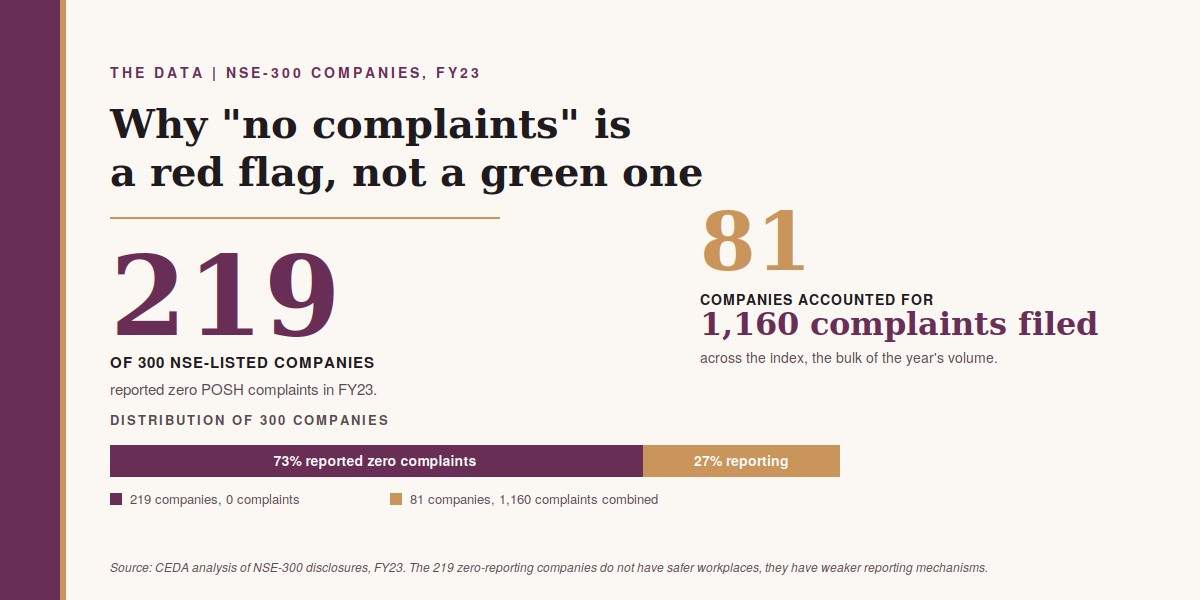
CEDA’s analysis of NSE-300 disclosures showed that in FY23, 73% of the companies reported zero complaints, while just 81 companies accounted for the bulk of the 1,160 complaints filed. The 219 zero-reporting companies don’t have safer workplaces. They have weaker reporting mechanisms.
POSH Training and Awareness
Training is where most POSH programmes fail quietly. The mandatory annual session, completed via a 30-minute e-learning module with a multiple-choice test at the end, satisfies the audit requirements but does nothing to enhance understanding.
Mandatory vs meaningful
Section 19 of the POSH Act requires employers to organise workshops and awareness programmes at regular intervals. The Act doesn’t define “regular,” and that ambiguity has been exploited. The minimum bar in most Indian workplaces is one annual session, often delivered through identical slides regardless of the audience.
The maximum bar is harder to find. The few organisations that do POSH training well treat it as a year-round programme, not an annual event.
Format choices that actually move the needle
Each training format serves a particular purpose but can also have drawbacks. The most effective programmes combine formats.
They run a mandatory baseline e-module for everyone, layered with role-specific live workshops for managers, IC members, and leadership. They use Indian case studies, not US examples. They’re conducted in regional languages where the workforce isn’t fully English-fluent, particularly in manufacturing, BPO, and frontline retail contexts.
| Format | What it does well | When it falls short |
| Live workshop | Allows real questions, scenario discussion, and IC visibility | Limited reach in distributed teams |
| Scenario-based e-learning | Tests judgment, not memorisation | Loses depth without a facilitator |
| Manager-only sessions | Reaches the population most likely to receive disclosures | Often skipped because senior employees consider themselves exempt |
| IC member training | Builds inquiry capability | Tends to focus on legal text rather than emotional skill |
| Leadership sessions | Models accountability from the top | Skipped as “not for them” |
Tailoring for Indian workplace realities
Generic global POSH content misses too much. The illustrations in Indian training programmes need to reflect the conduct patterns Indian workplaces actually see, not the office-romance trope from American HR videos.
Cultural specifics matter: how WhatsApp work groups blur into personal life, how senior-colleague language patterns can carry a lifetime of normalised intrusion, how regional festivals and rituals are used as cover for inappropriate behaviour. Training that names these patterns is training that lands.
Measuring What Actually Matters
Most organisations measure POSH the way a beginner measures fitness, by counting reps. The annual report goes to the District Officer, the Board Report carries the complaint number, and the audit gets ticked. None of those metrics tells you whether the workplace is safer.
Better measurement starts with these signals:
- Awareness levels. Do employees know who’s on the IC? Can they name two IC members without looking it up? In real surveys, this number is often surprisingly low.
- Trust and perception. Anonymous pulse surveys that ask variations of “If you saw or experienced harassment, would you trust the IC to handle it fairly?” track actual safety experiences over time.
- Resolution timelines. Average time from complaint filing to inquiry completion, average time from completion to action implementation. Slippage on either is a credibility killer.
- Complainant feedback. A confidential post-inquiry survey of complainants (anonymised, aggregated, surfaced to leadership). The complainant’s experience of the process is the closest signal of how the system is actually performing.
- Manager confidence. Do managers know what to do when an employee discloses harassment to them? A quick test reveals the gap.
- Repeat rates. How many cases involve a respondent who has been the subject of an earlier complaint? Repeat patterns are leading indicators.
Why the case count alone is misleading
A rising number of complaints can mean two opposite things: that harassment is rising, or that trust in the system is rising. Without context, the same data point points in different directions.
The right interpretation needs to be triangulated against awareness data, employee tenure of complainants (newer employees reporting more often suggests recent training is working), and survey trust metrics.
The Udaiti Foundation’s 2024-25 Close the Gender Gap Dashboard, drawing on data from 1,386 NSE-listed companies, observed a 16% rise in POSH complaints alongside a 28% rise in pending cases. The first signal looks positive. The second signals that redressal is straining. Both must be read together.
POSH in Modern Workplaces
The POSH Act was drafted for the workplace in 2013. The modern workplace has shifted in ways that test its application, but broadly, it hasn’t outrun it. The Act’s expansive workplace definition has stretched well, even if implementation has lagged.
Remote and hybrid environments
Hybrid work means harassment doesn’t always need a shared physical space. After-hours video calls, asynchronous messaging, and virtual team-bonding sessions all create new vectors for harassment.
The Act covers them, but evidence collection is more difficult, jurisdiction over witnesses is more complex, and the IC’s familiarity with digital forensics is often limited.
Gig economy and third-party workers
Gig workers, platform workers, contract employees, and vendors visiting workplaces all qualify as workers under the POSH Act. The protection extends to them. The mechanisms often don’t.
A delivery rider harassed at a customer’s home, a freelance designer harassed by the client’s project manager, a security guard harassed by a tenant, all of these scenarios are covered, and most are systemically underserved.
Off-site interactions and social media
Work-related events held outside the office, training programmes, off-sites, client dinners, and conferences are workplaces under the Act. So is the social media that follows from them.
A LinkedIn DM, an Instagram comment, or a company WhatsApp group post can all constitute sexual harassment if the content meets the unwelcomeness threshold and is connected to the work relationship.
The role of technology
A handful of HR-tech tools now offer anonymous reporting, AI-driven training, and case-tracking dashboards. They have a place. They also carry risks. Anonymous reporting tools, if poorly governed, can fragment complaints and obscure patterns.
AI-driven training, if built on US-centric content, can drift further from the Indian context. The right approach treats technology as a complement to human capability, not a substitute for it.
Conclusion: The Real Benchmark
The POSH Act sets the floor. It tells employers what they cannot ignore: an Internal Committee, a written policy, a complaint mechanism, an annual report, and a training cadence.
But the law is only the floor. Policy is the structure built on it, and culture determines whether that structure holds up when tested. A workplace can have flawless policies and still see harassment go unreported. A workplace with a less polished policy but a deeply trusted IC will see more complaints, faster resolutions, and better outcomes for everyone.
Ultimately, the benchmark for POSH compliance is not the audit. It’s whether an employee who experiences harassment in your workplace believes that reporting it will lead to a fair, timely, confidential, and consequential response. If she does, your POSH framework is working. If she doesn’t, it isn’t, regardless of what the file says.
That’s the standard. The law gets you to the door. Trust is what gets people to walk through it.
FAQs
What is the POSH Act?
The POSH Act is the Sexual Harassment of Women at Workplace (Prevention, Prohibition and Redressal) Act, 2013. It is India’s principal law on workplace sexual harassment and applies to every workplace in India, public or private, organised or unorganised. The Act defines sexual harassment, lays out employer duties, mandates an Internal Committee in workplaces with ten or more employees, and prescribes a complaint and inquiry process.
Who is protected under the POSH Act?
The POSH Act protects every woman who works in a workplace, regardless of age or employment status. This includes full-time and part-time employees, interns and apprentices, daily-wage and contract workers, women working from home in connection with the workplace, and clients, customers, and vendors visiting the workplace. The Act does not cover men, transgender employees, or non-binary employees.
What counts as sexual harassment under the POSH Act?
Section 2(n) of the POSH Act lists five categories of conduct that qualify as sexual harassment: physical contact and advances, demands or requests for sexual favours, sexually coloured remarks, showing pornography, and any other unwelcome physical, verbal, or non-verbal conduct of a sexual nature. The test is whether the conduct was unwelcome to the aggrieved woman, not whether the person doing it intended harm.
Is the POSH Act applicable to companies with fewer than 10 employees?
Yes. The POSH Act applies to all workplaces in India, but the mechanism differs by size. Workplaces with ten or more employees must constitute an Internal Committee. Workplaces with fewer than ten employees, and cases where the complaint is against the employer, are handled by the Local Committee constituted at the district level by the District Officer.
What is the composition of the Internal Committee under the POSH Act?
Under Section 4 of the POSH Act, the Internal Committee must include a Presiding Officer who is a senior woman employee, at least two members from the workplace committed to the cause of women or with social work or legal experience, and one mandatory external member from an NGO or a person familiar with sexual harassment issues. At least half the members must be women. Members are appointed for a term of up to three years.
What is the timeline for filing a POSH complaint?
A POSH complaint must be filed within three months of the last incident of sexual harassment. The Internal Committee can extend the limitation by another three months for sufficient reason. The Supreme Court reinforced the strictness of this timeline in Vaneeta Patnaik v. Nirmal Kanti Chakrabarti (2025), dismissing a complaint as time-barred even while acknowledging that the allegations were serious.
How long does the POSH inquiry process take?
The Internal Committee must complete the inquiry within 90 days from receipt of the complaint and submit its report to the employer within 10 days of conclusion. The employer must implement the IC’s recommendations within 60 days. Either party can appeal to a court or tribunal within 90 days of the recommendation if dissatisfied.
What are the penalties for non-compliance with the POSH Act?
Failure to comply with the POSH Act attracts a fine of up to ₹50,000 for the first offence. Repeat or aggravated violations can lead to higher penalties and even cancellation of business licences. Under the Companies (Accounts) Second Amendment Rules, 2025, companies are also required to disclose complaints received, complaints disposed of, and complaints pending beyond 90 days in their Board Reports.
Does the POSH Act cover remote work and digital harassment?
Yes. The POSH Act’s definition of workplace is interpreted expansively and covers remote work environments and digital communication platforms used for work. Work-from-home setups, Slack channels, video calls, and after-hours WhatsApp groups all fall under the workplace definition once tied to employment. Sexually explicit messages, emails, and social media posts can constitute harassment if they meet the unwelcomeness threshold.
What is the SHe-Box portal?
SHe-Box is the central government’s complaints portal run by the Ministry of Women and Child Development. Complainants can file a sexual harassment complaint through the portal, which then routes it to the appropriate Internal Committee or Local Committee for inquiry under the POSH Act.