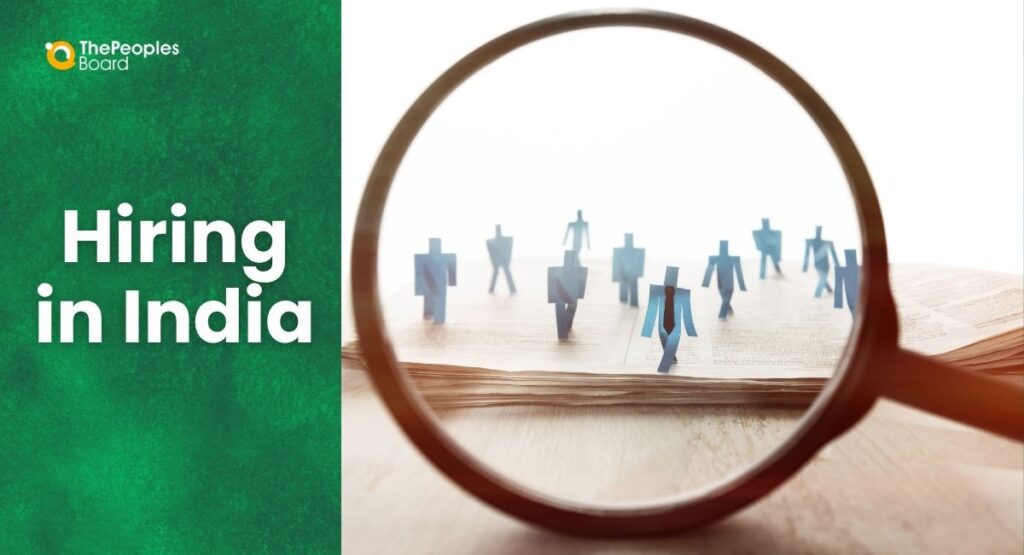

Hiring in India is being rewritten in real time. AI-linked job postings are projected to grow 32% year-on-year in 2026, reaching nearly 3.8 lakh positions, even as average time-to-hire stretches to 35-45 days and 73% of talent acquisition leaders say roles have become harder to fill.
The four new Labour Codes came into force on 21 November 2025, reshaping how appointment letters, fixed-term contracts, and gig worker engagements must be structured. The Digital Personal Data Protection (DPDP) Act has changed what recruiters can collect, store, and share. And a clear majority of Indian employers now prioritise skills over degrees when shortlisting candidates.
What Hiring Means in 2026
Hiring is the process of identifying, evaluating, and bringing on a new employee to meet a defined business need. It sits at the centre of three overlapping functions that are often used interchangeably but are not the same thing.
| Term | What it covers | Time horizon |
| Recruitment | The act of sourcing and selecting candidates for a specific open role | Short-term, role-by-role |
| Hiring | The full cycle from requisition to offer acceptance and onboarding | Medium term, end-to-end per hire |
| Talent acquisition | The strategic function that builds talent pipelines and capability for current and future business needs | Long-term, organisation-wide |
In Indian organisations, hiring has shifted from a transactional HR responsibility to a strategic function tied directly to business outcomes. Three forces have driven that shift.
First, the labour market has formalised faster than at any point in the last decade. The Labour Codes 2025 require mandatory appointment letters for all hires, including gig and platform workers, full social security parity for fixed-term employees, and unified employment classification across permanent, fixed-term, contract, and platform categories.
Second, technology has compressed the funnel. AI now sits in resume parsing, candidate matching, interview scheduling, and even first-round screening conversations. Over 90% of Indian firms have piloted GenAI in HR functions, though only 38% report high relevance for their organisation today.
Third, the compliance overlay has expanded. The DPDP Act and the DPDP Rules 2025 have changed what counts as personal data, what consent looks like, and how long candidate information can be stored.
The result is that hiring in 2026 is faster, more measured, more regulated, and more contested than it was even three years ago.
The Hiring Process: Step by Step
A modern hiring process in India runs across eight stages. Each stage has its own metrics, its own failure modes, and its own compliance requirements.
Workforce Planning and Identifying Talent Needs
Before a job description is written, the organisation has to know what it is solving for. Workforce planning answers three questions: what capabilities does the business need now, what will it need in the next 12 to 24 months, and where will those capabilities come from.
Strong workforce planning rests on a few practices:
- Forecasting headcount against revenue, product, and geographic expansion plans
- Mapping internal talent against current and projected role demands
- Identifying which roles can be filled through internal mobility versus external hiring
- Building succession plans for critical leadership and specialist positions
- Aligning HR business partners and hiring managers on the brief before sourcing begins
This stage is where most hiring failures originate. A vague brief produces a poorly written job description, which produces a poorly sourced pipeline, which produces a poor hire.
Writing Job Descriptions That Work
A job description is both an internal alignment document and an external marketing asset. Strong JDs share a few traits:
- A clear role title that matches what the market actually searches for
- Three to five core responsibilities, ranked by importance
- A distinction between must-have and nice-to-have skills
- Honest expectations on experience, qualifications, and location
- Transparent compensation bands where the organisation can offer them
The most common mistakes are over-listing requirements, copying old JDs without updating them, and using internal jargon that candidates outside the company will not recognise. AI-generated JDs have made the first draft faster, but they have also made generic descriptions more common. The differentiation now sits in the human edit.
Sourcing Candidates
India in 2026 has one of the most fragmented sourcing landscapes in the world. The right channel depends on the role, the seniority, and the volume.
| Channel | Best suited for | Typical strength |
| Naukri, LinkedIn, Indeed | Mid-senior white-collar | Volume and search depth |
| Apna, WorkIndia | Blue-collar and frontline | Tier-2 and Tier-3 reach |
| Employee referrals | All levels, especially niche skills | Quality and culture fit |
| Campus placements | Freshers and early-career | Scale and standardisation |
| Recruitment agencies and RPOs | Mid-senior, niche, and confidential roles | Specialised pipelines |
| Internal talent marketplaces | Lateral and project moves | Lower cost, faster ramp |
| Executive search firms | CXO and board roles | Discretion and depth |
Employee referrals continue to deliver the highest quality of hire in most Indian organisations, often at a fraction of the cost per hire of agency channels. Additionally, internal mobility is now a measurable lever rather than an HR aspiration: internal promotions carry zero recruitment fees, zero days of external time-to-hire, and significantly faster ramp-to-productivity than external hires.
Screening and Shortlisting
Once applications arrive, the screening stage filters them down to a manageable shortlist. Most large Indian organisations now use a combination of:
- Applicant Tracking System (ATS) keyword filtering against the JD
- AI-powered resume parsing and candidate-job matching
- Manual review by recruiters for the top 10-15% of applications
- Pre-screening calls or chatbot interactions before interview scheduling
The trade-off is real. AI screening improves speed but introduces algorithmic bias risk if not monitored. Manual screening preserves judgment but does not scale. Most Indian teams in 2026 run a hybrid model: AI does the first pass, recruiters review the AI-filtered set, and hiring managers see only the final shortlist.
A growing complication is that candidates have begun optimising CVs for AI parsing rather than human readability, producing keyword-stuffed resumes that pass the filter but fail the interview.
Interviews and Assessments
Indian hiring typically involves three to five interview rounds, depending on seniority. The structure usually looks like this:
- Recruiter screen: Basic fit, role expectations, compensation alignment.
- Hiring manager interview: Domain expertise, motivation, scenario-based questions.
- Technical or functional assessment: Coding test, case study, work sample, presentation.
- Cross-functional or panel interview: Collaboration, leadership, culture evaluation.
- Final or leadership round: Strategic thinking, long-term fit, compensation discussion.
The culture-fit-versus-culture-add debate has shifted in recent years. Hiring for “culture fit” can quietly reinforce homogeneity. Hiring for “culture add”, where the question is what new perspective or capability a candidate brings to the existing culture, broadens the pipeline and improves long-term retention.
Selection, Offer, and Negotiation
Once a candidate is selected, the offer stage opens. This is where the most preventable losses happen. Common reasons offers fall through include slow rollout, weak counter-offer handling, opaque compensation breakdowns, and a poor candidate experience during negotiation.
A modern Indian offer process includes:
- A formal written offer with the full CTC structure, basic pay (now required to be at least 50% of gross under the Code on Wages), benefits, joining bonus if applicable, and notice period
- Background verification across criminal, education, employment, and address checks, conducted with explicit candidate consent under the DPDP Rules 2025
- A clear timeline from offer to joining, with regular check-ins during the notice period
- A documented response to counter-offers from the current employer
Background verification has changed materially. Under the DPDP Rules 2025, a one-line consent clause in an offer letter is no longer sufficient. Employers must obtain explicit, purpose-specific consent, with retention timelines defined for both hired and non-hired candidates.
Rejection and Candidate Communication
The most overlooked step in the hiring process is also the most damaging when handled poorly. Ghosting candidates after interviews is one of the most cited frustrations on Indian employer review platforms like AmbitionBox and Glassdoor.
Good rejection communication is short, timely, and respectful:
- A rejection within five working days of the final interview round
- A clear reason, even if brief
- A door left open for future opportunities, where appropriate
- A thank-you for the candidate’s time and interest
Candidates who are rejected well often become referral sources, future hires, or customers. Candidates who are ghosted leave reviews. The cost of getting this wrong is reputational, and it compounds.
Onboarding and Early Integration
Hiring does not end at offer acceptance. The window between offer signing and the end of the first 90 days is where retention is won or lost. Research across global onboarding studies consistently shows that roughly one in three new hires who leave within six months cite mismatched expectations during the recruitment process as the primary reason.
A strong onboarding experience covers:
- Pre-joining engagement through the notice period (welcome kits, manager check-ins, document collection)
- A structured first-week orientation covering policies, tools, and team introductions
- A 30-60-90 day plan with defined goals and check-ins
- An assigned onboarding buddy or peer mentor
- Manager-led one-on-ones from week one onwards
The connection between onboarding quality and employer branding is direct. New hires talk about their joining experience on LinkedIn, on AmbitionBox, and in their professional networks within the first 30 days.
Types of Hiring: A Quick Comparison
Indian organisations use different hiring models for different needs. Each comes with its own cost profile, compliance requirement, and business use case.
| Type | When organisations choose this | Compliance under Labour Codes 2025 |
| Full-time permanent | Long-term capability, leadership, and core business roles | Full statutory benefits (PF, ESI, gratuity, leave) |
| Fixed-term employment | Project work, seasonal demand, defined-duration needs | Full benefit parity with permanent employees; gratuity eligibility after one year of continuous service |
| Contract and temporary | Specialised or short-term needs, non-core functions | Contract labour engagement now requires unified all-India licences where more than 50 workers are engaged |
| Gig and platform | Flexible, task-based, app-based work | New social security framework; aggregator contribution of 1-2% of annual turnover, capped at 5% of payments to platform workers |
| Campus hiring | Fresher pipelines, scale hiring for entry-level roles | Standard employment rules apply on joining |
| Executive and leadership | CXO, board, and senior specialist roles | Full statutory benefits, often with additional contractual terms |
Apart from the mentioned methods, Internal hiring and promotions are hiring channels in their own right, not just sourcing tactics. Similarly, Diversity hiring is a lens applied across all categories rather than a separate type.
Remote and global hiring, especially through Global Capability Centres, has also come to account for a significant share of mid- and senior-level hiring in Bengaluru, Hyderabad, Pune, Gurugram, and Mumbai.
Skills-Based Hiring: The Defining Shift of 2026
The most consequential change in Indian hiring over the last three years is the move from degree-based filtering to skills-based evaluation. Recent industry data suggests roughly 85% of Indian employers now prioritise demonstrated skills over academic credentials when shortlisting candidates.
Why Skills are Replacing Degrees
Though the shifting preference from degrees to skills is being driven by numerous factors, some are more prominent than others:
- The rapid expansion of Indian colleges and inconsistent academic standards has reduced the reliability of degrees as a hiring filter
- High-volume application flows have made CGPA-based screening unsustainable, particularly for IT and engineering roles
- Roles in AI, cloud, cybersecurity, and data science change faster than formal curricula can adapt
Companies like Swiggy, PhonePe, and Unacademy have publicly moved towards portfolio-based and project-based evaluation for technology roles. TCS’s National Qualifier Test (NQT) is one of the largest standardised skills assessments in the country, and IBM’s SkillsBuild has positioned itself as an alternative credentialing route for entry-level technology talent.
What Skills-Based Hiring Looks Like in Practice
In place of CGPA thresholds and degree filters, skills-based hiring relies on:
- Practical coding assessments and real-world problem-solving exercises
- Portfolio reviews (GitHub repositories, Kaggle competitions, personal projects)
- Hackathons and timed challenges
- Behavioural and aptitude tests combined with technical depth assessments
- Recognition of certifications and bootcamp credentials alongside or in place of degrees
For campus hiring in particular, the move has been pronounced. Many large IT services and product companies now treat CGPA as one data point among several, rather than as a gating criterion.
The Challenges Most Employers Underestimate
Skills-based hiring is not a clean replacement for degree-based hiring. It comes with its own problems:
- Assessment quality: Building or buying skills assessments that genuinely predict on-the-job performance is harder than it looks.
- Standardisation: Comparing candidates across different assessment formats, panels, and timeframes requires disciplined calibration.
- Bias risks: Skills assessments can carry their own biases, particularly when designed without diverse review.
- The hire-then-develop gap: Hiring on demonstrated skills is only half the story. Organisations that do not invest in continued skill development quickly run into the same capability gap they hired to solve.
Most Indian organisations in 2026 run a hybrid model: degree as a soft filter for some roles, skills assessment as the primary evaluation criterion, and structured interviews to validate both.
AI and Technology in Hiring
The hiring stack has changed faster in the last 24 months than it did in the previous decade. Three layers sit underneath it: the ATS, the AI layer that wraps around it, and the assessment platforms that feed into it.
Applicant Tracking Systems
An ATS is the system of record for a hiring process. It manages requisitions, candidate data, interview workflows, and offer management. In India, the most commonly deployed platforms include Naukri RMS, Zoho Recruit, Keka, Darwinbox, and increasingly, India-built AI-first platforms.
A modern ATS adds value in a few clear ways:
- Centralising candidate data and conversation history across recruiters
- Automating repetitive scheduling, reminders, and status updates
- Enforcing consistent stages and approval workflows
- Producing the reporting layer for time-to-hire, source-of-hire, and pipeline conversion
The limitation is that an ATS is only as good as the data discipline of the team using it. Half-filled records, inconsistent tagging, and abandoned candidate stages reduce the signal it can produce.
AI Across the Hiring Funnel
AI is now embedded across the hiring funnel, not just at the resume screening stage. The most common applications in Indian organisations include:
- Resume parsing and skills extraction from unstructured CVs
- Candidate-job matching using semantic similarity rather than keyword overlap
- AI-generated job descriptions, outreach messages, and interview questions
- Predictive analytics on candidate quality and likelihood to accept an offer
- Conversational AI for first-round screening and FAQ handling
- Interview scheduling across multiple panels and time zones
The adoption-versus-results gap is the defining tension. Over 90% of Indian firms have piloted GenAI in HR, but fewer than 4 in 10 report high organisational relevance from the tools. The teams seeing real returns are the ones treating AI as a layer that augments recruiter judgment rather than replacing it.
Virtual Hiring and Digital Assessments
Remote and hybrid hiring is now standard for white-collar roles in India. The supporting infrastructure includes:
- Asynchronous video interviews where candidates record responses to standard questions
- Live video interviewing with built-in note-taking and rating tools
- Proctored online coding and technical assessments
- Personality and behavioural assessments integrated into the ATS workflow
The trade-off in virtual hiring is signal quality. Asynchronous video saves recruiter time but loses the back-and-forth of a live conversation. Online assessments scale beautifully but require careful proctoring to prevent gaming.
Hiring Metrics That Actually Matter
Most Indian organisations measure hiring activity rather than hiring outcomes. The metrics that genuinely move the needle are narrower than the ones most teams track.
| Metric | What it measures | India benchmark 2026 |
| Time-to-hire | Days from the candidate entering the pipeline to offer acceptance | 35-45 days average; 44-60 days for senior roles |
| Cost-per-hire | Total spend per closed hire, including internal recruiter time | ₹1.5-3.5 lakh for mid-senior hires |
| Quality-of-hire | Performance of hires at 6 and 12 months, weighted against retention | Tracked through a combination of manager rating and tenure |
| Offer acceptance rate | Offers accepted as a percentage of offers extended | 90% and above is considered healthy |
| Source-of-hire ROI | Quality-of-hire and cost-per-hire by sourcing channel | Referrals are typically considered best |
| Cost of a bad hire | Total cost when a hire underperforms and exits | ₹7.5-18 lakh at ₹15-25 LPA roles; ₹25-40 lakh and above for senior roles |
The cost of a bad hire is the metric most Indian organisations do not track and most need to. A senior bad hire who underperforms for four to six months, serves a 90-day notice, and is then replaced through a new search consumes seven to nine months of salary cost with reduced or negative productivity, before the role is even available to refill.
Candidate Experience and Employer Brand
Candidate experience is no longer a recruiter’s soft concern. It is a measurable input into offer acceptance, referral generation, and employer brand reputation.
Why Candidate Experience Sits at the Centre of Hiring Now
Indian candidates in 2026 research employers before they apply. Glassdoor, AmbitionBox, LinkedIn reviews, and Reddit threads carry weight, particularly for mid- to senior-level hires choosing between competing offers.
A negative candidate experience cycles back into the hiring funnel through declined offers, lower referral rates, and harder sourcing for the next requisition.
The link between candidate experience and employer branding is direct. Every interview is a brand impression, whether the candidate is hired or not.
The Most Common Hiring Frustrations in India
The recurring complaints on Indian candidate review platforms cluster around a few themes:
- Ghosting: Candidates not hearing back after interviews, sometimes for weeks
- Opaque processes: No clarity on stages, timelines, or what is being assessed
- Disorganised interviews: Interviewers are unprepared, panels duplicate questions, and technical rounds are unrelated to the role
- Slow offer rollout: Verbal commitments not followed by written offers for days or weeks
- Adversarial negotiation: Lowball offers, aggressive counter-offer handling, and last-minute compensation revisions
What Good Candidate Experience Looks Like
Good candidate experience is not expensive. It is mostly a matter of process discipline.
- Acknowledge every application within 48 hours
- Communicate the hiring stages and expected timelines at the recruiter screen
- Provide proactive status updates, even when there is no update to share
- Brief interviewers on the candidate, the role, and what they should assess
- Roll out written offers within 48-72 hours of verbal commitment
- Close the loop with every interviewed candidate, including those not selected
The candidates who walk away from a bad process with a clear explanation often come back, refer others, or recommend the company even if they don’t join.
Compliance, Fairness, and the Law
Hiring in India in 2026 sits inside a denser compliance overlay than at any point in the last decade. Three frameworks matter most: the Labour Codes 2025, the DPDP Act and Rules, and anti-discrimination law.
Indian Employment Law in Hiring
The four new Labour Codes came into force on 21 November 2025, consolidating 29 central labour laws. For hiring specifically, the practical changes include:
- Mandatory written appointment letters for all new hires, including fixed-term, contract, gig, and platform workers
- Basic pay required to be at least 50% of total remuneration, affecting CTC structures and PF/gratuity calculations
- Full social security parity for fixed-term employees, with gratuity eligibility after one year of continuous service
- Layoff and retrenchment approvals are now required only for establishments with 300 or more employees, up from the earlier threshold of 100
- Contract labour engagement rules now apply where more than 50 contract workers are employed, up from 20
- Annual health check-ups required for all workers aged 40 and above
Background verification, explained in detail in TPB’s coverage, continues to cover criminal, education, employment, and address checks. What has changed is the consent framework around it.
Data Privacy and the DPDP Act
The Digital Personal Data Protection Act, 2023, with its 2025 Rules, is the most consequential data privacy reform Indian HR has seen. For hiring, the practical implications include:
- Explicit, purpose-specific consent for collecting, processing, and storing candidate data
- Data minimisation, where employers collect only what is needed for the stated purpose
- Defined retention timelines, typically 180 days for non-hired candidates, with documented deletion processes
- Candidate rights to access, correct, and request deletion of their personal data
- Employer accountability as the Data Fiduciary, even when background verification is outsourced
- Penalties ranging up to ₹250 crore for serious non-compliance
A one-line consent clause in an offer letter no longer meets the standard. Application forms, privacy notices, and vendor contracts all need to be rebuilt around the DPDP framework.
Bias, AI, and Algorithmic Hiring
Bias in hiring is not new. What is new is that algorithmic hiring can scale bias faster than human hiring can. The most common bias points in Indian hiring include:
- Affinity bias: Hiring people who feel familiar, often replicating existing demographics
- Pedigree bias: Over-weighting IIT, IIM, and Tier-1 college credentials
- Language and accent bias: Penalising candidates whose first language is not English
- Regional bias: Preference for candidates from certain states or cities
- Gender bias: Manifesting in JD language, interview questions, and compensation offers
Inclusive hiring practices that work in Indian organisations include structured interviews with the same questions and a rubric for every candidate, blind screening that removes name, college, and gender markers in the first pass, diverse interview panels, and accessibility audits of the hiring process for candidates with disabilities.
The ethical questions around AI hiring are sharpening. Transparency about what the algorithm evaluates, auditability of the decisions it produces, and human oversight of final selection are the three minimum standards to which Indian organisations should hold their AI hiring vendors.
Hiring Challenges Indian Organisations Face Today
The ManpowerGroup 2026 Talent Shortage Survey found that 82% of Indian employers reported difficulty filling roles in 2026, well above the global average of 72%. This highlights that even with better tools, better data, and better frameworks, hiring in India remains hard.
The AI and Digital Skills Gap
AI capabilities have overtaken engineering and IT as the hardest skills for Indian employers to find. Nearly 45% of Indian organisations now identify AI, digital, and data skills as their single largest workforce constraint.
The talent pool is large in absolute numbers but thin in role-ready capability, leaving most employers competing for the same narrow band of senior AI talent in Bengaluru, Hyderabad, and Pune.
Long Hiring Cycles for Mid and Senior Roles
Average time-to-hire in India sits in the 35-45 day range, while time-to-fill for senior roles runs 44 to 60 days once internal approvals are factored in. The hidden cost sits in the approval layer, where a requisition typically waits 5 to 10 days for budget sign-off before sourcing can even begin.
Strong mid-senior candidates usually evaluate two to three offers in parallel, and a 45-day process competes poorly against a 25-day one.
High Attrition and the Cost of Repeat Hiring
India’s IT sector attrition has stabilised to around 13-14% across the top five IT services companies in FY26, but the headline number masks two pressures. Attrition in niche skill areas like AI/ML, cloud, and cybersecurity runs significantly above the sector average, while consumer tech and early-stage startups continue to see attrition in the 18-25% range. The net effect is that a meaningful share of hiring activity is replacement hiring rather than growth hiring.
Hiring for Roles That Did Not Exist Three Years Ago
AI prompt engineers, AI ethics officers, ML platform engineers, ESG compliance heads, and Chief AI Officers are now real roles in Indian organisations, but most companies are still figuring out how to define them.
The job description for an “AI Engineer” varies wildly across employers, leaving recruiters sourcing the wrong profile and candidates losing trust in the process. Compensation benchmarking is equally fragile, with salary ranges varying widely for what looks like the same title.
The IT Sector Slowdown and Its Hiring Impact
TPB’s layoff tracker has documented sustained workforce reductions across Indian IT services through 2025 and into 2026. The slowdown has softened fresher hiring volumes, paused bench-heavy hiring models, and tightened lateral hiring for mid-level IT services roles.
The result is a bifurcated market, where traditional IT services hiring has cooled while specialised, AI-adjacent hiring sits in fierce competition.
The Hiring Manager and Recruiter Dynamic
The least discussed challenge in Indian hiring is also one of the most consequential. Hiring decisions sit with the hiring manager, sourcing accountability sits with the recruiter, and the two functions often hold different views of what the role actually needs.
The friction shows up as vague briefs, late role changes, blanket shortlist rejections, and mixed signals on compensation. Organisations resolving this dynamic run a structured intake meeting per requisition and hold both functions jointly accountable for hiring outcomes.
In the End…
Hiring in India in 2026 sits at the intersection of speed, technology, and trust. The funnel is faster than it has ever been. The tools are more capable than they have ever been. The compliance overlay is heavier than it has ever been. And the candidate, with their phone, their AmbitionBox account, and their professional network, knows more about the employer than the employer knows about them.
What has not changed is that hiring is, at its core, a judgment call about a person. AI can compress the funnel, structured interviews can sharpen the decision, and frameworks can reduce the bias. But the moment of choosing a candidate, and the moment of welcoming them on Day 1, still rests on something that no algorithm has replaced: the human ability to recognise potential, build trust, and create the conditions under which someone can do their best work.
The organisations that combine efficiency with empathy, rigour with respect, and speed with care will be the ones that win the talent the next decade demands. The ones that automate without judgment will keep filling roles and keep losing the people in them.
FAQs
What is the difference between hiring, recruitment, and talent acquisition?
Recruitment is the act of sourcing and selecting candidates for a specific open role. Hiring is the full cycle from requisition to offer acceptance and onboarding. Talent acquisition is the strategic, long-term function that builds talent pipelines and capability for current and future business needs. In Indian organisations, the three are often used interchangeably, but they operate at different time horizons and scopes.
What are the key changes to hiring under India’s Labour Codes 2025?
The four Labour Codes came into force on 21 November 2025. For hiring, the main changes include mandatory written appointment letters for all new hires (including gig and platform workers), basic pay required to be at least 50% of total remuneration, full social security parity for fixed-term employees with gratuity eligibility after one year, and revised thresholds for contract labour engagement and retrenchment approvals.
How does the DPDP Act affect candidate data and background verification?
The DPDP Act and its 2025 Rules require explicit, purpose-specific consent for collecting, processing, and storing candidate data. A one-line consent clause in an offer letter is no longer enough. Employers must follow data minimisation, define retention timelines (typically 180 days for non-hired candidates), honour candidate rights to access and deletion, and remain accountable as the Data Fiduciary even when background verification is outsourced.
What is the average time-to-hire in India in 2026?
Average time-to-hire in India sits in the 35-45 day range for most white-collar roles. For senior positions, time-to-fill stretches to 44-60 days once internal approvals are factored in. A meaningful share of this delay comes from the approval layer, where requisitions often wait 5 to 10 days for budget sign-off before sourcing begins.
What is skills-based hiring and why is it growing in India?
Skills-based hiring evaluates candidates on demonstrated capabilities (coding tests, portfolios, work samples, certifications) rather than academic credentials. Roughly 85% of Indian employers now prioritise skills over degrees when shortlisting. The shift is driven by inconsistent academic standards, unsustainable CGPA-based screening at scale, and roles in AI, cloud, and cybersecurity changing faster than formal curricula can adapt.
How much does a bad hire cost an Indian employer?
The cost of a bad hire typically ranges from ₹7.5-18 lakh for roles at ₹15-25 LPA, and ₹25-40 lakh or more for senior roles. The full cost includes salary paid during underperformance, the 90-day notice period, the replacement search, lost productivity, and the impact on team morale. Most Indian organisations do not track this metric, though it materially affects hiring ROI.
Which sourcing channels work best for hiring in India?
The right channel depends on the role and seniority. Naukri, LinkedIn, and Indeed work well for mid-senior white-collar hiring. Apna and WorkIndia have stronger Tier-2 and Tier-3 reach for blue-collar roles. Employee referrals consistently deliver the highest quality of hire at the lowest cost. Campus placements suit fresher hiring at scale, while executive search firms remain the standard for CXO and board-level roles.
What hiring metrics should HR leaders track in 2026?
The metrics that move the needle are narrower than the ones most teams track: time-to-hire, cost-per-hire, quality-of-hire at 6 and 12 months, offer acceptance rate, source-of-hire ROI, and the cost of a bad hire. Activity metrics like applications received or interviews scheduled are useful, but they measure effort rather than outcome.
How can Indian employers reduce candidate ghosting and improve experience?
Good candidate experience is largely a matter of process discipline. Acknowledge every application within 48 hours, communicate hiring stages and timelines at the recruiter screen, provide proactive status updates even when there is no update, brief interviewers in advance, roll out written offers within 48-72 hours of verbal commitment, and close the loop with every interviewed candidate, including those not selected.
What is the biggest hiring challenge for Indian employers in 2026?
The ManpowerGroup 2026 Talent Shortage Survey found that 82% of Indian employers reported difficulty filling roles, well above the global average of 72%. AI, digital, and data skills are the single largest workforce constraint, identified by nearly 45% of Indian organisations. Long hiring cycles, attrition in niche skill areas, and the absence of established benchmarks for emerging roles compound the challenge.