
AI in HR refers to the use of artificial intelligence to automate, augment, and improve human resource processes across the employee lifecycle. From resume screening to attrition prediction, from onboarding chatbots to pay equity audits, AI is now embedded in nearly every function HR is responsible for.
For most of its history, HR ran on a combination of judgment, relationships, and paperwork. A manager flagged a high performer. A recruiter remembered a strong CV from last year. A leader sensed that engagement was slipping in a particular team. Decisions were made, and policies were written, but the underlying logic was often invisible, hard to audit, and impossible to scale.
AI changes the unit of HR work. Pattern recognition that used to live in a recruiter’s head can now run across a million resumes. Sentiments that used to be inferred from one-on-one conversations can be detected across thousands of survey responses and Slack messages. Predictions that used to come from gut feel can now be quantified, stress-tested, and revisited.
This isn’t about replacing HR judgment. It is about giving HR teams a wider lens, faster signals, and a more honest mirror.
What is AI in HR?
Artificial intelligence in HR is the application of machine learning, natural language processing, and generative AI to HR tasks involving large volumes of data, repetitive decisions, or unstructured text.
In practical terms, it is the technology that lets an HRMS rank candidates by fit, surface attrition risk before a resignation letter arrives, or auto-generate a personalised learning path for every employee in the company.
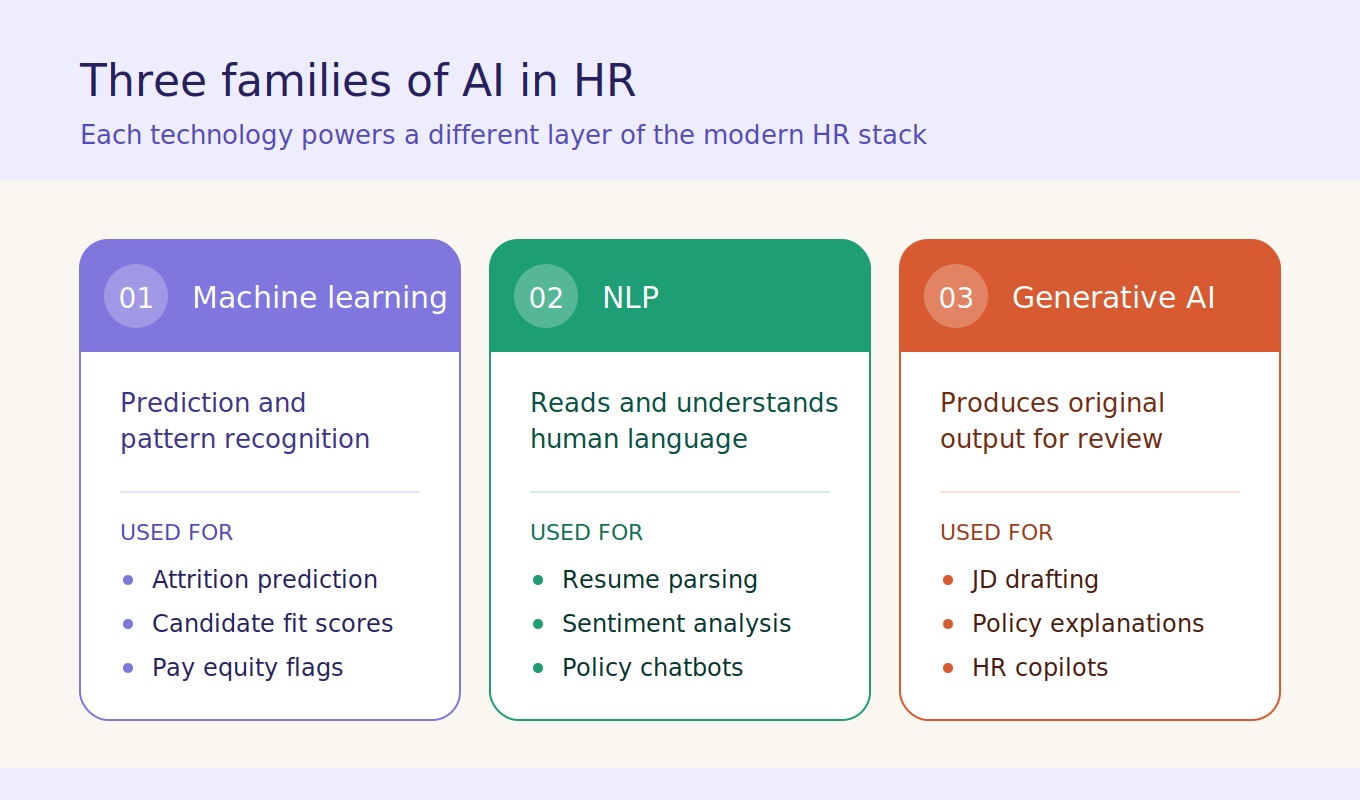
Three families of AI do most of the work in modern HR systems.
- Machine learning is the engine behind prediction and pattern recognition. It learns from historical HR data, things like who got promoted, who left, and who performed well, and uses those patterns to score future events. Attrition prediction models, candidate fit scores, and pay equity flags all sit in this category.
- Natural language processing, or NLP, is what allows AI to read and understand human language. It powers resume parsers, sentiment analysis on engagement surveys, exit interview text mining, and the chatbots that answer questions about leave policy at 11 pm. Anything that involves making sense of unstructured words is NLP territory.
- Generative AI is the newest layer. It writes job descriptions, drafts policy explanations, summarises long documents, builds first drafts of training content, and powers conversational HR copilots. Where earlier AI mostly classified or predicted, generative AI produces original output that an HR professional can then edit and approve.
These technologies share three core capabilities that explain why they matter in HR: they recognise patterns at scale, predict likely outcomes, and automate work that used to consume HR’s time without relying on HR’s judgement.
AI Across the Employee Lifecycle
The clearest way to understand where AI fits in HR is to walk through the employee lifecycle. Every stage has touchpoints where AI either reduces manual effort, surfaces signals humans can’t see at scale, or produces something useful that didn’t exist before.
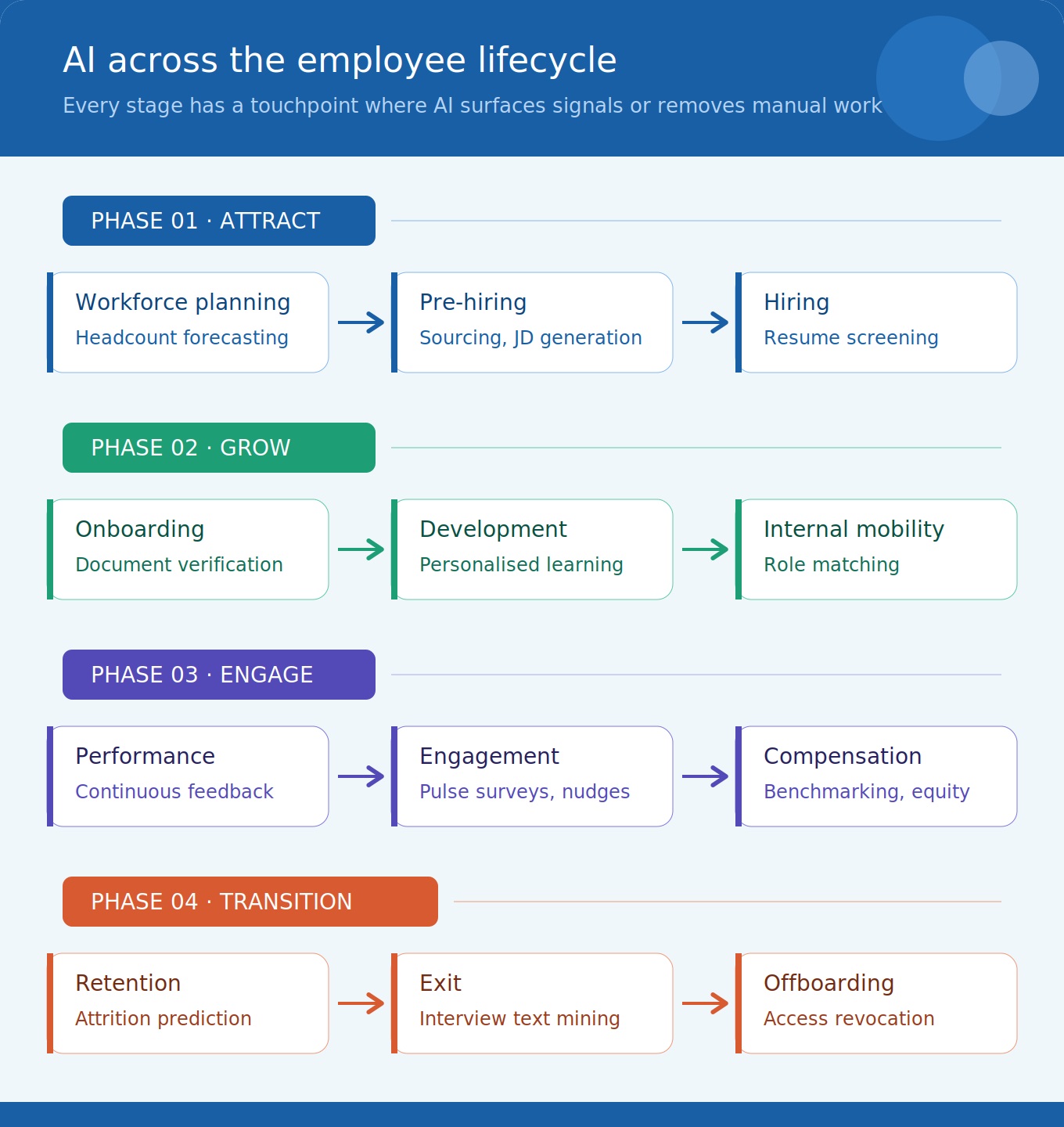
| Lifecycle Stage | Primary AI Use Cases | What It Replaces |
| Workforce Planning | Headcount forecasting, scenario modelling, skills mapping | Annual finance-led headcount exercises |
| Pre-hiring | Sourcing, JD generation, market intelligence | Manual market mapping |
| Hiring | Resume screening, candidate matching, and interview analysis | Spreadsheet-based shortlisting |
| Onboarding | Document verification, conversational FAQs, workflow routing | Form-by-form HR handholding |
| Development | Personalised learning, skill gap analysis, career pathing | One-size-fits-all training |
| Internal Mobility | Role matching, career pathing, succession recommendations | Manager-network-driven moves |
| Performance | Continuous feedback, sentiment-based input, and goal tracking | Annual review fatigue |
| Engagement | Pulse surveys, query bots, nudges | Static annual surveys |
| Compensation | Benchmarking, pay equity, anomaly detection | Spreadsheet-led calibration |
| Retention | Attrition prediction, flight-risk scoring, intervention triggers | Reactive resignations |
| Exit | Interview text mining, attrition prediction, alumni signals | Underused exit forms |
| Offboarding | Access revocation, asset recovery, and alumni onboarding | Manual checklists across systems |
The point of the table isn’t comprehensiveness. It is that no part of the employee lifecycle is immune to AI’s reach, and HR teams that approach AI as a “recruitment tool” miss most of the value.
Talent Acquisition and Recruitment
Recruitment is where most Indian HR teams first encountered AI, and it remains the most visible application. The volume is high, the data is structured, and the cost of inefficiency is easy to measure in time-to-hire and cost-per-hire.
- Resume screening and shortlisting: AI tools rank applications against role requirements, surface candidates whose profiles match the job description, and route the strongest few to recruiter attention.
- AI-assisted job descriptions and sourcing: Generative AI drafts JDs in minutes, suggests inclusive phrasing, and recommends keywords that match how candidates actually search. Sourcing tools mine LinkedIn, Naukri, GitHub, and other platforms to surface passive candidates that traditional search misses.
- Chatbots for candidate interaction: AI-powered chatbots handle the high-volume, low-judgement work of recruiting: answering FAQs about the role, scheduling interviews, collecting basic information, and keeping candidates warm during long hiring cycles.
- Video interview analysis: Some platforms claim to analyse facial expression, voice, and word choice to score a candidate’s “fit.” This category sits squarely in the territory where bias risk is highest, and HR teams should evaluate it with extra scepticism before deployment.
- Predictive hiring analytics: By comparing hire data against later performance and retention outcomes, it tells you which sourcing channels actually produce employees who stay and succeed, not just employees who pass interviews.
A practical caution: faster hiring is not always better hiring. AI screens for the patterns it has been trained on. If your historical hires skewed in a particular direction, the model will skew the same way unless you actively correct for it.
Onboarding and Employee Integration
Once a candidate accepts, HR’s work shifts from selection to integration. AI’s role here is less about decision-making and more about removing friction at scale, especially for employers who hire large batches of new hires each year.
- Automated onboarding workflows: Handle the predictable steps: offer letter generation, document collection, ID issuance, equipment requests, system access provisioning, and induction scheduling with AI. Each step that used to involve back-and-forth emails becomes a triggered action in the HRMS.
- Virtual assistants: For new hires, AI acts as a first line of help during the most disorienting weeks of a job. New employees can ask a chatbot about leave policy, payroll cycles, IT setup, or where to find the cafeteria, and get an answer without queuing for an HR business partner.
- Personalised onboarding journeys: Use AI to tailor the first 30, 60, or 90 days based on role, location, and prior experience. A senior hire from a competitor doesn’t need the same induction as a campus fresher. AI lets HR design that distinction without manually building 200 onboarding plans.
- Document verification and compliance automation: With NLP and computer vision, AI-powered tools can read, validate, and flag inconsistencies in identity proofs, educational documents, and prior employment records. Background verification platforms increasingly run these checks in the background, surfacing only the cases that need a human eye.
Learning and Development
L&D is where AI’s promise of personalisation is most visible, because the alternative, identical training for everyone, is so obviously inadequate. The challenge isn’t whether to personalise. It is how.
- Personalised learning recommendations: These match employees to courses, certifications, and modules based on their role, current skills, career interests, and learning history. The model gets sharper as it sees more data on what employees actually complete and apply.
- Skill gap analysis: It compares the skills the organisation needs with those it currently has and produces a map of where investment is most urgent. For functions undergoing technological shifts, AI in particular, this analysis is no longer optional.
- AI-generated training content: Through this feature, L&D teams can produce first drafts of modules, micro-learning content, quizzes, and scenarios in a fraction of the time.
- Adaptive learning platforms: Adjust difficulty and pacing in real time based on a learner’s progress. A high performer skips ahead. A struggling learner gets more practice. The same module serves multiple proficiency levels without manual branching.
- Career pathing and internal mobility: AI maps current employees against open roles, surfaces internal candidates who match emerging skill needs, and recommends moves that traditional HRBP networks would miss.
Performance Management
Performance management has been the most-criticised function in HR for the better part of two decades. Annual reviews are too late, too political, and too disconnected from actual work. AI doesn’t fix this on its own, but it changes what’s possible.
- Continuous performance tracking: This replaces the once-a-year review with an ongoing record. AI aggregates signals from project management tools, code repositories, sales systems, customer feedback, and peer recognition to give managers a near-real-time view of how individuals and teams are performing.
- AI-assisted goal setting: Managers and employees can write better OKRs and KPIs. Generative AI takes a goal phrased in vague language and rewrites it in measurable terms. It checks whether goals at one level actually ladder up to the level above. And it flags goals that have stayed unchanged for too long.
- Feedback analysis: AI can read and categorise the qualitative comments that pile up in performance systems and pulse surveys. Where humans see dozens of free-text responses, AI sees themes: which managers are mentioned positively, which projects are draining morale, which teams are quietly disengaged.
- Performance prediction and benchmarking: This compares an employee’s trajectory against patterns in the organisation’s history. It can flag who is on a high-potential track, who is plateauing, and where calibration between managers is inconsistent.
Employee Engagement and Experience
Engagement used to mean an annual survey, a slide deck of scores, and a quiet hope that things would be better next year. AI has reshaped what engagement work actually looks like.
- Pulse surveys and sentiment analysis: These run on shorter cycles than annual surveys, often weekly or monthly, and use NLP to extract themes from open-text responses. Instead of waiting for a year-end report, leaders see emerging issues in something close to real time.
- AI chatbots for HR queries: As virtual assistants, they handle the bulk of repeatable employee questions: leave balance, salary structure, expense rules, policy lookups. Employees get an answer in seconds. HR teams stop being a help desk and reclaim time for the work only humans can do.
- Experience platforms with personalised nudges push reminders, recommendations, and check-ins based on what an individual employee is likely to need.
- Analysis of communication pattern: Tools that read aggregated email and messaging metadata can surface signs of overwork, burnout, or collaboration breakdowns. Used carefully, they reveal genuine problems. Used carelessly, they cross into surveillance.
Workforce Planning and Analytics
This is where AI quietly becomes most strategic. Workforce planning was historically a once-a-year exercise driven by finance, with HR as a junior partner. AI changes that conversation.
- Headcount forecasting: AI uses historical hiring, attrition, and business growth data to model what the workforce will look like in six, twelve, and twenty-four months. It surfaces gaps before they become emergencies and overstaffing before it becomes layoffs.
- Attrition prediction models: Replacing an employee in India costs anywhere from a few months’ to over a year’s salary, depending on the role. AI models that flag flight risk early give HR a window to intervene through compensation adjustments, role changes, or genuine career conversations.
- Scenario planning and workforce optimisation enable leaders to test what happens if a business line grows by 30%, a market contracts by 15%, or a key location is restructured. Each scenario produces a different workforce shape, and AI lets HR compare them quickly without having to rebuild the model from scratch.
- Skills-based workforce mapping: Instead of describing the workforce by job titles, AI describes it by skills, then matches those skills to current and future business needs. Roles become adjustable. Mobility becomes visible. Hiring becomes targeted.
Compensation, Payroll, and Benefits
Compensation is one of HR’s highest-stakes functions and one of the messiest. AI has begun to clean up the mess in four distinct ways.
- Salary benchmarking using market data: Replace the old model of buying a static survey once a year and trying to make it last. AI-powered benchmarking platforms continuously refresh comparators, segment by skill and location, and flag where the organisation is paying above or below market rates.
- Pay equity analysis: Using regression and clustering models, AI identifies pay disparities that aren’t visible in raw averages. It controls for tenure, role, location, and performance, then surfaces unexplained gaps along gender, demographic, or location lines.
- Payroll anomaly detection: This is the quiet hero of AI in payroll. Indian payroll involves overlapping rules across PF, ESI, professional tax, TDS, gratuity, and state-specific levies, and a single error can compound across a year. AI builds a baseline of what “normal” looks like and flags deviations.
- Benefits utilisation insights: These insights show which benefits employees actually use, which they ignore, and which segments of the workforce engage with what. The result is a benefits programme that gets refined over time rather than negotiated once and forgotten.
HR Operations and Automation
Most HR teams underestimate how much of their workload sits in administrative tasks. AI doesn’t eliminate this work, but it removes the human cost of doing it.
- HR helpdesk automation routes employee queries to chatbots first, then to humans for cases that need judgment. Tier 1 queries close in seconds. Tier 2 queries reach HR with full context already attached.
- Document management and processing uses NLP and OCR to read, classify, extract, and file the paperwork HR generates: offer letters, agreements, statutory filings, performance documents, and exit paperwork. The document doesn’t need to be rekeyed. It needs to be filed, indexed, and made retrievable.
- Workflow automation for leave, approvals, and requests removes the routing logic from human HR. Leave request goes to the manager, then to the backup approver if it’s pending past a threshold, with policy compliance checked automatically along the way. The system handles the if-then logic. HR handles the exceptions.
- Compliance tracking and reporting keep pace with statutory obligations across PF, ESI, gratuity, professional tax, and the rolling implementation of the Labour Codes. AI doesn’t replace compliance expertise. It replaces compliance scrambling at month-end.
Diversity, Equity, and Inclusion
DEI is one of the areas where AI carries both the highest promise and the most significant risk. The same tools that can surface bias can also encode it. Handled carefully, AI can significantly help in creating a diverse and fair workplace.
- Bias detection in hiring and promotions: AI examines decision patterns for systematic disparities. If candidates from one background are systematically scored lower at the screening stage, AI can surface that pattern. The same applies to promotion rates, performance scores, and pay decisions.
- Diversity analytics and reporting: By moving DEI from an annual ESG slide to an ongoing dashboard, AI keeps a regular track of the company’s workforce composition. Representation by level, function, location, and tenure becomes visible in near real time, and gaps become harder to hide behind aggregate numbers.
- Inclusive job description generation: With NLP, AI can flag language that research has shown to discourage applications from particular groups. Words and phrases that skew applicant pools get rewritten before the JD is posted.
- Monitoring representation trends: Track how the workforce composition evolves over time as AI catches drift early, where a particular function is becoming homogenous despite stated DEI goals, and gives leadership a chance to course-correct before it becomes a story.
The caution is structural. AI trained on historical hiring data will reproduce those patterns, including biases. Amazon famously scrapped a recruitment AI after discovering the system had learned to penalise resumes containing the word “women’s.” The lesson generalises. Bias detection in AI requires bias detection of AI.
Employee Well-being and Safety
Well-being is a relatively new application area for AI, and the most important rule here is restraint. The tools work. Whether they should be deployed in any given context is a separate question.
- Burnout prediction and workload analysis: By combining signals from working hours, meeting load, leave patterns, and communication intensity, AI can flag employees showing signs of overwork and possible burnout. The intent is to trigger a conversation, not a flag in a file.
- Mental health sentiment signals: Using NLP on aggregated, anonymised survey responses, AI identifies teams or locations where well-being is deteriorating. Individual-level sentiment analysis is a line most thoughtful HR teams refuse to cross.
- Risk detection in workplace behaviour: This is most often used in safety-critical industries: manufacturing, construction, logistics, and healthcare. AI scans incident reports, near-miss data, and observation logs to identify patterns before they become accidents.
- Safety reporting tools: AI-powered platforms make it easier for employees to report incidents, hazards, or harassment. Mobile-first, multilingual, and increasingly AI-assisted, they remove friction from reporting and make it harder for safety issues to stay invisible.
Exit Management and Alumni Insights
Exits are HR’s most underused source of intelligence. By the time an employee resigns, they have stopped editing their feedback for political safety, and what they say reflects what they actually believe. AI helps HR hear it.
- Exit interview analysis uses NLP to read free-text exit responses across hundreds or thousands of leavers and surface themes: which manager keeps appearing, which policy keeps being mentioned, which compensation gap keeps being cited. The output is patterns, not anecdotes.
- Identifying attrition patterns combines exit, hire, performance, and tenure data to address questions HR usually struggles to answer with precision. Which cohorts leave fastest? Which roles have the highest regret rate? Which managers lose the most people?
- Alumni engagement insights treat former employees as a long-term asset, not a closed file. AI segments alumni by role, tenure, and likelihood of returning or referring, and helps HR build alumni programmes that deliver real recruiting and brand value.
AI Tools and Technologies Used in HR
The technology stack supporting AI in HR has matured into a few clear categories. Most Indian organisations end up using a combination of all four.
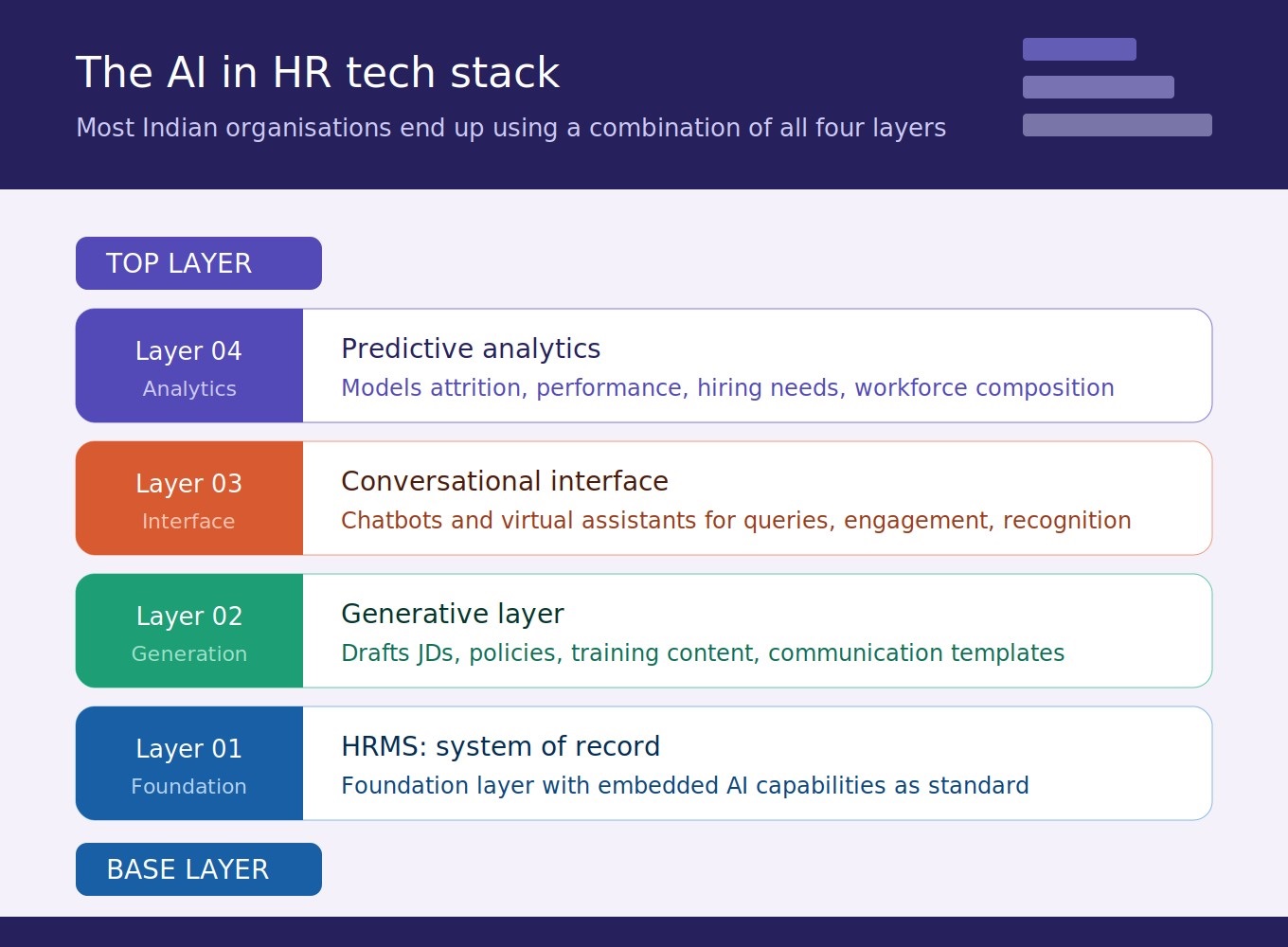
1. HRMS platforms with AI capabilities
Human Resources Management Systems (HRMS) form the foundation of AI usage in HR. The shift over the last five years has been from AI as a separate purchase to AI as a feature inside the system of record.
2. Generative AI tools for content and communication
JD writing, policy drafting, communication templates, training content, and meeting summaries are increasingly being drafted by tools like ChatGPT, Microsoft Copilot, Google Gemini, and Claude before HR review.
3. Chatbots and virtual assistants
AI-powered chatbots and virtual assistants handle conversational HR work. Leena AI, in particular, has emerged as a category leader in the Indian enterprise context, while platforms like inFeedo and Vantage Circle bring AI-driven engagement and recognition into the same conversational layer.
4. Predictive analytics platforms
By pulling data from across the stack, predictive analytics platforms model attrition, performance, hiring needs, and workforce composition. Some are standalone (Visier, Crunchr). Many are now embedded inside HRMS suites themselves.
The vendor landscape will keep shifting. The architectural pattern, system of record + generative layer + conversational interface + analytics overlay, is likely to remain stable for some time.
The Data That Powers AI in HR
AI in HR is only as useful as the data it draws on. The categories of data that matter most are predictable, and so are the failure modes when the data isn’t ready.
- Employee demographics form the baseline: role, level, location, tenure, function, manager, organisational unit. Most HRMS platforms have this, but the quality varies wildly between recently implemented systems and legacy platforms held together with workarounds.
- Performance and productivity data includes ratings, feedback, OKR or KPI completion, project delivery records, and increasingly, signals from the tools employees actually use to do their work.
- Engagement and survey data bring in what employees say about the workplace, both at scale (annual or pulse surveys) and incidentally (open-text feedback, helpdesk queries, exit comments).
- Recruitment and hiring data captures the funnel: application volume, source, time-to-hire, offer-to-accept ratio, first-year performance, and first-year attrition. Without this, recruitment AI can’t actually learn what works.
The single biggest barrier to AI in Indian HR isn’t technology. It is data quality.
Most Indian organisations still run HR on a patchwork of HRMS modules, legacy payroll software, attendance trackers, separate L&D platforms, and Excel files no one wants to claim ownership of.
AI built on top of that fragmentation produces fragmented insights. Garbage in, garbage out is the oldest rule in data, and it has not been suspended for HR. Before the AI question gets interesting, the integration question has to be answered.
Benefits of Using AI in HR
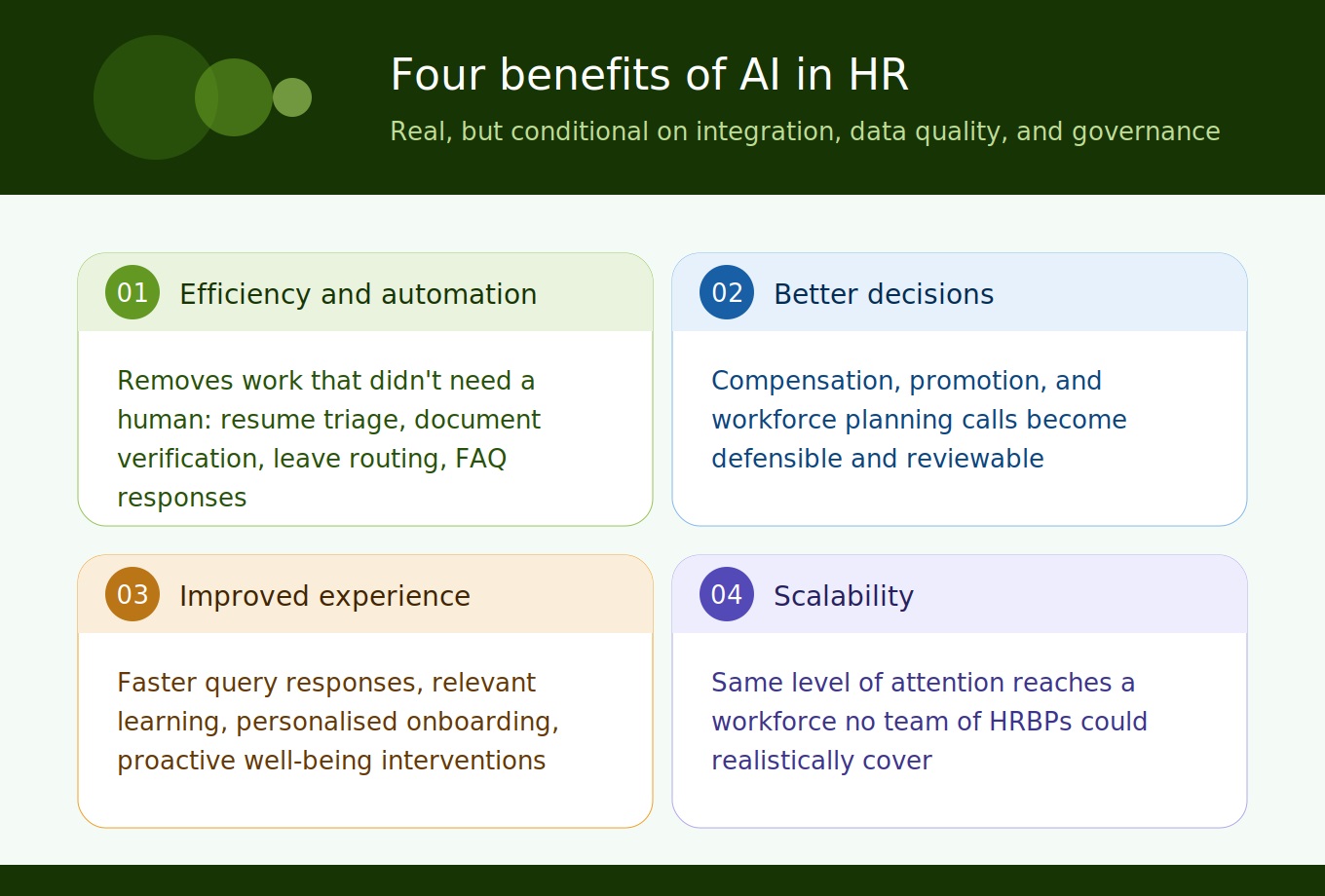
Strip away the marketing language, and the benefits of AI in HR fall into four categories. The benefits are real, but they are also conditional. They depend on integration, data quality, governance, and a clear sense of what HR is actually trying to achieve. AI doesn’t fix an unclear strategy. It amplifies it.
Efficiency and automation
AI removes work that didn’t need a human. Resume triage, document verification, leave request routing, FAQ responses, and document retrieval. None of these is work HR teams enjoy. All of them used to take hours each week.
Better decision-making through data
When a decision used to depend on intuition and one or two data points, AI lets HR weigh dozens. Compensation calibration, promotion decisions, workforce planning, and DEI reporting all become more defensible because the underlying logic is visible and reviewable.
Improved employee experience
Faster responses to queries, more relevant learning, more personalised onboarding, and proactive interventions on well-being and engagement all stack up. Each one alone is a small improvement. Together, they shift what it feels like to work somewhere.
Scalability of HR processes
A 200-person company can run HR with relationships and judgment. A 50,000-person company cannot. AI is what allows the same level of attention to scale across a workforce that no team of HR business partners could realistically reach.
Challenges and Limitations
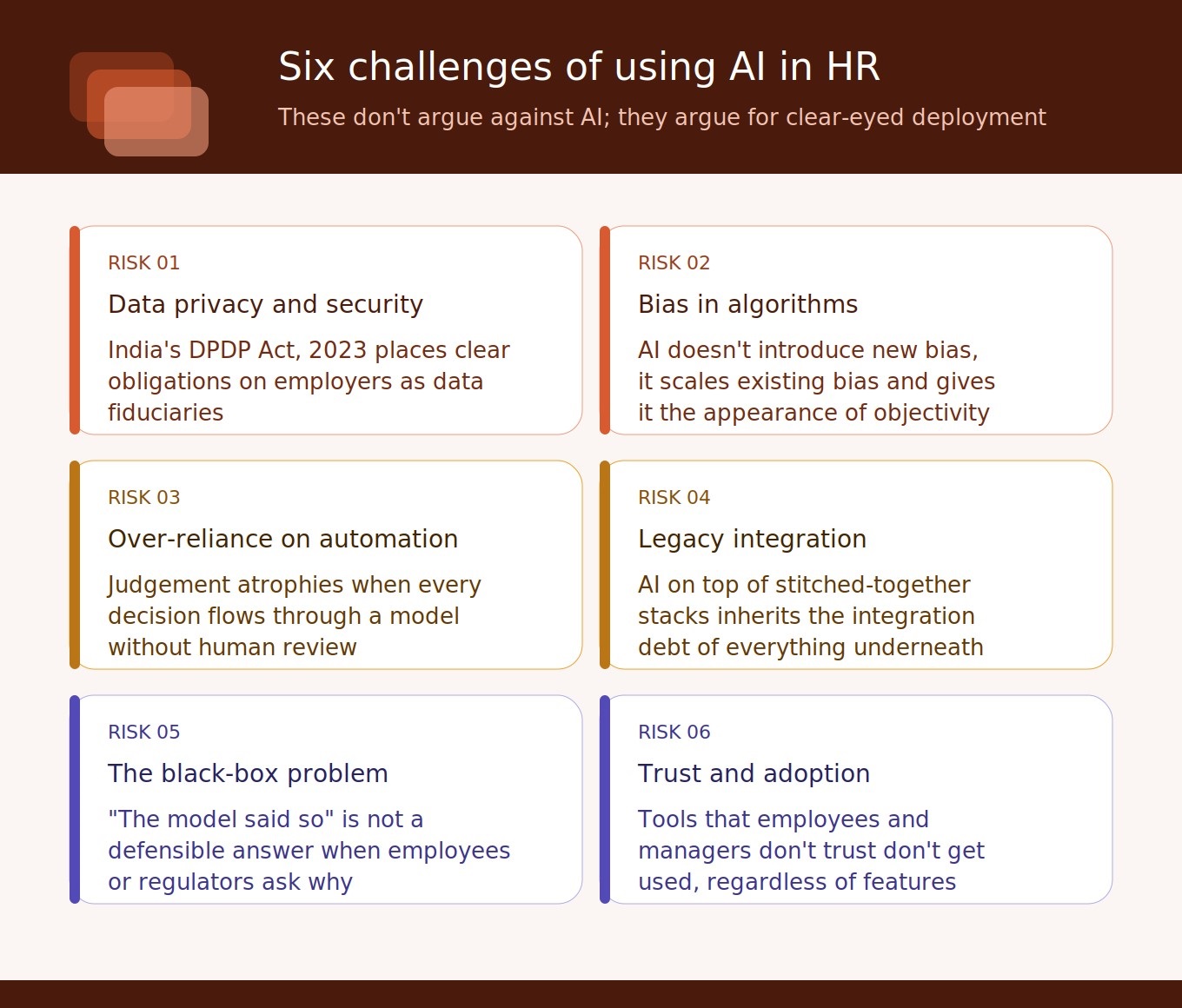
For every benefit, there is a corresponding challenge that HR leaders need to take seriously before deployment. These limitations don’t argue against using AI in HR. They argue for using it with a clear understanding of where the failure modes are and how to mitigate them.
Data privacy and security concerns
Employee data is among the most sensitive data any organisation holds: salaries, health information, performance records, grievances, and biometrics. AI systems that ingest employee data without aligning to this framework create legal and reputational exposure that no operational gain can offset.
India’s Digital Personal Data Protection Act, 2023, with its rules notified in 2025, places clear obligations on employers as data fiduciaries: explicit notice, purpose limitation, retention limits, and breach reporting timelines.
Bias in algorithms
AI learns from history. If the history is biased, the AI will be too. The risk isn’t that AI introduces new bias. It is that AI scales existing bias and gives it the appearance of objectivity. Continuous bias auditing isn’t optional. It is the price of running these systems in domains where decisions affect people’s careers.
Over-reliance on automation
When every decision flows through a model, judgment atrophies. HR teams that defer to AI scores without understanding the underlying logic end up unable to explain their decisions to employees, regulators, or themselves. Algorithmic decisions that cannot be articulated are a liability, especially in compliance-heavy environments.
Integration with legacy systems
Most Indian HR functions still run on a stack assembled over the years rather than designed in one go. AI added on top of this stack inherits the integration debt of everything underneath. The platforms that promise plug-and-play AI rarely deliver it in environments where the underlying data lives in five different systems.
The black-box problem
Many AI models, especially the more sophisticated ones, struggle to explain their own outputs. When an employee asks why their salary recommendation came out a particular way, or why their attrition risk score is what it is, “the model said so” is not an answer that holds up. Explainability isn’t a nice-to-have. It is a core requirement for AI in HR.
Trust and adoption
AI tools that employees and managers don’t trust don’t get used. Trust isn’t built by features. It is built on transparency about what the AI does, what data it uses, what decisions it informs, and what recourse employees have when they disagree with it.
The Future of AI in HR
A few directions are clear enough to plan around, even without specific timelines. The future of AI in HR isn’t a single destination. It is a series of choices about what to automate, what to augment, and what to keep firmly in human hands.
- Generative AI will keep absorbing routine HR content work. JDs, policies, communications, training material, and reports will increasingly be drafted by AI and edited by HR rather than written from scratch. The skill that becomes scarce is editorial judgement, not writing speed.
- AI copilots will become embedded in HR workflows. Rather than separate tools, AI will sit inside the HRMS, the recruiting platform, and the performance system as an always-available assistant. Asking the system a question in plain language will become the default interface.
- Skills-based organisations will expand. As job titles lose their predictive power and skills become the unit of work, HR systems will reorganise around skills as the primary record. AI is the engine that makes this practical at scale, mapping current skills, projecting future needs, and matching the two.
- Agentic AI will move from experiment to deployment. The next layer beyond generative AI is autonomous systems that can plan, decide, and execute multi-step workflows.
- Responsible and ethical AI will move from rhetoric to regulation. Globally, AI governance is tightening. HR leaders who build responsible AI practices into their stack now will be ahead of the curve when regulation catches up.
AI as an Enabler, Not a Replacement
AI’s value in HR comes from augmentation. It extends the reach of HR teams that already know what they’re doing. It surfaces patterns that humans couldn’t see at scale. It removes work that didn’t need to be done by people in the first place.
The Indian HR function in 2026 is already beyond the question of whether to adopt AI. The question now is how thoughtfully it gets implemented. The organisations that will win the next decade aren’t the ones with the most sophisticated tools. They are the ones whose HR leaders ask harder questions before deployment, build governance around the systems they use, and stay clear about what AI is doing on their behalf.
AI is a powerful tool for HR. The discipline lies in knowing what it is for, and what it is not.
FAQs
What is AI in HR?
AI in HR is the application of machine learning, natural language processing, and generative AI to HR tasks involving large volumes of data, repetitive decisions, or unstructured text. It is used across the employee lifecycle, from recruitment and onboarding to performance, payroll, and exit, helping HR teams make faster, more data-backed decisions at scale.
How is AI used in HR in India?
Indian HR teams use AI for resume screening, candidate matching, onboarding chatbots, personalised learning, attrition prediction, salary benchmarking, pay equity audits, payroll anomaly detection, exit interview analysis, and workforce planning. Most Indian HRMS platforms now have AI features embedded as standard rather than as a separate purchase.
What are the benefits of AI in HR?
The benefits of AI in HR fall into four categories. The first is efficiency through automation of repetitive work like resume triage and document verification. The second is better decision-making through data, where compensation, promotion, and workforce planning calls become more defensible. The third is improved employee experience through faster query responses and personalisation. The fourth is scalability of HR processes across large workforces that no team of HR business partners could realistically reach.
What are the challenges of using AI in HR?
The key challenges include data privacy and security concerns under India’s Digital Personal Data Protection Act, 2023, bias in algorithms trained on historical hiring data, over-reliance on automation that erodes HR judgement, integration with legacy HR systems, the black-box problem of unexplainable AI decisions, and building employee trust in AI-driven HR processes.
Which AI tools are commonly used in Indian HR?
Indian HR teams commonly use HRMS platforms with embedded AI capabilities, generative AI tools like ChatGPT, Microsoft Copilot, Google Gemini, and Claude for content drafting, conversational AI platforms like Leena AI and inFeedo for engagement, and predictive analytics platforms like Visier and Crunchr for workforce analytics. The architectural pattern of system of record plus generative layer plus conversational interface plus analytics overlay is becoming standard across Indian enterprises.
Will AI replace HR professionals?
AI is unlikely to replace HR professionals. Its value lies in augmentation. It removes repetitive work, surfaces patterns at scale, and supports decisions, while HR judgement, relationship-building, and ethical oversight remain firmly human responsibilities. The skill that becomes scarce is editorial and strategic judgement, not execution speed.
Is AI in HR compliant with Indian data protection laws?
AI systems handling employee data must comply with India’s Digital Personal Data Protection Act, 2023, with its rules notified in 2025. The Act places clear obligations on employers as data fiduciaries, including explicit notice, purpose limitation, retention limits, and breach reporting timelines. AI deployments that ingest employee data without aligning to this framework create legal and reputational exposure that no operational gain can offset.
How does AI help with employee retention in India?
AI helps with retention by combining tenure, performance, compensation, manager, engagement, and behavioural signals to flag flight risk early. Replacing an employee in India costs anywhere from a few months’ to over a year’s salary, depending on the role. AI attrition models give HR a window to intervene through compensation adjustments, role changes, or genuine career conversations before a resignation letter arrives.
What is the future of AI in HR?
The future of AI in HR points toward generative AI absorbing routine content work, AI copilots embedded inside HRMS workflows as the default interface, the rise of skills-based organisations where skills replace job titles as the primary record, agentic AI executing multi-step HR workflows autonomously, and tighter regulation around responsible and ethical AI use as global AI governance frameworks mature.
Can AI reduce bias in HR decisions?
AI can both reduce and amplify bias, depending on how it is deployed. It can examine decision patterns for systematic disparities in hiring, promotions, and pay, and surface gaps that humans miss. However, AI trained on historical data will reproduce the biases in that data, including ones HR may not be aware of. Bias detection in AI requires bias detection of AI, which means continuous auditing, explainability standards, and human oversight of every deployment.