
Every organisation wants its people to embrace AI. And by most measures, India’s workforce is doing exactly that by picking up new tools, adapting workflows, and reporting productivity gains. The numbers look good. The pilots are running. The transformation, on paper, is well underway.
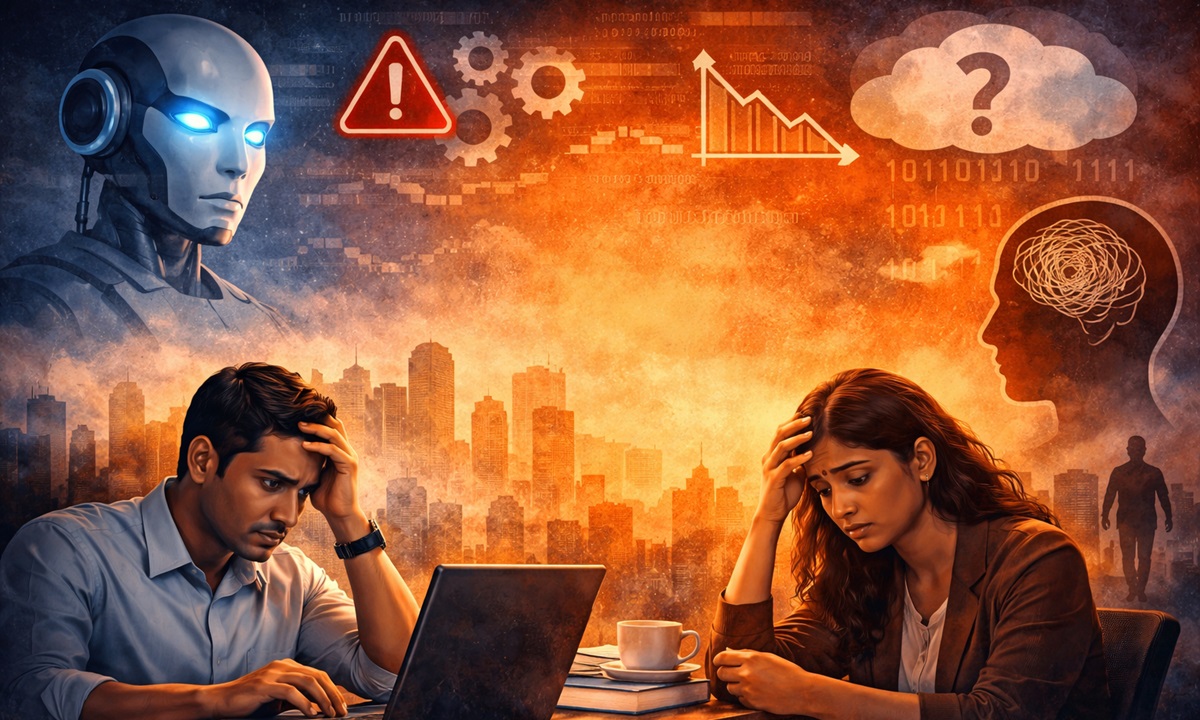
But numbers rarely capture what is happening in the background. Behind the adoption dashboards, a quieter story is unfolding. One of unease, fatigue, and a growing sense among employees that the pace of change is outrunning their ability to keep up.
In 2026, the most significant HR tech risk in India is not whether employees will use AI. It is how they feel while doing so, and what that is costing them.
India’s AI Success Story, On Paper
The numbers are genuinely impressive.
According to the EY 2025 Work Reimagined Survey, India leads globally with an ‘AI Advantage’ score of 53, compared to a global average of 34. Around 62% of Indian employees use GenAI at work regularly, which is among the highest adoption rates in the world. A full 86% of employees believe AI positively impacts productivity, and 90% of employers agree with this sentiment.
By all means, on the surface, India looks like the model market for HR tech success. Organisations are rapidly scaling AI pilots. Employees are experimenting, adapting, and showing measurable gains. The EY report also gives India a ‘Talent Health’ score of 82, which is the highest across all 29 geographies assessed.
If the story ended at adoption metrics, India’s HR tech moment would read like a triumph. However, it does not end there.
Beneath the Surface: The Rise of Employee Anxiety
Indian employees are not disengaged from AI. They are deeply, sometimes anxiously, engaged with it. The strain shows up in three interconnected ways: fear of what AI will do to their jobs, stress from what it is already doing to their minds, and a slow internal fracturing that has no obvious name yet.
Job Displacement Fears
India’s workforce is using AI at record rates and is worrying about it in equal measure. According to a 2024 IIM-Ahmedabad study of white-collar workers, 68% of Indian employees fear their roles could be automated within five years, even as a majority have already begun using AI tools.
In fact, a Voice of India report by Great Place To Work India found that, among millennials specifically, nearly 49% report fears of AI-driven job replacement as a persistent undercurrent in their working lives.
The numbers from the ground reinforce this. Data released by Astrotalk in December 2025 revealed that career-related anxiety rose by 50% in 2025, with “Is AI going to take my job?” becoming the single most common question on the platform. The company compared this new trend of questions to the job anxiety spike seen during COVID-19.
The IT sector has given employees very specific reasons to worry. With companies like Tata Consultancy Services (TCS) announcing mass layoffs and restructuring driven by AI capabilities, fears of job displacement for many seem to be turning into reality.
Stress and Mental Health Signals
The emotional toll of this environment is becoming harder to ignore. A 2024 Emotional Wellness State of Employees Report from wellness platform YourDOST found that 64% of employees aged 21 to 30 are battling high stress levels, with a 31% year-on-year increase in employees reporting high or extreme stress. Among women, the figure climbs to 72.2%.
Research published in the PMC journal in 2025 found that Indian IT workers navigating AI-related role shifts are showing increasing levels of anxiety, burnout, and a sense of disorientation. A peer-reviewed study from the International Journal of Indian Psychology conducted across IT, finance, and education sectors found that negative perceptions of AI around job insecurity and task complexity were directly associated with higher stress levels.
In other words, the stress and mental health decline when it comes to the rise is not just theoretical. For many, the new technology has had a real impact on how secure they feel about their jobs, their skills, and their future.
The “Quiet Cracking” Phenomenon
There is a phrase gaining traction in HR circles that captures something the data cannot fully name: quiet cracking. Unlike quiet quitting, which is visible in reduced effort, quiet cracking is invisible. Employees appear productive. They are hitting targets, submitting deliverables, attending standups, but internally, they are struggling.
The pressures feeding this phenomenon are specific. Fear of obsolescence sits at the centre: the anxiety that the skill you spent years developing may be worth significantly less twelve months from now. Layered on top of that is the constant reskilling pressure: the expectation that learning is a perpetual activity, not a finite one. And beneath both is a growing loss of control: the feeling that decisions about one’s role, workflow, and future are increasingly being made by systems rather than by people.
This is not disengagement. This is something more corrosive, because it is happening to employees who are still showing up, still performing, still trying.
The Trust Deficit in AI Systems
Adoption and trust are not the same thing. This is something that Indian organisations are beginning to discover the hard way.
A 2025 IDC Data and AI Impact Report, commissioned by SAS, found that despite India’s high GenAI adoption rates, Indian organisations have, on average, 8% less trust in GenAI than the global average.
This trust gap has a revealing shape when you look at what employees resist. Research and trends consistently show that while Indian employees broadly accept AI as an assistant, they resist AI as an authority.
They will use AI to draft a report; they are far more reluctant to accept AI-managed performance reviews, AI-generated performance scores, or AI-guided career decisions. The distinction matters enormously for HR tech design.
There is also a shadow behaviour gaining traction globally, and India is not immune. Employees in workplaces without clear AI policies are beginning to use AI tools secretly, in parallel to official workflows, without disclosure. When policy is absent or unclear, employees don’t stop using AI. They go underground. This creates a hidden adoption layer that organisations cannot measure, govern, or support.
Adoption Is Outpacing Readiness
High adoption and genuine readiness are not the same thing. Employees are using AI tools without fully understanding them, often without organisational guidance, and almost always without the confidence that comes from structured, intentional learning. The result is a workforce that appears capable on the surface but increasingly feels out of its depth beneath the surface.
The Training Gap
The confidence numbers tell a story that stands in sharp contrast to the adoption headlines. A 2025 Udemy survey conducted by YouGov found that only three out of ten Indian professionals feel confident in their AI skills, even as nearly three-quarters are already using AI tools in their roles. Moreover, 61% of Indian employees say their employers don’t provide clear guidance on using AI in their day-to-day tasks.
Similarly, the ANSR and Talent500 AI Advantage Report 2025 found that 72% of Indian professionals are learning AI independently, while only one in three reports access to structured company training. Even though employees are not waiting for organisations to catch up, the gap between self-led curiosity and employer-led capability building is becoming a breeding ground for anxiety.
Skill Obsolescence Pressure
The pace of change is not just fast, it is relentlessly fast. Skills that were considered advanced a year ago are being automated or commoditised. Entry-level roles in testing, L1 support, and data entry are among the first to shrink.
The WEF Future of Jobs Report 2025 estimates that 63 out of every 100 Indian workers will require retraining by 2030, with 12 in every 100 unlikely to be able to upskill at all.
What makes this particularly taxing is not the volume of learning required, but the timeline. Reskilling is no longer a periodic event. It is becoming a continuous, unpaid cognitive burden, and for many employees, it spills well beyond working hours.
The Psychological Cost of “Always-On Transformation”
India’s AI-powered workplaces are generating a form of cognitive load that existing HR frameworks were not designed to address.
Constant adaptation creates cognitive overload
When transformation is permanent rather than episodic, employees never get the psychological relief of arriving at a stable “new normal.”
Every quarter brings new tools, new expectations, and new training modules. The brain, which manages change through temporary stress responses, is now expected to sustain that stress indefinitely.
Algorithmic monitoring reduces autonomy
The expansion of AI-driven performance tracking through real-time productivity dashboards, AI-assisted benchmarking, and automated check-ins. It is, essentially, reshaping what it feels like to be at work.
Research on workplace surveillance consistently links reduced perceived autonomy to increased stress, lower intrinsic motivation, and a higher risk of burnout. When employees feel watched by systems rather than supported by people, the psychological contract frays.
The more AI employees use it, the more concerns tend to grow
This is perhaps the most counterintuitive finding from recent research. Rather than familiarity building comfort, deeper engagement with AI tools appears to surface more concerns, especially about accuracy, fairness, and what the technology is actually doing to one’s career.
Exposure does not automatically produce trust. Without intentional trust-building, it can produce the opposite.
The Retention Risk: Anxiety Is Driving Attrition
Here is where the business case for taking employee anxiety seriously becomes undeniable.
India’s overall attrition rate is declining, from 18.7% in 2023 to 17.1% in 2025, according to Aon’s Annual Salary Increase & Turnover Survey of 1,060+ companies. But the aggregate trend masks a more troubling dynamic within specific talent pools.
The employees who are most engaged with AI, who have upskilled, who have built new capabilities, who are most “future-ready” by any measurable standard, are also the ones showing the highest quit intent.
The paradox is stark. India’s AI investments are, in some cases, directly producing the talent that leaves. Highly-skilled, AI-literate employees are also the most marketable, the most aware of their options, and the most likely to leave for environments where they perceive greater psychological safety, fairer AI governance, or more meaningful work design.
With the rise of AI adoption, retention in 2026 is inseparable from the quality of the human experience inside AI transformation.
The Real Risk for HR Tech in 2026
The conversation in most Indian boardrooms around HR tech still centres on familiar questions: implementation timelines, ROI, integration with existing HRMS, and vendor selection. These are not wrong questions. But they are incomplete ones.
The emerging risk is not technical. It is human. The real HR tech problem in 2026 is emotional resistance, psychological unsafety, and a trust deficit that deployment metrics cannot detect.
AI adoption success will increasingly be measured not by usage rates or productivity gains alone, but by what employees feel while using it. Do the employees feel supported or surveilled? Do you feel capable or inadequate? Do they feel seen or replaced?
Organisations that continue to measure AI success only through an efficiency lens, without considering these questions, are bound to miss the attrition signals until it is too late.
What HR Leaders Must Do Differently
Solving an anxiety problem with a technology solution will not work. What India’s HR leaders need right now is a shift in lens. From measuring how many employees use AI, they need to pivot to understanding how those employees experience it.
This means building deliberate human infrastructure around the technology: the kind that normalises struggle, rewards transparency, and treats psychological safety as a deployment requirement rather than an afterthought.
1. Build Psychological Safety into AI Rollouts
AI implementation is a change management problem before it is a technology problem. HR leaders need to normalise uncertainty, to explicitly communicate that not knowing how to use a new tool is not a performance failure.
“Creating a psychologically safe workplace starts with listening, trust, and open communication,” Arvind Baug, Manager-HR at Colliers, shared with ThePeoplesBoard. Utilising these principles, companies need to create a space where employees can voice AI-related fears without professional risk.
2. Redesign Work, Not Just Tools
Deploying AI into existing workflows without redesigning those workflows is a missed opportunity, and often a source of the added complexity employees report.
The goal should be to align AI with what makes work meaningful: autonomy, skill variety, human creativity, and visible contribution. AI that enhances these qualities builds engagement. AI that erodes them builds resentment.
3. Make Reskilling Humane
India’s organisations have made a structural error in how they approach reskilling: they have largely treated it as an after-hours activity, a personal responsibility, a benefit rather than a business investment.
This model is producing employees who feel both pressure to upskill and guilt when they cannot. The shift that’s needed is from demanding capability to building confidence, from self-directed after-hours learning to embedded, structured, role-specific learning during working hours.
4. Increase Transparency and Trust
Black-box HR tech, or systems that make decisions employees cannot understand, question, or appeal, is the fastest path to a trust deficit. HR leaders need to be explicit about crucial questions.
Where is AI being used in the employee lifecycle? How are performance decisions made? What data is being collected, and how? Transparency does not require organisations to share everything. It requires them to stop hiding what matters most to employees.
5. Measure Employee Sentiment as a Core KPI
If AI anxiety is a business risk, and the attrition data suggests it clearly is, then it needs to be measured like one. AI anxiety levels, perceived fairness of AI systems, and trust in AI-driven decisions belong on the HR dashboard alongside adoption metrics, productivity scores, and engagement indices.
What gets measured gets managed. What does not get measured becomes a surprise.
In the End…
India’s next great HR tech challenge is not a technology problem. It is a human one.
The country has proven it can adopt AI faster than almost anyone else on earth. The question 2026 is raising is whether the human infrastructure of that adoption is strong enough to sustain it.
Organisations that will win are those that understand that AI transformation is not just a digital project. It is a human one. It requires the same leadership attention, investment, and care as any other major cultural shift. Perhaps more, because its pace is unprecedented and its psychological stakes are high.
Adoption gets you usage. Trust gets you impact. And in India’s AI story, the difference between the two may ultimately determine which organisations build the future they are imagining and which ones spend the next decade wondering why their most capable people kept leaving.
FAQs
What is the biggest HR tech risk in India in 2026?
The biggest HR tech risk in India in 2026 is not AI adoption itself — it is employee anxiety. While adoption rates are among the highest in the world, rising fears of job displacement, reskilling pressure, and a trust deficit in AI-driven systems are creating a hidden people risk that deployment metrics alone cannot detect.
Are Indian employees afraid of AI replacing their jobs?
Yes. A 2024 IIM-Ahmedabad study found that 68% of Indian white-collar employees fear their roles could be automated within five years. Among millennials specifically, close to 49% report persistent fears of AI-driven job replacement, according to a Great Place To Work India report.
What is “quiet cracking” in the context of AI at work?
Quiet cracking refers to a phenomenon where employees appear productive on the surface — hitting targets, attending meetings, submitting work — while silently struggling with anxiety, skill obsolescence pressure, and a growing loss of control over their work. Unlike quiet quitting, it is invisible and affects employees who are still fully engaged.
Do Indian employees trust AI at work?
Not entirely. Despite India’s high GenAI adoption rates, a 2025 IDC report found that Indian organisations have, on average, 8% less trust in GenAI than the global average. Employees broadly accept AI as an assistant but resist AI as an authority — particularly in performance reviews, career decisions, and scoring.
How confident are Indian employees in their AI skills?
Only 3 out of 10 Indian professionals feel confident in their AI skills, according to a 2025 Udemy survey, even though nearly three-quarters are already using AI tools in their roles. Additionally, 61% say their employers provide no clear guidance on how to use AI in daily tasks.
How is AI adoption affecting employee attrition in India?
India’s overall attrition rate has declined to 17.1% in 2025 (Aon). However, the employees most engaged with AI — those who have upskilled and built new capabilities — also show the highest quit intent. AI-literate employees are the most marketable and the most likely to leave for environments with better psychological safety and fairer AI governance.
What should HR leaders do to address employee anxiety around AI?
HR leaders should build psychological safety into AI rollouts by normalising uncertainty, redesign workflows rather than just deploying tools into existing ones, make reskilling a structured in-hours activity rather than a personal after-hours burden, increase transparency about how AI is used in the employee lifecycle, and start measuring AI anxiety as a core HR metric alongside adoption and productivity data.
What is the difference between AI adoption and AI readiness?
AI adoption refers to how many employees are using AI tools. AI readiness refers to whether employees feel confident, supported, and informed in using them. India currently has high adoption but low readiness — with 72% of professionals learning AI independently and only 1 in 3 having access to structured employer-led training.