
Transitioning from being an HR professional to a business owner can be a challenging road to navigate. While advocating for the people’s interests, a new business owner also has to keep in mind the business’s necessities and how every decision affects employees and revenue.
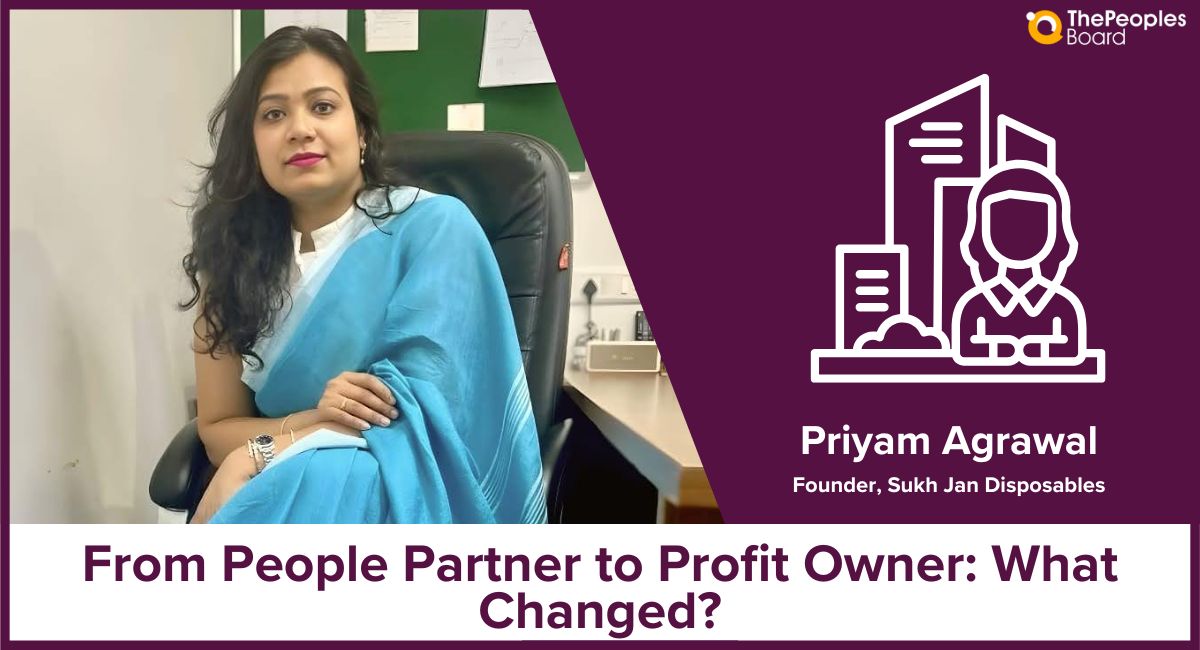
Navigating a new business can be challenging for everyone, but can prior HR experience help on this path? Priyam Agrawal, Founder of Sukh Jan Disposables, shared her own thoughts about the same.
With over 14 years of experience in HR, Priyam has worked for companies such as YAAP, Oplifi, mydala.com, and Acura Consulting. She was also associated with Alankit Assignments, NTL Logistics Plus India, and Pantaloon Retail in the past. In August 2023, Priyam started her own business, called Sukh Jan Disposables, part of Sukhjan Vyavasaay. The company provides eco-friendly disposable food packaging products.
In a conversation with ThePeoplesBoard, Priyam talks about how her priorities shifted from being a people partner to being a profit owner. She talksin this interview about the unique challenges that came her way and how she navigated them, drawing on her past lessons as an HR professional.
TPB Team: What was the moment that pushed you from being a People Partner to becoming a business owner?
The ability to make a decision. As a people partner, I could manage the decisions, manage very well, but business decisions are mostly never consulted with a people partner. The obvious need for revenue also nudged the push, where building a company became more of a priority than an employee-friendly policy. It’s sad, but true.
TPB Team: How different did running a business feel compared to influencing one from the HR seat? What assumptions did you carry from HR that got challenged almost immediately?
No matter how much I could train, guide, correct and align, the performances ultimately remained with the people and their managers. Running the business made me take a position where I can align and correct, reward efforts and reprimand mistakes, keeping in mind my own training of being a HR.
As an HR, I have always wanted to give chances, but business sees revenue first, mostly, especially as a start-up. There was only as much I could bet on someone. If their efforts weren’t directed towards revenue, I had to let go, which I never favoured when I was in HR.
TPB Team: Which HR skills translated most seamlessly into entrepreneurship and surprised you by their impact?
Employee engagement and no, it’s not just making rangoli or playing Dumb Charades. Engaging an employee means keeping them abreast with the growth of the company and showing them the bigger picture. As an entrepreneur, it helped as employees became stakeholders and made contributions towards growth accordingly.
TPB Team: Did your experience in hiring and talent assessment help you build an early team faster or better?
Faster or better? I don’t know. But it did take me time to let go of my pre-conceived notions about certain profiles, backgrounds, and experiences. I could see what a resume can offer beyond the PDF it came in. Yes, my reach to candidates is better because I was an HR. I got connected to a lot of skill sets over time, so yes, I attract applications faster than my own junior HR.
TPB Team: Which parts of HR thinking didn’t prepare you for the pace or ambiguity of running a business?
Attendance Management. As an HR, all I wanted was proper punch-ins and punch-outs, leaves applied properly, etc. I thought that it was all the discipline I needed. But business is dynamic, sudden, unorganised, and at times biased too. I couldn’t go by the books all the time; some chaos is good.
TPB Team: Did your people-first mindset ever clash with financial or survival decisions? How did you navigate that?
All the time. It still does, and it always will. I am still navigating. A small example, no matter how much I want my finance manager to enjoy his time off that he took for his wedding, well earned, well deserved, but the GST return on the 10th of the month is non-negotiable. I am not happy about it, but can’t afford fines.
TPB Team: Was there a moment when you realised that “best HR practice” wasn’t always “best business practice”?
What’s best is best. But yes, those practices might not be suitable for my business size at the moment. Best HR practices need to be aligned with what’s best for the business as well. Say what works in Manufacturing doesn’t work in retail. Also, I feel HR is mostly driven from the top. The attitude and tone of the founders set the practices which become best for the business.
TPB Team: As an HR leader, you advise on decisions. As a founder, you own them. How did that shift feel?
Very scary. Exciting, but scary. As an HR, I could advise, but as a founder, I have to show and tell the same advice that I gave before. Although I really feel more of a transition than a shift. What I decide today as a Founder has a lot to do with what I learnt as an HRBP.
TPB Team: How did your tolerance for risk change once payroll, cash flow, and clients became your responsibility?
That varied as per the decision. I took long shots on people matters because I had the experience to back that up. I was confident in policies, HR matters, labour codes, but other aspects like product costing, logistics, taxation, etc., didn’t allow any room for risk-taking. So my tolerance to risk increased, but for people matters
TPB Team: How has being a founder changed the way you view HR leaders in corporate setups today?
Nothing changed much, but I did utilise HR better, to the business advantage in my business. I have always viewed HR as pillars in a business. At the entry gate, they influence the employee life cycle and are custodians of culture, which impacts performance. I still give them credit for that.
TPB Team: If an HR professional wants to start a business, what mindset shift should happen before they begin?
A balance between people first approach and revenue impacts. One cannot be hopelessly optimistic. An HR romanticises employee welfare, employee engagement and growth, and while all that is necessary to run the show in the long run, to start and survive, the mindset should be revenue and growth-driven decisions.
TPB Team: Looking back, would you say HR was a head start, a mixed bag, or a hidden advantage in your founder journey?
A mixed bag. I would often go back thinking as an HR and worry about creating back-ups for resources. However, as a founder, the cost involves to hire, train and employee also becomes visible. I can’t keep replacing people. While as an HR, I was expected to keep the pipeline ready to refill or replace, as a founder, I am more concerned with making things work. Hence, a mixed bag!