
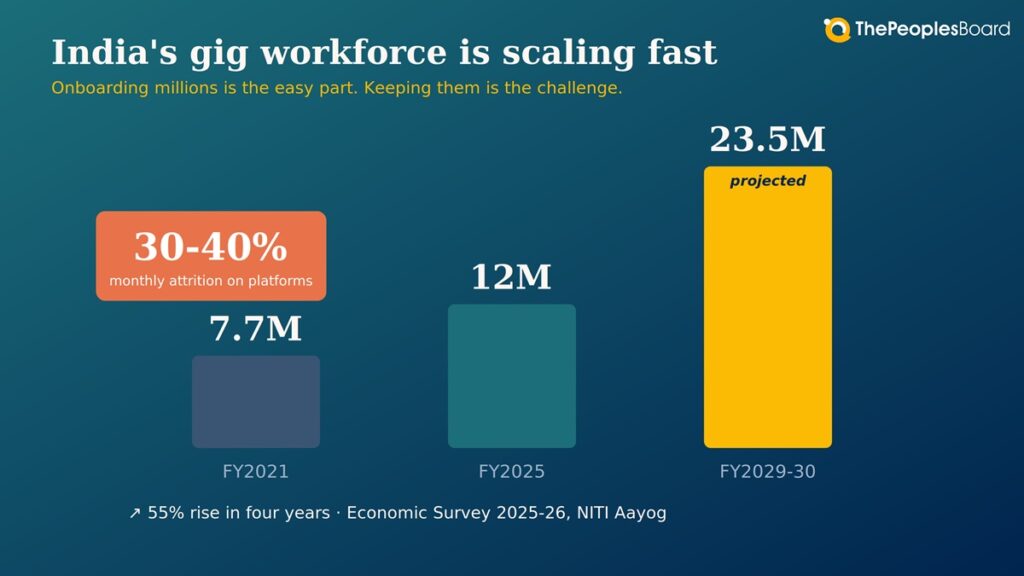
India’s gig workforce grew from 7.7 million in FY2021 to 12 million in FY2025, a 55% rise in four years, according to the Economic Survey 2025-26. NITI Aayog projects it will reach 23.5 million by 2029-30. That’s a lot of people to onboard. The harder part is keeping them. Monthly attrition across delivery and ride-hailing platforms runs 30% to 40%, and some platforms churn their entire active base within three to four months.
For anyone managing a contingent workforce, the maths is unforgiving. Every worker who logs off for good takes their onboarding cost, their training time, and their route knowledge with them. Engagement isn’t a soft metric here. It’s the difference between a stable supply of workers and a recruitment treadmill that never stops.
This is why we must look at why gig and contract workers disengage in the Indian context, what the data says about the pressure points, and which retention levers actually move the needle.
Why Gig Worker Engagement Is Different
Engaging a gig worker has almost nothing in common with engaging a salaried employee. There’s no annual appraisal, no team lunch, no manager checking in. The relationship is transactional, app-mediated, and easy to exit. A delivery rider can switch platforms in the time it takes to open a different app.
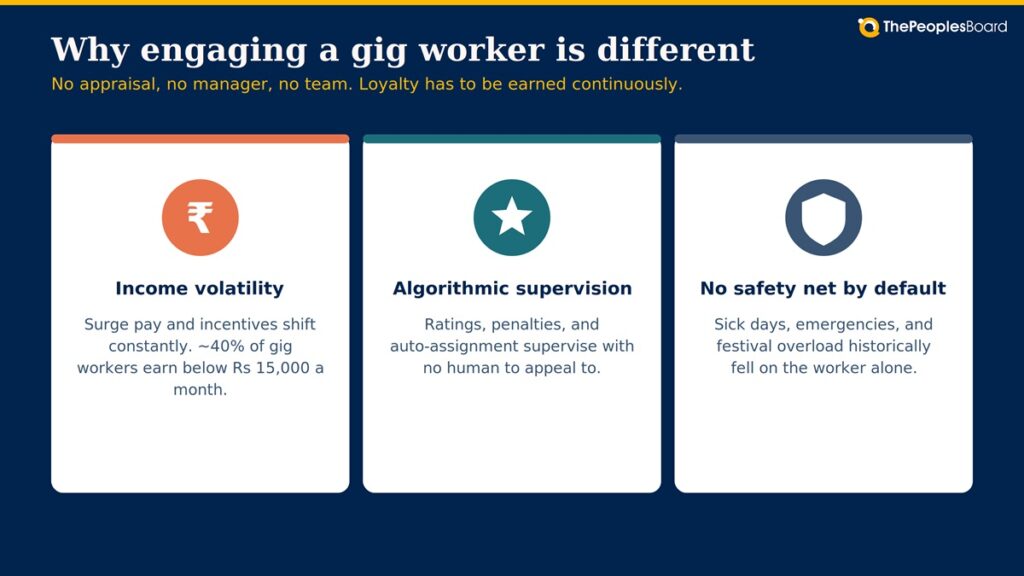
Several structural features make gig engagement its own discipline:
- Income volatility: Platform pay structures change often. Surge multipliers fluctuate, incentives get pulled back, and workers can’t predict a monthly figure. Around 40% of gig workers earn below ₹15,000 per month, which leaves little cushion when earnings dip.
- Algorithmic supervision: Ratings, penalties, and auto-assignment create a form of oversight with no human on the other end. A rating drop or an account suspension can cut off income with no clear appeal.
- No safety net by default: Sick days, family emergencies, and festival-season overload all fall on the worker. Gig workers historically lacked social security, paid leave, and health coverage, which the Economic Survey flagged as a driver of poor job security.
The result is a workforce that feels replaceable, and behaves accordingly. When switching costs are near zero, loyalty has to be earned continuously, not assumed. TPB has looked at what employers can do to overcome these gig-workforce challenges in more detail, and the pattern there matches the one here.
The First 72 Hours Decide Retention
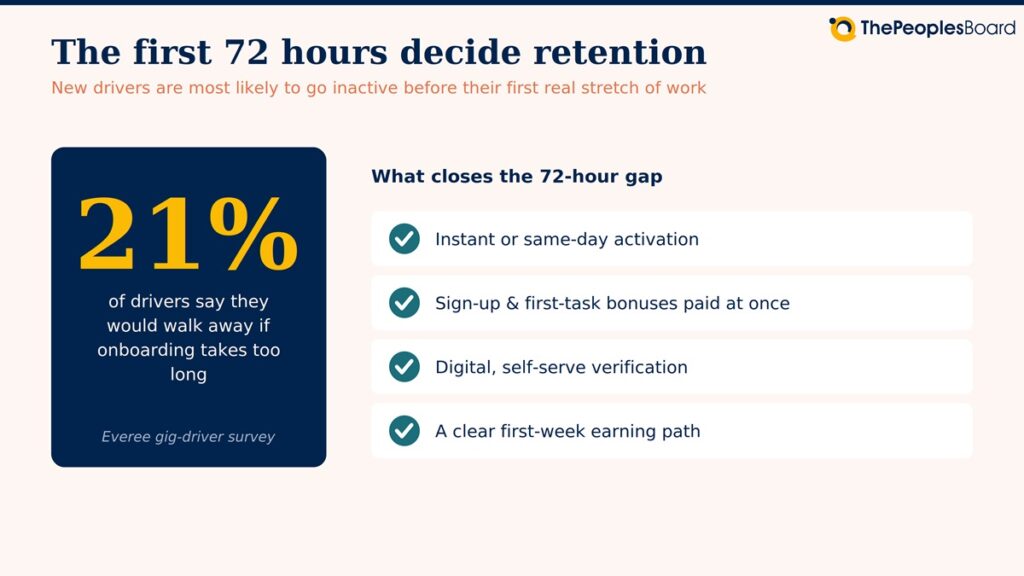
Disengagement often starts before a worker completes a single meaningful stretch of work. New drivers are most likely to go inactive within the first 72 hours, and slow onboarding is a direct cause. In one gig-driver survey, 21% of drivers said they’d walk away from a platform if onboarding took too long.
Speed matters because gig work is often impulsive. The longer the gap between signing up and the first earning, the more likely the worker loses interest or defects to a competitor that lets them start faster. Platforms that compress registration to minutes, rather than days of document verification, hold on to more of the workers they acquire.
A few onboarding practices show up repeatedly on platforms with lower early drop-off:
| Practice | What It Does |
| Instant or same-day activation | Closes the gap between sign-up and first earning |
| Sign-up and first-task bonuses paid immediately | Bridges the 72-hour window where new workers go dormant |
| Digital verification and self-serve documentation | Removes the wait for manual approval |
| Clear first-week earning path | Gives the worker a concrete reason to return tomorrow |
The through-line is simple. The first few hours are vital for retaining employees. The few days follow the same trend. The easier the gig is for employers to onboard employees and the quicker the results show up in employees’ wallets, the higher the engagement.
Pay Speed and Incentive Design
For gig workers, time is money in a literal sense, so how fast and how predictably they get paid shapes whether they stay.
A bonus paid three days after a qualifying delivery has minimal behavioural effect because the worker doesn’t connect the reward to the action. The same bonus paid within seconds creates a direct cause-and-effect loop.
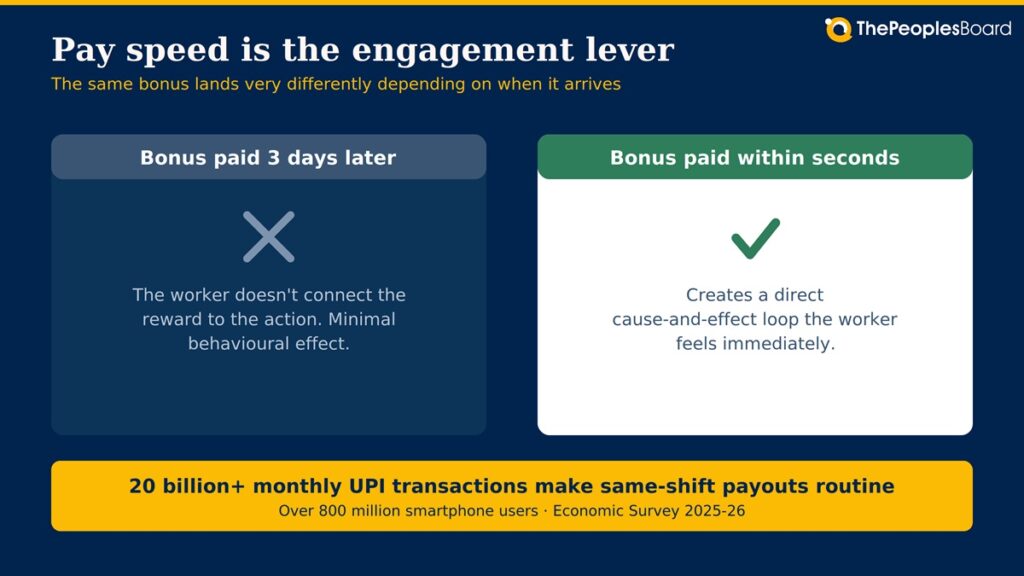
This is where instant UPI payouts have changed the calculus. India’s payment rails, with over 800 million smartphone users and more than 20 billion monthly UPI transactions, make same-shift earnings technically routine. The platforms that use this well tie incentives tightly to behaviour they want to reinforce: peak-hour bonuses, consecutive-trip rewards, and referral payments released the moment the referred worker completes a qualifying task.
There’s a cautionary history here, though. During the pandemic, aggressive incentive schemes drew workers in and were then quietly withdrawn. One IDR account describes drivers lured by a ₹1,000 bonus on every fourth ride and a ₹5,000 referral bonus, only to see the incentives pulled once supply grew. Workers remember bait-and-switch. Incentive design that builds trust outlasts incentive design that manufactures a short-term spike.
Safety, Ratings, and the Human Cost
Engagement erodes fastest when workers feel unsafe or unheard. The push for ultra-fast delivery windows has become a flashpoint. The Union Labour Ministry has discouraged unsafe hyper-fast delivery practices on road-safety grounds, and Kerala’s Motor Vehicles Department was among the first to issue notices to delivery firms over pressure on riders.
A couple of levers consistently reduce the friction that drives workers away:
- Fair, transparent ratings: When income, identity, and app rating are all linked, an opaque penalty feels like a threat to livelihood. Clear rating criteria and a real appeals path lower that anxiety.
- Working grievance systems: Karnataka’s gig-worker framework includes a grievance mechanism and gives workers the right to refuse tasks without penalty, addressing algorithmic surveillance and arbitrary account deactivation head-on. Platforms that build similar channels voluntarily don’t wait for regulation to force it.
Psychological stress rises when a single account suspension can wipe out a month’s income. Reducing that fear is engagement work, even if it never appears on an incentive dashboard. The wider point that strong safety policy on paper often fails in practice applies squarely to gig work, where day-to-day protection from unsafe vehicles, clients, and hours is still thin.
Where Regulation is Heading
Engagement strategy in India now sits alongside a shifting legal backdrop, and getting ahead of it is part of retention. The four Labour Codes came into effect on 21 November 2025, and the Code on Social Security formally recognises gig and platform workers, extending social security, welfare funds, and benefit portability.
Under the Code, aggregators may be required to contribute 1% to 2% of annual turnover toward a social security fund, capped at 5% of the amount paid to gig workers. Several states have moved faster than the central rules:
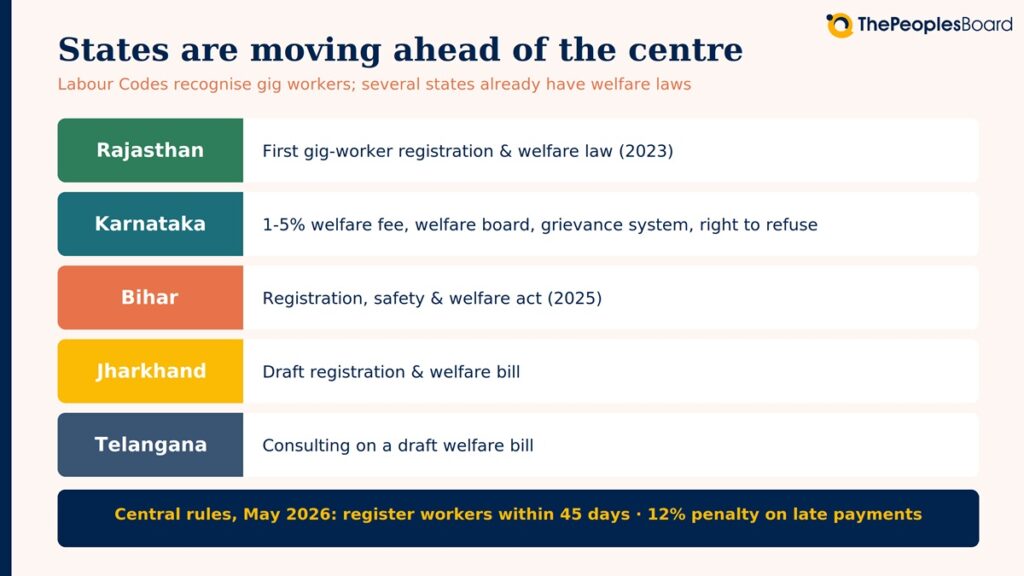
The final Social Security rules notified in May 2026 now require aggregators to register gig workers on a central portal within 45 days, with a 12% annual interest penalty for late contributions, so the compliance clock is already running. Registration on the e-Shram portal and discussion around extending Ayushman Bharat health coverage signal where benefits are going.
Treating social security as a retention asset rather than a compliance cost is the shift worth making. After all, workers stay longer where they feel protected.
What Actually Improves Retention
Pulling the threads together, the platforms that engage contingent workers well tend to do a handful of concrete things rather than run one big programme. Some platforms report retention improvements of 25% to 30% after implementing structured engagement, and the investment pays back through lower recruitment and onboarding costs.
The practices that recur:
- Activate fast. Get workers earning in their first session, not their first week.
- Pay instantly and predictably. Tie rewards to actions in real time, and don’t withdraw incentives without warning.
- Make ratings and penalties transparent. Give workers a clear path to contest decisions.
- Build real grievance channels. A worker who can raise an issue and get a response is a worker who stays.
- Treat benefits as retention, not overhead. Social security registration, insurance, and health cover reduce the fear that pushes workers out.
- Invest in HR technology that scales. Managing tens of thousands of workers manually isn’t feasible; dashboards that flag churn indicators early let teams act before a worker goes dark.
None of these is exotic. What they share is a recognition that gig engagement is continuous, not periodic, and that the worker always has an exit one tap away.
In the End…
The gig economy isn’t a fringe of India’s labour market anymore. It’s 2% of the total workforce today and projected to contribute ₹2.35 lakh crore to GDP by the end of the decade. At that scale, treating workers as interchangeable is a strategic liability, not just an ethical one.
Keeping gig and contract workers engaged comes down to a few honest commitments: pay them fast, treat their ratings fairly, give them a way to be heard, and don’t wait for the law to force basic protections. The platforms doing this already see the payoff in steadier supply and lower churn. The ones that don’t will keep running the recruitment treadmill, hiring the same volume of workers every quarter just to stand still.
FAQs
How large is India’s gig workforce?
India’s gig workforce grew from 7.7 million in FY2021 to 12 million in FY2025, a 55% rise in four years, according to the Economic Survey 2025-26. NITI Aayog projects it will reach 23.5 million by 2029-30.
Why is gig worker engagement different from engaging salaried employees?
Gig work has no annual appraisal, team lunch, or manager check-in. The relationship is transactional, app-mediated, and easy to exit. Income volatility, algorithmic supervision through ratings and penalties, and the absence of a default safety net make gig engagement its own discipline. With near-zero switching costs, loyalty has to be earned continuously rather than assumed.
Why do the first 72 hours matter for gig worker retention?
New drivers are most likely to go inactive within the first 72 hours, and slow onboarding is a direct cause. In one gig-driver survey, 21% of drivers said they’d walk away from a platform if onboarding took too long. Platforms that compress registration to minutes and pay first-task bonuses immediately hold on to more of the workers they acquire.
How does pay speed affect gig worker engagement?
A bonus paid three days after a qualifying delivery has minimal behavioural effect because the worker doesn’t connect the reward to the action. The same bonus paid within seconds creates a direct cause-and-effect loop. Instant UPI payouts, supported by over 20 billion monthly UPI transactions, make same-shift earnings routine and let platforms tie incentives tightly to the behaviour they want to reinforce.
What do India’s Labour Codes mean for gig workers?
The four Labour Codes came into effect on 21 November 2025, and the Code on Social Security formally recognises gig and platform workers, extending social security, welfare funds, and benefit portability. Aggregators may be required to contribute 1% to 2% of annual turnover toward a social security fund, capped at 5% of the amount paid to gig workers. Final rules notified in May 2026 require aggregators to register gig workers on a central portal within 45 days.
What practices actually improve gig worker retention?
The recurring practices are: activate workers fast so they earn in their first session, pay instantly and predictably without withdrawing incentives unannounced, make ratings and penalties transparent with a clear appeals path, build real grievance channels, treat benefits like social security and health cover as retention rather than overhead, and invest in HR technology that flags churn indicators early. Some platforms report retention improvements of 25% to 30% after implementing structured engagement.