

India’s workforce is vast, a majority still outside the formal economy, and safety is no longer a conversation about fire exits and first-aid kits alone. It now includes mental health, dignity, inclusion, and the freedom to speak up without losing your career.
The global shift is clear too; the WHO’s focus on Mental Health at Work has only made the Indian gap sharper.
Conversations about workplace safety in India often lead to sweeping policy overhauls and organisation-wide initiatives. While focusing on one or two aspects of what impacts an employee in the workplace, other aspects get lost between hushed conversations and hesitation.
Nearly three out of four Indian professionals still hesitate to be transparent about taking leave for mental health reasons, fearing they’ll be viewed as ‘incapable’ as per a Naukri report. Combined with the rising concerns about POSH incidents in workplaces and discussions on religious expression, the numbers say something uncomfortable about Indian workplaces in 2026.
On paper, we have never looked stronger with tighter laws, digital reporting portals, mandatory board disclosures, and open conversations about mental health. In practice, the vast majority of unsafe experiences at work are still going unnamed, unreported, and unresolved.
The Legal Backbone is Finally Catching Up
If the last decade of workplace safety in India had a single theme, it was reporting infrastructure. The revamped She-Box portal, relaunched in August 2024, has become the government’s most visible attempt to centralise harassment complaints across sectors.
In 2025 alone, the portal received 254 complaints, and since its revamp, a total of 296 complaints have been filed. The numbers may look modest against the scale of India Inc., but they signal a shift most HR leaders underestimate; complaints now travel outside internal HR channels into a traceable, government-monitored ecosystem.
Alongside this, the Ministry of Corporate Affairs’ 2025 amendment has pulled POSH compliance into boardroom territory. From July 14, 2025, companies must disclose detailed POSH data in their Board Reports. Non-compliance attracts penalties of up to ₹5 lakh for the company and its directors in case of repeat or aggravated violations. Safety, in other words, has finally become a governance issue and not just an HR checkbox.
But legal strength and cultural change don’t always travel together. Enforcement remains uneven, especially in educational institutions, smaller firms, and the informal economy, where Internal Committees often exist only on paper.
Sexual Harassment: The Most Visible Layer, Still the Most Underreported
Data from the Ashoka University Centre for Economic Data and Analysis and Business Standard shows that 10,337 sexual harassment cases were registered under the POSH Act across 300 NSE-listed companies between FY14 and FY25.
The most common reading of India’s POSH data today is a cultural shift: rising reporting confidence rather than worsening workplaces. That reading is correct, but dangerously incomplete.
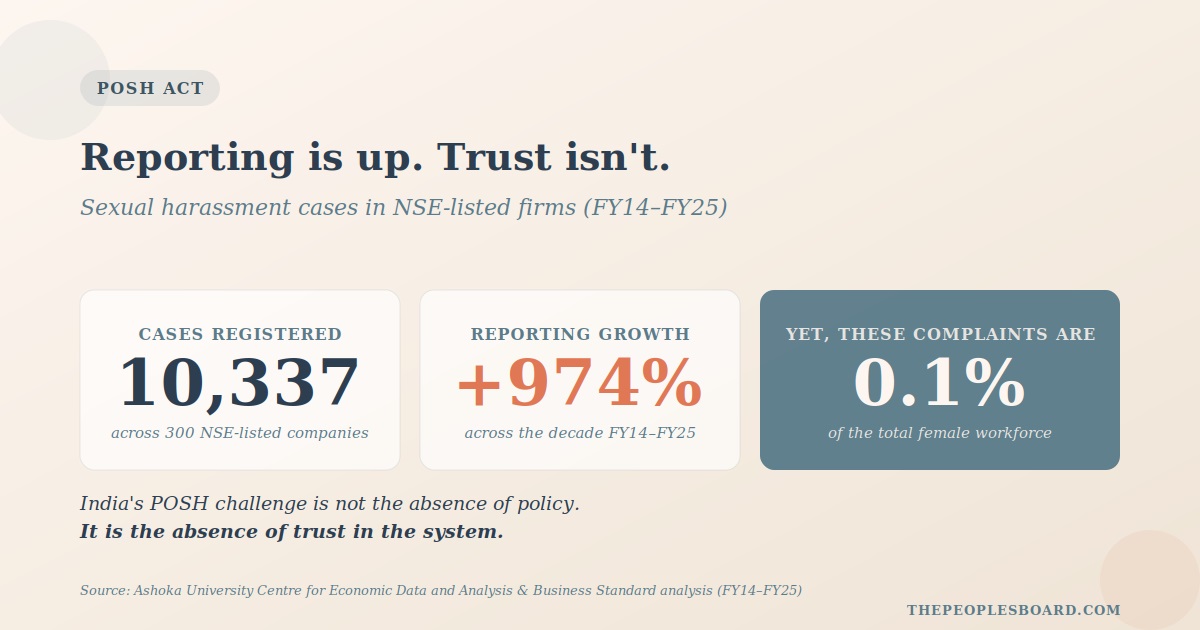
Though reporting grew by 974% over the decade, India’s top 30 listed companies recorded a 6.2% rise in POSH complaints in FY25 alone. POSH complaints account for a mere 0.1% of the total female workforce at NSE 300 companies, a figure that clashes uncomfortably with every ground-level study of harassment prevalence in India.
The TCS Nashik case has brought this discrepancy to light in a sharp manner while highlighting the gaps still existent not just in POSH policies but also in the trust mechanism within companies. Any policy, no matter how good on paper, is only as effective as the system ensuring its execution, something that has become evident through the events in the Nashik BPO.
India’s POSH challenge, then, is not the absence of policy. It is the absence of trust in the system.
Physical Safety: Still Critical, Still Uneven
For a large section of India’s workforce, workplace safety has never been about culture or psychology; it is about whether they come home at the end of the shift.
That conversation shifted meaningfully on November 21, 2025, when the Occupational Safety, Health and Working Conditions Code, 2020 finally came into force. The Code consolidates 13 central labour laws, including the Factories Act and the Mines Act, into a single framework, standardises employer duties, mandates safety committees in larger factories and construction sites, and extends free annual health check-ups to all employees.
The numbers explaining why this reform was overdue are sobering. DGFASLI data records roughly three worker deaths a day in India’s registered factories, and that’s only the formally reported portion.
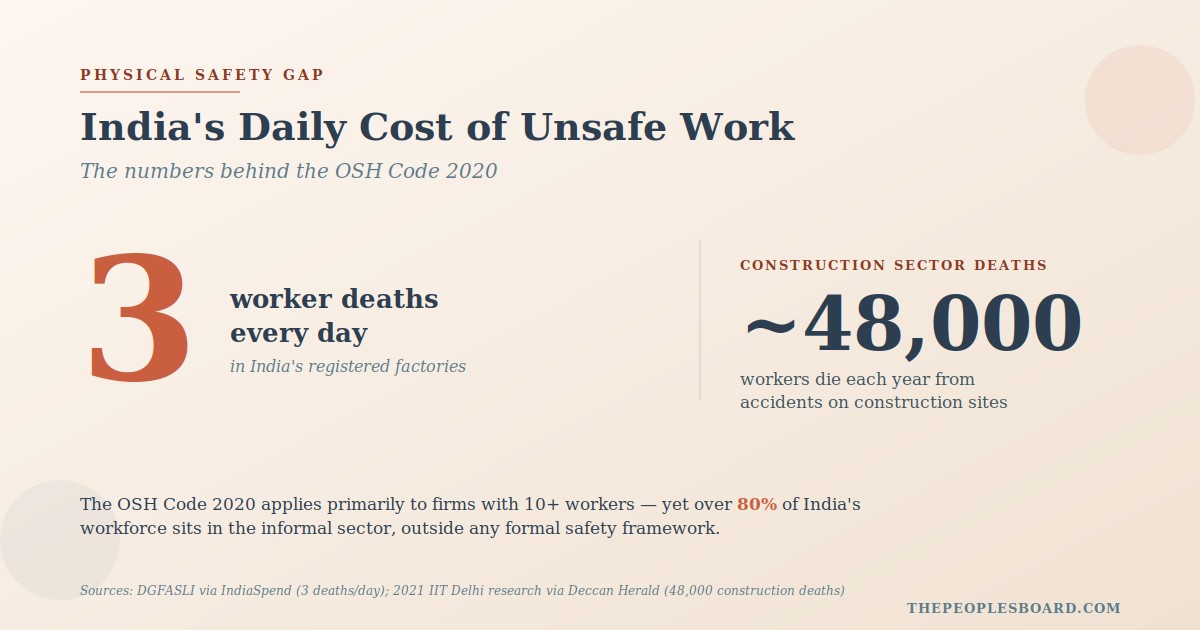
A 2021 IIT Delhi research estimates that nearly 48,000 workers die every year from occupational accidents in India in the construction sector alone. Ground realities in 2025 made the urgency impossible to ignore, from three sanitation workers dying of asphyxiation while cleaning a septic tank in Tiruppur, to Karnataka’s construction boards recording 223 worker deaths across five years.
For HR leaders, the operational shift is immediate. Safety committees have to be constituted, single-window registrations completed, annual health check-ups provisioned, and inter-state migrant workers, historically treated as a contractor’s problem, now sit squarely within the employer’s accountability chain.
But the harder truth is this: the OSH Code applies primarily to establishments with 10 or more workers. With over 80% of India’s workforce in the informal sector, the overwhelming majority of Indian workers still operate outside any formal safety framework. Physical safety, for them, remains structural, not statutory.
Religious and Cultural Safety: The Conversation Few Are Having
This is the part of the workplace safety conversation Indian HR has historically avoided, and can no longer afford to.
India is not a culturally neutral workplace. Festivals are negotiated, dietary choices are read into, accents are quietly judged, caste surnames shape assumptions long before appraisals do, and dress codes often sit awkwardly between personal faith and corporate uniformity.
Most HR teams acknowledge this informally, but almost none track it formally. There is no reporting category for “I was mocked for fasting during Ramzan,” “My caste was used as a joke in a team meeting,” or “I was pressured to join a pooja I did not want to attend.”
The data we do have makes the scale of this blind spot hard to dismiss. A 2024 workplace survey found that 47% of Indian employees reported experiencing some form of workplace discrimination, ranging from bias around gender and age to religion and caste.
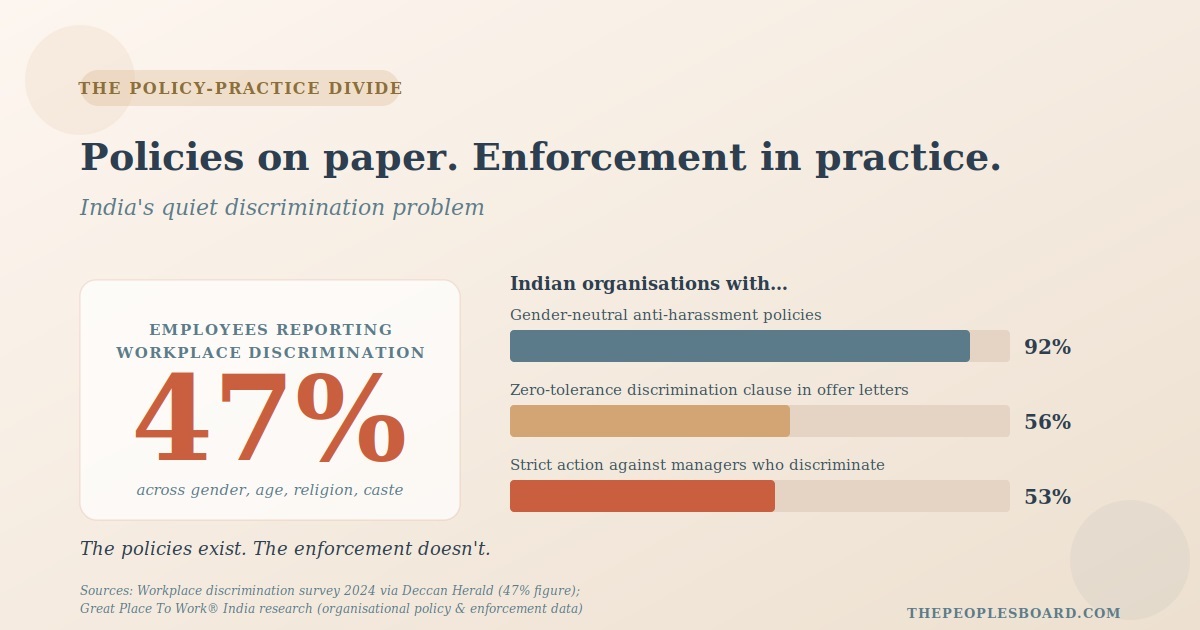
Great Place To Work® India research adds another layer of discomfort: while 92% of Indian organisations have implemented gender-neutral anti-harassment policies, only 53% take strict action against managers who engage in discriminatory practices, and just 56% include a zero-tolerance discrimination clause in offer letters.
The policies exist. The enforcement doesn’t. The absence of a category is not the absence of an experience. It is just the absence of data.
This is where Indian HR’s blind spot becomes expensive. When an employee’s experience doesn’t fit an existing complaint category, they tend to stay quiet. The cost shows up later, often in the exit interview, the attrition spike, or the reputational damage traced back to “an isolated incident” that wasn’t isolated at all.
The TCS Nashik case made this painfully visible; what surfaced as sexual harassment complaints also carried layers of religious coercion that no internal system had a clean way to classify, escalate, or investigate in time.
For HR leaders, the operational gap is clear: India needs reporting frameworks that recognise religious and cultural harm as a distinct safety issue, and not a subset of something else. Until then, these experiences will continue to sit in the silences between categories.
Psychological Safety: The Frontier India is Still Defining
If physical and sexual safety represent the visible layer, psychological safety is the one that quietly determines whether your policies actually work. And India is nowhere near where it needs to be.
A Naukri Pulse 2025 report found that nearly 75% still hesitate to be transparent about taking leave for mental health reasons, with 31% fearing being viewed as ‘incapable’, 27% worrying about judgment from colleagues, and 21% fearing it could impact their career growth.
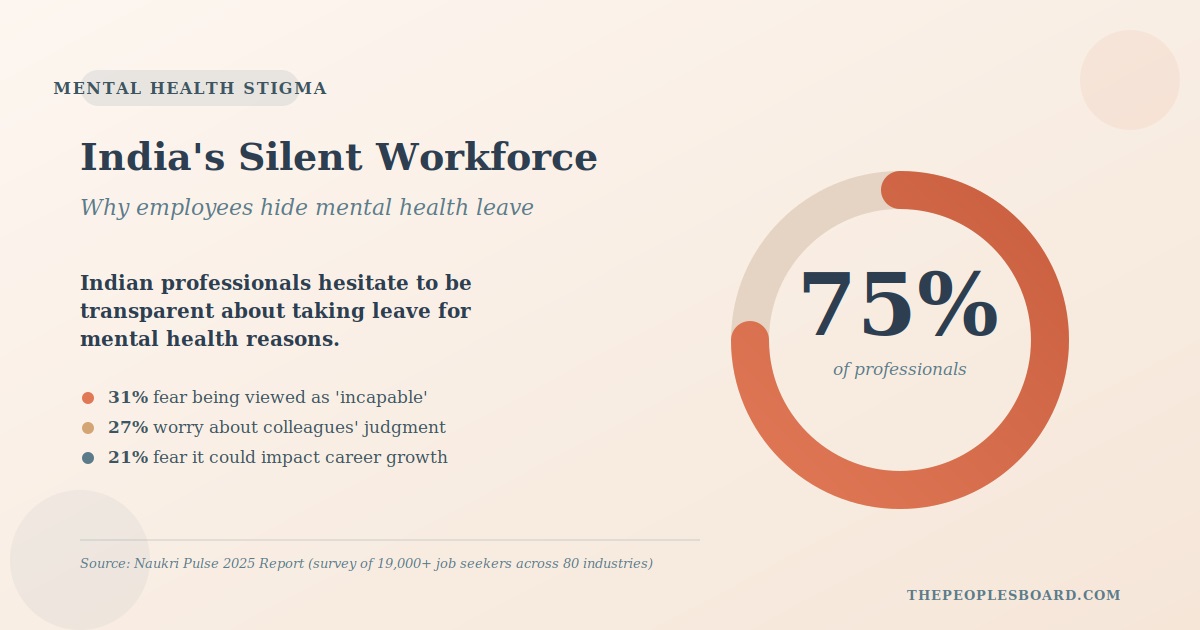
The survey, drawn from over 19,000 job seekers across 80 industries, found that 45% mark mental health days as regular sick leave, 19% avoid taking leave for mental health altogether, and freshers with 0–5 years of experience are the most hesitant.
The cultural reading of this data is straightforward. In hierarchical Indian workplaces, the cost of speaking up still feels higher than the cost of silence. Managers rarely model vulnerability, feedback loops are shallow, and disagreement is often read as insubordination. Psychological safety cannot be engineered through policy documents; it has to be modelled from the top.
Mental Health and Emotional Well-being: A Crisis Without a National Dataset
The scale of India’s workplace mental health challenge is impossible to miss, and almost impossible to measure precisely. Research by Sattva Consulting shows that more than 80% of India’s white-collar workforce has experienced at least one mental health symptom, with nearly half reporting multiple indicators of distress.
Deloitte’s workplace mental health survey estimates that poor mental health among employees costs Indian employers approximately ₹1.1 lakh crore, around $14 billion per year. The number highlights that the country’s mental health crisis is not just about employee welfare but also about the financial strain that it inevitably leads to.
“Workplace stress in India stems from several factors, including excessive workload, unsocial working hours, and a rise in workplace harassment and bullying,” says Dr Rakesh Kumar Chadda, Head of Psychiatry at Amrita Hospital, Faridabad.
India still lacks a comprehensive national dataset on workplace mental health. Organisations, in many cases, are moving faster than policy frameworks, like launching EAPs, mental health champions, and flexible leave structures.
TCS has rolled out TCS Cares; Jindal Stainless has designated mental health champs internally. But without a shared measurement standard, much of this progress remains scattered and unverifiable.
Inclusion as a Safety Issue
Inclusion is often discussed as a DEI concern. It is also, fundamentally, a safety concern. When employees cannot be open about who they are, their caste, their gender identity, their sexuality, their religion, every other conversation about safety sits on shaky ground.
The data India does have, though limited, is clarifying. A 2023 Deloitte LGBT+ Inclusion @Work survey found that 34% of LGBTQ+ professionals in India cite concerns about personal safety as a barrier to being open at work.
The 2024 India Workplace Equality Index, which assessed 150 large companies, reported that while over 90% now extend health insurance to same-sex partners, actual LGBTQ+ representation remains under 1% at even the most progressive Indian employers, a number that exposes how far policy adoption has outpaced genuine inclusion.
Beyond sexual orientation, women represent only about 20% of the 6.6 million employees across NSE 300 companies, a structural under-representation that quietly shapes who feels safe speaking, and whose complaints get heard.
There is still no centralised reporting on caste-based or LGBTQ+ workplace discrimination in India, which means much of this conversation still travels through anecdote, resignation letters, and the occasional media exposé rather than data. But the indirect indicators are loud enough.
The safety that doesn’t get measured is rarely the safety that doesn’t exist. It is usually the safety that has been normalised.
Safety in the Gig and Blue-Collar Economy
Any honest conversation about workplace safety in India has to confront a number of issues most boardrooms prefer to skip over.
NITI Aayog projects that India’s gig workforce will expand from 7.7 million in 2020–21 to 23.5 million by 2029–30, accounting for roughly 4.1% of the country’s total livelihood and nearly 7% of the non-agricultural workforce. Add domestic workers, factory labourers, and construction crews to that, and the majority of India’s working population sits outside any formal safety framework whatsoever.
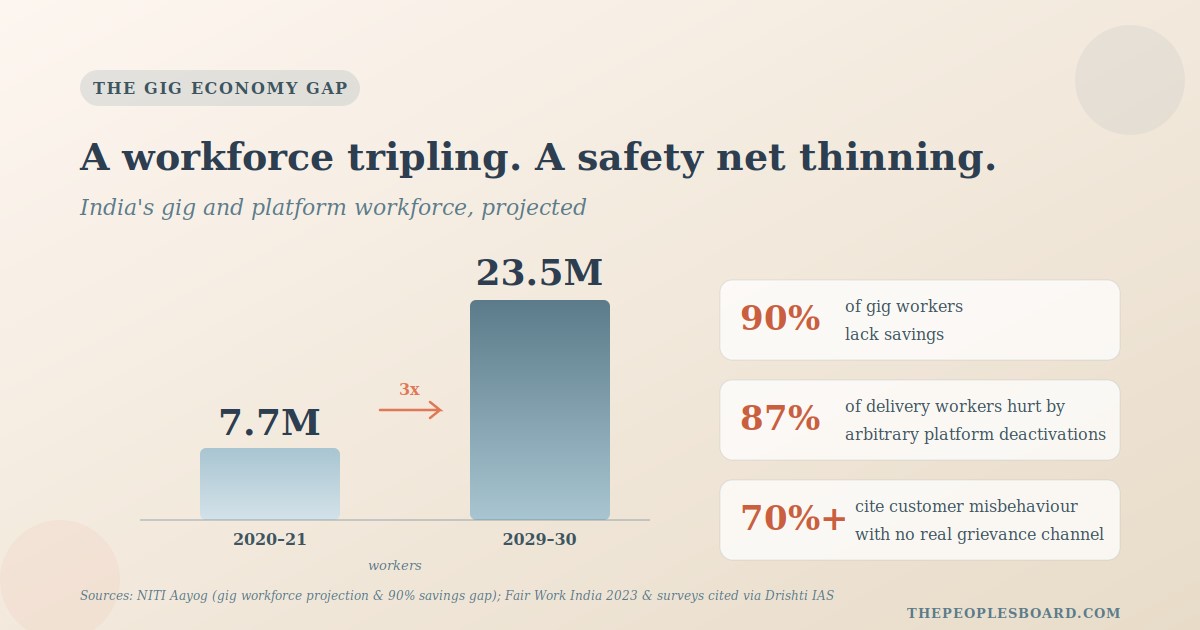
The gap is not theoretical. A 2024 NITI Aayog report found that 90% of gig workers lack savings and face high vulnerability to emergencies. A 2023 Fair Work India study pegged average monthly earnings for delivery and ride-hailing workers at just ₹15,000–20,000, often for shifts exceeding 10 hours.
Surveys have shown that 83% of cab drivers and 87% of delivery workers report being negatively affected by arbitrary platform deactivations, while over 70% cite customer misbehaviour as a persistent stressor with no meaningful grievance redressal channel.
The 2020 Code on Social Security recognised gig and platform workers for the first time, but implementation remains patchy, and day-to-day protection from harassment, unsafe vehicles, unsafe clients, and unsafe hours is still thin. Until safety frameworks meaningfully extend into this workforce, India’s overall safety story will remain only half told.
The Role of Leadership and HR: From Compliance to Accountability
The most significant shift in the last 18 months has been the move from compliance to accountability. The MCA’s 2025 amendment makes it clear: POSH disclosure is not an HR metric hidden in a sustainability report. It is a directorial responsibility disclosed in the Board’s Report, visible to investors, regulators, and the public.
This is governance-grade attention. And it changes the HR conversation. Safety can no longer be owned only by an IC committee or a wellness team. It sits with leadership because its failures now reach the boardroom.
Technology: Helpful, But Not a Substitute for Trust
Digitisation has undeniably improved visibility. The She-Box portal centralises complaint tracking. HR tech platforms now offer anonymous pulse surveys, AI-driven sentiment analysis, and digital whistleblower channels. These are meaningful improvements.
But technology has a ceiling. An anonymous survey doesn’t become safe if employees believe the organisation can trace them. A whistleblower portal doesn’t build trust if past complaints were handled badly.
Moreover, AI-led monitoring sits uncomfortably close to surveillance in workplaces already low on psychological safety. The tools are only as credible as the culture that deploys them.
Where Indian Organisations Still Fall Short
The data, when read together, point to a consistent pattern:
- Reporting is rising, but still vastly undercounts the actual incidence.
- Laws are strengthening, but implementation is weakening sharply in smaller institutions and the informal sector.
- Mental health is acknowledged more, but measured less.
- Inclusion is discussed more but tracked minimally.
- Technology is being adopted, but trust is not automatic.
The underlying cultural reality is the same: employees still fear retaliation, stigma, and career damage. Every safety framework that ignores this reality will continue to underperform, no matter how well it is written.
More than on-paper assurances, employees want a system that they can trust to actually work. Even a handful of safety measures, consistently implemented, builds more employee trust than an exhaustive policy framework that exists only on paper
The Road Ahead: Building Truly Safe Workplaces
The next phase of workplace safety in India will not be won through stronger laws alone. It will be won through trust, slow, unglamorous, operational trust built over years of consistent handling of complaints, clear leadership behaviour, and genuine investment in psychological safety.
Three things will define the next chapter:
- Measuring psychological safety with the same rigour organisations apply to POSH compliance.
- Extending protections meaningfully into the informal and gig workforce.
- Building organisational cultures where speaking up has no penalty, not a quiet one, not a career-shaping one.
In today’s age of social media and open communication, employees feel freer to express their grievances. While many companies have started to pay attention to what their employees are saying, there is still a long way for India Inc as a whole to go.
In the End…
India is at an inflexion point in workplace safety, and the numbers make it clear: stronger laws, better reporting, and rising awareness. But numbers alone flatter the picture. The deeper truth is that workplace safety in India is still experienced unevenly, reported selectively, and enforced inconsistently.
The question for HR leaders in 2026 is no longer whether their policies are compliant. It is whether their employees believe them.
Because every workplace safety framework, from POSH to mental health leave to inclusion charters, ultimately depends on a single question the policy can never answer: if something happens to me here, will I be safe enough to say so?
Until that answer is a confident yes, compliance will remain the floor, not the ceiling.
FAQs
What does workplace safety mean in India in 2026?
Workplace safety in India now extends beyond physical hazards to include sexual harassment (POSH), mental health, psychological safety, religious and cultural dignity, and protections for gig and informal workers. The legal framework is anchored by the POSH Act, the OSH Code 2020, and MCA 2025 disclosure rules.
Is POSH disclosure mandatory in Indian Board Reports?
Yes. Following the Ministry of Corporate Affairs’ 2025 amendment effective July 14, 2025, companies must disclose detailed POSH data in their Board Reports. Non-compliance attracts penalties of up to ₹5 lakh for the company and its directors in cases of repeat or aggravated violations.
What is the She-Box portal and how does it work?
The She-Box (Sexual Harassment Electronic Box) is a central government portal for registering workplace harassment complaints. Since its August 2024 relaunch, it has received 296 complaints, 254 of them in 2025 alone. Complaints are traceable and monitored outside internal HR channels.
What does the OSH Code 2020 change for Indian employers?
The Occupational Safety, Health and Working Conditions Code, 2020, effective November 21, 2025, consolidates 13 central labour laws into one framework. It mandates safety committees in larger factories and construction sites, annual health check-ups for employees, and employer accountability for inter-state migrant workers.
Why do Indian employees hesitate to take mental health leave?
A 2025 Naukri Pulse survey of 19,000+ job seekers found 75% hesitate to be transparent about mental health leave. 31% fear being seen as incapable, 27% worry about judgement, and 21% fear career impact. 45% mark mental health days as regular sick leave; 19% skip leave entirely.
Are gig workers covered under India’s workplace safety laws?
Partially. The 2020 Code on Social Security recognised gig and platform workers for the first time, but implementation remains inconsistent. With India’s gig workforce projected to reach 23.5 million by 2029-30, day-to-day protection from harassment, unsafe vehicles, and platform deactivations remains largely unaddressed.



