

Hiring in India picked up sharply in 2026. White-collar hiring grew 8% in FY26, the best year in three, according to Naukri’s JobSpeak index. Employer confidence climbed even higher: ManpowerGroup’s hiring outlook for India hit 68% in the April–June quarter, its highest ever. But there’s a catch. 82% of Indian companies say they can’t find the skills they’re looking for.
So the market is busy and confident, yet hiring is harder than all that demand suggests. That tension runs through every number below.
How fast is India hiring in 2026?
India’s hiring is growing, but the growth has moved away from IT services and toward almost everything else. Naukri’s JobSpeak index, which tracks new job postings and recruiter activity, ended FY26 up 8% on the year before. FY25 grew just 2%, so this is a genuine recovery, not a one-month bounce.
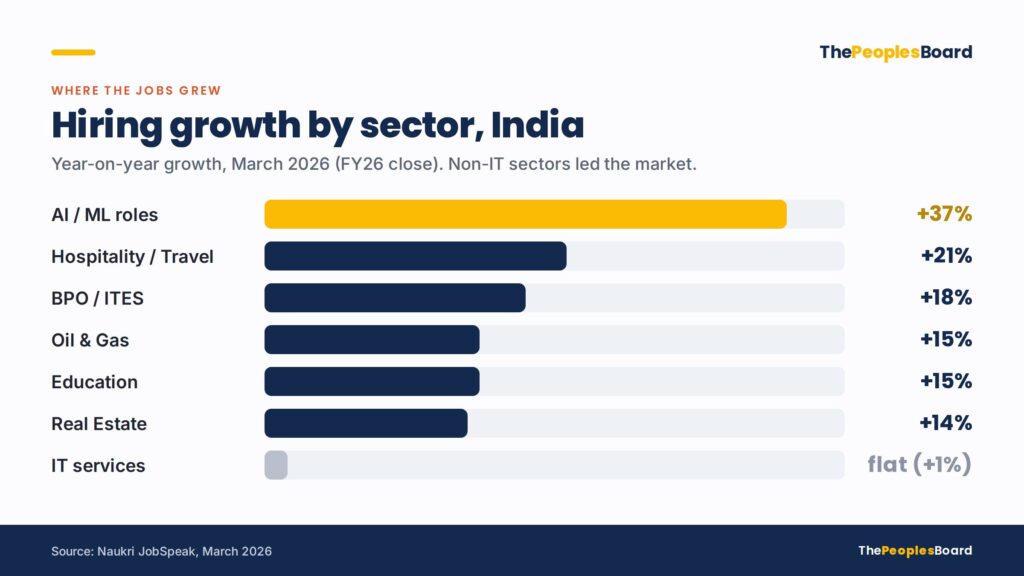
Here’s where the jobs are. At the close of FY26 (March 2026), non-IT sectors led the way:
| Sector | YoY growth, March 2026 |
|---|---|
| Hospitality / Travel | ~+21% |
| BPO / ITES | +18% (anchored by non-metro markets) |
| Oil & Gas | +15% |
| Education | +15% |
| Real Estate | +14% |
| IT services | Broadly flat |
| AI / ML roles | +37% in March; +45% for the full fiscal |
Source: Naukri JobSpeak, March 2026 (FY26 close).
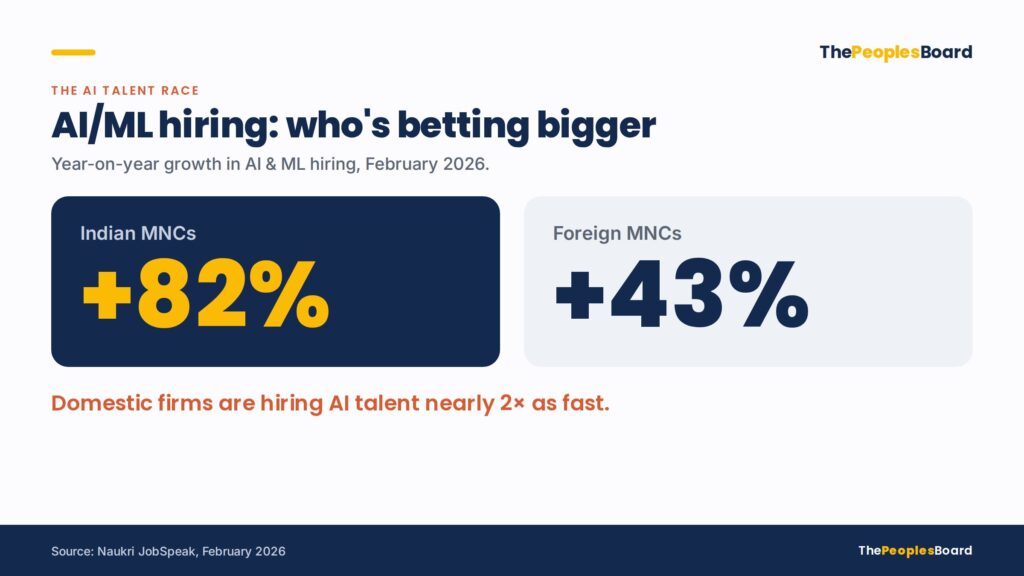
Two things worth pulling out. First, AI and ML hiring is booming, and Indian companies are chasing it hardest. Indian MNCs grew their AI/ML hiring 82% year on year in February 2026, nearly double the pace of foreign MNCs. Second, IT services stayed flat while everything around it grew. For years, when IT hiring slowed, the whole white-collar market felt it. Not this time. If your business sits outside tech, the market is working in your favour right now.
Employer confidence backs this up. ManpowerGroup’s Employment Outlook Survey measures how many employers plan to add staff minus those planning to cut. India sits at or near the top of every market it covers, and by Q2 it led the world outright:
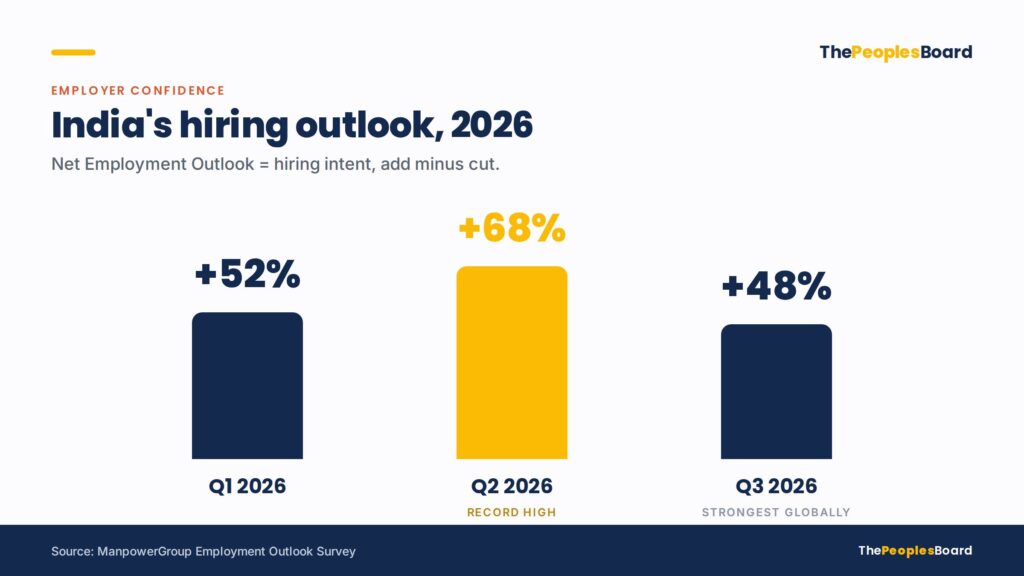
The Q3 dip looks alarming until you read it properly. Confidence cooled from a record peak, but 48% is still the most optimistic reading of any country surveyed. Employers blamed economic uncertainty, not AI, for the caution. In plain terms, they’re being careful, not pulling back. If you’re planning headcount for the second half of the year, that’s the mood you’re hiring into. For the fuller picture, see our complete guide to hiring in India in 2026.
How long does it take to hire in India, and what does it cost?
Most hires in India take about 35 to 45 days, from the day a role is approved to the day someone accepts. But that average tells you almost nothing on its own, because the range by sector is enormous. Hiring patterns vary across sectors and industries, with some filling the talent gap much more quickly than others.
| Role type | Typical time-to-hire |
|---|---|
| Retail/e-commerce | 14–20 days (fastest) |
| Manufacturing (shop floor to engineering) | 25–44 days |
| BFSI | ~44 days |
| Healthcare / Pharma | ~49 days |
| Senior AI/ML, cloud, cybersecurity | 50–70 days |
| Executive/leadership | 120+ days |
Most hires in India take about 35 to 45 days, from the day a role is approved to the day someone accepts. That’s the national average, and it climbs steeply with seniority. High-volume and entry-level roles fill fastest, often inside a couple of weeks. Mid-level roles sit in the middle. Senior, niche, and leadership hires can stretch to two, three, even four months once you add the extra interview rounds, stakeholder sign-offs, and salary negotiation that come with them.
One caveat worth saying plainly: India has no independent national benchmark that breaks time-to-hire down cleanly by sector or level. So benchmark against the kind of role you’re filling, and treat the number as a gut-check on your own pipeline, not as hard fact.
That gut-check is worth running. Most teams never do, and the ones that do usually find days, sometimes weeks, hiding inside a process they assumed was fine.
Now the number that surprises most HR leaders: your real cost-per-hire is almost certainly higher than the one on your dashboard. Many teams calculate it from job-board and platform spend and stop there, which can leave ₹2–4 lakh per mid-senior hire uncounted once agency fees are added in. That’s not a knock on agencies. A strong agency earns its fee on a hard-to-fill senior role and often pays for itself. The win is simply seeing the full picture, because the moment you do, two good things happen: your channel decisions get sharper, and your CFO trusts your numbers on sight.
And then there’s the cost almost nobody puts on a spreadsheet: the wait after “yes.” Notice periods in India run 30 to 90 days, and about one in three IT roles carries a full 90-day notice. So a candidate can accept in week one and still not be at their desk for another one to three months. That single gap stretches your real time-to-productivity far beyond any days-to-offer figure. The good news is that it’s completely predictable. Track the offer-to-start gap as its own number, plan backwards from it, and the 90-day wait stops being a nasty surprise and becomes something you simply staff around.
Where India’s hires actually come from
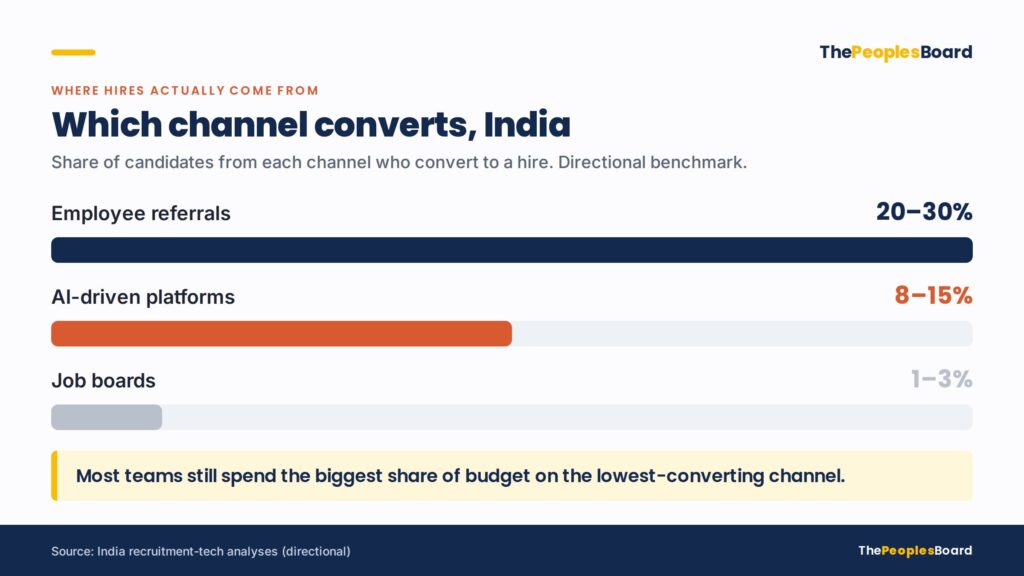
Referrals are, by a wide margin, the best-converting way to hire in India. Yet most teams still spend the bulk of their budget on job boards, which means the money is going to the weakest channel.
Here’s how the main channels turn candidates into actual hires:
- Employee referrals: 20–30% of referred candidates get hired
- AI-driven platforms with intent scoring: 8–15%, and climbing
- Job boards: just 1–3%
Referrals also tend to stay longer and settle in faster, which is why they cost the least over time. One warning, though: referrals carry bias. The more senior the person making the referral, the less scrutiny the candidate usually gets. Put referred candidates through the same interview process as everyone else.
For reach and volume, Naukri.com and LinkedIn India are still the go-to channels for mid-senior and Global Capability Centre (GCC) roles. And GCCs are now a hiring force in their own right. GCC hiring grew across the big metros through FY26 and is spreading into tier-2 cities like Coimbatore, Kochi, Baroda, and Ahmedabad, which often means sourcing from places you haven’t before. If you’re rebuilding a pipeline after a slow spell, our guide on moving from a hiring freeze to a hiring sprint breaks down the channel mix.
Offer-drops, Counteroffers, and No-shows
Offer acceptance in India is lower than a lot of HR teams expect, and it isn’t because your process is broken. It’s structural. For senior roles hired the traditional way, only about 55–65% of offers get accepted. Two forces drag it down: aggressive counteroffers, and those long notice periods, during which competing offers keep landing in the candidate’s inbox. Someone who accepts your offer on Monday can have two more by the time they finish serving notice.
This is why “offer shopping” is so common in Indian IT hiring. For a lot of candidates, your offer letter is the start of a negotiation, not the finish line.
Ghosting runs both ways. Candidates go quiet after saying yes. Employers go quiet after final interviews, which is one of the loudest complaints on AmbitionBox and Glassdoor India. And it costs you. Ghosted candidates leave reviews, and those reviews shape what the next candidate thinks before they ever apply. A clear rejection within five working days of the final round is cheap protection for your employer brand.
The fix isn’t a clever tool. It’s a quicker process and honest communication. Teams that tighten their funnel and decide faster simply lose fewer people along the way.
Freshers vs Laterals: The 2026 Split
Fresher hiring is growing faster than any other experience level in India right now. Postings for people with 0–3 years of experience jumped 16% year on year in early 2026, the highest growth of any group, per Naukri JobSpeak. More telling still: demand for freshers in the 20+ LPA salary band rose 23%. For the top tier of graduates, “entry-level” no longer means entry-level pay.
That’s the real 2026 story: a split fresher market. On one side, the big IT services firms restarted mass campus hiring, with starting packages around ₹3.5 LPA. On the other, product companies, GCCs, and specialist AI roles pay several times that, with the top specialist tracks at the IT majors themselves running into double-digit lakhs. Same graduating batch, completely different outcomes, decided mostly by skills and college.
Lateral hiring in traditional IT services, meanwhile, got tighter. The old bench-heavy model that used to soak up mid-level movers cooled off, even as specialist and AI-adjacent lateral hiring stayed fiercely competitive. So the market is split by seniority too: hot at the fresher and specialist ends, cautious in the mid-level IT middle.
One longer-term catch is worth flagging. When companies cut entry-level hiring to save money today, they starve their own leadership pipeline for later. That’s exactly the trade-off Indian CHROs are wrestling with, which we covered in what Indian CHROs are doing differently on the leadership pipeline.
What to Watch
Two signals point in opposite directions heading into FY27. Employer confidence is still the highest in the world, but it’s easing. And the hard part of hiring has flipped, from finding demand to finding people. With 82% of employers short on skills and AI/ML hiring still red-hot, the winners in 2026 won’t be the ones posting the most jobs. They’ll be the ones who build a pipeline before the role is even approved, who treat offer acceptance and source-of-hire as numbers worth watching every month, and who move fast enough to close a candidate before a 90-day notice window lets a rival slip in.
The jobs are back. The edge now belongs to whoever hires with discipline.
FAQs
What is the average time to hire in India in 2026?
The average time-to-hire in India is roughly 35 to 45 days from approved requisition to accepted offer. It varies widely by sector: retail and e-commerce roles fill in 14–20 days, BFSI around 44 days, and senior AI/ML or cybersecurity roles can take 50–70 days. Executive searches often exceed 120 days.
Which sector hires fastest in India?
Retail and e-commerce hire fastest, typically 14 to 20 days, driven by high volume and standardised roles. Executive and niche technical roles are slowest.
How much did white-collar hiring grow in India in FY26?
White-collar hiring grew 8% year on year in FY26 according to Naukri’s JobSpeak index, up from 2% in FY25 and the strongest growth in three years. Non-IT sectors led, while AI/ML roles grew 45% for the year.
What is India’s hiring outlook for 2026?
India’s Net Employment Outlook was +68% for Q2 2026, a record high, before easing to +48% for Q3, per ManpowerGroup. Even after cooling, India’s outlook stayed the strongest of any country surveyed.
What is a good offer acceptance rate in India?
For senior roles hired through traditional channels, offer acceptance in India runs about 55–65%. The main drags are high counteroffer rates and long notice periods, during which candidates keep receiving competing offers.