
Most Indian organisations still decide who is ready for a new role the same way they did a decade ago: a manager’s gut feel, a résumé on file, and a job title that may no longer describe what the person actually does. That method breaks down when skills shift faster than org charts can be redrawn.
The World Economic Forum’s Future of Jobs Report 2025 estimates that 39% of workers’ core skills will change or become obsolete by 2030, and 63% of employers name skills gaps as the single biggest barrier to business transformation. AI skills mapping is how a growing number of companies are replacing guesswork with a live, evidence-based read on what their people can already do and where they can go next.
What AI Skills Mapping Actually Means
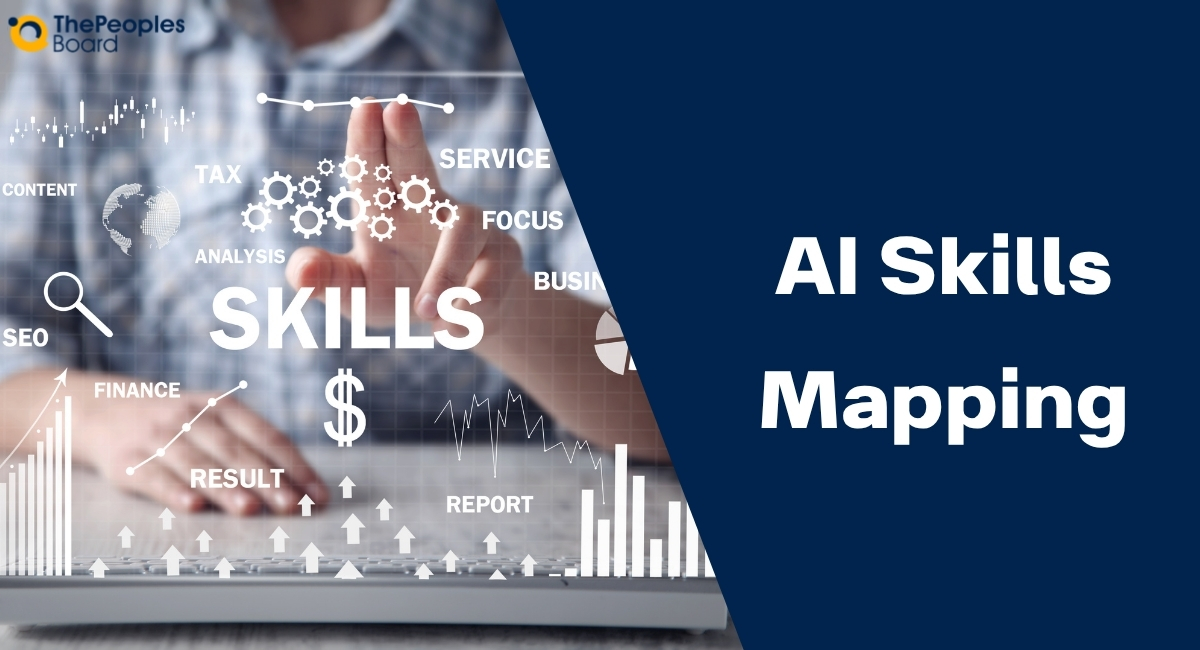
AI skills mapping is the practice of building a continuously updated inventory of every employee’s capabilities, then matching those capabilities against the skills open and emerging roles demand. It sits on top of a skills taxonomy, a structured library of skills grouped into families and tied to proficiency levels, and it uses machine learning to infer proficiency rather than relying only on what people declare about themselves.
The mechanics separate it from the static competency frameworks HR teams have kept for years. Older systems captured a snapshot at a point in time and then aged badly. AI-driven systems pull signals from work itself and refresh the picture as the work changes.
Where The Skills Data Comes From
Skills inference engines assemble a profile by reading across several sources instead of asking employees to fill in a form. They analyse job descriptions, learning histories, project contributions, and, in technical functions, artefacts such as code commits, tickets, and documents. The result is a capability profile that gets richer the more a person works, which is why vendors describe assessment as becoming cheaper and continuous rather than a periodic HR exercise.
The output is more useful than a self-rated skills survey. It surfaces non-obvious matches, linking, for example, a marketing analyst to a supply-chain optimisation role because the underlying analytical skills overlap. It also reduces the bias that creeps in when employees rate themselves or when managers nominate the people they happen to notice.
How It Differs From A Talent Marketplace
A skills map is the underlying data layer. A talent marketplace is the interface that puts that data to work, posting internal roles, gigs, and projects, and recommending them to employees whose inferred skills fit. Companies such as those profiled in Deloitte’s skills-based organisation research treat the two as parts of one system: the map identifies readiness, the marketplace acts on it.
TCS, Infosys, and Wipro have each built internal deployment engines that route employees to projects based on skills profiles rather than reporting lines, a model that matters when Nasscom reports that over 40% of tech roles in Indian GCCs face a skill gap and the half-life of a technical skill has fallen to roughly three years. A role defined by a fixed job description can go stale before the next appraisal cycle.
Why Indian Companies Are Adopting It Now
Cost and retention are driving adoption faster than any technology trend. Building a capable employee internally is cheaper than buying one on the open market, and employees who move internally tend to stay. Nasscom’s GCC analysis finds upskilling a current employee costs 2.5 times less than hiring externally, and employees with high internal mobility stay 60% longer.
The pressure is sharpest in India’s Global Capability Centres, which now employ close to two million professionals and are shifting from volume hiring to skill-mix hiring. When niche skills command salary premiums and the mid-career experience band is scarce, redeploying proven internal talent becomes a competitive necessity rather than a nice-to-have. The same Nasscom data shows 78% of GCCs are already reskilling internal teams for generative AI adoption, which only works if a company knows who is closest to ready.
Career growth is also what keeps Indian talent in place. LinkedIn’s Economic Graph data cited by Nasscom shows career growth consistently ranking above pay as a priority for Indian employees across experience levels. A visible internal path, powered by an honest skills map, speaks directly to that. HR leaders looking at internal mobility as a retention strategy are finding that the mapping layer is what makes the path credible.
How Companies Run The Process
A skills-mapping rollout tends to move through a recognisable sequence, though the timeline stretches across years rather than quarters. The steps below describe how a mid-to-large Indian enterprise typically approaches it, drawing on the phased model Deloitte and skills-tech vendors describe.
| Stage | What Happens | Typical Output |
| Build the taxonomy | Define the skills library, grouped into families and mapped to proficiency levels | A structured list, often 1,000 to 1,500 skills |
| Assess the workforce | Combine manager ratings, self-assessment, and inferred work-product evidence | A baseline capability profile per employee |
| Launch the marketplace | Roles and projects post their skill needs; employees see matched opportunities | Cross-team assignments and internal applications rise |
| Close gaps | Route employees to targeted learning based on the gap between current and target roles | Measurable movement toward readiness |
Grounding Readiness In Evidence, Not Titles
The starting principle that separates a working system from a stalled one is measuring what people can actually do, not what their job title implies. A baseline built on inferred evidence gives HR a defensible answer to the question of who is ready, and it exposes hidden capability that title-based planning misses entirely. This is the modern extension of competency mapping, automated and kept current.
Gap analysis then turns the map into action. Once a target role’s skill requirements are clear, the distance between an employee’s profile and that role becomes a concrete development plan, feeding directly into upskilling and reskilling programmes rather than generic training catalogues.
Fitting Mapping Into Wider Planning
Skills maps feed two decisions at once. They inform workforce planning by showing where capability is thin before a business need becomes a crisis, and they strengthen internal recruitment by giving hiring managers a shortlist of internal candidates whose skills already match.
The WEF’s projection that 19 of every 100 workers will be reskilled and redeployed within their organisation by 2030 describes exactly the movement a good mapping system is built to enable.
How to Implement AI in Skills Mapping
The gap between buying a skills-mapping tool and getting value from it is where most rollouts stall. SHRM’s State of AI in HR 2026 research warns that urgency often pushes HR teams into rushed, disjointed technology investments, and a skills map built on messy data or launched without manager buy-in tends to sit unused. A disciplined sequence, starting narrow and proving value before scaling, is what separates a working system from expensive shelfware.
Auditing The Current Process First
The groundwork happens before any AI touches the data. An honest look at how internal moves and project staffing happen today surfaces the real friction points, whether that is roles filled by whoever a manager already knows or capable people overlooked because their skills were never recorded. This audit also reveals the state of the data the system will depend on, since an inference engine trained on incomplete or inconsistent records will produce a capability profile no one trusts.
Data readiness deserves particular attention in Indian enterprises where employee records are often fragmented across legacy HRIS, spreadsheets, and project-management tools. Consolidating and cleaning that data, and reconciling it with obligations under the Digital Personal Data Protection Act, 2023, is unglamorous work that determines whether the eventual output is credible.
Piloting In One Function
A contained pilot beats a company-wide launch for a first attempt. A single function with strong data quality and a supportive leader, testing AI matching for one high-friction use case such as project staffing, keeps the experiment small enough to learn from and cheap enough to abandon if it fails. Transparency with the pilot group matters here: employees told plainly that the tool exists to open opportunities, not to rank them for cuts, engage with it rather than game it.
Baseline metrics set before the pilot make the results legible afterwards. Internal fill rate, time to fill a role, employee satisfaction with the process, and manager adoption give a concrete read on whether the tool improved anything or simply added a layer.
Building Governance And Human Checkpoints
Explainability and oversight cannot be bolted on later. A skills map that influences who gets a stretch assignment or a promotion carries real consequences, so a human reviewer needs to sit between the system’s recommendation and any decision that affects a person’s career. Manager coaching is part of this, since a recommendation is only as good as the conversation that follows it.
Scaling comes last, and only once the pilot process works. Feedback loops from employees, managers, HR, and legal keep the system honest as it widens, and periodic checks on the inference model catch bias or drift before it compounds. A skills-mapping programme is a standing capability that needs maintenance, not a one-time installation.
Where AI Skills Mapping Falls Short
The technology carries real limits, and treating its output as fact rather than signal is the most common failure. Inference engines can misread the data they ingest, and a capability profile is only as good as the work signals feeding it. Employees in roles that leave a thin digital trail can be undervalued relative to those whose work is easy for a system to read, which risks entrenching the visibility gap rather than closing it.
Bias is a related danger. A system trained on historical patterns can reproduce the very inequities an organisation is trying to move past, and Indian HR teams adopting these tools carry obligations under the Digital Personal Data Protection Act, 2023, when processing employee data at this depth. Explainability matters too: an employee told they are not ready for a role deserves to know which skills the system flagged and why. LinkedIn’s 2025 Workplace Learning Report underlines the point that AI adoption alone does not solve the skills challenge; the strongest results come from pairing the technology with human judgement, manager coaching, and clear career conversations.
In the End…
A useful first move this quarter is a single-role audit: the role your business most struggles to fill externally, mapped against which current employees sit closest to it on skills rather than title. The exercise works manually where no platform exists yet, using project histories and manager input, which teaches an HR team what good skills data looks like before any tooling gets bought.
One measurable target, such as the share of roles filled internally, tracked against external hiring cost, turns the exercise into an accountable programme. Explainability is worth demanding from any vendor before a contract is signed, alongside a check against the Digital Personal Data Protection Act, 2023, so the mapping strengthens employee trust rather than eroding it. The organisations getting value from AI skills mapping are the ones treating it as a decision aid that makes human judgement sharper, not a verdict that replaces it.
FAQs
What is AI skills mapping?
AI skills mapping is the practice of building a continuously updated inventory of every employee’s capabilities, then matching those capabilities against the skills that open and emerging roles demand. It sits on a skills taxonomy and uses machine learning to infer proficiency from work signals rather than relying on what people declare about themselves.
How is AI skills mapping different from a talent marketplace?
A skills map is the underlying data layer that identifies who is ready for a role. A talent marketplace is the interface that acts on that data, posting internal roles, gigs, and projects and recommending them to employees whose inferred skills fit. Companies treat the two as parts of one system, the map identifies readiness and the marketplace acts on it.
Why are Indian companies adopting AI skills mapping now?
Cost and retention are the main drivers. Nasscom finds upskilling a current employee costs 2.5 times less than hiring externally, and employees with high internal mobility stay 60% longer. The pressure is sharpest in Global Capability Centres, where over 40% of tech roles face a skill gap and 78% of GCCs are already reskilling teams for generative AI adoption.
Where does the skills data come from in an AI skills map?
Skills inference engines assemble a profile by reading across job descriptions, learning histories, project contributions, and, in technical functions, artefacts such as code commits, tickets, and documents. The profile gets richer the more a person works, which makes assessment continuous rather than a periodic HR exercise.
What are the limits of AI skills mapping?
Inference engines can misread the data they ingest, and employees whose work leaves a thin digital trail can be undervalued relative to those whose work is easy to read. Systems trained on historical patterns can reproduce existing bias, and Indian HR teams carry obligations under the Digital Personal Data Protection Act, 2023. The strongest results pair the technology with human judgement, manager coaching, and clear career conversations.