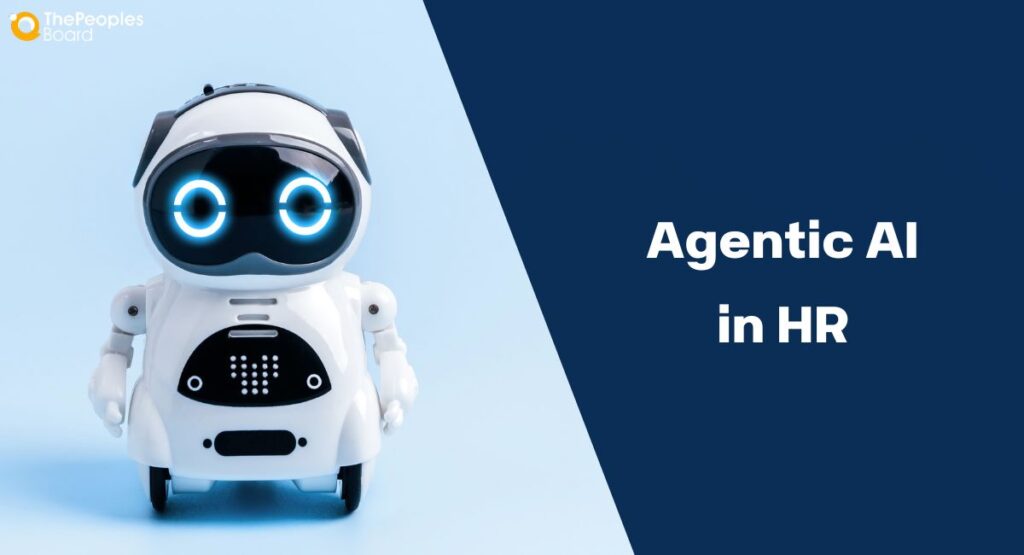

Agentic AI is the next layer of AI in HR. It schedules the interview, raises the ticket, recommends the learning path, and flags the policy breach. All without a prompt for every step.
The EY AIdea of India Outlook 2026 report found that 24% of Indian C-suite leaders are already deploying agentic AI, calling it a clear inflexion point. The rest are watching, piloting, or planning.
For HR, the question isn’t whether it’s coming. It’s what to understand, evaluate, and govern before it lands inside workflows.
What Agentic AI Actually Means
Agentic AI is a category of AI systems that can plan, decide, and act across multiple steps and multiple tools to complete a goal, without needing a human prompt at each step.
The “agent” part matters. An agent perceives a trigger, reasons through a sequence of actions, executes them across connected systems, and adjusts based on what happens. It can use tools, query data, write back to systems of record, and hand off to a human when it needs to.
That’s the simple version. The practical version sounds like this:
- A new hire’s offer is accepted. An onboarding agent triggers IT provisioning, schedules the first-week calendar, sends the welcome pack, books the manager introduction, and confirms documentation collection. No HRBP touches any of it unless something breaks.
- An employee’s Slack message says, “I’m planning maternity leave in December.” An employee service agent confirms eligibility under the Maternity Benefit Act, pre-fills the application, schedules a manager conversation, and queues a re-onboarding plan for the return month.
This is different from traditional HR automation. Rule-based automation runs only the paths it was scripted for. It can route a leave request or trigger a confirmation email. It cannot decide.
Agentic AI handles ambiguity. It can interpret a question, reason about what action fits, and pull from multiple data sources before doing anything.
Agentic AI vs Generative AI: The Real Difference
Both sit on large language models. Both can write. The split is what each one does after it writes.
| Dimension | Generative AI | Agentic AI |
| Trigger | Human prompt | System event, schedule, or human prompt |
| Output | Content (text, summary, draft) | Actions across systems |
| Decision-making | None, beyond what to generate | Yes, within the defined scope |
| Workflow span | Single response | Multi-step, multi-tool |
| Memory | Conversation-bound, often reset | Persistent, context-aware |
| HR analogy | A drafting assistant | A junior HRBP who can be delegated to |
The clean way to think about it: generative AI writes the offer letter. Agentic AI writes the offer letter, sends it through the e-sign tool, monitors for acceptance, triggers onboarding, books the laptop, and updates the HRMS. All without anyone clicking through five tabs.
Workflow orchestration is where the line gets sharpest. A generative model can describe how to onboard a hire. An agent does it. The capability isn’t in the writing. It’s in the doing.
Where Agentic AI is Showing Up in HR
Indian HR teams aren’t deploying agentic AI everywhere at once. The pattern is targeted: high-volume, rules-heavy, multi-system workflows first. Judgment-heavy decisions much later, if at all.
Candidate Scheduling and Recruitment Coordination
This is the most mature use case. Agents handle initial screening conversations, calendar coordination across recruiters and hiring managers, and follow-ups with candidates who go silent. PwC’s Strategy& estimates that agentic AI can deliver up to 60% reduction in time-to-hire through autonomous resume screening and scheduling.
For high-volume hiring, especially in BPO, retail, and frontline roles, this is where most pilots start. The work is repetitive, the rules are clear, and the cost of a bad screening decision is recoverable.
Employee Query Resolution
Tier-1 HR queries follow predictable patterns. Leave balance. Payroll explanation. Reimbursement status. Policy clarification. An employee support agent connected to the HRMS, payroll system, and policy knowledge base can answer most of these directly, raise a ticket if the question is out of scope, and learn from the resolution.
This is where most Indian enterprises see the largest workload shift. The HR helpdesk doesn’t get smaller. It gets reassigned to the cases that actually need a human.
Learning and Skill Recommendations
A learning agent reads someone’s role, recent project work, performance signals, and stated career goals, then surfaces specific courses, internal mentors, or projects to take on. It doesn’t just push a content library. It tracks completion, adjusts based on what worked, and updates as skills evolve.
Asma Shaikh, who runs Enthral.ai, has been building agentic AI solutions in this space and has called learning the most exciting frontier for HR autonomy. TPB covered her view in a recent HR Voices conversation on agentic AI.
Internal Mobility Matching
Most internal job boards in India still rely on employees finding roles, applying, and hoping a recruiter notices. Agentic AI flips this. The agent reads the open role, scans the workforce for skill matches, surfaces non-obvious candidates, and nudges both the employee and the hiring manager toward a conversation. It also drafts the development plan if the match needs upskilling.
For Indian organisations with large workforces and high attrition, this is the use case with the clearest retention argument.
What HR Teams Stand to Gain
The benefits of Agentic AI cluster around outcomes that matter most in Indian HR right now.
Reduced manual workload
Most HR teams in India spend a disproportionate share of time on administrative work: ticket triage, scheduling, documentation chase-ups, and status updates. Agents absorb the bulk of that. The team that spent mornings answering policy questions can spend them designing the policy.
Faster employee experience
A query resolved at 11 PM doesn’t wait for 9 AM. An onboarding handoff doesn’t sit in someone’s inbox over the weekend. For organisations with shift workers, distributed teams, or 24/7 operations, this matters.
Scalable workflows
When HR teams scale headcount, support costs usually scale with them. Agentic AI breaks that link for the workflows it covers. The marginal cost of resolving the thousandth query in a month looks close to the cost of the first.
Standardisation
Agents apply the same logic to every case, which is good for fairness, audit trails, and compliance. It’s harder when the policy itself is wrong, which is a separate problem.
The Risks That Boards are Already Flagging
The capabilities that make agentic AI useful are the same ones that make it risky.
The FICCI-EY Risk Survey 2026, released in February 2026, found that “AI risk is now a core business risk and not merely a technology issue,” with threats including hallucinations, data poisoning, model drift, deepfakes and shadow AI.
The same report flagged that agentic systems introduce fresh legal ambiguity when actions are executed without explicit approvals.
Over-Automation
Not every HR decision should sit with an agent. Termination decisions, final hiring calls, performance ratings, and grievance resolutions involve judgment, context, and accountability that no current system handles well. The temptation is to automate them because the agent can. The discipline is to draw the line.
A May 2026 Harvard Business Review piece, co-authored by BCG Henderson Institute researchers, warned that treating AI agents like employees breaks down in production because agents lack the human escalation loops.
The same piece noted that across BCG’s AI at Work data, only 13% of organisations have actually integrated agents into real workflows, while 56% are still piloting under heavy human supervision.
Hallucinations
Agents that run on language models inherit language model failures. A confidently wrong answer about leave eligibility is a small problem. A confidently wrong policy interpretation that results in someone losing a benefit, getting denied a transfer, or being misclassified on a compliance issue is not.
In agentic systems, the risk compounds. A hallucinated input doesn’t stop at the screen. It triggers actions. Then it triggers more actions. By the time someone notices, the cleanup is messy.
Bias Propagation
The India AI Governance Guidelines explicitly flag bias and discrimination from inaccurate data, leading to unfair decisions in employment as one of six main AI risk categories. Agents trained on past hiring or promotion data inherit the patterns inside that data. If those patterns were biased, the agent scales the bias.
The harder issue is opacity. When an agent makes 1,000 decisions a week, identifying which ones were biased becomes a forensic exercise. This is what TPB covered in its piece on AI adoption and the trust gap in Indian HR: adoption is racing ahead of acceptance, and bias audits are not keeping pace.
Accountability Gaps
When an agent takes an action that turns out to be wrong, who answers for it? The vendor? The HR leader who deployed it? The CIO who connected it? The model provider?
The legal answer in India is unsettled. S&R Associates, in a recent analysis, noted that India’s current statutes, including the IT Act and the DPDP Act, are oriented towards data governance and intermediary conduct rather than autonomous system behaviour. The proposed Digital India Act may begin to close that gap, but it isn’t here yet.
In the meantime, accountability defaults to the human in the chain. The same HBR research above found that managers in the chain of AI-assisted work were held more accountable for errors than they would have been without the agent, with individual accountability rising and identified error rates dropping.
The tool doesn’t erase accountability. In some cases, it concentrates on the manager who clicked deploy.
What Indian HR Leaders Should Check Before Adoption
Before any agentic AI rollout, three readiness conditions deserve honest evaluation. Most organisations meet one of them well. Most don’t meet all three.
Data Maturity
Agents are only as good as the data they read from and write to. Indian enterprises with fragmented HR tech stacks (HRMS in one tool, payroll in another, ATS in a third, LMS in a fourth) often discover that the agent can’t do what the demo showed because the data doesn’t connect.
Questions worth asking:
- Is employee master data consistent across HRMS, payroll, and the ATS?
- Are policy documents structured well enough that an agent can read them accurately?
- Do leave, attendance, and reimbursement records have clean field names and reliable timestamps?
- What’s the error rate in the source data?
If the answer to most of these is “we’ll fix it during implementation,” the project is at risk.
Process Standardisation
Agents execute processes. If the process changes depending on which HRBP runs it, which manager signs off, or which region the employee sits in, the agent will either pick one version and ignore the others, or break.
The harder version of this question is whether the process should be standardised in the first place. Some flexibility exists for good reason. Some exists because no one wrote it down.
Human Oversight Models
The strongest framework circulating in the Indian market right now is a three-tier Human in the Loop (HITL) approach. The valueX2 2026 guide lays it out cleanly:
| Tier | Action Type | Examples |
| Auto-Execute | Low-risk, reversible | Answering PTO queries, sending reminders, and updating non-sensitive records |
| Escalate | Medium-risk, needs review | Flagging attrition risk, suggesting a shortlist, and recommending talent moves |
| Block | High-risk, needs human sign-off | Final hiring decisions, promotions, performance ratings, terminations |
Every agentic deployment in HR needs this tier map before it goes live. Without it, every action looks the same to the system. That’s how over-automation accidents happen.
For organisations earlier in the AI maturity curve, TPB’s guide on AI adoption in HR in India walks through the broader readiness picture.
Where This is Heading
Agentic AI is a technology that is evolving rapidly. Even mere months are enough to change the landscape of Indian HR, especially in certain key areas.
Multi-agent systems
Today’s deployments mostly use a single agent for a single workflow. The next phase is multiple agents collaborating: a sourcing agent, a screening agent, and a scheduling agent, all working on one hire.
Gartner’s 2026 Strategic Technology Trends has flagged multi-agent systems as a top enterprise priority. Indian system integrators, including Infosys, Persistent, Tech Mahindra and Wipro, are already building these platforms, partly for clients and partly for their own back office.
The “AI manager” debate
As agents take on more tier-1 work, the question of who manages them, sets their scope, and audits their decisions becomes structural.
Mercer’s 2026 Global Talent Trends report, based on nearly 12,000 respondents, found that 98% of executives plan organisational design changes over the next two years, and 65% expect 11% to 30% of their workforce to be redeployed or reskilled because of AI. New roles like “agent operations lead” will likely sit at the intersection of HR and IT.
Regulatory direction
India’s regulatory stance is still being written. The DPDP Act, 2023, already touches consent and automated decision-making. The India AI Governance Guidelines, issued in late 2025, identify the risk categories but stop short of prescriptive controls for agentic systems. The proposed Digital India Act may provide a more structured framework.
Globally, the EU AI Act treats most HR AI systems as high-risk by default, with full obligations applying from August 2026. For Indian multinationals, that European baseline will shape internal policy long before Indian law catches up.
In the End…
Agentic AI is the second wave of AI in HR. The first wave was about what software could write. The second is about what it can do, end-to-end, without supervision at every step.
The honest read for Indian HR teams: this technology is useful for the right workflows, risky for the wrong ones, and almost entirely dependent on the readiness work done before deployment. Data hygiene, process standardisation, and clear oversight tiers aren’t optional add-ons. They’re the difference between a deployment that holds up and one that quietly breaks trust with employees.
The teams that will get this right in 2026 aren’t the ones moving fastest. They’re the ones that have figured out exactly where autonomy serves the business and exactly where judgment still needs a human in the chair. That distinction has to be built, role by role, decision by decision, inside the function itself.
Start with the question that matters most: which workflows are repetitive, rules-heavy, and reversible? That’s where agentic AI earns its keep. Everywhere else, slow down.
FAQs
What is agentic AI in HR?
Agentic AI in HR refers to AI systems that can plan, decide, and act across multiple steps and tools to complete an HR workflow, without needing a human prompt at each step. Unlike rule-based automation, agentic AI interprets context, reasons through actions, and executes them across connected systems like HRMS, ATS, payroll, and learning platforms.
How is agentic AI different from generative AI in HR?
Generative AI produces content like offer letters, job descriptions, or policy drafts in response to a prompt. Agentic AI takes the next step: it sends the offer letter, monitors acceptance, triggers onboarding, and updates the HRMS, all without separate human prompts. Generative AI writes. Agentic AI acts.
What are the main use cases of agentic AI in Indian HR?
The most mature use cases in Indian HR include candidate scheduling and recruitment coordination, tier-1 employee query resolution, learning and skill recommendations, and internal mobility matching. High-volume, rules-heavy workflows are seeing the earliest deployments, especially in BPO, retail, and frontline hiring.
What are the risks of agentic AI in HR?
The key risks include over-automation of judgment-heavy decisions like terminations and performance ratings, hallucinations that trigger incorrect actions across systems, bias propagation from historical data, and accountability gaps when an agent’s decision turns out to be wrong. The FICCI-EY Risk Survey 2026 flagged AI risk as a core business risk, not just a technology issue.
Is agentic AI in HR legal in India?
India’s current statutes, including the IT Act and DPDP Act 2023, focus on data governance and intermediary conduct rather than autonomous system behaviour. The India AI Governance Guidelines, issued in late 2025, identify risk categories but stop short of prescriptive controls for agentic systems. The proposed Digital India Act may bring a more structured framework. For Indian multinationals, the EU AI Act, which treats most HR AI as high-risk from August 2026, will likely shape internal policy first.
What is human in the loop (HITL) in agentic HR AI?
Human in the loop is an oversight model that decides which AI actions can run autonomously, which need human review, and which require explicit sign-off. The standard three-tier framework auto-executes low-risk actions like PTO query responses, escalates medium-risk actions like shortlist recommendations, and blocks high-risk actions like final hiring decisions, promotions, and terminations.
How should HR teams prepare for agentic AI?
Three readiness conditions matter: data maturity (consistent employee master data across HRMS, payroll, and ATS), process standardisation (workflows that don’t change based on who runs them), and a clear human oversight model with defined tiers for autonomous, escalated, and blocked actions. Most organisations meet one of these well. Few meet all three.
Will agentic AI replace HR jobs in India?
Agentic AI is expected to shift HR work rather than eliminate it. Tier-1 administrative work like ticket triage, scheduling, and status updates will be absorbed by agents, freeing HR teams for policy design, employee experience, and strategic work. Mercer’s 2026 Global Talent Trends report found 65% of executives expect 11% to 30% of their workforce to be redeployed or reskilled because of AI, and new roles like “agent operations lead” are emerging at the intersection of HR and IT.