


A woman on your payroll works from a WeWork desk your company rents. She’s harassed by someone from another company at the shared coffee counter. Who does she complain to? Your Internal Committee, or the operator’s? The honest answer is that both may have a role, and getting it wrong exposes your organisation to a statutory penalty.
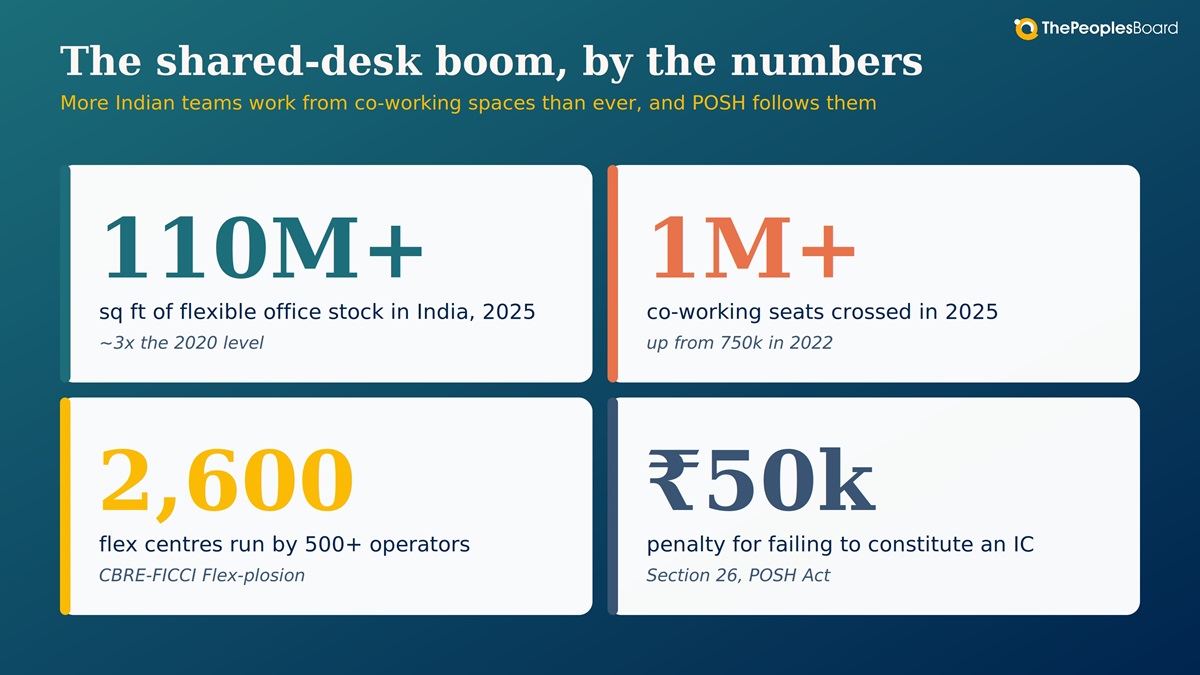
This isn’t a fringe scenario anymore. India’s flexible office stock crossed 110 million square feet in 2025, roughly three times its 2020 level, with over 500 operators running about 2,600 centres, according to the CBRE-FICCI Flex-plosion report.
Coworking seats crossed the 1 million mark in 2025, up from 750,000 in 2022, per industry estimates. More Indian teams work from shared spaces than ever. And the POSH Act doesn’t care whose name is on the lease.
What the Law Actually Says About “Workplace”
The Sexual Harassment of Women at Workplace (Prevention, Prohibition and Redressal) Act, 2013 defines “workplace” far more broadly than a company’s own office. Under Section 2(o), a workplace covers any establishment where work happens, and Section 2(o)(v) extends it to any place visited by an employee arising out of or during the course of employment, including transport the employer provides for the journey.
A co-working desk your company pays for is your employee’s workplace. So is a client site, an off-site, a conference, and increasingly a video call. The Act uses an “extended workplace” logic: protection follows the employee, not the building.
Section 2(f) matters just as much. It defines “employee” to include regular, temporary, ad hoc, and daily-wage staff, whether hired directly or through an agent, plus co-workers, probationers, trainees, and apprentices, paid or unpaid. So the intern your startup places at a shared desk is covered. So is the consultant on a three-month contract.
Put those two definitions together, and the principle is simple. If a woman is at a co-working space because of her job, that space is her workplace under the law, no matter who owns it.
Who Counts as the “Employer” Here
The confusion in shared spaces comes from a single question: who is the employer? The Act’s answer decides who carries the duty. The person or body that manages, supervises, and controls the organisation an employee works for is the employer under the POSH Act. That’s the company that hired her, not the landlord who rents the desk.
But the co-working operator is also an employer, to its own staff. WeWork India, Awfis, Smartworks, 91springboard, and IndiQube all employ community managers, front-desk teams, and facilities staff. Each of those operators is an employer in its own right and must run its own Internal Committee under Section 4, which applies to every establishment with 10 or more employees.
So a single co-working floor can hold several employers at once, each with a separate compliance obligation. The client company. The operator. Sometimes a second or third tenant company shares the same floor. This is where responsibility gets tangled, and where HR teams tend to assume someone else is handling it.
The Split of Duties: Who Owns What
Here’s the clearest way to think about it. The Act places the core redressal duty on the company that employs the woman, while the operator carries duties toward its own staff and a practical duty to keep the premises safe.
| Responsibility | Client Company (tenant) | Co-Working Operator |
| Constitute an Internal Committee for its own employees | Yes, if 10+ employees | Yes, for its own staff |
| Receive and inquire into a complaint by its employee | Yes, primary duty | Only if complainant is operator’s own staff |
| Provide a safe working environment on the premises | Shared, contractually | Yes, as the premises controller |
| Display POSH policy and IC details at the workspace | Yes, for its team | Yes, at the shared premises |
| Conduct awareness training | Yes, for its employees | Yes, for its staff |
| File the annual report with the District Officer | Yes | Yes |
| Act on IC recommendations within 60 days | Yes | Yes |
The grey zone is the middle row. When harassment happens in a common area, involving people from two different tenant companies, jurisdiction can get contested. The complainant’s own employer runs the inquiry, but the respondent sits outside that IC’s authority. Cooperation between the two companies and the operator becomes the only workable path.
The Common Area Problem
Shared kitchens, breakout zones, event spaces, and lifts are where the co-working model collides with the POSH framework. These spaces belong to no single tenant. And an incident there rarely involves only one company’s people.
Consider three realistic situations:
- Same company, shared premises: Two employees of the same tenant, harassment at the shared cafe. Straightforward. The tenant’s IC has full jurisdiction, because the location is a workplace under Section 2(o)(v) and both parties are its employees.
- Different companies, common area: The complainant works for Company A, the respondent for Company B, incident in the shared lounge. Company A’s IC can inquire, but it has no disciplinary power over Company B’s employee. Company A recommends that Company B’s IC or management must act, and the operator may need to restrict the respondent’s access.
- Complaint against operator staff: A tenant’s employee is harassed by a community manager. Now the operator is the respondent’s employer, so the operator’s IC handles the disciplinary side, while the tenant supports its own employee.
None of these is hypothetical edge cases. With shared floors housing dozens of companies, cross-company incidents are a structural feature of the model, not an exception.
What Employers Should Put in the Lease
Most co-working disputes over POSH could be settled before they happen, in the licence agreement. Yet most standard co-working contracts say nothing about it. That’s a gap HR should close with legal before signing.
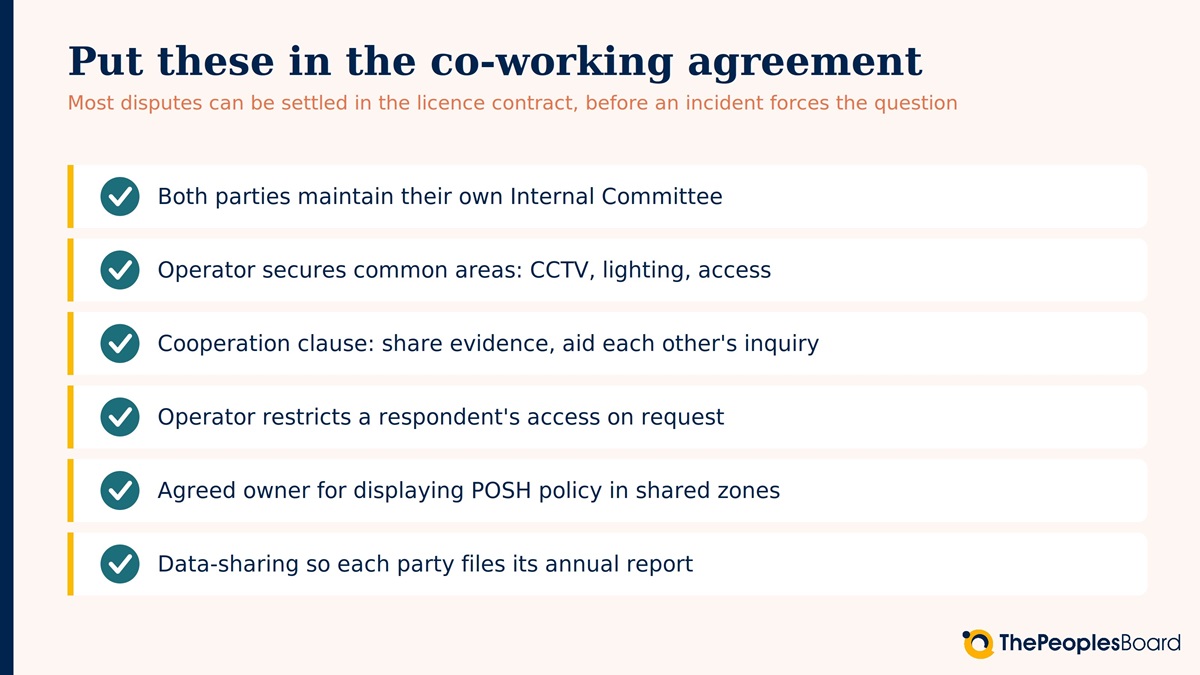
A POSH-aware co-working agreement should spell out:
- IC constitution: Confirmation that the operator maintains its own Internal Committee and that the tenant maintains its own.
- Common-area safety: The operator’s responsibility for CCTV, lighting, access control, and incident response in shared zones.
- Cooperation clause: A commitment that both parties will share information, preserve evidence, and cooperate with each other’s IC inquiries, subject to Section 16 confidentiality.
- Access restriction: The operator’s agreement to restrict or remove access for a respondent pending or following an inquiry, on the client’s request.
- Awareness display: Who displays POSH policies and IC contact details in shared spaces.
- Annual reporting cooperation: Data-sharing to help each party file its report accurately.
Foreign companies placing India teams in shared spaces should note that a global HR policy doesn’t substitute for local compliance. A UK or US parent with an Indian office of 10 or more still needs an IC constituted under Indian law, not a group-wide grievance system.
Why This Matters More in 2026
Courts and regulators have stopped treating POSH compliance as a paperwork formality. In Aureliano Fernandes v. State of Goa (2023), the Supreme Court flagged serious gaps in POSH implementation across the country and issued directions to strengthen it. The Court drew attention to Section 26 penalties of up to ₹50,000 for failing to constitute an IC or for other non-compliance, with repeat offences attracting doubled fines and possible cancellation of business licences.
The Court also directed that compliance data be uploaded to the SHe-Box portal, the Ministry of Women and Child Development’s centralised platform, which was relaunched on 29 August 2024 and now acts as a repository of IC and Local Committee information across workplaces. Non-constitution of an IC has been held to be a punishable offence in its own right by multiple High Courts.
For a company running a distributed workforce across several co-working locations, that’s a real exposure. Each location where 10 or more of your people work is a workplace. The obligation to provide a safe environment, display your policy, and route complaints to your IC travels with them. “We work out of a shared space, so the operator handles it” is not a defence the law recognises.
There’s a cultural cost too, not just a legal one. Workplace safety and psychological security shape retention, especially for women, whose labour-force participation in India still sits around 37% per the PLFS 2023-24. A shared-desk arrangement that leaves an employee unsure who to turn to is a safety gap, whatever the lease says.
A Practical Checklist for HR
A Practical Checklist for HR
Compliance in a shared space tends to fail not because HR ignored the POSH Act, but because responsibility sat in a blind spot between the company and the operator. The steps below turn the principles above into a quick audit you can run before an incident forces the question. Work through each one for every co-working location your team occupies, not just the head office, and get the answers in writing where a verbal assurance won’t hold up later.
- Confirm your own IC is constituted, trained, and current, wherever your people sit. An IC missing its external member, or one that never meets, fails Section 4 even if it exists on paper.
- Map every co-working location where you have 10 or more employees. The threshold is counted per employer, not per building, so a team split across three centres can trigger the duty at each.
- Check whether the operator maintains its own IC and get it in writing. A community manager’s verbal assurance is worth nothing when a complaint against operator staff actually lands.
- Add POSH clauses to the licence agreement: cooperation, access restriction, common-area safety, and reporting. These four decide what happens when a cross-company incident occurs, so treat them as non-negotiable and involve legal before signing.
- Display your POSH policy and IC contact details at each location your team uses. Section 19 makes conspicuous display a statutory duty, and it has to reach every desk, not just head office.
- Brief employees that their co-working desk is a workplace under the Act, and that complaints go to your IC, not the operator’s front desk. This one point of confusion is what leaves complainants stuck at the coffee counter.
- Confirm awareness training reaches distributed and shared-space teams, not just head-office staff. Satellite employees are the easiest to skip and the most exposed to common-area incidents.
In the End…
Ask who owns the POSH duty in a co-working space and you get shrugs in three directions: the tenant points at the operator, the operator points at the tenant, and the woman at the shared coffee counter points at no one because she doesn’t know. That gap is the whole problem. The law resolved it years ago, even if the market hasn’t caught up: the workplace follows the employee, and the duty to keep her safe follows the employer who signed her offer letter.
So the uncomfortable answer to the question this piece opened with is that your responsibility began the moment you placed her at that desk. The lease can hand the operator the CCTV, the lighting, and the door access. It cannot hand off the obligation to constitute your IC, route her complaint, and act within 60 days, because Section 26 puts that liability on you and nowhere else. A ₹50,000 penalty and a cancelled licence are the price of assuming otherwise.
Pull up your co-working agreements this week. Check who owns what, confirm your IC is live at every location your people sit, and close the gap now, while it’s still a line item on a checklist and not a complaint no one will own.
FAQs
Does the POSH Act apply to co-working spaces?
Yes. Under Section 2(o) of the POSH Act, a workplace includes any place an employee visits during the course of employment. A co-working desk your company pays for is your employee’s workplace, regardless of who owns the building. Protection follows the employee, not the lease.
Who handles a POSH complaint in a co-working space?
The Internal Committee of the company that employs the woman handles the complaint. The employer is the person or body that manages and controls the organisation she works for, not the co-working operator who rents the desk. The operator’s IC only handles complaints where its own staff is the respondent.
What happens if a POSH incident involves employees of two different companies in a shared space?
The complainant’s own employer runs the inquiry, but its IC has no disciplinary power over the respondent, who works for another company. The complainant’s IC can recommend that the respondent’s employer act, and the operator may need to restrict the respondent’s access. Cooperation between both companies and the operator becomes the only workable path.
Is the co-working operator responsible for POSH compliance?
The operator is an employer to its own community managers, front-desk, and facilities staff, so it must constitute its own Internal Committee under Section 4 if it has 10 or more employees. It also carries a practical duty to keep the shared premises safe. It does not take on the tenant company’s redressal duty toward the tenant’s employees.
What POSH clauses should be in a co-working licence agreement?
A POSH-aware co-working agreement should cover IC constitution by both parties, common-area safety measures like CCTV and access control, a cooperation clause for information sharing and evidence, access restriction for a respondent on request, who displays POSH policies in shared spaces, and data-sharing for annual reporting.
Can a company avoid POSH liability by saying the operator handles it?
No. Each co-working location where 10 or more of your people work is a workplace under the Act. The duty to provide a safe environment, display your policy, and route complaints to your IC travels with your employees. A lease can divide the practical duties but cannot transfer the legal one, and Section 26 penalties of up to ₹50,000 apply for non-compliance.



