
India’s HR community has spoken. In a recent TPB reader poll, 62% said working from home is practical right now, and 57% would pick a hybrid model for their organisation if given the choice.
The findings come at a moment when the work from home conversation has surged back into mainstream discourse.
PM Narendra Modi’s public appeal in Hyderabad, urging Indians to work from home, carpool, and use public transport to conserve fuel amid the ongoing West Asia conflict, has reopened a question many companies thought was settled.
Layer on the northern heatwave testing the limits of commute tolerance in NCR and beyond, and HR teams across the country are once again being asked to defend, redesign, or rethink their attendance policies.
So TPB asked its readers two pointed questions. The answers tell us a lot about where the Indian workforce stands in 2026.
Is working from home practical in India right now?
A clear majority of HR professionals believe work from home is practical in 2026, with 62% of TPB poll respondents saying yes. Here’s how the responses broke down:
- 62% said Yes
- 5% said No
- 7% said Maybe
- 25% said Depends on the Role
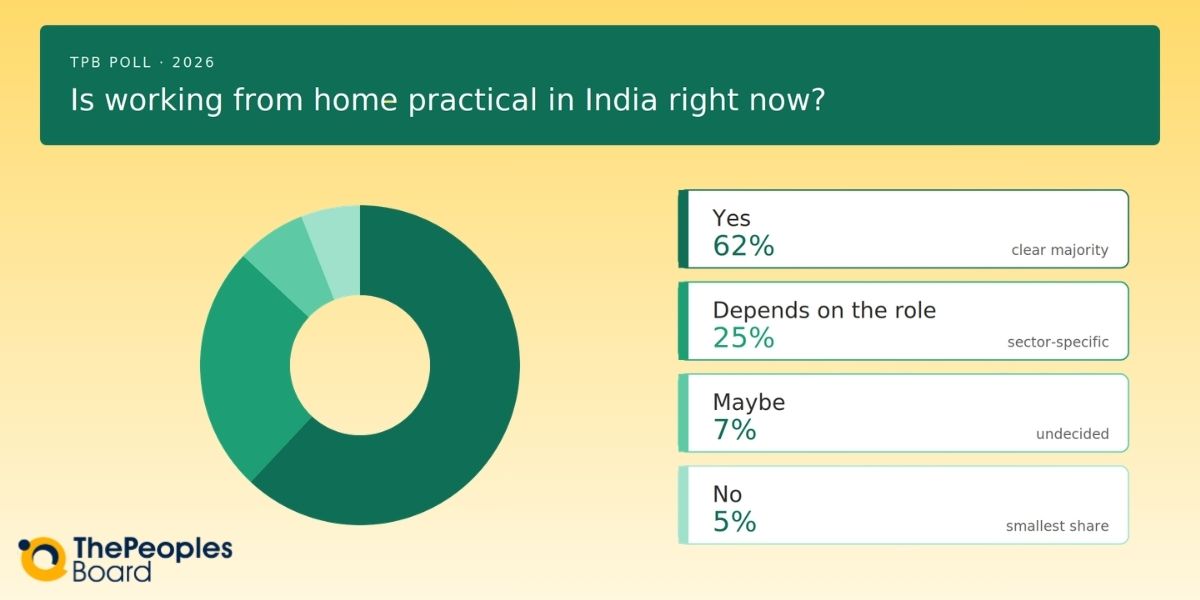
Two things stand out. First, WFH remains a popular work model even when respondents are asked to filter by feasibility rather than preference. Most professionals genuinely believe in the comfort and efficiency of working from home, and the share saying “no outright” is vanishingly small.
Second, role context matters a great deal. The 25% who said “depends on the role” is not a soft middle; it is a signal that practicality is sector-specific.
Grey-collar professionals (those in roles that blend manual and skilled work, such as healthcare workers, teachers, lab technicians, and field engineers) depend heavily on physical workplace infrastructure. For them, blanket WFH policies fall apart on contact with operational reality.
Which work model is best for Indian organisations?
When TPB asked readers which work model is best for their organisation, the hybrid model emerged as the clear preference:
- 57% chose Hybrid
- 28% chose Work From Home
- 13% chose Work From Office
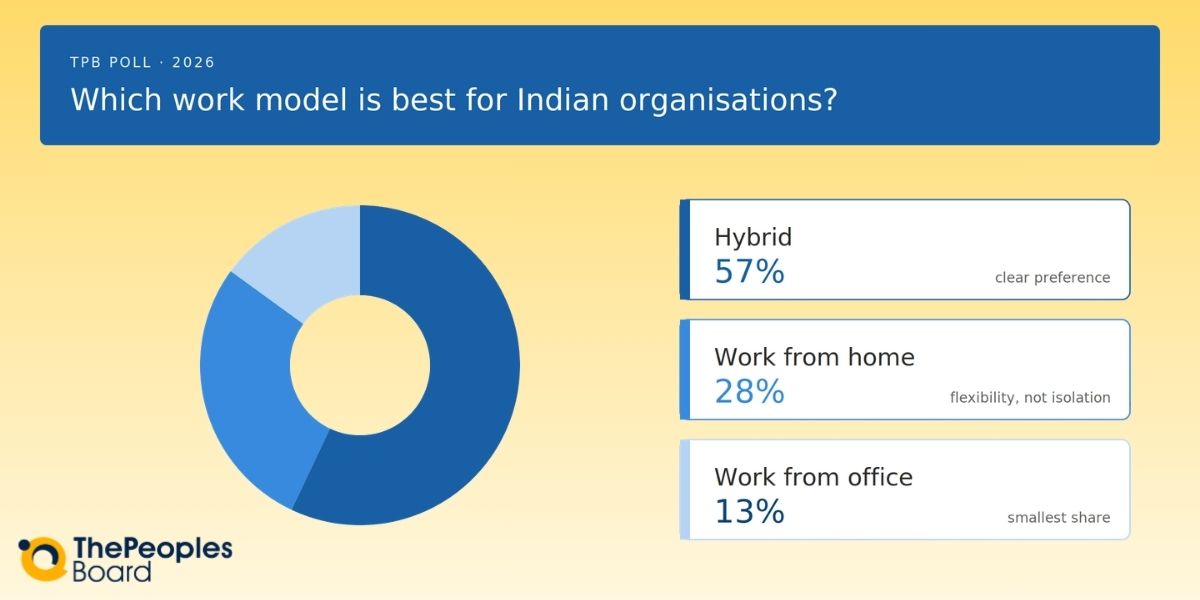
The hybrid majority confirms what India’s largest employers have been signalling for over a year. From IT services to BFSI, hybrid models are the dominant operating mode, blending the collaboration and culture-building of office days with the focus and flexibility of home days.
The phrase gets overused, but the appeal is real: the hybrid framework combines two work environments that each solve problems the other creates.
What is more striking is the spread between hybrid (57%) and pure WFH (28%). Even among employees who broadly support remote work, fewer than a third want it as a five-day-a-week arrangement. The appetite is for flexibility, not isolation.
That trend now extends well beyond the private sector. Following PM Modi’s appeal, the Delhi, Tripura, and Andhra Pradesh governments have introduced hybrid schedules for state employees.
Government work has traditionally required physical presence for file movement, public-facing duties, and inter-departmental coordination, so the shift carries weight. If even bureaucratic workflows can flex toward hybrid, the model is reaching workplaces previously assumed to be excluded.
What this means for HR leaders
The poll points to one shift: flexibility is now the baseline, but hybrid wins because it engages with what the job actually requires, not just what employees want.
For HR leaders, that means blanket mandates will keep struggling, the government’s hybrid pivot gives private employers useful cover, and the companies that win retention in 2026 will be the ones designing hybrids intentionally rather than retrofitting attendance rules.
The WFH debate has moved past the binary. The harder question now is whether HR teams can design workplaces that earn the presence they request.
FAQs
Is working from home practical in India in 2026?
According to a TPB reader poll, 62% of HR professionals say yes, working from home is practical in India right now. Only 5% disagreed outright, while 25% said practicality depends on the role, particularly for grey-collar professions that rely on physical workplace infrastructure.
Which work model do Indian HR professionals prefer?
The hybrid model is the clear favourite, with 57% of TPB poll respondents choosing it as the best fit for their organisation. Pure work from home received 28% support, while only 13% backed a full return to office.
Why is the hybrid model winning over pure WFH in India?
Even among supporters of remote work, fewer than a third want it five days a week. HR professionals prefer hybrid because it combines the collaboration and culture of office days with the focus and flexibility of home days, addressing what the job requires rather than just employee preference.
Are Indian government bodies adopting hybrid work?
Yes. Following PM Modi’s appeal in Hyderabad, the Delhi, Tripura, and Andhra Pradesh state governments have introduced hybrid schedules for their employees, signalling that flexibility is reaching even traditionally office-bound bureaucratic workflows.