
Personalised rewards tailor recognition and incentives to what an individual employee actually values, rather than handing everyone the same bonus, gift card, or plaque. The case for doing so is strong but not absolute. Personalisation lifts engagement and retention when it is designed around fairness and consistency, and it backfires when employees start reading it as favouritism or when the administrative load outweighs the payoff.
That tension sits at the centre of a debate most Indian HR teams are having right now. Recognition budgets are being scrutinised, the workforce is younger and more vocal about what it wants, and the old one-size-fits-all reward catalogue is showing its age.
Why the One-Size-Fits-All Model Is Breaking Down
For decades, recognition in most Indian organisations ran on a fixed formula tied to annual reviews, ratings, and long-service awards. It was formal, infrequent, and backwards-looking. That model is now colliding with a workforce whose expectations have shifted.
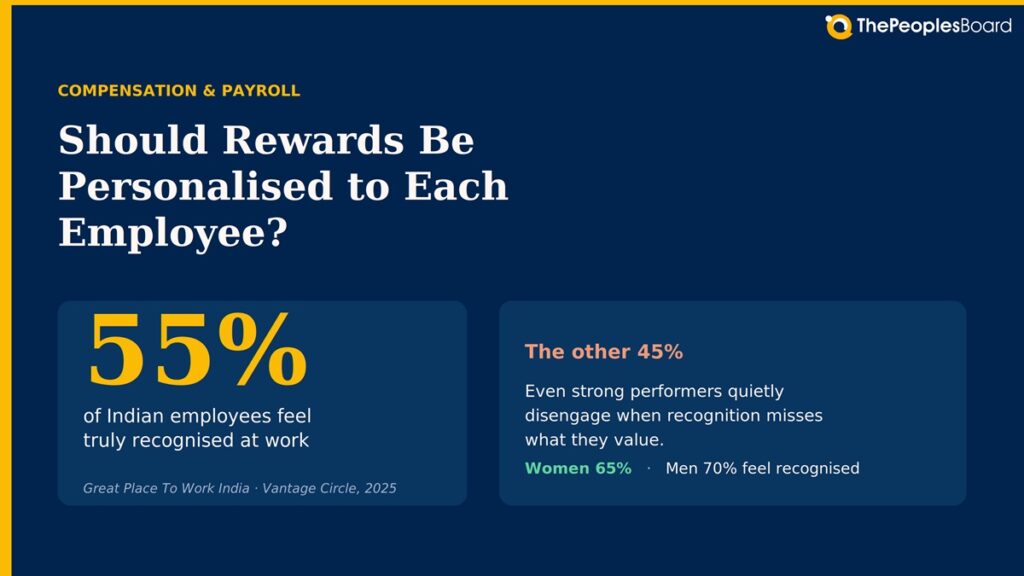
A 2025 study by Great Place To Work India and Vantage Circle found that only 55% of employees in India feel truly recognised at work. Among the 45% who don’t, even strong performers can quietly disengage. The same study surfaced demographic gaps: 65% of women reported feeling recognised, against 70% of men.
A uniform reward system assumes everyone is motivated by the same thing. The data says otherwise. Deloitte’s 2025 Gen Z and Millennial Survey found that only 6% of Gen Z and millennial respondents named reaching a leadership position as their primary career goal, a signal that traditional promotion-linked rewards no longer carry the weight HR assumes they do.
India’s demographic reality sharpens the point. Randstad India’s Gen Z Workplace Blueprint, released in October 2025, found young professionals prioritising pay, flexibility, and purpose in roughly equal measure. Engagement among Indian Gen Z sat at 81%, below millennials at 92% and Gen X at 91%. When a five-generation workforce shares the same reward menu, most of it lands flat for someone.
What Personalisation Actually Looks Like
Personalising rewards doesn’t mean negotiating a bespoke package with every employee. It means building enough choice and relevance into the system that the reward matches the person receiving it. The variables that most often get tailored:
- Reward type: Cash bonus versus paid time off, learning stipends, wellness benefits, or experiential rewards like travel or event tickets.
- Delivery style: Public recognition in a town hall versus a private note from a manager. A SHRM data point cited widely across recognition research puts public-recognition preference at 85%, but that figure hides a large minority who find public praise uncomfortable. (Terryberry)
- Timing: Immediate, in-the-moment recognition versus scheduled annual awards.
- Source: Manager-led, peer-to-peer, or leadership recognition. Gallup found that 28% of employees attribute their most meaningful recognition to their manager, but peers, senior leaders, and even customers each account for a meaningful share. (SelectSoftware Reviews)
- Life stage and role: Flexible benefits around dependent care, health, or commuting let employees pull the levers that matter to their circumstances.
The through-line is that effective recognition is specific. Generic praise reads as a formality; recognition tied to a named behaviour or a real preference reads as genuine.
The Case For Personalising Rewards
The business argument rests on three measurable outcomes: engagement, retention, and cost efficiency.
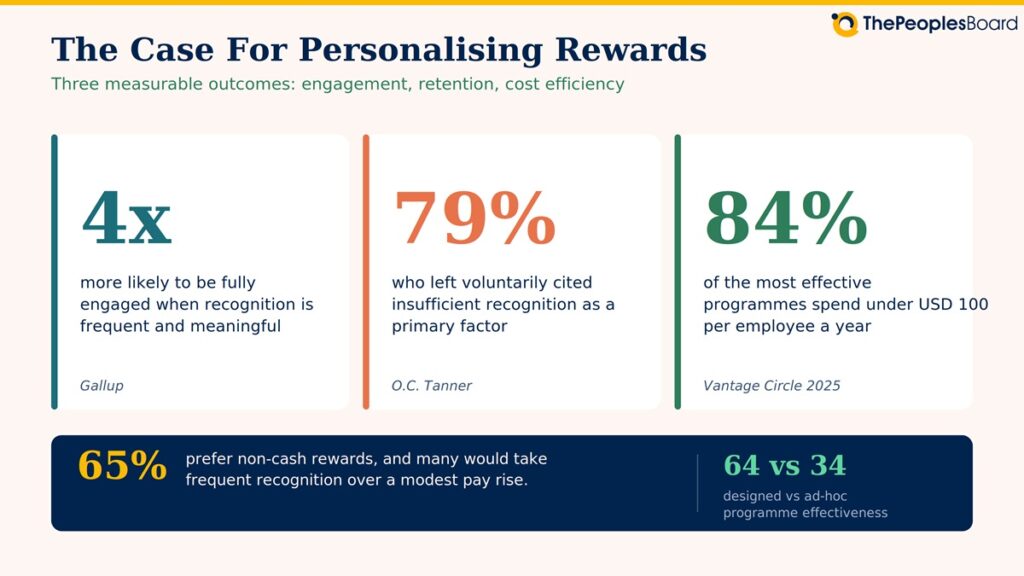
On engagement, Gallup research shows employees who receive frequent, meaningful recognition are roughly four times more likely to be fully engaged than those who rarely receive it. This connects directly to a problem TPB has tracked closely, with employee engagement in India sitting at some of its lowest recorded levels.
On retention, O.C. Tanner’s research found that 79% of employees who left voluntarily cited insufficient recognition as a primary factor, and SHRM data links strong recognition cultures to about 31% lower voluntary turnover.
On cost, personalisation is not a premium play. Vantage Circle’s State of Recognition & Rewards 2025 found that 84% of the most effective recognition programmes spend under USD 100 per employee per year, and that programmes built on the full AIRe design framework scored an average effectiveness rating of 64, nearly double the 34 recorded by programmes lacking systematic design. The differentiator was design quality, not budget size.
There is also a clear preference signal in the data. Roughly 65% of employees prefer non-cash rewards, and a notable share say they would choose frequent recognition over a modest pay rise, which points to acknowledgement being about feeling seen as much as being paid.
The Case Against, Or At Least For Caution
Personalisation carries real risks that HR teams underestimate.
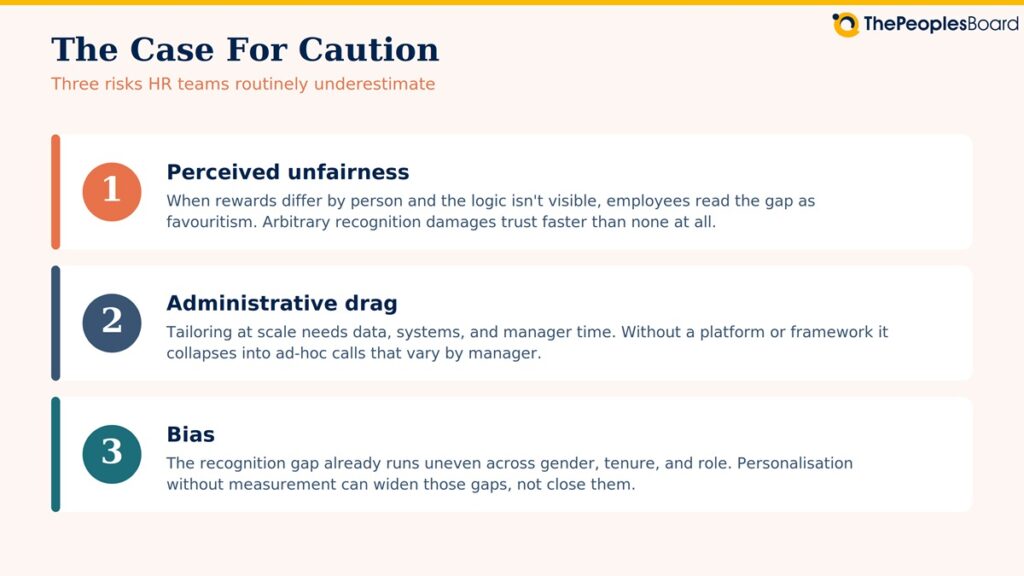
The first is perceived unfairness. When rewards differ by person, employees who don’t understand the logic can read the difference as favouritism. Recognition that feels arbitrary damages trust faster than no recognition at all. TPB has flagged this pattern in coverage of management behaviours that drive top talent away, where inconsistent acknowledgement is a recurring theme.
The second is administrative drag. Tailoring rewards at scale requires data, systems, and manager time. Without a platform or a clear framework, personalisation collapses into ad-hoc decisions that vary by how attentive an individual manager happens to be.
The third is bias. The same Great Place To Work India study that found the overall recognition gap also found it distributed unevenly across gender, tenure, and role. Personalisation without measurement can widen those gaps rather than close them, because it hands more discretion to managers who may carry unconscious preferences.
A quick way to weigh the trade-off:
| Dimension | Uniform Rewards | Personalised Rewards |
| Perceived fairness | Higher by default (everyone gets the same) | Depends entirely on transparent criteria |
| Relevance to individual | Low across a mixed workforce | High when data-driven |
| Administrative effort | Low | Moderate to high |
| Bias risk | Lower, but ignores real differences | Higher without measurement |
| Engagement impact | Modest | Strong when well designed |
| Cost | Predictable | Comparable if capped and structured |
How Indian Employers Are Approaching It
The practical middle path most Indian organisations land on is structured choice: a defined framework with room for individual preference inside it, rather than either a rigid catalogue or a free-for-all.
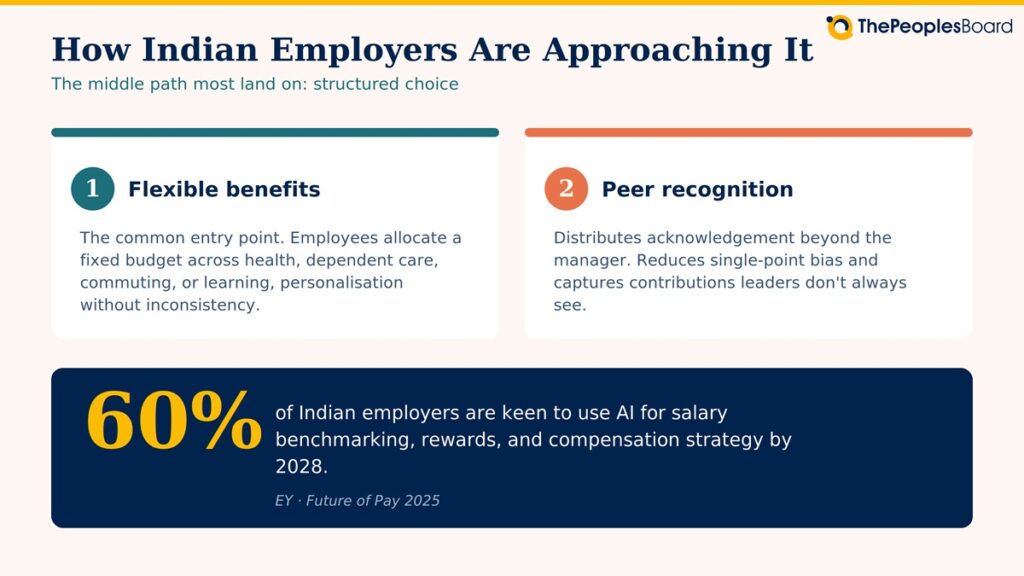
Flexible benefits are the most common entry point. Letting employees allocate a fixed benefits budget across health, dependent care, commuting, or learning gives personalisation without opening the door to inconsistency. Employee experience platforms have made this easier to run at scale. As TPB noted in its analysis of employee experience platforms, the EY Future of Pay 2025 report found 60% of Indian employers keen to use AI for salary benchmarking, rewards, and compensation strategies by 2028.
Peer recognition is the second lever. It distributes acknowledgement beyond the manager, which both reduces single-point bias and captures contributions leaders don’t always see. Research links peer-driven recognition to measurably higher engagement than top-down programmes alone.
The design principles that separate programmes that work from those that don’t:
- Tie recognition to specific behaviour, not tenure alone. Long-service-only awards, common in legacy Indian manufacturing and PSU environments, tend to disengage newer high performers who see no near-term path to acknowledgement.
- Make the criteria visible. Employees should understand why one person received a reward and how they could earn the same. Transparency is what converts personalisation from favouritism into fairness.
- Keep the recall window short. Recognition works best when it’s timely. A win acknowledged the same week lands harder than one saved for the annual cycle.
- Measure across demographics. Pull recognition data quarterly by gender, tenure, and role to catch the gaps that personalisation can otherwise hide.
- Invest in manager capability first. Training managers on how to recognise well typically produces a larger lift than any single new perk.
So, Should Rewards Be Personalised?
For most Indian employers, the answer is a qualified yes. Personalisation raises the ceiling on what recognition can achieve, because a reward that matches the person carries more weight than one that doesn’t. The data on engagement, retention, and cost efficiency all point the same way.
But the qualifier matters. Personalisation only works inside a structure that keeps it fair, transparent, and measurable. Strip out that structure, and the same practice that builds loyalty starts eroding trust. The organisations getting it right aren’t the ones spending the most. They’re the ones designing the most carefully, and the difference shows up in whether employees feel the recognition or ignore it. TPB has explored this shift in depth in its look at why recognition matters for retaining the new-age workforce.
In the End…
Personalised rewards are worth pursuing, but they are not a shortcut. The choice isn’t really between uniform and personalised. It’s between recognition that is designed and recognition that is improvised. A tailored reward inside a fair, visible framework outperforms both a generic catalogue and an unstructured one.
Before rolling out personalisation, HR teams should audit their current recognition data for the gaps that already exist, define the criteria employees can see, and equip managers to deliver acknowledgement that feels specific rather than scripted. Get those foundations right, and personalisation becomes a genuine retention lever. Skip them, and it becomes one more source of friction.
FAQs
Should employee rewards be personalised?
For most Indian employers, yes, with a qualifier. Personalised rewards raise engagement, retention, and cost efficiency, because a reward that matches the person carries more weight than a uniform one. But personalisation only works inside a structure that keeps it fair, transparent, and measurable. Strip out that structure and the same practice that builds loyalty starts eroding trust.
What does personalising employee rewards actually mean?
It doesn’t mean negotiating a bespoke package with every employee. It means building enough choice and relevance into the system that the reward matches the person receiving it. The variables most often tailored are reward type (cash versus paid time off, learning stipends, or wellness benefits), delivery style (public versus private recognition), timing, source (manager, peer, or leadership), and life stage or role.
Do personalised rewards cost more than uniform rewards?
No. Vantage Circle’s State of Recognition & Rewards 2025 found that 84% of the most effective recognition programmes spend under USD 100 per employee per year. The differentiator was design quality, not budget size. Programmes built on a full design framework scored an average effectiveness rating of 64, nearly double the 34 recorded by programmes lacking systematic design.
What are the risks of personalising employee rewards?
Three main risks. The first is perceived unfairness, when employees who don’t understand the logic read differences as favouritism. The second is administrative drag, when tailoring at scale lacks a platform or clear framework and collapses into ad-hoc decisions. The third is bias, when personalisation without measurement widens existing gaps across gender, tenure, and role rather than closing them.
How are Indian employers personalising rewards?
Most land on structured choice: a defined framework with room for individual preference inside it. Flexible benefits are the most common entry point, letting employees allocate a fixed budget across health, dependent care, commuting, or learning. Peer recognition is the second lever, distributing acknowledgement beyond the manager and reducing single-point bias.