

Most merger and acquisition (M&A) post-mortems read the same way. The numbers were sound, the strategic logic was solid, the synergies looked real on the spreadsheet. And yet the deal underdelivered. Ask why, and the answer is rarely in the financial model. It sits with the people who were expected to make the combined organisation work, and who quietly decided not to.
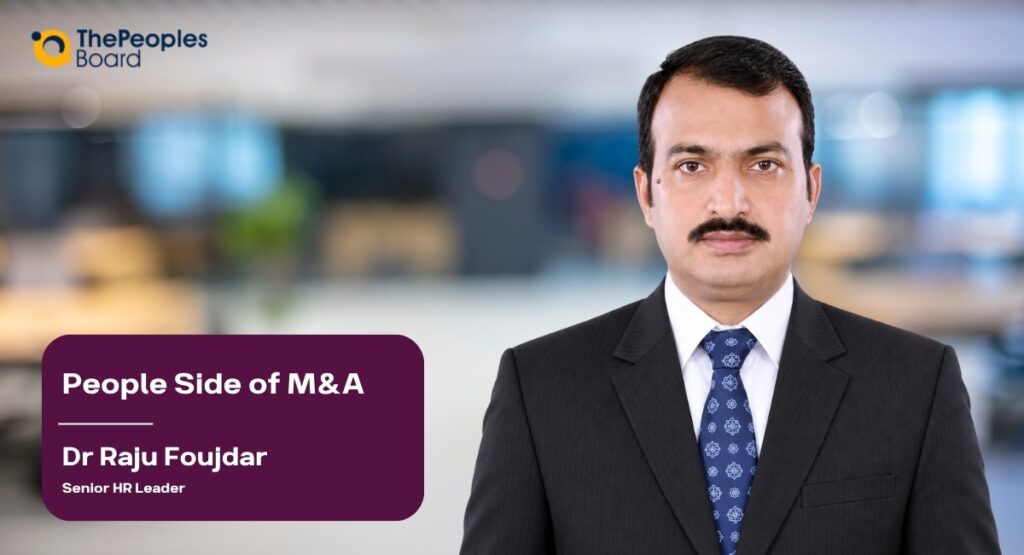
Dr Raju Foujdar has spent his career on that side of the deal, where culture, communication, and human capital decide whether an integration holds together or falls apart. In this conversation, he makes a case that HR practitioners will recognise instantly, but that dealmakers still routinely ignore. In an M&A, the people risk isn’t a soft risk. It’s the deal risk.
TPB Team: When companies focus on the financial and operational side of an M&A deal, what people-related issues are most likely to get overlooked?
Dr Raju: Mergers and Acquisitions (M&A) is a scientific process when people are involved. Unfortunately, people-related issues take a back seat in M&A deals. Organisations that understand the value of Human Capital take it quite seriously. Let’s not forget the words of “Field Marshal Manekshaw post India’s victory over Pakistan. When he was questioned on how India could ensure a win – even when Pakistan has the latest Technology and weapons. Field Marshal replied – It’s not the machines that make the difference; it’s the people behind the machines who have the impact of making a difference.
The people-related issues, which are generally overlooked, are such as: leadership uncertainty, key-talent retention, culture differences, employee anxiety about their future, compensation and benefits inequities, career-path uncertainty, employee identity and status, communication quality, “survivor” effects, integration challenges, different management philosophies, employee relations and people issues, diversity and inclusion impacts, customer-facing employees, and psychological contract.
TPB Team: At what point in the M&A process should HR and people considerations enter the conversation?
Dr Raju: If M&A has to be made successful and high performance oriented – HR should be involved the moment any such proposal is put on the table for discussions. HR is not just an enabling function now – they are a business partner.
TPB Team: How early should companies start thinking about cultural compatibility between the two organisations?
Dr Raju: Before the deal: Identify major cultural similarities and differences during due diligence. Assess leadership styles, decision-making, communication, risk tolerance, incentives, employee expectations, and organisational values.
The key point is that culture should influence the decision to pursue the deal, not merely the way the deal is implemented.
In practice, the earlier companies identify cultural differences, the more options they have to manage them. By the time the deal closes, major cultural problems can already be much harder and more expensive to fix.
A company can have strong financial and strategic reasons for an acquisition, but significant cultural incompatibility can lead to employee turnover, leadership conflict, poor collaboration, and ultimately failure to realise the expected synergies.
TPB Team: What are some early signs that employees are struggling with an acquisition or merger, even when the integration appears to be going smoothly?
Dr Raju: The first sign which is observed immediately is “We V/S They”. This shows that cultural differences are cropping up. The more early signs are: increased employee turnover, lower engagement, more absenteeism, declining productivity, deliberate failures, silence in meetings, Informal resistance, increased internal conflict, loss of collaboration, rumours and informal communication, reduced discretionary effort, Managers becoming overloaded, key employees becoming distant, employee confidence and commitment deteriorating underneath.
TPB Team: How much can differences in culture, leadership styles, or ways of working actually affect the success of an M&A?
Dr Raju: The further effect can be an adverse effect on employee retention, transaction leadership conflicts, slowing down integration speed, employees’ engagement with new Management, Customer relationships and realisation of synergies. Ultimately, financial and strategic fit may justify doing the deal, but cultural and leadership fit often determine how successfully the deal is executed.
TPB Team: What tends to happen when organisations try to impose one company’s culture on the other after a merger?
Dr Raju: When organisations combine, and the acquiring organisation tries to impose its culture, common outcomes include: Employee resistance, Loss of key talent, “Us vs them” mentality, Lower engagement and morale, Loss of valuable practices, reduced psychological safety, Surface-level compliance, Slower integration. Successful integrations often focus less on “Which company’s culture wins?” and more on “What culture does the combined organisation need?”
TPB Team: Employee uncertainty is common during M&A. What can leaders do to address concerns around job security, roles, and reporting structures?
Dr Raju: Employee confusion/uncertainty is one of the biggest human capital challenges during M&A. Leaders cannot always guarantee job security or immediate clarity, but they can reduce uncertainty by communicating honestly, consistently, and early.
However, effective approaches are: Communicate early and regularly; be honest about what is known and unknown; explain the timeline; clarify roles as quickly as possible; give managers the information they need; create channels for questions (town halls, Q&A sessions); treat employees fairly and consistently; recognise the emotional impact; and focus on what employees can control.
TPB Team: How should companies communicate with employees when they don’t yet have all the answers?
Dr Raju: When such M&A Activities are underway, the Managers and Leaders might not have clarity on all things. A better message is: “We don’t have all the answers yet, but here is what we know, here is what we are still deciding, and here is when you can expect the next update.”
That kind of transparency can make employees feel more secure even when difficult decisions are still ahead.
TPB Team: What happens to high-performing or critical employees during an M&A, and how can organisations prevent unwanted attrition?
Dr Raju: High-performing and critical employees are more likely to leave during an M&A than organisations expect, because they usually fall prey to strong competitors’ poaching strategies and are particularly sensitive to uncertainty about their future. What organisations can do: Identify critical talent early, understand why they stay, communicate directly with key employees, provide clarity about their future, use retention incentives carefully, give people a meaningful role in the integration, protect what makes them effective, and monitor attrition continuously.
The key lesson: Retention isn’t just about convincing employees to stay; it’s about giving them a compelling reason to stay.
TPB Team: Are there particular employee groups or roles that companies tend to overlook during integration?
Dr Raju: Yes. M&A integration often focuses heavily on senior executives and obvious high performers, while several other groups can be overlooked even though they are critical to making the combined organisation work.
Employee groups often overlooked in M&A include middle managers, Front-line employees, Long-tenured employees, Specialists and technical experts, Administrative and support staff, Employees in acquired or smaller locations, newer employees, employees without management visibility, and Employees with critical external relationships. An employee’s importance isn’t always reflected in their title. Someone managing an important customer, supplier, regulator, or strategic partner can be extremely valuable.
TPB Team: How should organisations approach differences in compensation, benefits, policies, and employee expectations between the two companies?
Dr Raju: Organisations should approach differences in compensation, benefits, policies, and employee expectations as both a fairness issue and an integration risk. The goal should not simply be to make everything identical immediately, but to create a consistent, transparent, and defensible approach.
The golden approach in harmonisation can be: Conduct a detailed comparison before closing, Identify the reasons behind the differences, Look for significant inequities, Develop clear principles for harmonisation, Communicate what will and won’t change, Avoid making promises too early, Pay particular attention to managers
Allow for local differences where appropriate; and monitor employee reactions.
TPB Team: What role should the leadership team play in making employees feel that the two organisations are becoming one, rather than simply being combined on paper?
Dr Raju: Leadership has a critical & central role in turning an M&A from a legal/structural combination into a genuinely integrated organisation. Employees tend to take their cues from what leaders say, but even more from what leaders consistently do.
Key & critical roles for leadership involve: Create a shared vision, Demonstrate unity at the top, Build a shared identity, Respect both legacies, Model the desired culture, Make integration visible, Communicate consistently, Address “us versus them” behaviour, Recognise and reward collaboration, Give employees a role in shaping the new organisation, The most important point. Employees judge integration by leadership behaviour, not the organisational chart.
If the leadership team says, “We are now one company,” but senior positions are divided by legacy company, teams continue to compete, and decisions favour one side, employees will quickly recognise the gap. The leadership should demonstrate the traits in their behaviour and not just in dialogue. People notice the behaviour and actions.
A successful leadership approach is therefore not about forcing employees to forget their previous organisation. It is about creating a credible shared future that employees from both organisations can identify with.
TPB Team: Can you share an example of a people or culture issue that seemed minor during an M&A but eventually had a much bigger impact?
During one of the M&A of a shut-down unit, we noticed that the involvement of line people was very low, and the same was reflected in employee engagement. When we decided to address the employees as part of the deal, the number shared with us was very low, as per our assessment. When we asked the previous organisation why the number was so low, they confirmed that they don’t want workers and line people to be involved in the town hall with our Top Management and Promoters.
We insisted and postponed the event for the next day, just to ensure that each and every employee is present in our first town hall. We got 100% attendance as soon as this message spread out. We had seen the line people in tears after that interaction. This helped ease the harmonisation process of both cultures. That unit was in loss due to Employee relations and IR. After that town hall, IR issues were reduced to negligible levels, and we ensured that the plant was at its production capability. It’s successfully and fully operational now and making huge profit. Even the trade union got non-registered. Today involvement in “Business Excellence” from that category is very very high and employee engagement increased tremendously.
Let’s remember Sir Henry Ford’s words: “You can take all my wealth, you can take my factories – Give me my people, I will start it tomorrow right again” This gives a true demonstration of people power and culture.
In the End…
If there’s one thread running through Dr Foujdar’s answers, it’s that employees judge an integration by what leaders do, not by what the org chart says. A merger can be legally complete and still fail the only test that matters, which is whether people from both sides can identify with a shared future. The uncertainty, the retention risk, the “us versus them” reflex: none of these is edge cases to be managed after the deal closes. They are the deal. And the earlier HR sits at the table, the more options the organisation has to get them right.
For HR leaders, the takeaway is less a checklist than a mindset. Treat the people side as the science it is. Communicate honestly even when the answers are incomplete. And remember that retention is never about persuading people to stay. It’s about giving them a reason worth staying for. The machines, as Dr Foujdar reminds us, were never the difference. The people behind them always were.