

Across India, several large employers have walked back remote-work flexibility over the past year, and engagement, not just cost or productivity, keeps coming up as the reason. HR teams running fully remote or work-from-home (WFH) programmes are finding that the engagement playbook built for offices, or even for hybrid teams, does not translate cleanly to employees who never walk into a workplace.
The problems are not the same ones global remote-work research talks about. They are shaped by India’s infrastructure, its labour law gaps, its joint-family living arrangements, and a workplace culture still calibrated around physical presence.
This piece looks at what makes remote employee engagement in India structurally different, not just harder, and what HR teams are doing about it.
Why Fully Remote Engagement is Its Own Problem
Most Indian engagement conversations today are framed around hybrid work, because that is where most large employers have landed. But a meaningful segment of India’s workforce still runs on fully remote or majority-remote arrangements, including:
- Startups with distributed teams
- Global capability centres (GCCs)
- BPO/ITES firms with distributed delivery models
This population faces a different risk profile than hybrid employees. Gallup’s State of the Global Workplace 2026 report found that employee engagement in India fell to 23% in 2025, the lowest level in four years. TPB’s earlier coverage of India’s engagement decline breaks down how steeply this drop hit specific cohorts.
What is less discussed is the location-specific dimension of that decline:
- Fully remote employees: 25% report loneliness
- Hybrid employees: 21% report loneliness
- On-site employees: 16% report loneliness
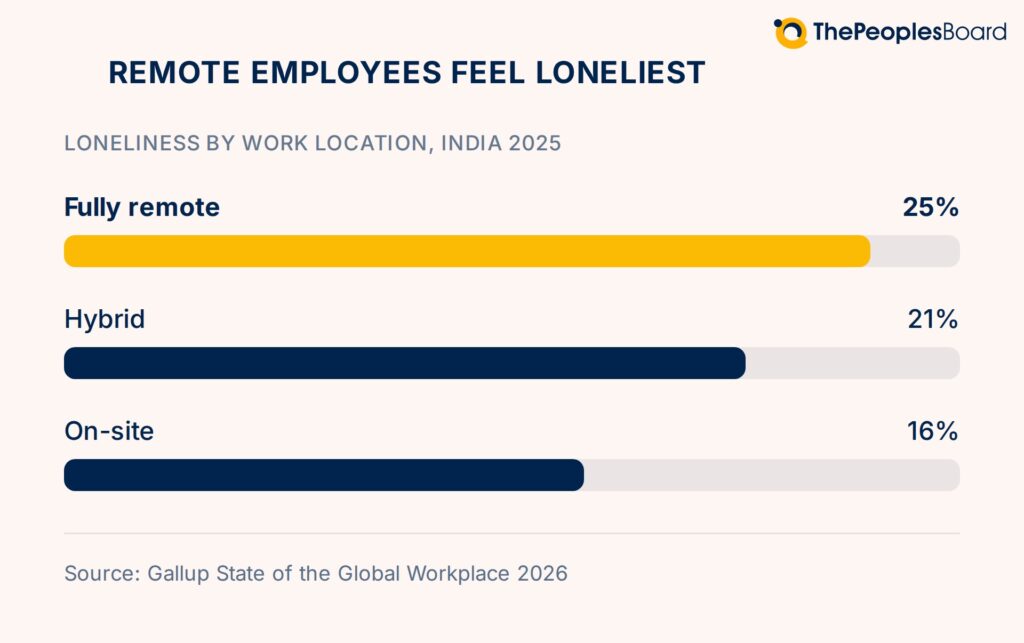
This is the largest gap Gallup found across any variable it studied (Gallup, 2026). Loneliness is not a soft metric either. Gallup’s data shows engaged employees are 64% less likely to report loneliness than disengaged ones, meaning the two problems feed each other. A remote employee who starts feeling disconnected disengages faster, and a disengaged remote employee has fewer built-in ways to reconnect than someone who at least shares a lunch table twice a week.
The India-Specific Layer: What Global Research Misses
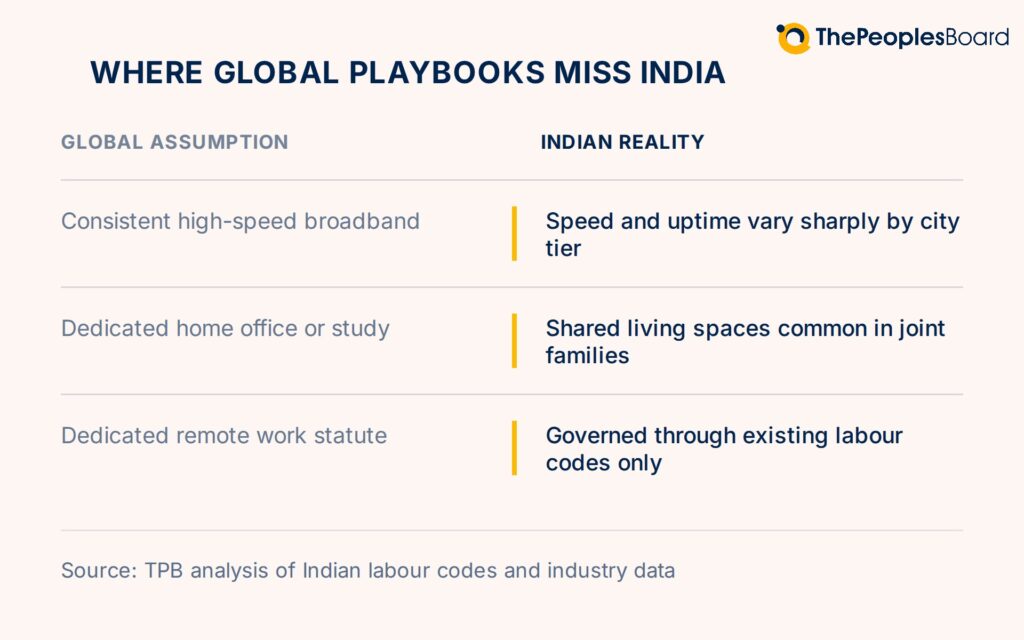
Global remote-work studies, largely US and European in origin, assume certain baseline conditions that Indian teams often cannot:
| Factor | Global Assumption | Indian Reality |
| Connectivity | Consistent high-speed broadband | Speed and uptime vary sharply by city tier; power outages remain routine outside metros |
| Home workspace | Dedicated office or study | Shared living spaces common in joint families and smaller apartments |
| Legal framework | Remote work often has dedicated statute | No standalone Indian law; governed through existing labour codes and contracts |
| Manager training | Remote management is an established discipline | Many managers promoted under office-first assumptions, with limited remote-specific training |
| Attendance culture | Output-based trust is common | Presence-based evaluation still influences appraisals in many firms |
Each of these gaps changes what “engagement” has to solve for. A US-style virtual town hall or Slack recognition badge does little for an employee whose internet drops during the meeting, or who is sharing a one-bedroom flat with three family members and cannot find fifteen private minutes for a wellness call.
Infrastructure as an Engagement Variable
HR teams tend to treat connectivity as a facilities issue. For fully remote Indian employees, it is closer to a psychological safety issue. An employee who repeatedly drops off calls due to unreliable internet does not just lose productivity. Over time, this pattern shows up as:
- Avoiding visibility altogether
- Skipping optional meetings
- Staying quiet in discussions
- Becoming harder to recognise or promote
This looks like disengagement on paper, when the root cause is structural. It is also measurably worse outside India’s top metros. Tier 2 and Tier 3 cities have expanded fibre access rapidly, but reliability still lags metro-grade uptime, and shared household connections during peak hours remain common in these markets as per Tata Play Fiber industry analysis.
Companies hiring remote talent from smaller cities to widen talent pools and manage costs are effectively importing an infrastructure risk into their engagement metrics without accounting for it.
The Regulatory Grey Zone
Unlike some other markets, India has no standalone law governing remote or WFH arrangements. Two developments matter here:
- The Industrial Relations (IR) Code, through its Draft Model Standing Orders for the service sector (2025), formally recognises WFH as a valid employment arrangement.
- The Occupational Safety, Health and Working Conditions (OSH & WC) Code, 2020 extends baseline welfare duties to remote employees.
Enforcement in practice, however, depends heavily on individual employer policy and recordkeeping. Without a clear statutory floor, remote employees at smaller Indian firms often have working-hour boundaries, overtime pay, and even basic workspace safety standards left to informal policy rather than enforceable rights.
Employees who sense their arrangement rests on employer goodwill rather than legal footing tend to engage more cautiously, holding back discretionary effort they would otherwise invest.
Standard working hours under most state Shops and Establishments Acts still cap at 48 hours a week for remote staff, with overtime compensated at double the regular wage. Codifying this clearly, rather than leaving it implied, removes one source of quiet anxiety that erodes trust over time.
Proxy Attendance and the Trust Deficit
A pattern specific to parts of India’s IT and ITES sector deserves direct mention: proxy attendance and moonlighting concerns, where employees log in on behalf of colleagues or hold undisclosed second jobs during remote hours. Several large IT firms tightened monitoring and biometric verification policies through 2023 and 2024 in direct response to this.
The engagement cost is asymmetric:
- A small minority of employees engaging in proxy behaviour triggers monitoring policies that affect the entire remote workforce.
- Employees who feel surveilled rather than trusted report lower engagement, even when their actual working conditions have not changed.
- The psychological contract shifts from “we trust you to deliver” to “we are watching you deliver.”
HR teams managing this tension need to separate performance monitoring, which protects business interests, from engagement monitoring, which should stay focused on wellbeing and connection rather than surveillance.
Isolation, Career Visibility, and the “Out of Sight” Penalty
Beyond infrastructure and regulation, Indian remote employees face a career-specific risk: reduced visibility to decision-makers. India’s workplace culture, across IT, BFSI, and manufacturing-adjacent services, has historically rewarded presence.
Senior leaders form impressions of readiness and reliability through informal, in-person signals: corridor conversations, being seen staying late, volunteering visibly in meetings. However, remote employees lose access to almost all of these signals.
This shows up directly in promotion and staffing decisions. Employees working from home for extended stretches often report being passed over for high-visibility projects, not because of performance gaps, but because they were not top-of-mind when opportunities came up.
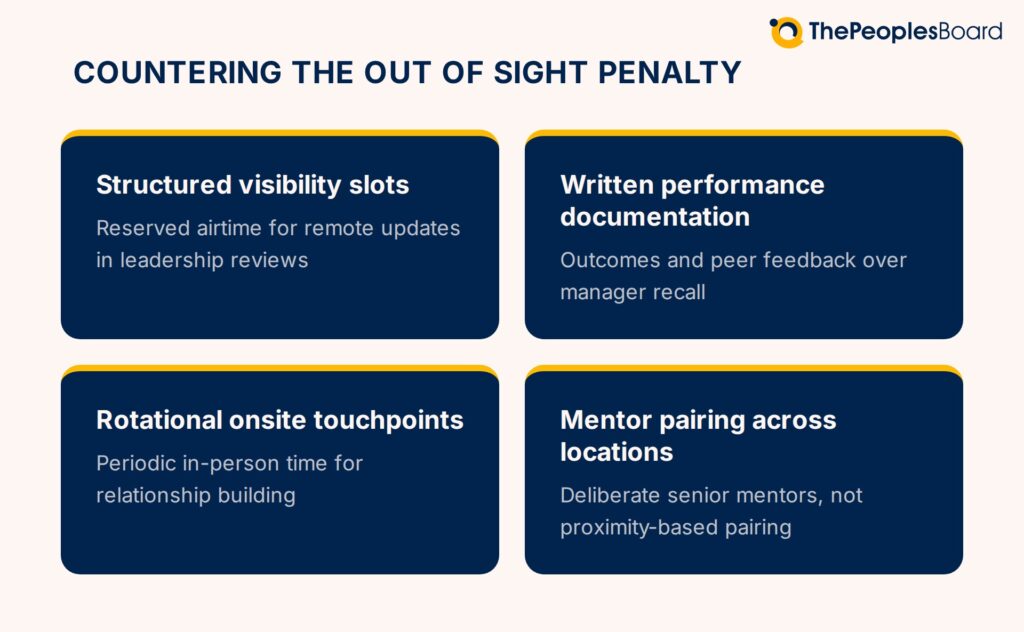
A few practical shifts HR teams are testing to counter this:
- Structured visibility slots: Reserving a portion of leadership review meetings specifically for remote-team updates, rather than letting in-office teams dominate airtime by default.
- Written performance documentation: Shifting appraisal inputs toward documented outcomes and peer feedback rather than manager recall, which favours whoever the manager saw most often.
- Rotational onsite touchpoints: Bringing remote employees into a physical location periodically, not for productivity, but specifically for relationship-building with leadership and cross-functional peers.
- Mentor pairing across locations: Assigning senior mentors deliberately to remote employees rather than leaving mentoring to proximity-based, organic pairing.
None of these fixes is a new idea globally. What is different is the scale of the gap they need to close in India, where informal, presence-based signalling has historically carried more organisational weight than in flatter, more documentation-driven Western corporate cultures.
What HR Teams Are Actually Measuring
A recurring mistake is measuring remote engagement with the same survey used for the entire company, then averaging the result. This masks exactly the population that needs attention. HR teams getting a better signal are segmenting data specifically:
- Engagement scores split by work location (fully remote, hybrid, on-site), not blended into one company-wide number.
- Manager engagement tracked separately from individual contributor engagement. Gallup’s India data shows manager engagement fell more steeply than IC engagement between 2024 and 2025, and disengaged managers pass that disengagement down to their remote reports faster than to in-office ones, since remote reports have fewer alternative sources of organisational connection.
- Tenure-banded segments, since early-tenure remote hires who never experienced in-person onboarding show measurably different disengagement patterns than employees who joined in-office and later shifted remote.
- Attrition regret data specifically from remote exits, to identify whether departing remote employees cite isolation, career stagnation, or compensation as the primary driver, since the intervention differs for each.
Companies running outcome-based performance frameworks rather than hours-tracked systems report this segmentation is easier to act on, because it isolates whether a dip is about the work itself or about connection and visibility.
In The End…
Fully remote engagement in India is not a smaller version of the hybrid engagement problem. It runs into a different set of constraints: patchy infrastructure outside metro cores, a labour law framework still catching up to remote arrangements, a workplace culture built on physical visibility, and trust dynamics complicated by proxy attendance concerns unique to parts of the Indian services sector.
The companies managing this well are not the ones running the most virtual town halls. They are the ones treating remote engagement as an infrastructure, policy, and visibility problem simultaneously, not just a culture one. That means:
- Auditing WFH policies against actual labour code provisions
- Building deliberate visibility mechanisms for remote staff rather than assuming merit will surface on its own
- Measuring remote and on-site engagement as genuinely separate populations rather than blending them into a single, misleading average
The harder question every HR leader should be asking isn’t whether remote work hurts engagement. It’s about whether their organisation has actually built systems designed for people who are never in the room, or is still running an office-era playbook with a video call bolted on.
FAQs
Why is remote employee engagement in India different from hybrid engagement?
Remote employees in India face structural barriers hybrid staff do not, including unreliable internet outside metro cities, no standalone remote work law, and reduced visibility to leadership. Gallup’s 2026 data shows fully remote employees report loneliness at 25%, compared to 21% for hybrid and 16% for on site staff.
Does India have a law governing work from home arrangements?
No standalone law exists yet. Remote work is addressed indirectly through the Industrial Relations Code’s Draft Model Standing Orders for the service sector and the Occupational Safety, Health and Working Conditions Code, 2020, with enforcement depending heavily on individual employer policy.
Why do internet and infrastructure issues affect employee engagement?
Repeated call drops and connectivity gaps push remote employees to avoid visibility, skip meetings, and stay quiet in discussions, a pattern that looks like disengagement but is actually rooted in infrastructure quality, especially in Tier 2 and Tier 3 cities.
What is proxy attendance and how does it affect remote teams in India?
Proxy attendance refers to employees logging in on behalf of colleagues or holding undisclosed second jobs during remote hours, a pattern seen in parts of India’s IT and ITES sector. It has led firms to tighten monitoring, which can lower engagement across the entire remote workforce even among employees who never engaged in the behaviour.
How can HR teams fix the “out of sight” penalty for remote employees?
HR teams are testing structured visibility slots in leadership reviews, written performance documentation over manager recall, rotational onsite touchpoints, and deliberate mentor pairing across locations to counter reduced visibility for remote staff in promotion and staffing decisions.
How should companies measure remote employee engagement accurately?
Companies should segment engagement scores by work location instead of blending them into one company-wide number, track manager and individual contributor engagement separately, and analyse attrition regret data specifically from remote exits to identify whether isolation, career stagnation, or compensation is driving departures.