


Every wrong hire leaves a balance sheet entry that most Indian organisations never record. The salary shows up in payroll. The recruitment fee shows up in the TA budget. But the compounding cost, the interest that accrues quietly on a poor hiring decision, rarely appears anywhere. That accumulated liability is recruitment debt, and for HR and talent acquisition leaders, it’s one of the most underpriced risks in the function.
The concept borrows from technical debt in software. A team ships a quick fix to hit a deadline, and the shortcut works until the interest comes due in bugs, rework, and slower releases. Hiring behaves the same way. A rushed offer, a skipped reference check, a candidate waved through on gut feel: each shortcut buys speed today and charges compounding interest later.
What Does a Bad Hire Cost in India?
A single wrong hire in India costs far more than the recruitment fee. The commonly cited global floor, from the U.S. Department of Labour, puts the cost of a bad hire at least 30% of the employee’s first-year earnings. SHRM’s fuller accounting stretches that range to between 50% and 200% of annual salary, with senior roles clustering toward the upper end.
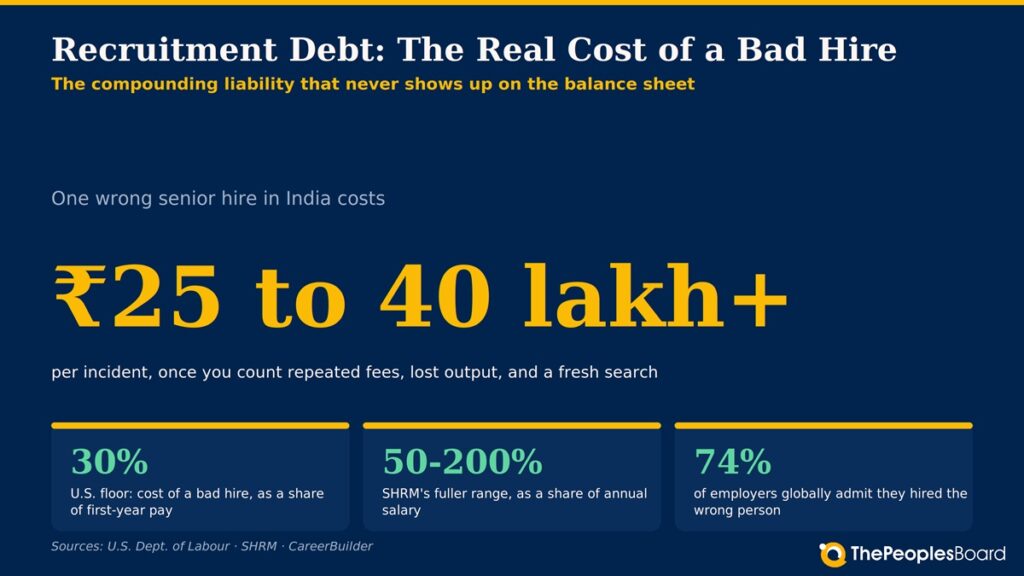
Indian numbers tell a sharper story. At the ₹15 to 25 LPA level, a poor hire costs the average employer between ₹7.5 lakh and ₹18 lakh once you account for recruitment fees, salary paid during the performance gap, lost productivity, and the cost of restarting the search. At ₹30 LPA and above, that figure consistently crosses ₹25 to 40 lakh per incident.
The scale of the problem is not marginal. In India, 84% of companies report being significantly affected by a bad hire, and 29% say a single wrong hire cost them over ₹20 lakh, according to industry survey data. Globally, CareerBuilder found that 74% of employers admit they’ve hired the wrong person for a role.
Here’s how the cost stacks up by seniority in the Indian market:
| Role Level | Typical Annual CTC | Estimated Cost of a Bad Hire | Primary Cost Drivers |
| Entry / Junior | ₹4 to 8 LPA | 30% to 50% of CTC | Re-recruitment, onboarding, ramp-up loss |
| Mid-Senior | ₹15 to 25 LPA | ₹7.5 to 18 lakh | Agency fees repeated, 15% to 20% team productivity drop, manager time |
| Senior / Leadership | ₹30 LPA and above | ₹25 to 40 lakh plus | Strategic delays, direct-report attrition, decision damage |
The pattern is consistent across every study: the cost scales sharply with seniority, and the visible recruitment fee is the smallest line in the ledger.
Why Recruitment Debt Compounds Instead of Just Adding Up
A one-time cost you can absorb. Debt is different, because it grows while you’re not looking. When repeated, certain mechanisms turn a single poor hire into a compounding liability.
Re-recruitment repeats the full bill
In most Indian mid-senior searches, the backfill goes straight back to the same agency or job board that produced the original hire. There’s rarely a root-cause review of why the first hire failed before the search restarts. So the entire recruitment cost, agency fee, screening time, and interview rounds get incurred a second time on top of the first.
Team productivity drops around the bad hire
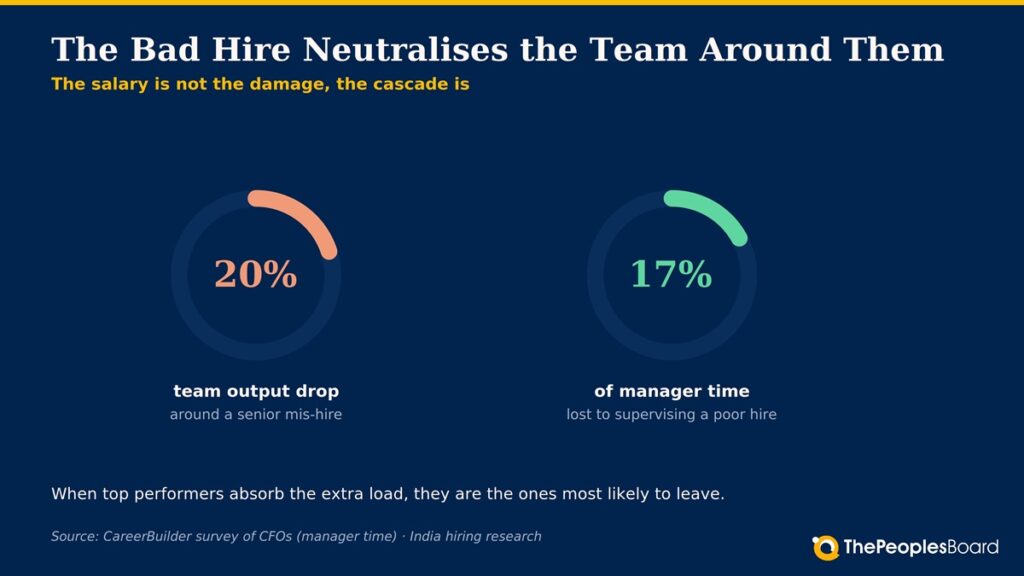
Research consistently shows team output falls 15% to 20% when a senior mis-hire disrupts the workflow. Projects slip. Peers absorb the slack. And the best performers, the ones quietly picking up the extra load, are the ones most likely to start looking elsewhere.
Manager time gets redirected to damage control
A CareerBuilder survey of CFOs found managers spend roughly 17% of their time supervising a poor hire. That’s time pulled away from strategy, coaching, and the rest of the team, and it doesn’t show up in any cost-per-hire calculation.
Attrition begets attrition
When a wrong hire lands in a team, attrition tends to spread. Confidence in leadership erodes, engaged employees disengage, and the replacement cycle starts again. India’s IT sector shows how expensive this churn already is even without factoring in mis-hires: in Q3 FY26, voluntary attrition sat at 12.3% at Infosys, 13.5% at TCS, 14.2% at Wipro, and 12.4% at HCL Tech. Every point of that, multiplied across headcounts in the hundreds of thousands, is replacement cost.
The bad hire isn’t just consuming their own salary. They’re neutralising the productivity of the manager above them and the team around them, and that cascade is where recruitment debt does its real damage.
Where the Debt Originates: The Shortcuts That Cost Most
Recruitment debt is almost always self-inflicted at the point of decision. The same failure points show up across Indian and global hiring post-mortems.
- Speed over suitability: When a role stays open too long, or a team is stretched thin, managers rush. CareerBuilder’s analysis attributes 38% of hiring failures to panic hiring, where the pressure to fill a seat overrides careful evaluation.
- Vague or inflated job descriptions: Unclear success criteria attract the wrong candidates and make objective evaluation almost impossible. If nobody agrees what “good” looks like, everybody guesses.
- Skipping structured interviews: Unstructured, conversational interviews are one of the most reliable predictors of a wrong hire, because they measure rapport rather than capability. A structured behavioural interviewing approach tied to defined competencies narrows the gap.
- Treating reference and background checks as a formality: A real conversation with a former manager surfaces patterns a CV can’t. Robust background verification matters even more in regulated sectors, where a single fake credential creates compliance and liability exposure, not just embarrassment.
- Hiring for skill, ignoring fit: Even highly capable people underperform when their working style clashes with the environment. CareerBuilder’s data attributes the majority of hiring failures to attitudinal misalignment rather than technical gaps.
Each shortcut feels reasonable under deadline pressure. That’s exactly why the debt accrues so quietly.
How TA Leaders Can Pay Down and Prevent Recruitment Debt
You can’t eliminate hiring risk, but you can price it, track it, and reduce the interest rate. With the right moves, the liability can be decreased even when the hiring process is not perfect.
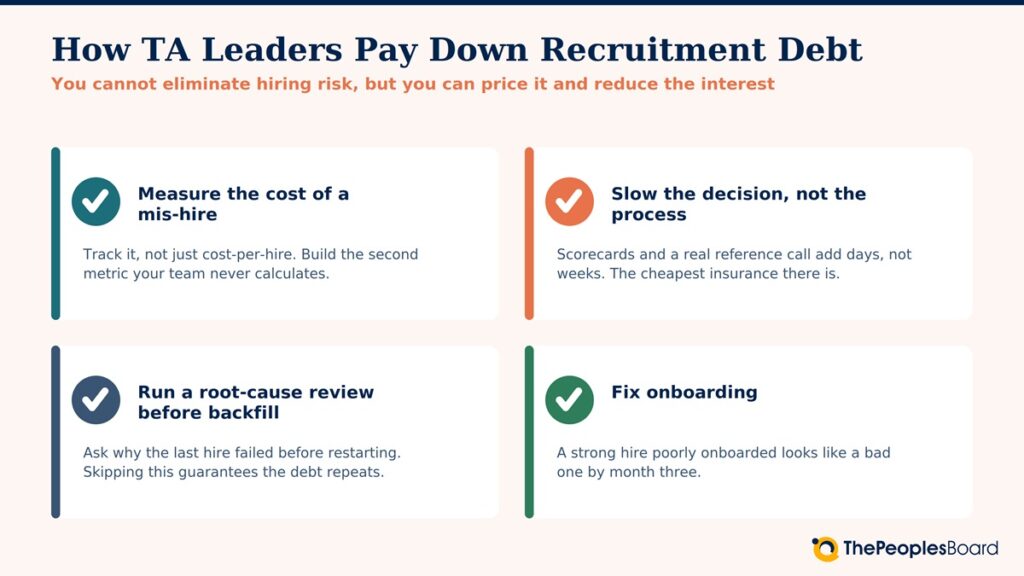
Measure the cost of a wrong hire, not just cost-per-hire
Most Indian HR teams track time-to-hire and cost-per-hire diligently and never calculate the cost of a mis-hire at all. Build the second metric. A workable formula:
Cost of Bad Hire = Recruitment cost (repeated) + (Annual CTC × 0.30) + (Manager monthly salary × months employed × 0.17) + productivity loss across the team
Run it once on a real recent example. The number usually reframes the whole conversation about hiring speed.
Slow the decision, not the process
Structured interviews, defined scorecards, and a genuine reference conversation add days, not weeks. Against a mis-hire that costs months of salary and team output, that’s the cheapest insurance available.
Run a root-cause review before every backfill
Before the search restarts, ask why the last hire failed. Was it the job description, the interview loop, the onboarding, or the fit assessment? Skipping this step is what guarantees the debt repeats.
Fix onboarding, because it’s where good hires are lost
A strong candidate poorly onboarded becomes indistinguishable from a bad hire by month three. A structured onboarding process protects the recruitment investment you’ve already made.
In the End…
Recruitment debt is real, measurable, and almost always invisible on the books until it’s already compounding. The organisations that stay out of debt aren’t the ones that hire fastest. They’re the ones that treat every hiring decision as a loan they’ll have to service, and that price the interest before they sign the offer.
Pick one open role this quarter, run the true cost-of-a-bad-hire formula on your last failed hire in that seat, and take that number to your next hiring-manager conversation. It’s the fastest way to turn recruitment debt from an invisible liability into a metric your function actually manages.
FAQs
What is recruitment debt?
Recruitment debt is the compounding cost that accrues on a poor hiring decision. Like technical debt in software, a hiring shortcut buys speed today and charges interest later through re-recruitment, lost productivity, and manager time. It rarely shows up on any balance sheet, which is what makes it so easy to underprice.
How much does a bad hire cost in India?
At the ₹15 to 25 LPA level, a wrong hire costs the average Indian employer between ₹7.5 lakh and ₹18 lakh once you count repeated agency fees, salary paid during the performance gap, lost productivity, and a fresh search. At ₹30 LPA and above, that figure consistently crosses ₹25 to 40 lakh per incident. The cost scales sharply with seniority.
Why does a bad hire cost more than the recruitment fee?
The recruitment fee is the smallest line in the ledger. A senior mis-hire drops team output by 15% to 20%, pulls roughly 17% of a manager’s time into damage control, and often triggers attrition among the strong performers absorbing the extra load. That cascade, not the salary, is where recruitment debt does its real damage.
How do you calculate the cost of a wrong hire?
Most Indian HR teams track cost-per-hire but never calculate the cost of a mis-hire. A workable formula: recruitment cost (repeated) + (annual CTC × 0.30) + (manager monthly salary × months employed × 0.17) + team productivity loss. Run it once on a real recent example, and the number usually reframes the whole conversation about hiring speed.
How can TA leaders reduce recruitment debt?
Measure the cost of a mis-hire, not just cost-per-hire. Slow the decision without slowing the process, using structured interviews, defined scorecards, and a genuine reference conversation. Run a root-cause review before every backfill so the same mistake doesn’t repeat. And fix onboarding, because a strong hire poorly onboarded looks like a bad one by month three.