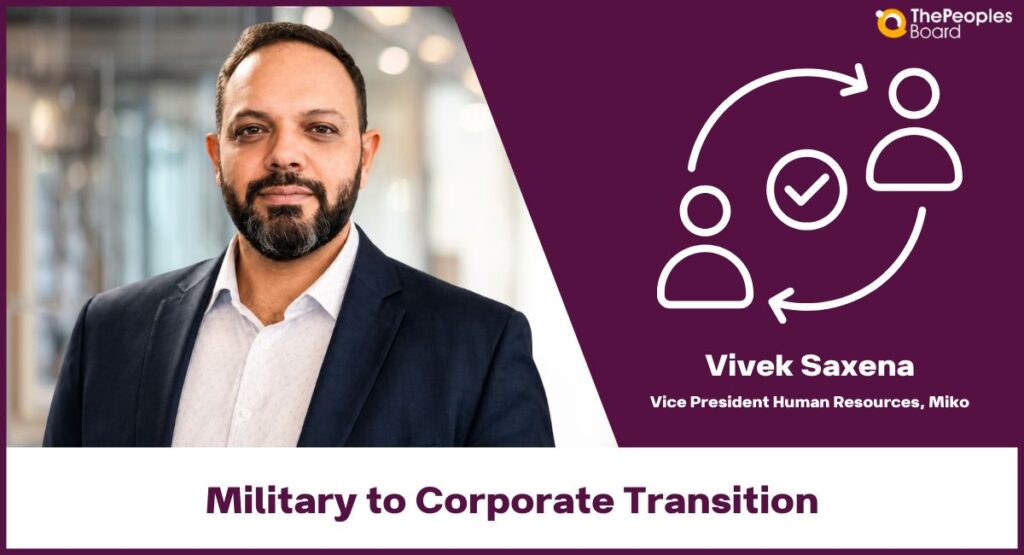
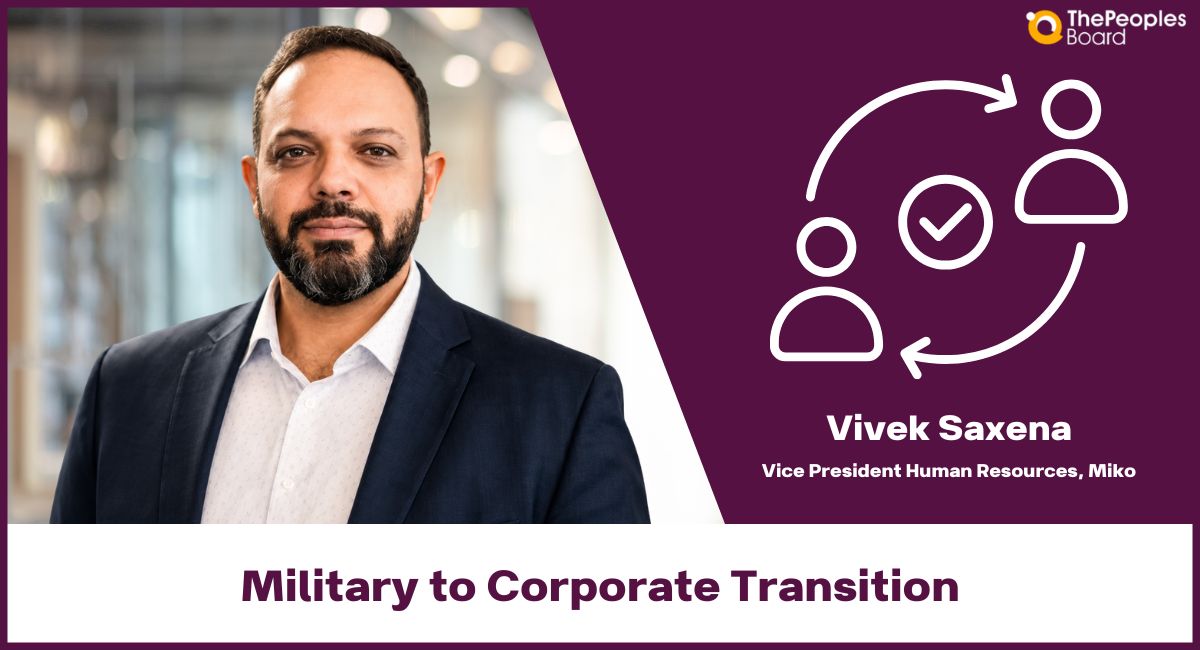

Vivek Saxena has spent 24 years learning what it means to lead — first as an Army officer across two decades of service, and now as Vice President of Human Resources and Group CHRO at Miko.ai. His transition from military to corporate life wasn’t just a change of uniform; it was a fundamental recalibration of language, influence, and identity. In this conversation with ThePeoplesBoard, Vivek speaks candidly about what he expected corporate life to be, what genuinely surprised him, and how principles forged in the field — accountability without caveats, feedback as a function, and investing in people before you need them — have shaped the kind of HR leader he has become.
TPB Team: What did you imagine corporate life would look like before you stepped into it?
Vivek: Honestly? I thought it would be structured, purposeful, and pretty straightforward — just without the uniforms and the early morning reveille.
After twenty years in the Army, I assumed companies ran on clear hierarchies, that decisions flowed logically from the top-down strategy, and that people largely pulled in the same direction. I expected the pace to be slower, the stakes lower, and the processes more documented. What I didn’t fully anticipate was how much ambiguity is just baked into corporate life. In the military, even in the fog of war, you have a clear doctrine, a chain of command, and a mission brief. In a fast-scaling startup, you often have none of that scaffolding. You’re essentially building the plane while flying it—and sometimes while interviewing the pilots 🙂
I had mentally prepared for that idea, but actually living it was something else entirely.
TPB Team: What was the first workplace behaviour that genuinely surprised you in your corporate role?
Vivek: It is genuinely the relationship people have with feedback.
In the Army, feedback is a sitrep (situation report)—it’s direct, immediate, and non-negotiable. It isn’t unkind; it’s functional. When outcomes depend on knowing exactly where you stand, there’s no room to soften a message until it disappears.
When I stepped into the corporate startup landscape, I saw something I hadn’t really encountered before: highly intelligent, capable professionals who were genuinely uncomfortable receiving direct feedback—and equally uncomfortable giving it. Observations got sugarcoated to the point where the actual message vanished. Everyone nodded in the meeting, but nothing changed afterward.
I had to learn a new vocabulary. Not to dilute the honesty, but to deliver it in ways that actually landed rather than making people defensive and shutting them down. That recalibration took time, and I won’t pretend it came naturally to me. Some days, it still doesn’t.
TPB Team: Which military skills did you expect to be useful, and which actually turned out to be?
Vivek: I expected planning, discipline, and execution rigour to translate well—and they did, though not always in the exact format I imagined.
What I didn’t expect to matter as much as it did was the ability to stay composed when the room has no answers. In a startup scaling across multiple countries, with shifting investor expectations and rapid hiring, chaos is the normal condition. There’s pressure, noise, and competing urgency constantly. The ability to hold a calm, decisive presence in that environment—to make a call with incomplete intel and stand behind it—turned out to be far more valuable than any specific process skill I brought.
Emotional intelligence (EQ) also surprised me. The Army develops it heavily—you are responsible for the welfare and morale of your troops in extreme conditions—but we rarely label it as “EQ.” In corporate HR, it turns out to be your primary weapon. Everything else is secondary.
TPB Team: What habits from your service days did you have to consciously unlearn at work?
Vivek: Two, immediately.
The first is assuming that a decision, once made, will simply be executed. In the military, an order carries immediate authority. In a founder-led startup, even a great decision needs to be sold, explained, and sometimes re-sold as the context shifts. I had to learn to build consensus—not as a compromise, but as a genuine leadership practice. That was a real adjustment.
The second is brevity as a default. Military communication is highly compressed—situation, task, intent, execution. It’s clean and fast. But corporate stakeholders, especially founders and boards, often need to see the reasoning behind a recommendation as much as the recommendation itself. I had to consciously expand how I communicated. Not because my thinking changed, but because the audience needed to see the “working out,” not just the final answer.
TPB Team: How does your military background shape the way you approach talent and performance today?
Vivek: Fundamentally, the Army taught me that performance is inseparable from context. A jawān (soldier) who appears to be struggling in one unit might be exceptional in another—if you take the time to understand what drives them and where their strengths actually lie. I carry that into every talent conversation. I am instinctively skeptical of performance data in isolation. Numbers tell you what happened; they rarely tell you why.
I also have a strong bias toward developing people rather than simply replacing them. The Army invests heavily in individuals because you can’t just hire a ready-made Battalion Commander from the market—the pipeline is long. I think corporate India leans toward the exit door far too quickly when someone underperforms. My first instinct is always to ask what the organization has—or hasn’t—done to support them, before I ask what the individual has or hasn’t done.
TPB Team: At Miko, you have built performance management systems from the ground up, so what was the first principle you refused to compromise on?
Vivek: Right Objectives and Honest calibration.
It sounds simple, but it isn’t. When building a performance system, there’s enormous pressure to design for comfort rather than clarity. Managers want to avoid difficult conversations, and leaders want to keep people happy. But that leads to rating inflation—and once that sets in, the system loses its value and trust entirely.
I refused to build a system that allowed us to sidestep honest conversations. That meant making calibration a structural requirement, training managers to have tough conversations, and being willing to have those conversations myself at the most senior levels.
Equally important was setting the right targets and refreshing them as the business direction shifted. To achieve this, we introduced an OKR-based Performance Management System (PMS) on a quarterly basis, ensuring our goals were always aligned with our rapid growth.
Ultimately, a performance system is only as honest as the culture surrounding it. You can’t design your way around that.
TPB Team: How do you coach first-time managers who have been promoted on technical merit but have never led a team before?
Vivek: The first thing I do is separate their identity from their previous role. Most first-time managers are promoted because they were outstanding individual contributors. Their instinct is to keep operating like one—to dive in and solve the problem themselves rather than enabling their team to solve it. Left unchecked, they become a bottleneck and their team feels bypassed. So the first real conversation is always: Your output is now your team’s output. Your job is to make them better—not to prove you are better than them.
The second thing is helping them sit with the discomfort of accountability. New managers often struggle to hold people accountable, especially former peers. I don’t try to make that comfortable. I tell them that the discomfort is normal, but avoiding those conversations only kicks the can down the road and makes things worse later.
I also give them permission to say, “I don’t know.” Some of the best leadership I’ve seen is a manager walking into a room and saying, “I’m figuring this out—help me understand your perspective.” That kind of vulnerability builds far more trust than faking authority ever could.
TPB Team: In the military, people stay because of mission and unit, so how do you build that kind of bond in a corporate workforce that has much weaker structural ties?
Vivek: You can’t manufacture belonging, but you can create the conditions for it.
In the Army, belonging comes from shared hardship, shared purpose, and shared identity (Naam, Namak, Nishan). In a startup, you actually have access to some of that. The early years of a fast-moving company carry genuine pressure, real uncertainty, and the thrill of building something new. The question is whether leadership intentionally keeps that purpose visible, or if it gets buried under quarterly targets and process noise.
What I’ve found works is specificity. Not “we are changing the world”—people can smell corporate PR immediately. But saying, “Here is the problem we are solving, here is why it matters, and here is exactly how your work connects to it”—that’s a real conversation. Teams who understand their impact will stay through the tough grinds in ways that a paycheck alone simply cannot sustain.
Beyond purpose, I invest heavily in the quality of the immediate team. People don’t leave companies; they leave managers. That’s as true in a startup as it is in a regiment.
TPB Team: Did you find office politics harder to navigate than military dynamics?
Vivek: It’s Different. Not harder.
The military has its own dynamics—rank, regimental loyalty, informal influence networks. Anyone who thinks the military is politics-free hasn’t spent much time there. But military politics tend to operate within a framework of a shared mission. The rules of engagement, however imperfect, are known. You can read the room because the room has a clear hierarchy.
Corporate politics, particularly in fast-growing startups, can be much more opaque. Influence is informal and agendas are rarely stated directly. You are reading context rather than rank, and because there are fewer institutional norms, that context shifts constantly.
My instinct is directness, but the corporate environment sometimes requires a bit more diplomacy and indirection. I won’t pretend it was an easy shift, but it wasn’t necessarily harder. It was just a different kind of intelligence I had to consciously develop.
TPB Team: What does accountability mean to you today?
Vivek: Ownership without caveats.
When something goes wrong on my watch, the first question I ask is what “I” could have done differently—not what circumstances or other departments prevented us from succeeding. That isn’t self-flagellation; it’s an orientation. If you own the outcomes, you have the power to change them. If you blame external factors, you are permanently a passenger in your own role.
In practice, I try to model this explicitly. When I drop the ball—and I do—I own it in front of my team. Not for show, but because the alternative is a culture where people hide their errors until they become crises. Accountability is built by leaders who are visibly accountable themselves, consistently, especially when it’s uncomfortable. You cannot install that through an HR policy.
TPB Team: What would you tell a veteran preparing for their first corporate job next month?
Vivek: Three things.
First—your rank transfers as credibility, not as authority. You’ll need to earn influence through relationships and results, not through the stars on your shoulder. It’s a different game, but once you understand the rules, you’ll be good at it.
Second—hold your fire. The military trains you to spot a problem and act immediately. In a new corporate environment, acting before you fully understand the context (the history, the relationships, the informal dynamics) can cost you goodwill that takes months to rebuild. Spend your first few weeks listening more than you speak. Seriously 🙂
Third—be patient with yourself. The transition is genuinely disorienting, even for people who handle pressure well. The identity shift alone—going from a clearly defined role in uniform to a title on a business card—is heavier than most veterans admit. Give yourself permission to find your footing. Your skills are solid; applying them just takes a bit of time.
TPB Team: What should companies do better to support veterans joining their workforce?
Vivek: Stop treating military experience as a cultural curiosity and start treating it as a core capability.
Most organizations that “support” veterans do it at the point of hiring—a nice induction, a buddy system, some cultural orientation. That’s necessary, but not sufficient. The real integration challenge happens across the first 12 to 18 months, as veterans navigate unwritten rules, corporate politics, and a massive identity shift. Very few companies invest in that period with any real intent.
I’d also ask companies to honestly examine their biases. There’s a persistent belief in some corporate corridors that military professionals are inflexible, heavily hierarchical, or bad at handling ambiguity. In my experience, that’s just projection. The military produces leaders who have made complex decisions under intense pressure, led diverse teams in terrible conditions, and done so with limited resources and no safety net. If you’re not finding ways to leverage that, the problem is usually in your onboarding, not in the veteran.
TPB Team: What is one thing corporate India could learn from how the military builds teams?
Vivek: Invest in your people before you need them.
The military doesn’t wait for a gap to appear before training someone. It builds capability continuously and systematically at every level, long before the demand arrives. The result is depth. If a leader falls, the next person steps up. When a crisis hits, someone is ready. That readiness is the product of decades of deliberate investment in people as a long-term strategic asset.
Corporate India, broadly speaking, is reactive. Hiring from the outside is the default response to a gap. Training and development are often the first budget lines cut when a quarter looks tough. The cost of that short-term thinking shows up in the fragility of teams when key people leave, and in the thin leadership pipelines across the industry.
If corporate India brought even a fraction of that long-term military orientation to developing its people, the structural resilience of our organizations would look vastly different. That’s not just an HR metric; it’s foundational to business success.
What stays with you after reading Vivek’s answers is how consistently he brings the question back to intention — of leaders, of systems, and of organisations as a whole. Whether he is talking about performance calibration, coaching first-time managers, or building belonging in a startup, his north star remains the same: do the honest thing, even when the comfortable thing is right there. For corporate India, which he believes exits on people too quickly and invests in them too late, that orientation is less a military habit and more a leadership imperative. Vivek’s journey is a reminder that the skills that matter most in HR — composure under pressure, genuine accountability, and the will to develop people — don’t come from a job title. They come from doing the work.
FAQ Schema:Q1: What challenges do military veterans face when transitioning to corporate jobs in India? Veterans often find corporate feedback culture, consensus-based decision-making, and informal influence networks harder to navigate than military hierarchies, despite bringing strong leadership, discipline, and EQ to their roles.Q2: How does military experience help in HR leadership? Military service builds emotional intelligence, composure under pressure, and a people-first orientation — all directly applicable to HR roles in talent management, performance systems, and team building.Q3: What should companies do to better support veterans joining their workforce? Beyond onboarding, companies should invest in structured support through the first 12–18 months of a veteran’s corporate career, focusing on navigating unwritten rules, informal culture, and the identity shift that comes with leaving uniform service.