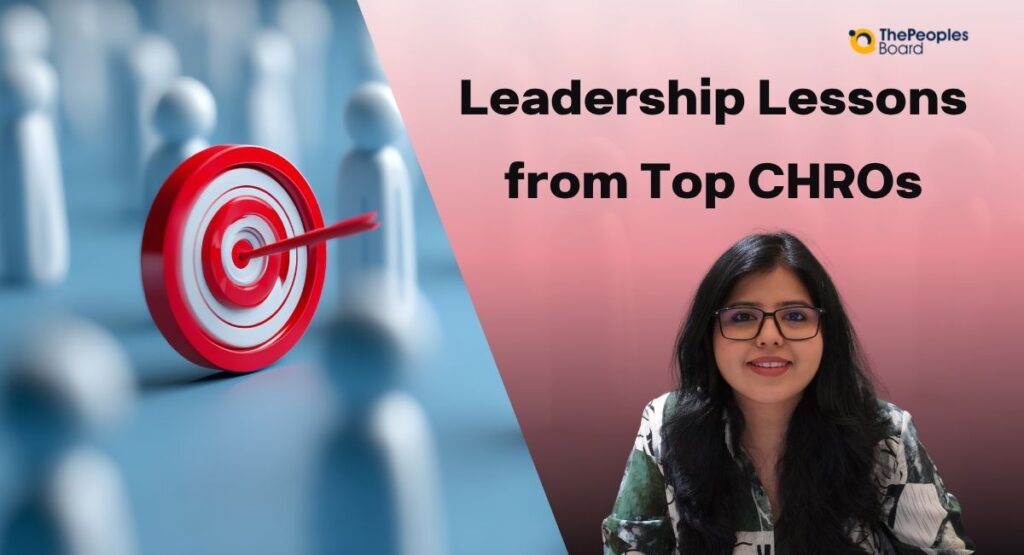

If 86% of CHROs say their role is changing dramatically, why are most companies still hiring for the old one?
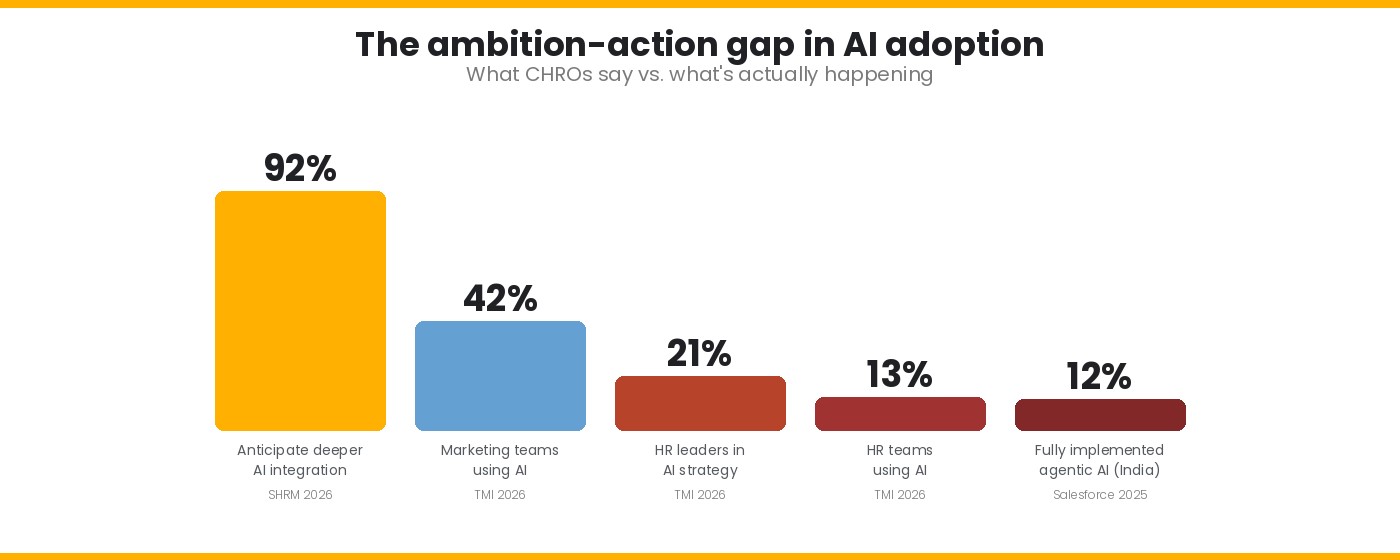
That’s the uncomfortable gap between ambition and action in Indian boardrooms right now. Gartner’s 2026 HR Priorities Survey of 426 CHROs shows AI transformation topping the priority list. SHRM’s 2026 report finds 92% of CHROs anticipate deeper AI integration this year, with 87% forecasting greater adoption within HR processes specifically.
Yet only 21% of HR leaders are closely involved in their company’s AI strategy decisions, according to TMI’s 2026 analysis. And just 12% of Indian CHROs say their organisation has fully implemented agentic AI, per a Salesforce global survey of 200 HR executives.
The gap isn’t about technology. It’s about leadership. As we explored in Day 1 of this series, the CHRO role in India has crossed an inflection point, but crossing it requires a fundamentally different kind of leadership than most organisations are hiring for.
India’s best CHROs are the ones who’ve closed this gap, and they aren’t waiting for permission, a perfect AI roadmap, or a vendor to solve it for them. They’re leading change with five lessons that any HR professional can apply, starting now.
Lesson 1: Don’t Start with AI. Start with Work Redesign
The biggest mistake CHROs make with AI is treating it as a technology adoption project. It isn’t. It’s a work redesign project that happens to involve technology.
Lakshmi Chandrasekharan, Senior Managing Director and CHRO at Accenture in India, has been vocal about this distinction. In a Business Today deep dive (April 2026), she argued that CHROs need to deconstruct jobs into tasks first, figuring out where human judgment and creativity add unique value, and where AI can take over. At Accenture India, AI adoption began not with a tool rollout but with a systematic analysis of what work actually consists of.
This matters because the numbers back it up. Gartner’s research found that 29% of the predicted AI-driven productivity gains come from changing the HR operating model itself and not from training employees on AI tools or running awareness campaigns. In other words, nearly a third of the value is locked inside how work is structured, not how good people are at prompting ChatGPT.
For Indian CHROs, the practical takeaway is clear. Before investing in AI platforms, map the work. Which tasks in recruitment, performance management, L&D, and compliance are repetitive, data-heavy, and judgment-light? Those go to AI. Which require context, empathy, and creative thinking? Those stay human — and become more valuable.
In fact, AI is already transforming six HR processes beyond recruitment in India: from payroll anomaly detection to leave pattern analysis to exit feedback mining. A Sia Partners analysis found that 60–65% of a recruiter’s activities are addressable with commercially available AI tools today. But the recruiter role doesn’t disappear. It expands into higher-value territory.
The lesson: AI doesn’t replace jobs. It replaces tasks. CHROs who start with work redesign, not tool selection, get results faster.
Lesson 2: Build AI Fluency — In Yourself First
Here’s a stat that should worry every CHRO who delegates AI to IT: while 42% of marketing teams already use AI, only 13% of HR teams do, according to TMI’s 2026 data. HR is falling behind, not because the tools aren’t ready, but because the leaders aren’t.
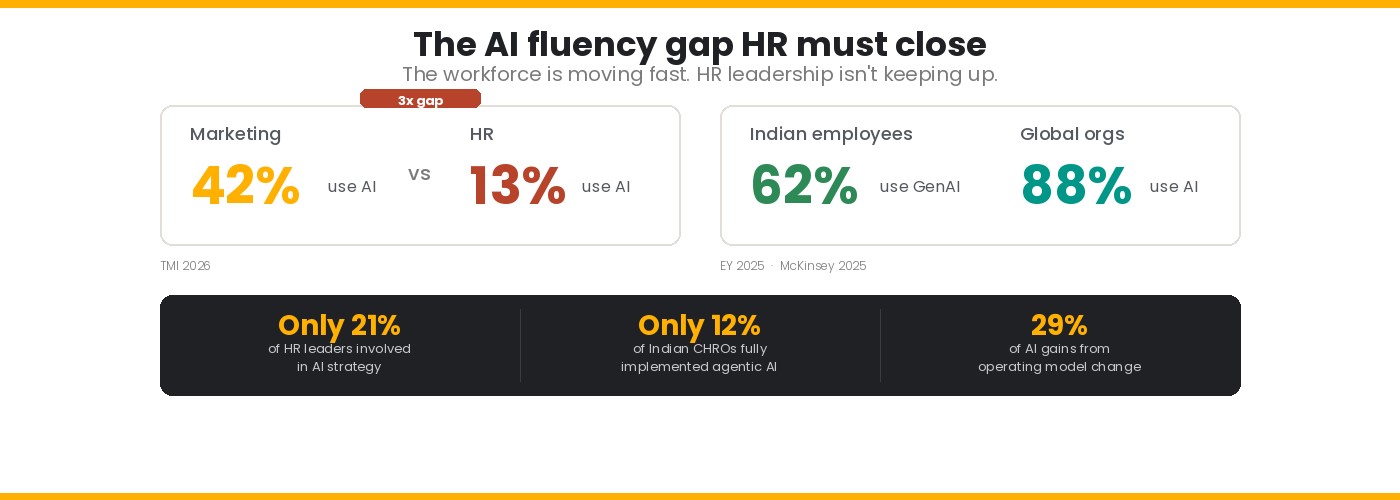
India is actually better positioned than most markets. The EY 2025 Work Reimagined Survey found that 62% of Indian employees use GenAI at work regularly, well above the global average. And Korn Ferry’s Workforce 2025 survey confirmed that employees in India are among the global leaders in AI training adoption. The workforce is moving fast. The question is whether HR leadership can keep up.
Nishchae Suri, Managing Director of Cornerstone OnDemand India, put it sharply in Business Today (April 2026): the most effective CHROs are those involved early in decision-making, asking critical questions about future skills, flexibility, and the kind of leadership the organisation needs. It requires AI fluency, not coding skills, along with the ability to read workforce data, question vendor claims, and design processes that use insights without adding bias.
AI fluency for CHROs means three things:
- Understanding what AI can and can’t do,
- Being able to evaluate AI tools for HR-specific use cases, and
- Having the confidence to sit at the AI strategy table alongside the CIO and CTO.
Understanding how people analytics and automation are redefining talent management is a practical starting point. McKinsey’s 2025 State of AI research shows that 88% of organisations globally use AI regularly, but the gap between pilots and business impact consistently comes down to people’s issues. CHROs who understand AI own the bridge between investment and impact.
The lesson: AI fluency is now a core CHRO competency. If you’re delegating AI entirely to IT, you’re delegating your own relevance.
Lesson 3: Make Reskilling a Business Strategy, Not an HR Program
The reskilling conversation in India has shifted from “should we?” to “how fast can we?” Indian CHROs expect agentic AI adoption to grow 383% by 2027, leading to a projected productivity gain of 41.7%, according to Salesforce’s 2025 survey. That’s not incremental. That’s a structural shift — and it means nearly a quarter (24.7%) of the Indian workforce will need to be redeployed as organisations embrace digital labour.
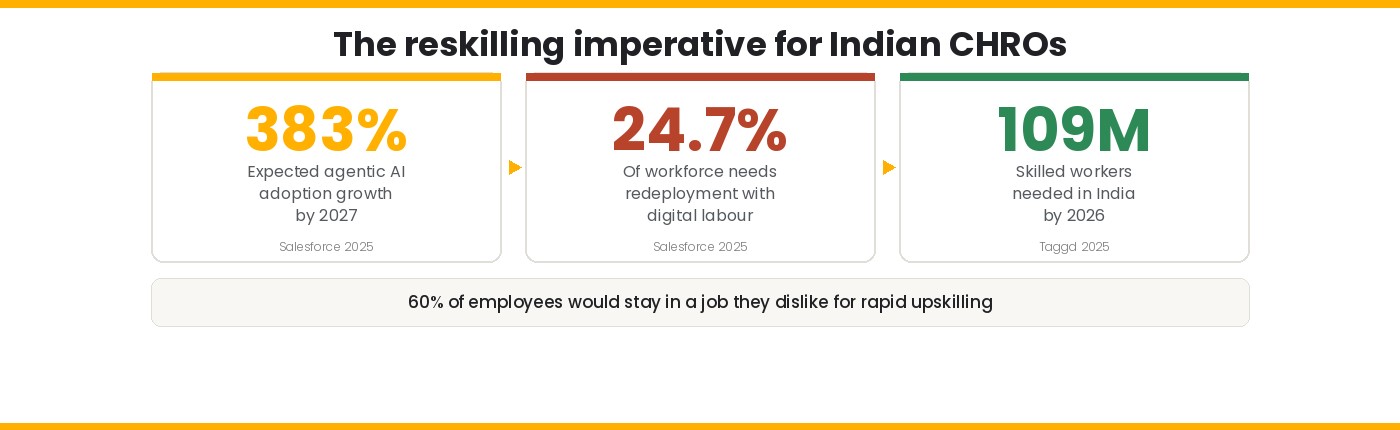
Korn Ferry’s data adds a useful insight: more than 60% of employees would stay in a job they dislike if it offered rapid upskilling opportunities. Reskilling isn’t just a retention strategy. It’s a competitive weapon.
Aarti Srivastava, CHRO for India at Capgemini, demonstrated this approach in Business Today (April 2026). She described how Capgemini’s HR works closely with business leaders to anticipate capability needs and embed continuous learning — not as a standalone L&D initiative, but as an integrated part of business planning. Talent strategies evolve in step with technological innovation and client demands. The learning function doesn’t sit in a silo. It sits inside the business strategy.
Niren Srivastava, Group CHRO at Motilal Oswal Financial Services, reinforced this in the same Business Today feature, noting that CHROs must continuously diagnose skill shortages and fix them — either by buying or building talent. And the ETHRWorld NexTech summit in February 2026 revealed that 30–40% of organisations are now using AI in HR beyond pilots, while HRIS adoption exceeds 75% across regions globally. The infrastructure exists. The leadership question is whether reskilling gets treated as a cost centre or a revenue enabler.
India’s unique advantage here: the country requires an estimated 109 million skilled workers across high-growth industries by 2026, according to Taggd’s analysis. And Indian HR tech companies are already building AI-powered workforce tools — from Darwinbox’s workforce intelligence platform to Keka’s AI-generated goal setting to Kognoz’s conversational assessments. CHROs who can build the reskilling engine at scale aren’t just doing HR work. They’re building the workforce that powers the next phase of India’s growth.
The lesson: Reskilling only works when it’s owned by the business, not by HR alone. The CHRO’s job is to make it a P&L conversation, not an engagement score.
Lesson 4: Lead Change by Making It Routine, Not Inspirational
Change fatigue is real. And the standard CHRO playbook of big-vision town halls, transformation manifestos, and “change champion” programs isn’t working the way it used to.
Gartner’s 2026 research offers a better alternative: routinise change rather than trying to inspire it. Their recommendation is direct — HR must help leaders focus employees on making progress across the change journey, not on generating excitement about the destination. And leaders need to regulate their own discomfort with change before they can help employees manage theirs.
This is especially relevant in India, where the biggest challenge isn’t AI itself — it’s leadership readiness. After interviewing dozens of CHROs and CEOs, they found a persistent duality: leaders spoke about transformation but acted with restraint, approving digital investments while hesitating to overhaul outdated structures.
Veena Bansal, CHRO at M3M India, acknowledged in a BW People feature that 2025 highlighted the importance of moving beyond caution. And Vinod Nair, CHRO at Aadhar Housing Finance, offered a candid assessment: companies grew in 2025 but slowed down on people decisions, with AI never moving beyond pilots and managers playing it safe. His view: organisations need to move from early pilots to real adoption, and eventually to institutionalisation.
The best Indian CHROs aren’t trying to make AI-driven change exciting. They’re making it normal. Small, repeatable decisions. Weekly experiments, not annual transformation programs. A culture where trying AI tools in a recruitment workflow or a performance review process is expected, not exceptional.
Chandrasekharan at Accenture India’s SHIFT framework captures this well — the “H” stands for Human-led, meaning technology adoption should be led by people, not imposed on them. The “F” is Fortitude — the resilience to keep pushing through resistance without burning out the organisation.
The lesson: The era of “inspiring” change is over. The CHROs getting results are the ones who make change boring, repeatable, and embedded in daily work.
Lesson 5: Own the Culture-AI Intersection. No One Else Will
Every other C-suite executive can contribute to the AI strategy. The CTO builds it. The CFO funds it. The CEO champions it. But only the CHRO can ensure that AI adoption doesn’t destroy the culture that makes the organisation work.
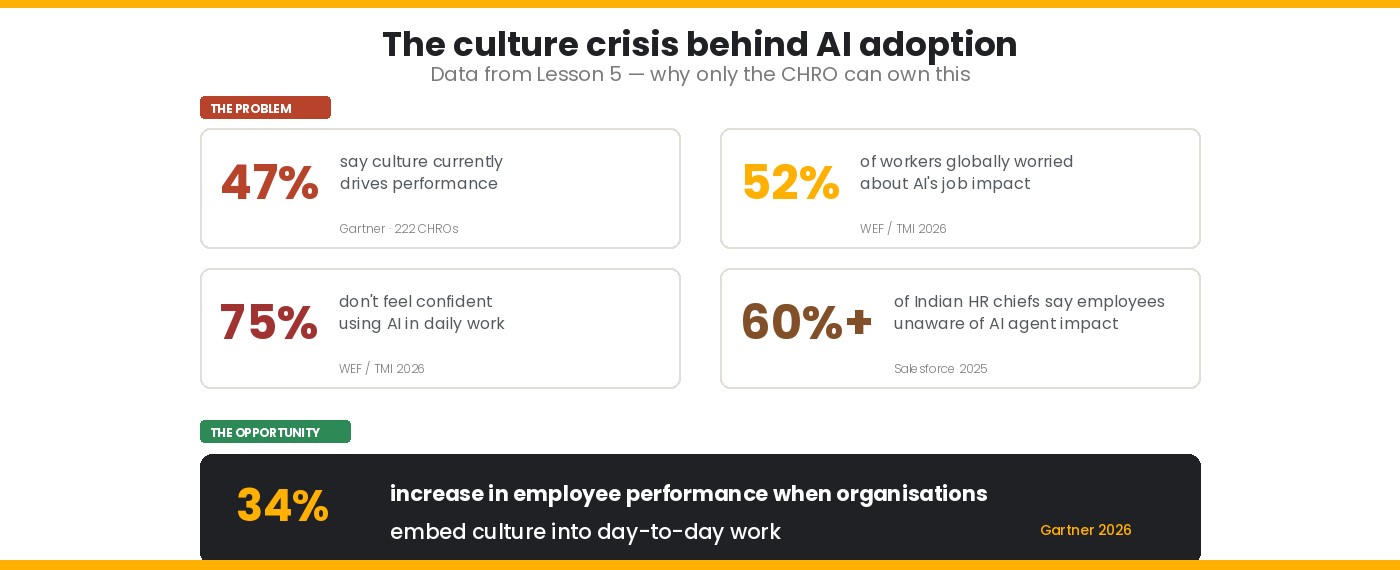
This is where the data gets urgent. A Gartner survey of 222 CHROs (July 2025) found that only 47% said their culture currently drives employee performance. Meanwhile, 52% of workers globally are worried about AI’s impact on their jobs, and 75% don’t feel confident using AI in their daily work, according to TMI’s research citing World Economic Forum data. And in India specifically, more than 60% of HR chiefs say their employees remain unaware of how AI agents will impact their work, per the Salesforce survey.
That’s a culture crisis waiting to happen. And it’s the CHRO’s to own.
Chandrasekhar Sripada at ISB made this case in Business Today (April 2026), arguing that CHROs who want to shape business strategy must develop the ability to sense changes in the external environment in real time — and translate those signals into cultural responses. That means not just deploying AI, but understanding how Agentic AI is reshaping HR’s role and preparing the workforce emotionally and practically for what comes next.
Gartner’s 2026 data shows that organisations that embed culture into day-to-day work see up to a 34% increase in employee performance. The CHROs who get this right — who make AI adoption feel safe, transparent, and purposeful — will see measurable performance gains. The ones who don’t will lose their best people to organisations that do. Because the real HR tech risk in India isn’t AI adoption itself — it’s employee anxiety, the trust deficit that deployment metrics can’t detect.
Deepti Varma, VP of HR at Amazon Stores India, and Shraddhanjali Rao, Head of HR at Google India, were among the leaders at the ET NexTech Human Capital Summit (February 2026) discussing exactly this — how to build human-centric, high-performance cultures that don’t just survive AI adoption but thrive because of it.
The lesson: AI adoption without cultural leadership is just an IT project. The CHRO who owns the culture-AI intersection becomes the most strategic person in the room.
The Five Lessons at a Glance
For quick reference, here’s what India’s top CHROs are teaching us about leading through AI-driven change:
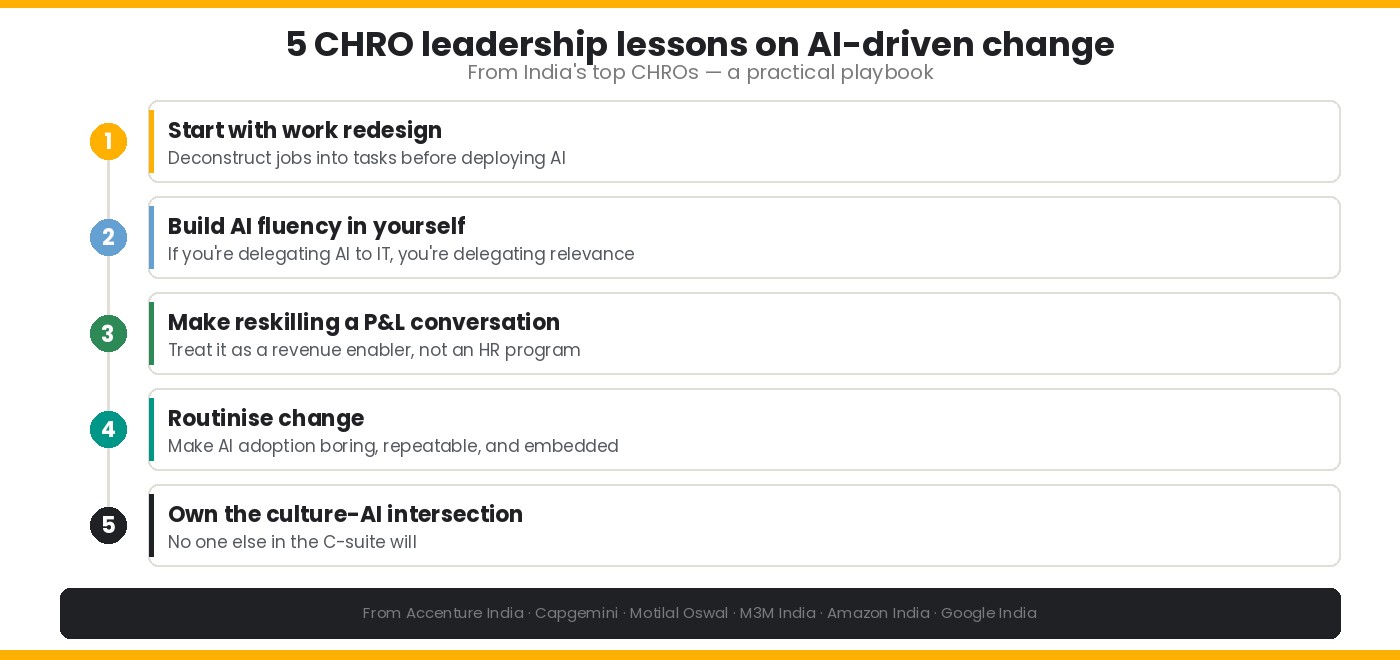
Lesson 1: Start with work redesign, not tool selection. Deconstruct jobs into tasks before deploying AI.
Lesson 2: Build AI fluency in yourself first. If you’re delegating AI to IT, you’re delegating your relevance.
Lesson 3: Make reskilling a P&L conversation, not an HR program. Treat it as a revenue enabler.
Lesson 4: Routinise change. Stop trying to inspire it. Make AI adoption boring, repeatable, and embedded.
Lesson 5: Own the culture-AI intersection. No one else in the C-suite will — and the organisation needs someone to.
These aren’t theoretical. They’re drawn from what India’s most effective CHROs are already doing — at Accenture India, Capgemini, Motilal Oswal, M3M India, Aadhar Housing Finance, Amazon India, and Google India. The playbook exists. The question for every HR professional is: are you building the skills to run it?
FAQ: CHRO Leadership and AI in India
How are Indian CHROs leading AI adoption?
Indian CHROs are leading AI adoption by starting with work redesign — deconstructing jobs into tasks to identify where AI adds value. They’re building personal AI fluency, embedding reskilling into business strategy, routinising change instead of relying on transformation programs, and owning the intersection of AI adoption and organisational culture. 92% of CHROs globally anticipate deeper AI integration this year (SHRM 2026).
What percentage of Indian companies use AI in HR?
30–40% of organisations are now using AI in HR beyond pilots, according to ETHRWorld’s Global Tech Transformations 2026 report. However, only 12% of Indian CHROs say their organisation has fully implemented agentic AI (Salesforce 2025). While 62% of Indian employees use GenAI at work regularly, HR departments lag behind marketing teams (13% vs 42% adoption) in organised AI use.
What skills do CHROs need for AI leadership?
CHROs need AI fluency (understanding capabilities and limitations, not coding), data literacy to interpret workforce dashboards, the ability to evaluate AI vendors critically, change management expertise to routinise adoption, and cultural leadership skills to ensure AI deployment feels safe and purposeful. The Indian School of Business identifies enterprise-wide thinking and environmental sensing as critical differentiators.
Why is reskilling important for Indian CHROs?
India requires an estimated 109 million skilled workers across high-growth industries by 2026. Indian CHROs expect agentic AI adoption to grow 383% by 2027, which means nearly 25% of the workforce will need redeployment. Reskilling is no longer an L&D initiative — it’s a business survival strategy that directly impacts revenue and competitive positioning.