
HR transformation is one of those phrases that sounds universal, yet plays out completely differently depending on the industry it lands in. A talent strategy built for a media company chasing creative velocity rarely survives intact inside a small finance bank that lives by regulatory precision. The business model, the CEO’s theory of how the company wins, and the maturity of the organisation all bend the people agenda in ways that no generic playbook can predict. And yet, much of the HR transformation conversation in India still treats it as a portable, repeatable exercise.
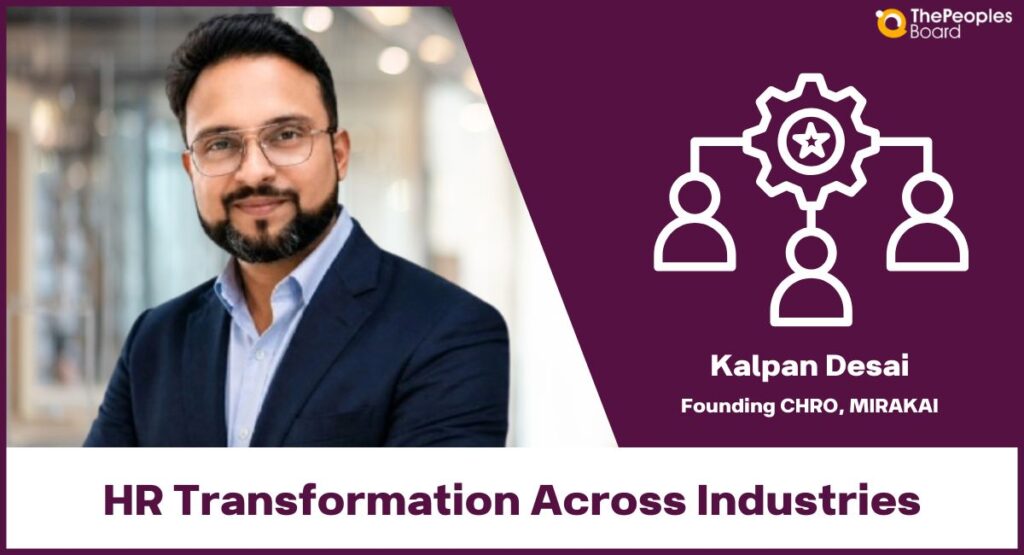
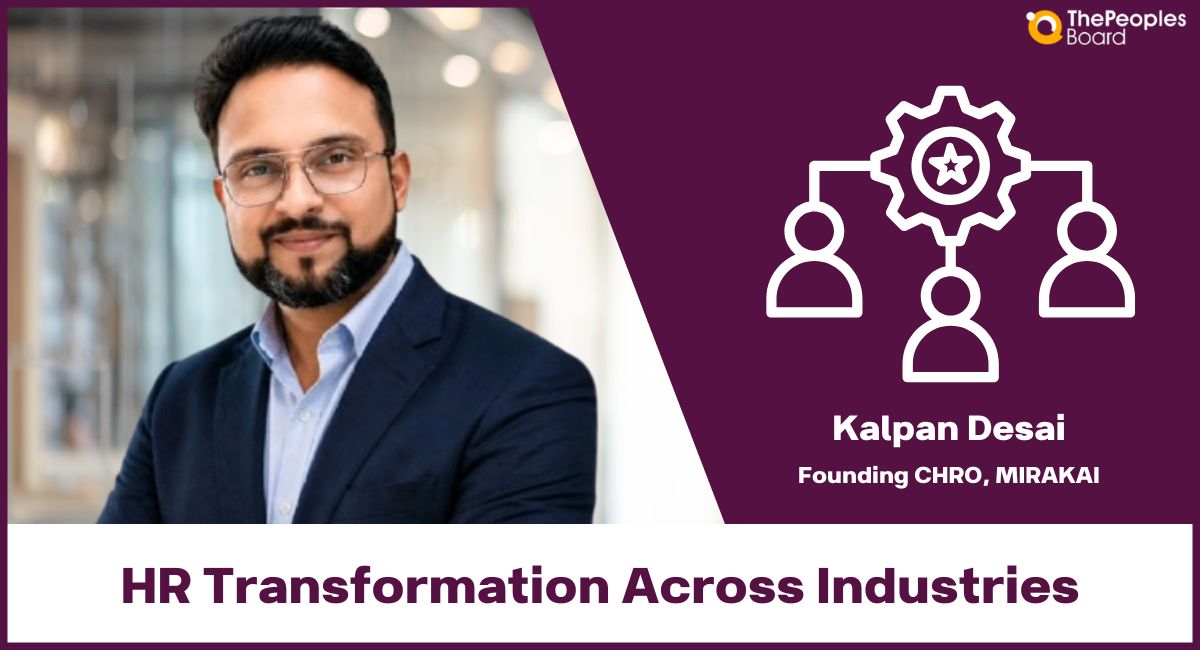
In this conversation, we speak with Kalpan Desai, Founding CHRO at MIRAKAI, whose career spans some of the most structurally different businesses in the Indian market, including Sony Pictures Networks, Viacom18, and Jana Small Finance Bank. Across media, BFSI, and now real estate, he has built and rebuilt people systems against the grain of each industry’s logic. He talks to us about why the “one-size-fits-all” approach keeps failing, how legacy governance slows down within mature organisations, how compliance can be designed as a constraint rather than a barrier, and what the next five years will demand of the CHRO role itself.
TPB Team: Why does the “one-size-fits-all” HR transformation playbook fail so often in practice?
Kalpan: Because most HR transformation programmes are designed by function and not by business model. When I led transformation at Viacom18 and later at Jana Small Finance Bank, the business models were structurally opposite – one rewarded creative velocity, the other demanded regulatory precision. Importing the same talent architecture across those contexts does not accelerate transformation; it creates sophisticated-looking misalignment. A CxO-level HR leader’s first commitment is to diagnose the business before designing the people system.
TPB Team: Which single factor shapes HR transformation more than any other across industries?
Kalpan: The CEO’s theory of competitive advantage – because every people decision is ultimately a bet on what will make the business win. At Sony Pictures Networks, the leadership team believed talent differentiation was a content moat, which shaped how we invested in capability and retention. That theory was different at a growth-stage BFSI like Jana, where the competitive lever was geographic penetration speed. I calibrate every transformation lever — structure, tech, culture — to that single strategic north star, not to HR best practice.
TPB Team: What does HR look like in a mature organisation that it cannot look like in a new startup?
Kalpan: In a mature organisation, HR’s strategic value lies in institutional leverage, activating deep workforce data, long-cycle succession, and governance architecture to compound business performance. At Sony and Viacom18, I operated as a business partner at the leadership table, using people analytics to influence portfolio and expansion decisions. That depth simply cannot exist at a greenfield company. At Mirakai, I am building the foundation that will eventually enable that leverage — but the Founding CHRO’s job is to architect for the organisation’s future scale, not its current size.
TPB Team: When you join a mature organisation, what existing systems usually slow transformation down the most?
Kalpan: Legacy governance, not legacy technology. The real drag is always the decision architecture — the layers of approval, the informal power structures, and the institutional habit of consensus over velocity. At Jana Small Finance Bank, the HRMS was functional; what slowed us down was a deeply embedded sign-off culture that treated every people investment as a risk event rather than a growth lever. My approach was to reframe HR decisions as business risk trade-offs directly in EXCO conversations — once the language changed at the top, the velocity followed.
TPB Team: How do you push HR change forward in a regulated industry without breaking the audit trail?
Kalpan: By positioning compliance as a design constraint, not a barrier — and communicating that distinction clearly to the Board and CEO. At Jana Bank, I sequenced every transformation initiative so that regulatory integrity was locked in first, which gave leadership the confidence to approve faster experimentation within defined guardrails. The discipline was simple but non-negotiable: every policy change carried a documented impact assessment before implementation, not after. That approach protected the business and built my credibility as a leader who could be trusted with both speed and governance simultaneously.
TPB Team: What did you have to unlearn in your first 60 days as Mirakai’s Founding CHRO?
Kalpan: I had to unlearn the instinct to build enterprise-grade systems before the enterprise exists. In large organisations like Sony and Viacom18, HR credibility was built through polished, end-to-end frameworks with full stakeholder alignment before launch. At Mirakai, I was simultaneously the strategist, the architect, and the executor — and the business needed decisions in weeks, not quarters. The shift was from sequencing perfectly to prioritising ruthlessly: hire the revenue-critical leadership first, build the governance layer around the business as it scales, and resist the temptation to institutionalise before the organisation is ready for it.
TPB Team: Where does the “low process, high speed” startup culture actively hurt the people function?
Kalpan: It creates a compounding talent debt that surfaces at exactly the wrong moment – during scale. The risk is not visible in month three; it is visible when a critical leader exits with no successor, or when the organisation doubles headcount and has no cultural scaffolding to absorb growth. At Mirakai, one of my earliest strategic calls as Founding CHRO was to insist on a structured hiring and onboarding architecture before we scaled, precisely because I have seen what unstructured speed costs a business in its next phase. Speed without architecture is not agility; it is deferred risk.
TPB Team: The same HR tech can succeed in one industry and fail in another. What explains the difference?
Kalpan: Technology adoption is a change management problem dressed as a configuration problem. The platform is rarely the variable – leadership accountability, manager behaviour, and workforce readiness are. An HRMS that thrived in a media environment where digital fluency was native, and managers were empowered, stalled in a field-force-heavy BFSI context where the same system was experienced as compliance overhead rather than business enablement. I have led implementations at both ends of this spectrum. The lesson I carry into every transformation: the go-live date is the beginning of adoption, not the end of implementation.
TPB Team: Boards everywhere ask for lower attrition and stronger pipelines. How do you manage that expectation gap with your CEO?
Kalpan: By refusing to let it remain an HR conversation. When I presented attrition analysis to leadership at Jana Bank, I reframed it as a revenue continuity risk — quantifying the cost of relationship discontinuity on AUM retention and branch productivity. The moment attrition became a P&L variable, I had the CEO’s full attention and the budget to act. My standing practice with every CEO I work with is to agree upfront, “I will own the people metric, but you will own the business outcome it maps to.” That shared accountability eliminates the expectation gap before it forms.
TPB Team: Tell us about a transformation idea that worked in one industry and failed when copied and pasted into another.
Kalpan: At Viacom18, I drove an internal talent marketplace that allowed employees to self-nominate for cross-functional projects — it generated a 30% internal fill rate on senior roles and became a genuine culture accelerator for the organisation. I attempted a version of this framework in a regulated financial services environment, and it hit an immediate wall. Compliance and risk teams flagged fluid cross-functional movement as a potential internal control breach. The strategic intent was identical; the operating context had fundamentally different risk tolerance. The lesson I took: transformation frameworks are hypotheses — they must be stress-tested against the industry’s governance reality before they are deployed, not after.
TPB Team: What is the most underrated skill HR leaders need before switching industries?
Kalpan: This is the easiest, it is “Commercial fluency” – specifically, the ability to read a P&L and connect people decisions to margin, velocity, and competitive positioning. Technical HR competence transfers across industries; commercial credibility does not come automatically. Every time I have moved sectors — media to financial services to real estate — my first investment was in understanding the business model deeply enough to have a genuine strategic conversation with the CEO and CFO before I had an opinion on the HR agenda. HR leaders who arrive with answers before they understand the business model rarely earn a seat at the table that matters.
TPB Team: What is one assumption about HR transformation that the next five years will completely overturn?
Kalpan: The assumption that the CHRO’s primary asset is people expertise. The next five years will establish that the CHRO’s primary asset is intelligence architecture – the ability to design systems that continuously learn about workforce capability, engagement, and risk in real time. Organisations that embed AI into talent planning, skills inference, and leadership pipeline prediction will not just improve their HR outcomes; they will build a structural competitive advantage that compounds over time. I am already building with this lens at Mirakai. The CHRO of 2030 will be judged not by the programs they launched, but by the intelligence infrastructure they institutionalised.
HR transformation does not begin with frameworks, tools, or even talent strategy. It begins with reading the business, the model, the moat, the risk appetite, and the stage of growth, and then designing the people system around that reality. For HR leaders moving between industries, or building a function from scratch the way Kalpan is at Mirakai, the real skill is not knowing the answers in advance.
It is having the commercial fluency to ask the right questions before forming an opinion. That, perhaps more than any tech stack or talent program, is what separates a CHRO who earns the seat at the table from one who is simply offered it.