


A new audit of 52 Indian business sites uncovered 4,694 instances of non-compliance, with every site showing gaps averaging about 90 per workplace. The findings come from Hiding in Plain Sight: Compliance Audit Insights 2026, a report by TeamLease RegTech built on physical audits of factories, warehouses, corporate offices and mines across 17 states and union territories.
The risk goes beyond fines: nearly half the findings include imprisonment clauses, and close to three in ten could land directors or senior officers in personal legal trouble. What sharpens the dataset is that every company covered had already commissioned a compliance audit. The gaps were sitting inside organisations that believed they were watching for them. The numbers below show where the exposure sits, which laws drive it, and what it looks like on the ground.
The Snapshot
The report’s dataset covers a specific slice of corporate India: 52 sites run by what TeamLease calls leading enterprises, drawn from factories, warehouses, corporate offices and mines across 17 states and union territories. Every site in the sample showed compliance gaps, and factories accounted for most findings.
| Audit Metric | Value |
| Sites audited | 52 |
| States and UTs covered | 17 |
| Workplace types | Factories, warehouses, corporate offices, mines |
| Total non-compliances | 4,694 |
| Sites with at least one gap | 52 of 52 |
| Average gaps per site | ~90 |
Factories alone generated 3,475 of the 4,694 findings, per Tribune’s reporting on the audit, or roughly three in four. Per site, that works out to 124.1 non-compliances per factory audited. For teams running HR audits alongside legal and EHS checks, the data shows where exposure is concentrated.
Where the Legal Risk Sits
The 4,694 count flattens what the audit found. Each non-compliance carries a different legal weight, and the report classifies them against the measures that matter at board level: whether the breach can trigger imprisonment, and whether it names a specific individual as liable.
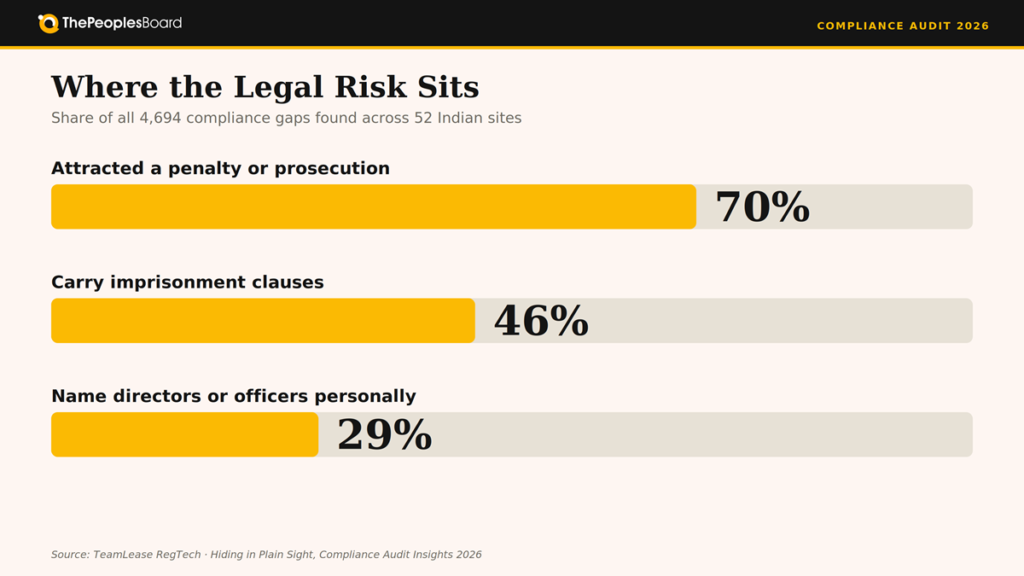
46% of the findings fall under provisions that carry imprisonment clauses, meaningfully above the 38% benchmark TeamLease RegTech pegs for Indian business law overall. The share that reaches directors is smaller but still substantial: 29% of findings named directors, senior officers or the factory occupier personally. That shifts the exposure from entity liability into a personal one, where the usual defence of ‘the company will pay’ doesn’t hold.
Imprisonment-liable findings also vary sharply by workplace type. Warehouses showed 52.1% of their findings tied to provisions carrying imprisonment risk, higher than the 46.4% recorded for factories. When the broader penalty bracket is included, around 70% of all 4,694 non-compliances attracted a penalty or prosecution of some form, meaning only three in ten were simple corrective items.
Taken together, nearly half of what the audits turned up is prosecutable and nearly a third can be pursued against named individuals, which puts HR audit and compliance squarely in board-risk territory rather than operational housekeeping.
Which Laws Are Driving the Gaps
The findings cluster around a narrow set of legal categories, with labour and environment, health and safety (EHS) laws producing the bulk of them and everything else contributing a long tail.
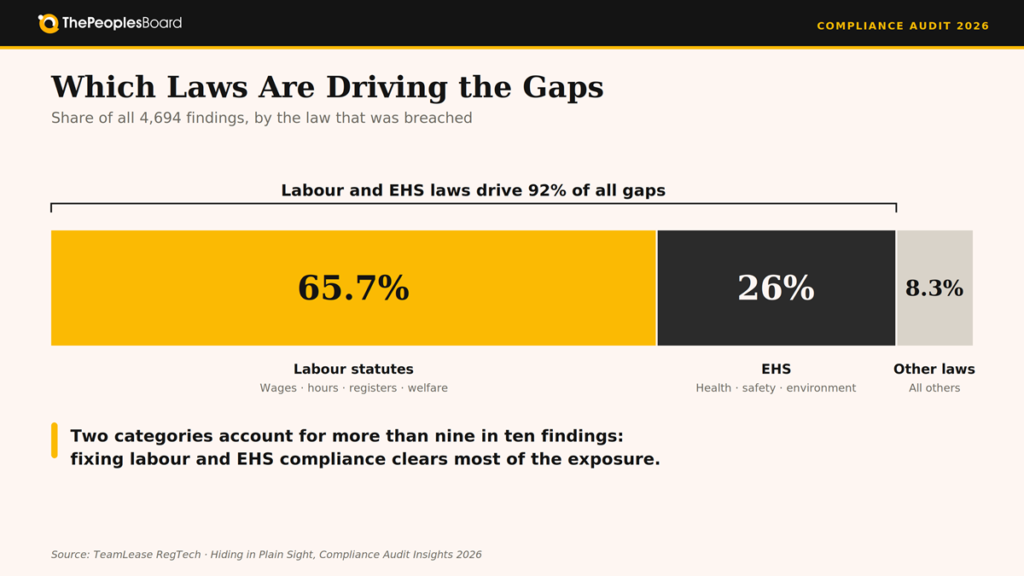
Labour and EHS laws together produce 92% of all findings. Within that, the split is roughly two-to-one: labour statutes account for 65.7% of all violations, and EHS regulations contribute another 26%. Within the labour share, 37.7% of the full dataset falls under statutes that have since been folded into the four Labour Codes, which the Government of India notified effective from 21 November 2025.
The structural reason behind the concentration is regulatory volume. Indian enterprises operate across three levels of government, seven categories of law, 21 types of regulatory instruments and 41 types of compliance. Inclusion-related laws, including POSH, equal remuneration and maternity benefits, left gaps in 16 of the 17 states and union territories audited. Only one jurisdiction returned a clean sheet on that category.
What Actually Goes Wrong on Site
At a more granular level, the audit’s classification puts half of the 4,694 findings in a single category: missing notices, registers and appointments. These are the documents, nameplates and nominations that statutes require sites to maintain, display or file.
That matters because this half of the dataset carries legal exposure disproportionate to its administrative nature. Several of these omissions sit under provisions whose penalties include imprisonment, which is why they count towards the 46% imprisonment-liable share already covered rather than sitting in a separate low-risk bucket.
In the End…
Across the dataset, having commissioned an audit isn’t the same as being compliant, and the gaps that surfaced were often on paper rather than in practice. The report’s framing of its findings as ‘hidden in plain sight’ reflects where they sit. Half are documentary. Almost half are jailable. Close to a third name real people.
HR, legal, and operations teams working off the same corporate risk register can triage more sharply from that mix: separate the physical-site evidence trail from board-level filings, map every obligation against the four Labour Codes rather than the laws they replaced, and treat director-named provisions as a distinct line item.