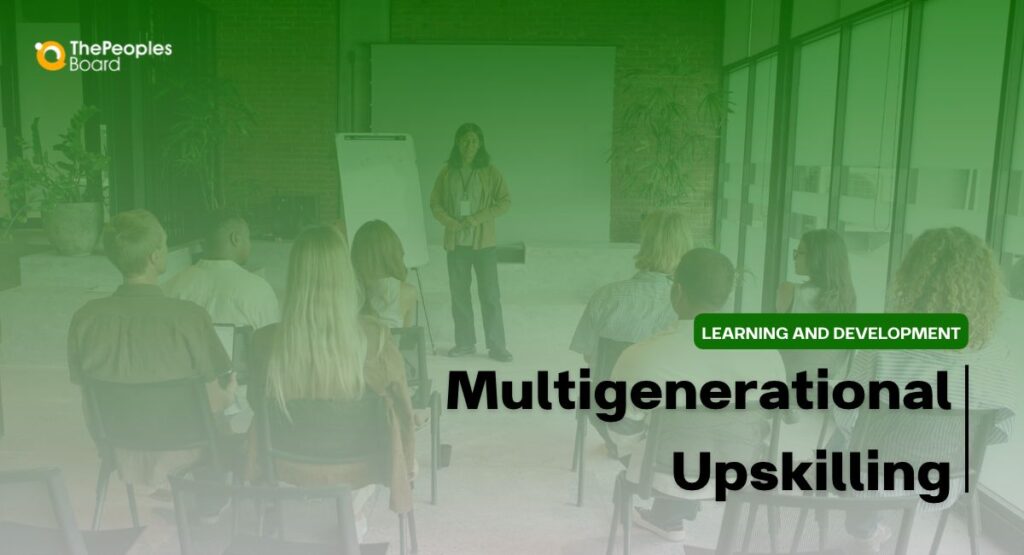

Four generations now share a floor at India’s larger employers, and L&D budgets are being asked to serve them all. At Infosys, under-30s make up 50.7% of the workforce in FY26, down from 52.6% a year earlier, while Great Place to Work India’s 2026 workplace study found Gen Z’s share of the national workforce has doubled to 26% since 2023.
Between a mid-career cohort that remembers the on-prem era and a Gen Z joining class that treats generative AI as a baseline tool, L&D heads at India’s corporates aren’t dealing with one upskilling problem. Several run in parallel, on the same budget line.
That demographic churn collides with a sharper structural pressure. The Deloitte-Nasscom Advancing India’s AI Skills report projects India’s AI workforce doubling to 1.25 million by 2027, with the market growing 25-35% a year. You can’t ration the skills refresh by age, seniority, or function. It has to land across all of them, and it has to land fast.
The Demographic Reality Corporate India Now Manages
The composition of a typical knowledge-worker floor in Bengaluru, Pune, or Gurugram looks nothing like it did five years ago. Boomers at the executive layer, Gen X at senior management, millennials in middle management, and Gen Z filling the junior and specialist bench create a four-generation structure that most Indian corporates haven’t formally planned for.
Each cohort arrived with a different relationship to continuous learning. A Gen X engineering manager at a BFSI firm likely trained once in a classroom when they joined and picked up the rest on the job. A millennial product manager has probably sat through at least one certification cycle every two years. A Gen Z associate expects micro-credentials, Slack-linked learning nudges, and formal recognition for self-driven courses on their LinkedIn profile.
The generational mix inside most Indian corporate workplaces today looks roughly like this:
| Generation | Age Band (2026) | Where They Sit in India Inc | Share of Workforce |
| Baby Boomers | 60+ | Board, promoter leadership, CXO advisories | ~2-3% |
| Gen X | 45-59 | CXO, senior VP, programme leadership | ~15-18% |
| Millennials | 29-44 | Middle management, product, delivery leads | ~55-60% |
| Gen Z | Under 29 | Analysts, engineers, specialists, early managers | ~22-26% |
Share estimates are drawn from Great Place to Work India’s 2026 culture studies and sector reports from the IT services and GCC segments. Baby boomers remain a thin but influential layer at the top of promoter-led firms and family businesses, often holding decision rights that outlast their formal roles.
At India’s Global Capability Centres specifically, the picture skews even younger, with 93% of GCC employees falling into the Gen Z or millennial bracket, leaving limited room for traditional apprenticeship-style knowledge transfer. HR strategies to manage this generational mix have moved from a nice-to-have to a core part of the L&D brief.
Fault Lines in Current Upskilling Programmes
A single learning catalogue, however well-stocked, now has to work for four audiences with different time budgets, different starting points, and different incentives to engage. The gaps show up in predictable places, and L&D heads at India’s larger employers are seeing them play out in parallel rather than in sequence.
The Mid-Career Time Squeeze
Mid-career professionals carry the heaviest delivery load and the least slack for learning. Millennial managers in their late thirties and early forties, sitting at the intersection of delivery accountability and household responsibility, face the sharpest time-scarcity problem across the Indian corporate workforce. They’re also the group with the most to lose if their skill stack goes stale.
A typical delivery lead at an Indian GCC or IT services firm clocks 50-60 billable hours a week, with client calls that spill into evenings and standups that start at 7 am for European teams. Carving out two hours a week for a Coursera module isn’t primarily an engagement issue. It’s a calendar one.
Learning programmes that rely on self-paced courses taken after hours tend to concentrate completion among Gen Z. Mid-career engagement collapses unless learning time is explicitly carved out of the delivery calendar. Where that’s happened, as in Indian IT services firms that build billable-time credits for upskilling into their project pricing, the design assumption is that learning hours sit inside the working week rather than after it.
The AI Fluency Mismatch
AI tools have inverted the usual skill-transfer hierarchy. The Deloitte-Nasscom survey found 71% of Gen Z workers see AI skills as a career accelerator, against 60% of the overall workforce, and a Gen Z associate who’s spent six months prompting ChatGPT or Claude in college often outperforms a senior architect encountering the same tools for the first time.
That inversion creates a cultural problem the standard upskilling programme rarely addresses. Senior managers can feel exposed when asked to re-learn basics alongside their reports. Classroom-style AI rollouts that put a VP in the same cohort as a joiner tend to see the senior drop out quietly. Programmes that split foundational AI literacy into separate tracks by role, keeping cohorts peer-level, see materially higher completion.
India’s IT services firms have invested at scale: in FY24 alone, TCS trained around 350,000 employees, and Wipro trained 220,000 on AI-related tools, according to the same Deloitte-Nasscom analysis. Scale, though, isn’t the same as absorption. Internal L&D leaders privately acknowledge that the completion-to-fluency conversion still favours the junior cohort, and that reaching parity requires design changes rather than more budget.
The Uniform-Curriculum Problem
Learning catalogues built around functional silos such as finance, HR tech, product, or data collapse the generational need back into a single mould. A Gen X delivery head and a Gen Z data analyst taking the same “Advanced SQL” module get the same experience, even though their motivations and starting points differ sharply.
The sharper design treats a module’s audience, pace, and assessment style as variables rather than fixed inputs. Even a modest split of two tracks instead of one lifts engagement meaningfully.
The alternative, which several Indian firms have landed in by default, is high enrolment with low completion, and a quarterly L&D review that struggles to show business impact. Reskilling fatigue sets in fastest when the catalogue feels undifferentiated.
What’s Starting to Work in Indian Firms
Organisations making progress have moved past the search for a single generational formula. They’re redesigning the plumbing of their upskilling and reskilling architecture so the same programme meets different cohorts on their own terms. Design shifts recur across case studies from Indian IT services, GCCs, and large BFSI employers.
Skills-Based Pathways Over Tenure Bands
Replacing tenure or band-level learning plans with a skills-first architecture lets the same catalogue serve a Gen Z specialist and a Gen X manager with role-specific depth. Infosys’ internal skills taxonomy and HCLTech’s digital pods both follow this logic, mapping learning units to competencies rather than grades.
The side benefit is that lateral and internal mobility becomes easier to track and reward. When learning is pegged to a skills graph rather than a seniority ladder, a senior manager picking up Python for data analysis and a joiner picking up Python for engineering can log the same unit without the hierarchy getting in the way. At TCS, the iEvolve platform lets employees pick learning tracks across the catalogue regardless of band, with completion data flowing into the appraisal cycle.
Reverse and Peer Mentoring Programmes
Pairing senior leaders with Gen Z associates to learn AI tooling, platform workflows, or newer collaboration stacks does more than solve the fluency gap. It also addresses the social anxiety that keeps senior cohorts out of mixed classrooms. Mahindra Group and Axis Bank have both experimented with structured reverse mentoring programmes around digital and AI skills, with reciprocal mentoring on strategy and client judgement flowing in return.
Tying Learning to Promotion Signals
Completion rates follow consequence. Programmes that make learning hours visible in appraisal conversations, or that gate internal postings on specific certifications, see materially higher engagement across cohorts.
The caveat is that the signal must be genuine, since Gen Z employees, in particular, quickly spot performative learning requirements and disengage. Great Place to Work India’s effort recession finding points directly to this risk: when extra effort doesn’t translate into visible outcomes, people stop showing up.
In the End…
The challenge isn’t about picking the “right” generation to design the learning programme around. The real work is accepting that corporate India now runs multiple learning economies on the same employee rolls, and that a single catalogue aimed at the median employee serves none of them well. L&D heads at Indian corporates can begin by auditing one existing programme against the questions that matter most: who completes it, who enrols without completing, and who never enrols at all.
The answers almost always break along generational and seniority lines, and the redesign usually begins by splitting the cohort before splitting the content. The firms that get this right in the next 18 months will be the ones whose skills stack can keep pace with the 1.25-million AI workforce India is being asked to build, without burning out the mid-career managers who still deliver most of the revenue.
FAQs
What does the generational mix in Indian corporate workplaces look like in 2026?
Four generations now share most Indian corporate floors: baby boomers (60+) hold around 2-3% of roles at the board and promoter leadership level, Gen X (45-59) occupies 15-18% at CXO and senior VP tiers, millennials (29-44) make up 55-60% in middle management and delivery, and Gen Z (under 29) accounts for 22-26% in analyst, engineering and specialist roles. India’s Global Capability Centres skew younger still, with 93% of employees in the Gen Z or millennial bracket.
Why do single-track upskilling programmes fail in multigenerational teams?
A uniform catalogue collapses four very different learning economies into one. A Gen X delivery head and a Gen Z analyst taking the same module arrive with different time budgets, starting points and incentives, which produces high enrolment but low completion. The sharper design treats pace, audience and assessment style as variables rather than fixed inputs, and splits cohorts before splitting content.
How can L&D teams upskill mid-career managers who have no spare time?
Mid-career millennials carry the heaviest delivery load and the least slack, often clocking 50-60 billable hours a week. Self-paced after-hours courses tend to see their engagement collapse. Programmes that build billable-time credits for learning into project pricing, as some Indian IT services firms now do, treat learning hours as part of the working week rather than an addition to it.
Why do Gen Z employees pick up AI tools faster than senior managers?
AI tools have inverted the usual skill-transfer hierarchy. The Deloitte-Nasscom report found 71% of Gen Z workers see AI skills as a career accelerator, against 60% of the overall workforce, and many enter the workforce already fluent in prompting. Mixed-cohort AI classrooms tend to see seniors drop out quietly to avoid exposure. Splitting foundational AI literacy into peer-level tracks lifts completion materially.
Does reverse mentoring actually work in Indian corporates?
Yes, when structured. Mahindra Group and Axis Bank have run reverse mentoring programmes pairing senior leaders with Gen Z associates on AI tooling and newer collaboration stacks, with reciprocal mentoring on strategy and client judgement flowing in return. The format solves both the fluency gap and the social anxiety that keeps senior cohorts out of mixed classrooms.
How large will India’s AI workforce need to be by 2027?
The Deloitte-Nasscom Advancing India’s AI Skills report projects India’s AI workforce doubling to 1.25 million by 2027, with the market growing 25-35% a year. That scale rules out rationing the skills refresh by age, seniority or function, which is why L&D redesign has moved from a nice-to-have to a core brief.
What makes employees stay engaged with learning programmes long-term?
Completion rates follow consequence. Programmes that make learning hours visible in appraisal conversations, or gate internal postings on specific certifications, see higher engagement across cohorts. The signal has to be genuine, since Gen Z employees in particular spot performative learning requirements quickly and disengage, which maps directly onto Great Place to Work India’s “effort recession” finding.