
A model learns which employees a company promoted over the past decade, then starts scoring the current workforce by how closely they match the ones who moved up.
It sounds efficient. It also quietly rebuilds whatever skew was already in those decisions, and now the skew runs at machine speed across every appraisal, shortlist, and retention flag.
That is algorithmic bias, and it has become an HR problem rather than a data science one, because the people it sorts are candidates and employees, and the HR team usually answers for the outcome.
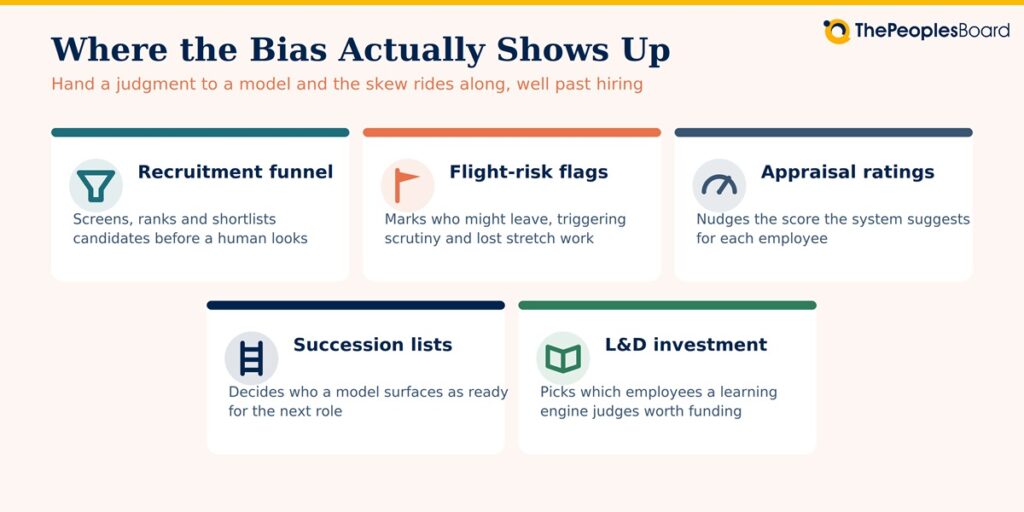
The reach is the part most companies underestimate. Bias in an algorithm doesn’t sit in the recruitment funnel and stay there. It shows up in who gets flagged as a flight risk, whose appraisal rating the system nudges, who a succession model surfaces as “ready,” and which employees an L&D engine decides are worth investing in. Wherever HR has handed a judgment to a model, bias can ride along.
What Algorithmic Bias Actually Means in HR
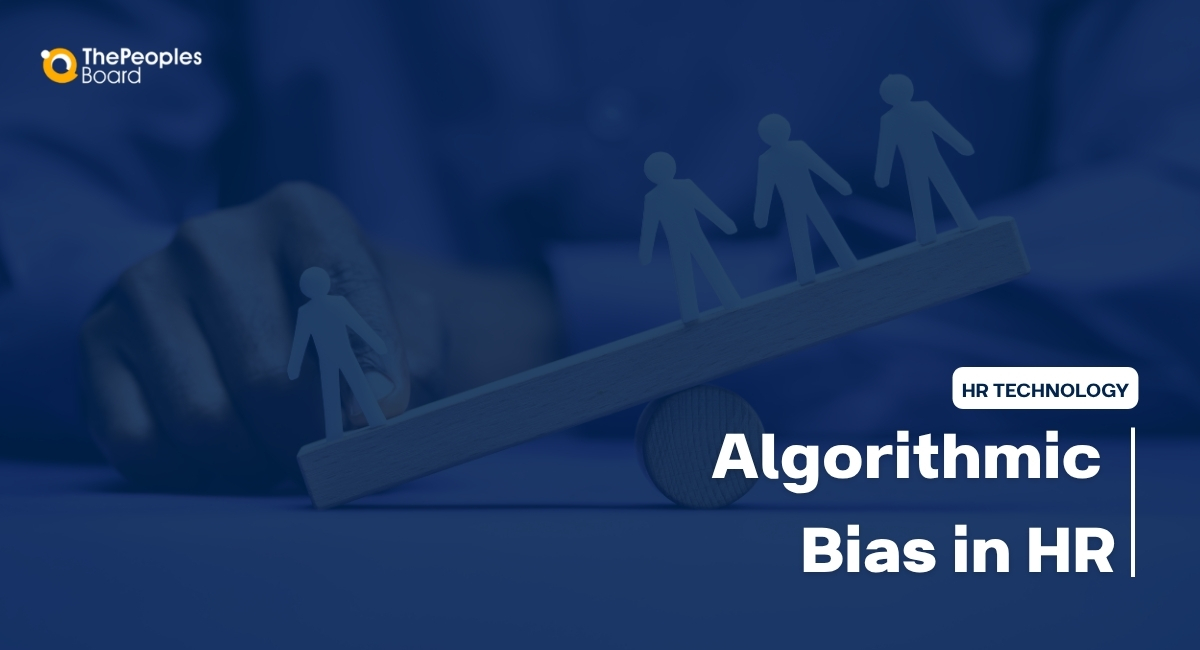
Algorithmic bias is a systematic, repeatable error in an automated system that produces unfair outcomes for a particular group. In hiring and people management, it shows up when a model consistently scores, ranks, or flags one set of people lower than another for reasons unrelated to their ability to do the job.
The word “bias” here isn’t about a machine holding an opinion. It’s about patterns in data and design that push results in one direction. A model doesn’t need a rule that says “prefer men” to end up preferring men. It only needs to learn from a history where men were hired more often, and it will treat that history as the target to reproduce.
A handful of sources feed most of the bias HR encounters:
- Training data: The model learns from past decisions. If those decisions favoured certain colleges, genders, or name types, the model inherits the pattern and calls it a signal.
- Proxy variables: A model rarely uses a protected attribute directly. It uses stand-ins. Pin code, mother-tongue markers in a resume, gaps in employment, or the name of a women’s college can all act as proxies for gender, caste, region, or religion.
- Design choices: What the model is told to optimise for shapes everything. Optimise for “candidates who look like our current top performers,” and the tool will narrow the funnel to whoever the company already overrepresents.
The clearest public example remains Amazon’s experimental hiring tool, which the company built from 2014 and scrapped around 2017. Trained on a decade of mostly male resumes, the system taught itself to penalise the word “women’s” and downgraded graduates of two all-women’s colleges. Nobody coded that behaviour. The data did.
The same mechanism that skewed a hiring tool will skew a promotion model or a pay recommendation, because they all learn from the same kind of history.
How Bias Enters an HR System
Bias doesn’t arrive at one moment. It accumulates across the pipeline, and each stage can add its own distortion. Mapping where it enters is the difference between fixing a root cause and patching a symptom.
In Hiring and Screening
Screening is where most HR teams meet algorithmic bias first, because it’s where volume forces automation. A parser reads a resume, a ranking model scores it, and a shortlist appears. The recruiter sees that shortlist. The thousands the model set aside stay invisible.
Research on this stage is sobering. A 2024 University of Washington study tested three large language models on more than 550 real resumes across three million comparisons and found the models favoured white-associated names 85% of the time versus 9% for Black-associated names, and male-associated names 52% of the time against 11% for female-associated names.
Black male names were never preferred over white male ones. The resumes were identical apart from the names. In an Indian context, the parallel proxies are name-based caste and religion cues, regional origin, and English fluency markers, and none of them measures whether someone can do the work.
In Pay and Appraisal
Compensation is quietly one of the highest-risk places for algorithmic bias, because pay decisions compound year on year. A model that recommends increments or normalises appraisal ratings against “comparable” employees can bake an existing gap into every future cycle. If women or a particular cohort started from a lower base, a tool benchmarking against history will treat that lower base as normal and protect it.
India already carries a wide starting gap for such a model to absorb. Government data from the Periodic Labour Force Survey and the Economic Survey show women earning materially less than men on average, with the gap widening at senior levels across sectors like IT services and BFSI. Feed appraisal or increment recommendations into a dataset shaped by that gap, and the algorithm learns to reproduce it under the cover of a neutral-looking score.
It’s why a growing number of Indian employers, from IT majors to large manufacturers, have moved toward structured pay-equity reviews rather than leaving compensation to opaque, pattern-matched logic.
In Promotion and Succession
Succession and “high-potential” models learn from who got promoted before, and in most Indian organisations that history skews male and skews toward certain functions. An algorithm trained to spot promotion-ready employees will learn that profile as the standard and rank everyone else against it, which quietly narrows the leadership pipeline further at exactly the point companies say they want to widen it.
The proxy problem is at its sharpest here, and a case from healthcare shows why. A widely used US hospital algorithm, examined in a 2019 study in Science, used healthcare spending as a stand-in for health need.
Because less money had historically been spent on Black patients, the model rated them as healthier than equally sick white patients, and correcting it would have raised the share of Black patients flagged for extra care from 17.7% to 46.5%. A succession model that uses “hours logged” or “visibility on marquee projects” as a proxy for potential makes the identical mistake, penalising anyone whose contribution the proxy fails to capture, such as employees returning from parental leave.
In Attrition and Retention
Flight-risk models flag who might leave so managers can intervene, and the intervention is where bias turns into action. If the model over-flags one group, those employees draw disproportionate scrutiny, awkward retention conversations, or quiet exclusion from stretch assignments. If it under-flags another, real attrition risk goes unaddressed until the resignation lands.
These tools feel objective in a way that makes them hard to challenge. A manager’s hunch that someone is disengaged invites pushback. A risk score of 82 out of 100 from a platform tends not to, even though the score carries its own encoded assumptions about what a “committed” employee looks like.
In Learning and Workforce Planning
L&D recommendation engines decide who sees which growth opportunity, and workforce-planning models shape where headcount and reskilling budgets go. Both quietly allocate a company’s investment in its people. When either learns from biased engagement or performance data, it routes opportunity toward the already-advantaged and away from everyone else, widening gaps the organisation may not even be measuring.
Engagement analytics deserve particular caution, because sentiment scoring often stumbles on Indian linguistic reality. A tool trained mainly on standard English can misread code-switching, regional phrasing, or mother-tongue-influenced writing as disengagement, turning a language artefact into a false signal about how a whole team feels.
Why This Matters More in India Right Now
AI in Indian recruitment isn’t a fringe experiment anymore, and that’s precisely why the bias question has moved up the HR agenda. The tools are being deployed at a scale and speed that outpaces most companies’ ability to audit them.
Adoption is running ahead of scrutiny. Naukri and other job platforms report sharp growth in AI-linked hiring, and volume recruiters across IT services and BPO now lean on automated screening to handle applicant floods that no human team could read line by line. The efficiency case is real. So is the exposure: a biased model applied to a million applicants doesn’t make a thousand bad calls; it makes a million.
The workforce backdrop raises the stakes further. India’s female labour force participation rate rose to 41.7% in 2023-24, up from 23.3% in 2017-18, a hard-won gain that a gender-skewed screening model can quietly erode by filtering women out before a recruiter ever sees them. A tool that learned from a male-dominated applicant history will treat that history as the goal, and the recovery in participation works against the grain of what the model expects.
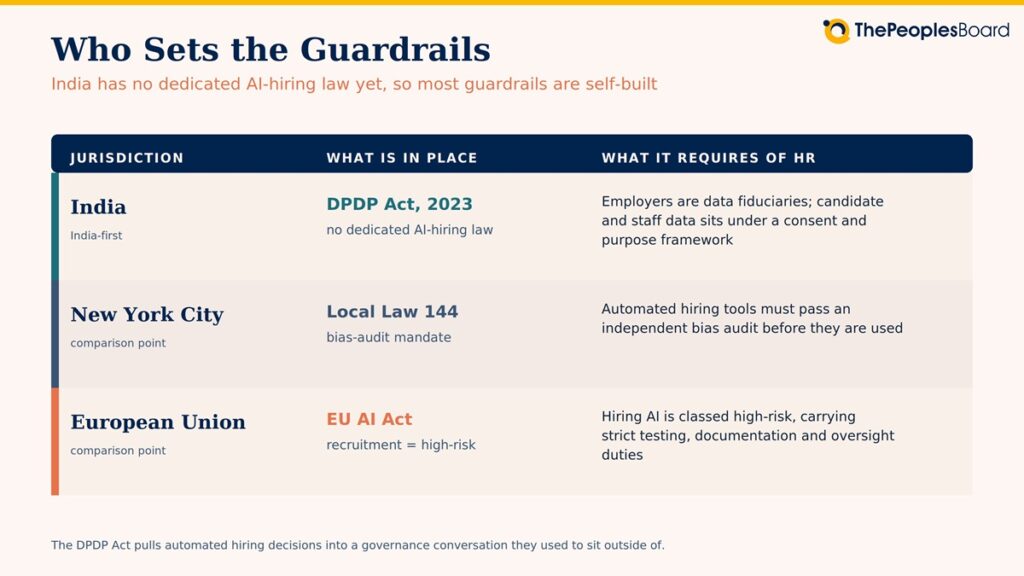
Then, there’s a compliance dimension, though it’s still taking shape. The DPDP Act, 2023 puts employee and candidate data under a formal consent-and-purpose framework and makes employers accountable as data fiduciaries for how that data gets processed, which pulls automated hiring decisions into a governance conversation they used to sit outside of. India has no dedicated AI-hiring law of the kind New York City and the EU have passed, so for now the guardrails are the ones HR builds itself.
What HR Can Do About It
The realistic goal isn’t a bias-free algorithm, because no such thing exists. It’s a system HR can inspect, question, and correct, with a human accountable for the outcome. That’s achievable, and most of it doesn’t require a data science degree.
The measures below matter most, and they’re ordered from what protects candidates directly to what protects the organisation over time.
| Measure | What It Involves | Why It Works |
| Audit before you trust | Test any screening or scoring tool on your own past data, checking outcomes across gender, region, and other groups before it goes live | Surfaces skew the vendor’s benchmark won’t show, because your applicant pool isn’t theirs |
| Keep a human in the loop | Use model output as one input to a recruiter’s decision, never as an automatic reject | Stops a single flawed score from silently ending a candidacy |
| Interrogate the proxies | Ask the vendor exactly which features the model uses, and strip or flag stand-ins for protected traits | Proxies are where “neutral” models hide their bias |
| Demand vendor transparency | Require documentation of training data, tested groups, and known limitations in the contract | Shifts the burden of proof onto the tool, where it belongs |
| Re-audit on a schedule | Recheck outcomes quarterly rather than once at rollout | Models drift as data and roles change, so a clean launch doesn’t stay clean |
Structured, job-related evaluation is the quiet backbone of all of this. When a role is scored against defined competencies rather than pattern-matched against past hires, there’s far less room for a proxy to do damage. TPB’s guide to running structured interviews for fairer hiring goes deeper on the practical mechanics.
None of this treats AI as the enemy. Used well, a good tool can widen a shortlist and catch human inconsistency, which is the argument TPB’s walkthrough of how to use AI in recruitment without losing oversight develops at length. The failure mode isn’t the technology. It’s deploying it as a black box and assuming the output is neutral because a machine produced it.
In the End…
One question is worth putting to your team this week, about a single tool you already use to screen, score, or rank people: what would happen if you ran last year’s applicants through it and sorted the results by gender, region, and name type? If nobody can answer, that’s the audit to schedule first.
A handful of commitments then belong in writing. Every automated hiring or people decision needs a named person accountable for it, so an outcome always has an owner. Your next vendor contract needs a bias-testing clause, so transparency becomes a requirement rather than a favour. And a recurring date to re-check outcomes has to sit on the calendar, because a model that was fair at launch won’t stay fair on its own.
The organisations that come out ahead won’t be the ones that avoided AI. They’ll be the ones that refused to let a score make a decision no human was willing to stand behind.
FAQs
What is algorithmic bias in HR?
Algorithmic bias in HR is a systematic, repeatable error in an automated system that produces unfair outcomes for a particular group of candidates or employees. It shows up when a model consistently scores, ranks, or flags one set of people lower than another for reasons unrelated to their ability to do the job, across hiring, appraisal, promotion, and retention decisions.
How does bias enter an HR or hiring algorithm?
Bias enters mainly through three routes: biased training data, proxy variables, and design choices. A model learns from past decisions and treats their skew as a target, uses stand-ins like pin code, college name, or employment gaps as proxies for protected traits, and reproduces whatever it is told to optimise for.
What is a real example of algorithmic bias in hiring?
The clearest public example is Amazon’s experimental hiring tool, built from 2014 and scrapped around 2017. Trained on a decade of mostly male resumes, it taught itself to penalise the word “women’s” and downgraded graduates of two all-women’s colleges. Nobody coded that behaviour; the historical data produced it.
Can algorithmic bias be removed from HR tools completely?
No fully bias-free algorithm exists, so the realistic goal is a system HR can inspect, question, and correct, with a named human accountable for the outcome. That means auditing tools on your own past data before rollout, keeping a human in the loop on every reject, interrogating proxy variables, and re-auditing outcomes quarterly.
Does Indian law regulate AI bias in hiring?
India has no dedicated AI-hiring law of the kind New York City and the EU have passed, so the guardrails are largely the ones HR builds itself. The DPDP Act, 2023 does put candidate and employee data under a consent-and-purpose framework and makes employers accountable as data fiduciaries, which pulls automated hiring decisions into a governance conversation they used to sit outside of.