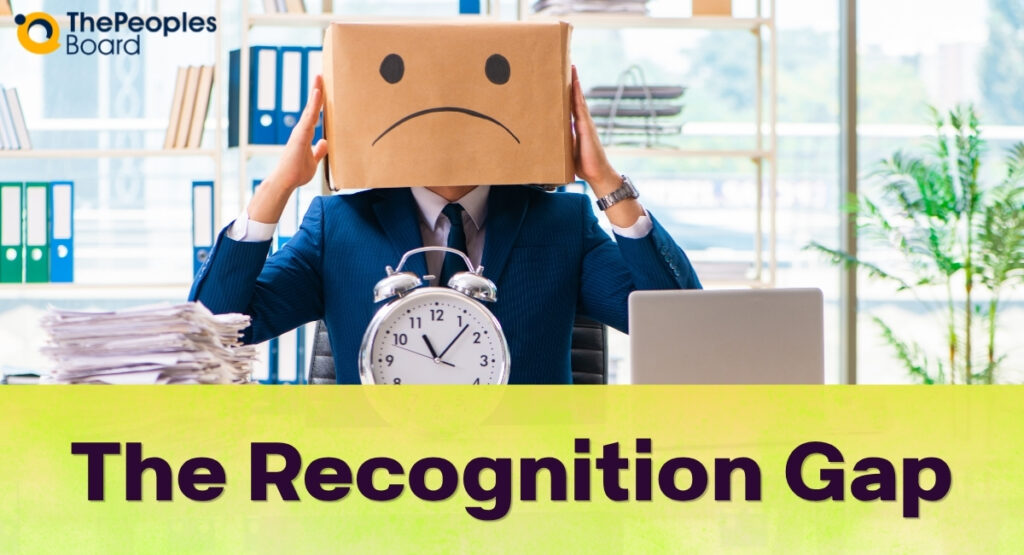


A manager forgets to name one person during a project wrap-up. Six months later, that person still remembers it. The praise that landed on a teammate faded from memory within days. The recognition that never came stayed.
That asymmetry sits at the centre of the recognition gap, and it explains why so many well-meaning appreciation programmes fail to move the numbers HR leaders care about. The absence of recognition registers more sharply, and lasts longer, than the presence of it. For Indian workplaces already navigating falling engagement and stubborn voluntary attrition, the cost of that missing acknowledgement is measurable.
Why the Missing Recognition Sticks in Memory
The human brain is wired to weigh what’s negative more heavily than what’s positive. Psychologists call it negativity bias, and it’s one of the most consistently documented findings in cognitive science. Adverse events have a greater effect on our psychological state than positive events of the same size, and we feel the negative ones more intensely even when the two are objectively equal.
Recognition that never arrives behaves like a small negative event. An employee who expected acknowledgement, watched a colleague receive it, and got nothing walks away with a vivid, durable memory of being overlooked. Even inside a relationship built on repeated support, people remember the one moment praise was withheld far more sharply than the many times it was given.
There’s a second layer to this in the workplace. Being passed over isn’t just a neutral non-event. It carries social meaning. It reads as a signal about status, about whether the work was seen, about where a person stands with their manager. Negative signals also tend to feel more revealing of where someone truly stands than positive ones, so one skipped mention can quietly outweigh months of routine appreciation.
The Recognition Gap by the Numbers
The gap isn’t a feeling. It’s a pattern that survey data captures year after year, and the Indian picture is now sharper than it has been in half a decade.
Engagement is the clearest signal. Gallup’s State of the Global Workplace 2026 report puts Indian employee engagement at 23% in 2025, a four-year low, and Gallup’s earlier 2025 edition found nearly half of Indian employees actively looking to leave.
Gallup defines engaged employees as those who feel emotionally connected to their work and workplace, while those who are not engaged put in minimal discretionary effort. Recognition is one of the cheapest, fastest levers for building that emotional connection, and its absence pulls in the opposite direction.
The money attached to it is not small. Gallup estimates that workplace disengagement costs India roughly $351 billion a year, equal to about 9% of the country’s GDP. Attrition, meanwhile, has cooled but stayed costly: Aon’s Annual Salary Increase & Turnover Survey 2025-26 recorded overall attrition of 16.2% in 2025, with e-commerce running near 28.7%.
What should worry HR most is that nearly 75% of those exits were voluntary, well above the 50 to 66% seen in global markets, which means most of India’s churn is people choosing to walk.
However, certain patterns explain why the gap persists rather than closing on its own:
- Managers are checking out first. Gallup’s India data shows manager engagement fell from 39% in 2024 to 30% in 2025, a steeper drop than among individual contributors. Since managers deliver most day-to-day recognition, a disengaged manager is a broken pipe in the recognition system.
- Lack of recognition is a named exit driver. Gallup attributes India’s rising intent to quit partly to burnout, poor leadership, and a lack of recognition. It sits alongside pay and career growth in Indian attrition studies, not below them.
What HR Usually Gets Wrong About Recognition
Most Indian organisations already run some form of appreciation. Awards nights, spot bonuses, employee-of-the-month boards, festive tokens. The programmes exist. The gap persists anyway.
- Recognition is treated as an event, not a habit. An annual awards ceremony recognises a handful of people once a year and leaves everyone else in the unrecognised majority for the other 364 days. Because the brain encodes the omission more strongly than the ceremony, a once-a-year model can generate more felt neglect than felt appreciation.
- Frequency is confused with meaning. Handing out recognition often doesn’t help if it feels generic. The volume of praise and its impact are two different things, and cheap, undifferentiated recognition can register as noise rather than acknowledgement.
- The pipeline depends entirely on managers who are themselves disengaged. When the person expected to notice good work has quietly checked out, recognition doesn’t get delegated elsewhere. It simply stops. That’s precisely the pattern India’s falling manager-engagement numbers describe.
TPB’s earlier reporting on why so many Indian employees quietly disengage traces the same fault line: systems that route recognition through a single overloaded manager tend to fail at exactly the moment that manager is under most pressure.
How HR Can Close the Recognition Gap
Closing the gap isn’t about spending more. It’s about designing recognition so the absence happens less often and the presence lands harder. Five moves do most of the work.
- Distribute the source. Don’t leave recognition solely with line managers. Build peer-to-peer recognition into everyday tools so acknowledgement keeps flowing even when a manager is stretched thin. Peer recognition also widens who gets seen, which shrinks the pool of people quietly nursing a memory of being overlooked.
- Make it frequent and specific. Replace the annual spotlight with small, regular, named acknowledgements tied to actual work. “Thanks for staying back to fix the payroll run before month-end” beats a generic certificate. Specificity is what signals the work was genuinely seen.
- Audit who’s being missed. Recognition gaps aren’t evenly distributed. Remote workers, night-shift staff, back-office and frontline roles, and quieter contributors are the ones most often skipped. A simple recognition audit, pulled from your engagement platform or the HRMS your team already runs on, shows who hasn’t been acknowledged in the last quarter. Those are the people most at risk of remembering the silence.
- Fix the manager layer first. No recognition programme survives a disengaged manager. Equip managers with prompts, reminders, and lightweight tools, and hold them accountable for recognition frequency the way some Indian firms now tie manager scorecards to team retention. That’s why recognition capability belongs inside how you train and coach managers rather than inside an annual HR campaign.
- Listen for the gap before it becomes an exit. Stay conversations and pulse surveys surface the overlooked-but-not-yet-resigned employee while there’s still time to act. Indian firms running structured stay surveys have reported meaningful attrition drops, and recognition history is one of the clearest early-warning fields to track.
None of these requires a new budget line. They require treating recognition as continuous infrastructure rather than a calendar event, and accepting that the goal isn’t to maximise praise. It’s to minimise the moments an employee walks away feeling unseen.
In the End…
Employees don’t keep a ledger of every kind word. They keep a much shorter, sharper list of the moments they expected to be seen and weren’t. That list is what negativity bias preserves, and it’s what quietly drives disengagement and exits long after the incident itself.
For Indian HR teams facing 23% engagement and near-50% intent to quit, the recognition gap is one of the few levers that costs almost nothing and moves quickly. The organisations that close it won’t be the ones with the flashiest awards night. They’ll be the ones that made sure the fewest people had a reason to remember the recognition they never received.
FAQs
What is the recognition gap?
The recognition gap is the difference between the acknowledgement employees expect for their work and what they actually receive. It matters because the absence of recognition registers more sharply and lasts longer in memory than praise that does arrive, quietly driving disengagement and voluntary exits.
Why do employees remember recognition they didn’t receive?
The human brain is wired for negativity bias, weighing negative events more heavily than positive ones of the same size. Recognition that never arrives behaves like a small negative event, and being passed over carries social meaning about status and whether the work was seen, so one skipped mention can outweigh months of routine appreciation.
How does the recognition gap affect employee engagement in India?
Gallup’s State of the Global Workplace 2026 report puts Indian employee engagement at 23% in 2025, a four-year low, with a lack of recognition named as one driver of rising intent to quit. Aon recorded overall attrition of 16.2% in 2025, and nearly 75% of those exits were voluntary, well above the 50 to 66% seen in global markets.
What do HR teams usually get wrong about recognition?
Three mistakes recur: treating recognition as an annual event rather than a daily habit, confusing frequency with meaning by handing out generic praise, and routing the entire pipeline through managers who may themselves be disengaged. Gallup’s India data shows manager engagement fell from 39% in 2024 to 30% in 2025.
How can HR close the recognition gap without extra budget?
Five moves do most of the work: distribute the source through peer-to-peer recognition, make it frequent and specific, audit who is being missed using engagement or HRMS data, fix the manager layer first, and listen for the gap through stay conversations and pulse surveys. Each treats recognition as continuous infrastructure rather than a calendar event.