
Gen Z now makes up close to 27% of India’s workforce, and in the country’s global capability centres, Gen Z and millennials together account for 93% of the headcount. Yet employee engagement in India fell to 23% in 2025, its lowest level in four years, according to Gallup’s State of the Global Workplace 2026 report. The two numbers together point to a specific problem. The largest cohort entering Indian workplaces is also the least engaged one, and most engagement programs were not built with this generation in mind.
This isn’t a motivation problem. It’s a design problem. Gen Z isn’t rejecting work. It’s rejecting a version of engagement built around annual surveys, ping-pong tables, and hierarchy-first feedback loops that assume everyone wants the same thing older generations wanted.
How Gen Z Engagement Actually Differs
Most HR teams still measure engagement the way they did for millennials, only faster. That’s the first mistake. The drivers themselves have shifted, not just the delivery speed.
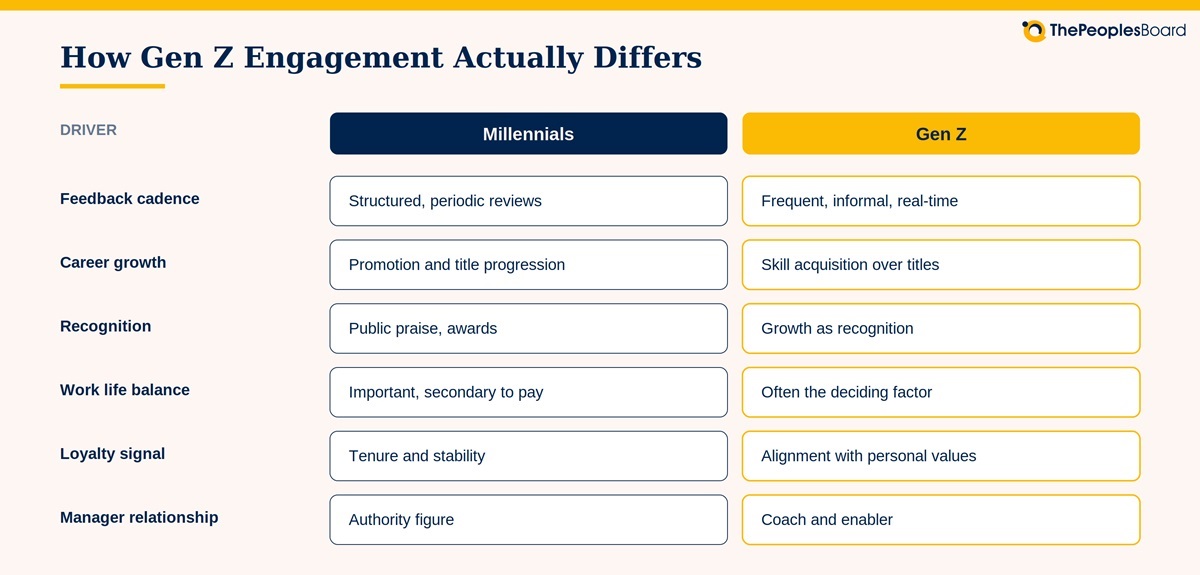
According to Naukri’s Voices @ Work report, which surveyed over 23,000 Gen Z professionals across 80-plus industries in India, 57% define career growth as learning new skills on the job rather than chasing promotions or salary hikes, and 81% prefer recognition through growth opportunities over verbal praise.
Half of the respondents ranked work-life balance as the most critical factor in a job offer, ahead of compensation itself, based on the Naukri Gen Z Work Code report.
Deloitte’s 2026 Gen Z and Millennial Survey found a similar pattern of recalibrated priorities in India. Over 60% of Gen Z and millennial respondents said housing affordability now shapes their career decisions, and about half said they had turned down a work assignment because it conflicted with their personal beliefs.
This is a workforce making career decisions on a wider set of criteria than pay and title alone, and engagement strategies built purely around compensation reviews will keep missing the point.
What HR Teams Are Getting Wrong
A handful of recurring mistakes show up across Indian organisations trying to engage this cohort.
- Treating annual engagement surveys as sufficient. By the time results come in, the feedback is already stale for a generation that expects real-time responsiveness.
- Confusing wellness spending with wellness outcomes. More than 70% of Indian organisations increased wellbeing budgets in 2026, but many are still tracking webinar attendance instead of whether people are sleeping better or staying longer, according to the India Corporate Health Study 2026 by People Matters and Truworth Wellness.
- Relying on managers trained for a different generation. Weekly one-on-ones designed as status checks land as interrogations for employees who expect coaching conversations, not oversight.
- Assuming job hopping equals disloyalty. Gen Z’s early-career tenure runs shorter than any prior generation, but research from Randstad frames this as growth-seeking rather than disengagement. Employees leave when they stop seeing development, not simply because a better offer appeared.
- Underinvesting in psychological safety while overinvesting in perks. Organisations that demonstrated visible empathy reported 30% higher engagement and 25% lower attrition than sector peers, per the ICICI Lombard India Wellness Index 2025, yet 75% of Indian employees still hesitate to label an absence as mental-health related, per Deloitte India 2025 data cited in the same Nasscom Insights piece on Gen Z workforce sentiment.
- Building generic engagement surveys instead of diagnostic ones. A survey that asks the wrong questions returns a score without telling HR teams what to fix. TPB’s own breakdown of engagement survey questions HR teams must ask covers this gap in more depth.
The Cost of Getting It Wrong
The consequences are already visible in hiring data, not just survey scores. According to staffing experts cited by The Economic Times, Indian IT companies and global capability centres are dedicating roughly 40% of all hiring in Q4 FY26 simply to backfill Gen Z employees leaving faster than firms can plan for, based on reporting on India’s replacement hiring wave. Infosys, Wipro, and HCLTech have each disclosed attrition dynamics where a meaningful share of fresher intake now exists to replace departures rather than to expand headcount.
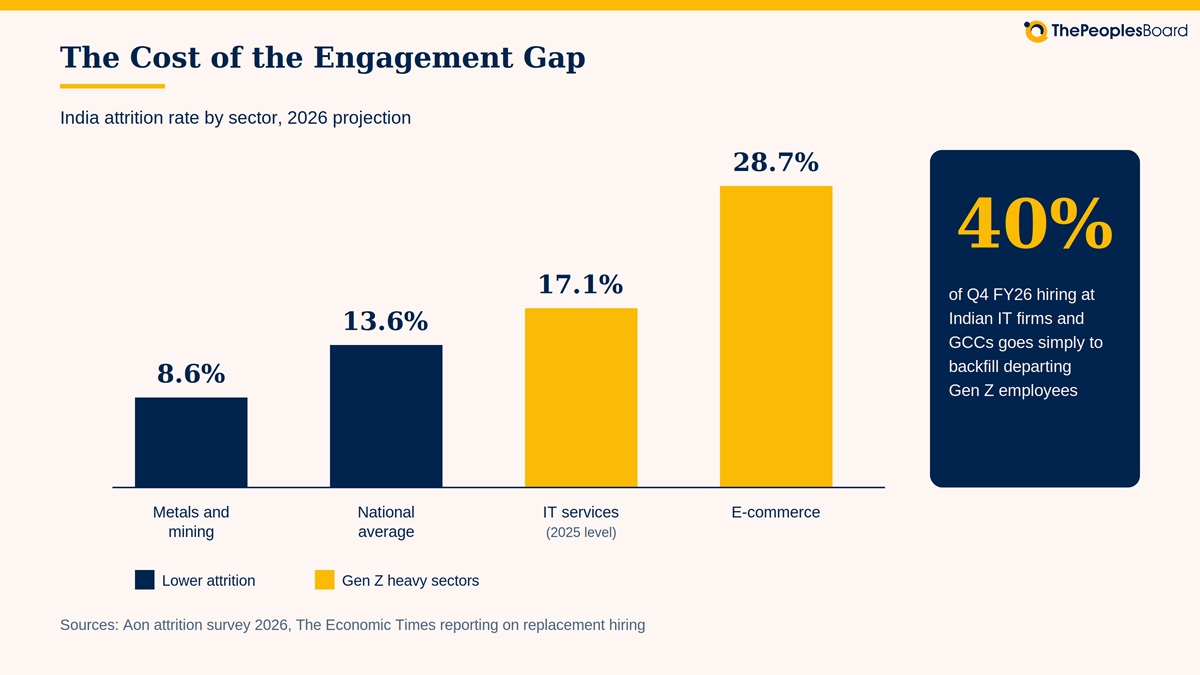
This is playing out against a backdrop where India’s overall attrition rate is projected to stabilise around 13.6% in 2026, down from 17.1% in 2025, but with sharp variation by sector, from 8.6% in metals and mining to 28.7% in e-commerce, according to Aon’s attrition survey of over 1,060 companies. Gen Z-heavy sectors like IT services and e-commerce sit at the higher end, which suggests the engagement gap and the attrition gap are the same problem viewed from two directions.
What Actually Moves the Needle
Santosh Rudrawar, CHRO at Sanjay Ghodawat Group, described the shift plainly in a conversation with TPB: hierarchies are flattening, careers are becoming more personalised, and continuous feedback is replacing episodic reviews.
He also flagged hiring itself as a weak point, noting that for Gen Z candidates, a slow, generic hiring process signals a lack of respect for their time before they’ve even joined.
A few practical shifts consistently show up in what’s working across Indian employers:
- Replace annual reviews with short, frequent check-ins. Weekly 15-minute conversations cost nothing and directly address the feedback-speed gap.
- Build visible internal mobility. Employees who see a real skill-growth path inside the company are less likely to look outside it.
- Give managers coaching training, not just compliance training. The manager relationship is the single most cited reason Gen Z employees stay or leave.
- Make pay and growth criteria transparent. Ambiguity around promotion timelines reads as a red flag to a generation used to instant feedback loops elsewhere.
- Track impact metrics over participation metrics. Attendance at a wellness webinar is not the same as improved retention or productivity.
Technology-enabled performance tools are making some of this easier to operationalise, from pulse surveys to real-time sentiment tracking. Tools help, but they only work when the underlying management practice changes alongside them. And with hiring in India in 2026 already leaning on AI-driven recruitment, the same generation being hired through faster, smarter processes expects to be managed with the same level of responsiveness once they’re in the seat.
Recent Incidents That Show the Gap in Real Time
The engagement gap isn’t only visible in survey data. It plays out in public, often through a single viral post that captures what a broader cohort is already feeling.
- A resignation email as workplace commentary: In May 2026, a 21-year-old content marketing strategist from Lucknow, Pratishtha Gupta, posted screenshots of her resignation email on Instagram after calling out an unmanageable workload and workplace culture at her company. The post spread widely across social platforms, with commentary framing it as a stand-in for broader Gen Z frustration with burnout and low pay.
- A leave request turning into a flashpoint. A video showing Gen Z employee Simran’s blunt reaction after a manager cancelled their approved leave went viral in February 2026, reigniting online debate over how much say employees should have over time off once it has already been approved.
- A LinkedIn post on the leave-guilt gap. A LinkedIn post by Shivam Dubey, a talent acquisition coordinator, contrasted a colleague’s unquestioned three-week vacation in Europe with the follow-up questions he faced after taking two days off in India. The post drew thousands of reactions, largely from younger professionals who said the same pattern showed up early in their careers and simply repeated itself as they got more senior.
None of these incidents is an isolated HR failure at a single company. Each one went viral because it named something a much larger group of employees already recognised, which is exactly why HR teams should treat viral workplace moments as informal, real-time engagement signals rather than one-off PR problems to manage individually.
In the End…
Gen Z engagement isn’t a separate HR problem requiring a separate playbook bolted onto existing programs. It’s a signal that the underlying model of engagement, built around annual cycles, hierarchy-based feedback, and generic wellness spending, no longer matches how the largest share of India’s workforce actually experiences work.
The organisations narrowing the gap aren’t necessarily spending more. They’re measuring differently, training managers differently, and treating feedback as a weekly habit rather than an annual event. For HR teams still running 2015-era engagement models on a 2026 workforce, the fix starts with admitting the model, not the generation, is the problem.
FAQs
How is Gen Z employee engagement different from millennial engagement?
Gen Z prioritises frequent, informal feedback over structured annual reviews, and values skill acquisition over promotion titles. Work life balance often outweighs pay as a deciding factor, and loyalty tends to track personal values rather than tenure.
Why is employee engagement in India declining despite rising Gen Z representation?
Most engagement programs were designed for earlier generations and rely on annual surveys, generic wellness spending, and hierarchy first feedback loops. These structures don’t match how Gen Z employees expect to be heard or developed at work.
Does frequent job switching mean Gen Z employees are disengaged?
Not necessarily. Research frames early Gen Z job changes as growth seeking behaviour rather than disloyalty. Employees tend to leave when they stop seeing a clear development path, not simply because a better offer appears elsewhere.
What can HR teams do to improve Gen Z engagement in India?
Replace annual reviews with short weekly check ins, build visible internal mobility, and train managers to coach rather than monitor. Transparent pay and growth criteria also matter more to this workforce than compensation alone.