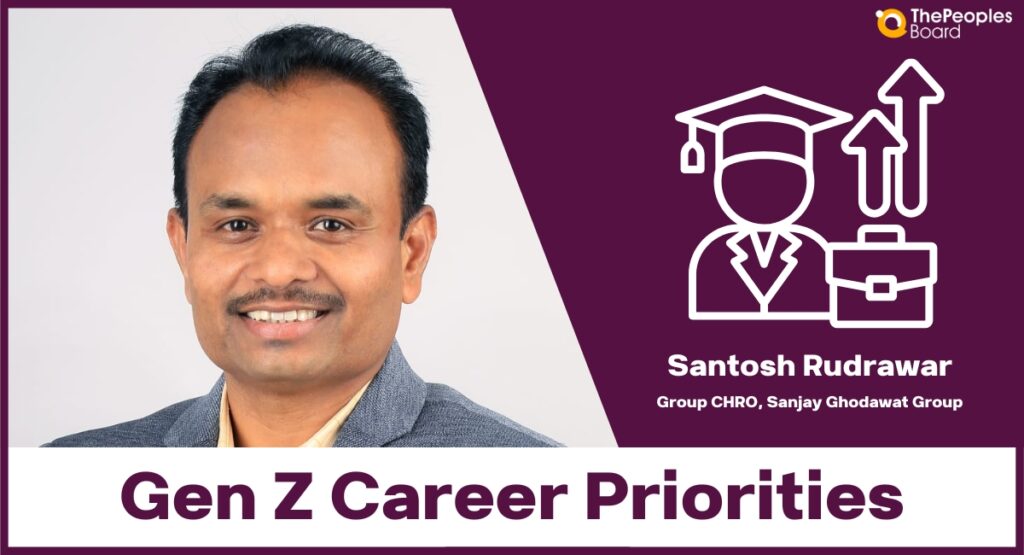

Santosh Rudrawar has spent over 25 years navigating the complexities of people leadership across Indian conglomerates, joint ventures, and multinationals, and if there’s one thing he’s learned, it’s that the rules of workforce engagement are rewriting themselves faster than most organisations are prepared for. As Group CHRO of the Sanjay Ghodawat Group, a diversified conglomerate spanning education, aviation, FMCG, and energy, he’s had a front-row seat to what it actually takes to build culture at scale, not just on paper, but across businesses, geographies, and generations.
In this conversation, Santosh speaks candidly about the generation that’s forcing HR to evolve: Gen Z. From hiring processes that feel like black boxes to career growth timelines built on ambiguity, he breaks down where organisations are still getting it wrong, and what it genuinely takes to get it right. His perspective isn’t theoretical. It’s shaped by the daily reality of building a high-performance, inclusive culture for a workforce that questions quickly and expects actions to match words.
TPB Team: Where do traditional hiring processes fail Gen Z the most, and what does a genuinely Gen Z-ready process look like?
Santosh: According to me, traditional hiring processes were never designed for a generation that values transparency, speed, and authenticity. For Gen Z, hiring often feels like a black box which has long forms, delayed feedback, and generic interactions. That signals a lack of respect for their time and individuality. A Gen Z-ready process flips this. It is transparent, interactive, and experience-led. It gives candidates a real view of the organisation through skill-based assessments, live problem-solving, and direct conversations with future peers or young leaders. It’s less about evaluating them in isolation and more about helping them understand where they fit. That shift from assessment to engagement is critical.
TPB Team: What needs to change in how companies design and communicate career growth timelines for Gen Z?
Santosh: The biggest shift required is moving from ambiguity to clarity. Gen Z is not willing to wait indefinitely based on implied promises. They want visibility into what growth looks like, what skills matter, what paths exist, and what progress actually means. Organisations need to move away from the single “ladder” mindset to a “career lattice” where lateral moves, short-term projects, and skill-based progression are equally valued. What works well is showing real journeys, including setbacks. When growth is presented as real and non-linear, it builds credibility. The era of “wait your turn” is over; transparency is now a leadership responsibility.
TPB Team: Gen Z expects self-directed learning, not scheduled training. What does a learning culture that works for them actually look like?
Santosh: Learning today must be continuous, contextual, and self-driven. Gen Z does not engage with learning as an event. They engage with it as a habit, something that fits into their flow of work and life. A relevant learning culture enables access rather than mandates participation. It provides digital platforms, peer learning opportunities, and real-world problem-solving exposure. More importantly, leaders need to shift from driving compliance to encouraging curiosity. Some of the most meaningful innovations come from individuals who explore beyond their defined roles. That’s the behaviour organisations need to enable.
TPB Team: Flexibility means different things across industries. Where should organisations draw the line, and how do you have that conversation honestly?
Santosh: Flexibility cannot be defined uniformly, as it must be contextual. The key is not offering blanket policies but creating clarity. What is possible in a role, what is not, and why. The most effective approach is co-creation. When employees are involved in designing flexibility within operational boundaries, the outcomes are far more sustainable. Sometimes flexibility is about time, sometimes about location, and sometimes simply about autonomy in how work gets done. The real shift is from control to trust and balanced with clear accountability.
TPB Team: Gen Z is the first generation to have grown up with AI as a natural tool. How should companies be preparing them to lead with emerging technologies, not just use them?
Santosh: For Gen Z, AI is not disruptive; it is intuitive. The opportunity for organisations is to move beyond access to ownership. Instead of just deploying tools, they need to involve Gen Z in shaping how these tools are applied. One powerful lever is reverse mentoring, where younger employees guide senior leaders on emerging technologies and new ways of working. When organisations create space for Gen Z to challenge existing processes and experiment with technology, they move from being users of AI to becoming shapers of it.
TPB Team: As per Gen Z, well-being goes beyond a basic mental health helpline. What does a credible well-being framework actually require?
Santosh: Well-being today is multidimensional, such as mental, physical, financial, and social. While access to support systems like counselling is essential, what truly differentiates organisations is cultural integration. Well-being cannot sit as a standalone initiative; it must be embedded in how work is designed and how leaders behave. Leadership openness plays a critical role. When leaders acknowledge challenges and normalise conversations around well-being, it creates psychological safety. A credible framework is not defined by programs alone, but by how consistently the organisation demonstrates care in everyday decisions.
TPB Team: For Gen Z, inclusion means a seat at the decision-making table, not just representation by headcount. What structural changes make that real?
Santosh: Inclusion for Gen Z is about influence, not just presence. To make this real, organisations need to create structured opportunities for younger voices to contribute to decision-making through forums, projects, and leadership programs. It also requires rethinking traditional filters like “years of experience” and focusing more on capability and potential. When organisations genuinely act on feedback and visibly incorporate diverse perspectives into decisions, inclusion shifts from being symbolic to meaningful.
TPB Team: Building a high-performance, inclusive culture across a diversified conglomerate like SGG is ambitious. What’s been the hardest part of making that real for a Gen Z workforce?
Santosh: The hardest part is sustaining consistency across diverse businesses while challenging deeply embedded ways of working. Culture transformation is not a one-time intervention as it requires continuous effort, especially when decentralising decision-making and pushing accountability deeper into the organisation. Gen Z accelerates this challenge because they question quickly and expect alignment between words and actions. While it can be demanding, it also acts as a forcing function, ensuring that change is not superficial but real and sustained.
TPB Team: You’ve worked across Indian, JV, and MNC cultures for over 25 years. How differently does Gen Z show up across these environments?
Santosh: What stands out is adaptability. In Indian organisations, Gen Z tends to be more direct and expressive. In joint ventures, they often act as cultural bridges. In MNCs, they operate with an expectation of global standards and are more assertive in demanding them. However, the underlying mindset remains consistent, that they question legacy thinking and push for relevance. That makes them powerful catalysts for change across contexts.
TPB Team: There’s an ongoing debate about whether organisations should adapt to Gen Z or should Gen Z adapt to organisational realities. Where do you stand?
Santosh: It must be a balanced equation. Organisations need to evolve, especially around purpose, flexibility, and inclusion, because workforce expectations are changing structurally. At the same time, Gen Z also needs to understand organisational constraints, whether operational, regulatory, or strategic. The most effective environments are built on mutual adaptability, where both sides engage openly and align on what is possible while working towards what is ideal.
TPB Team: Looking five years ahead, what does the ideal Indian workplace look like for a Gen Z professional, and how far does the industry still have to go?
Santosh: I believe the future workplace will be far more fluid, transparent, and human-centric. Hierarchies will flatten, careers will become more personalised, and continuous feedback will replace episodic reviews. Well-being and inclusion will move from being initiatives to becoming non-negotiable foundations. While progress is visible, there is still a gap, especially in execution consistency. Organisations that move decisively now will not only attract Gen Z talent but will also build more resilient and future-ready cultures.
What comes through clearly in Santosh’s perspective is a belief that the Gen Z conversation isn’t a generational problem to manage, it’s an organisational opportunity to seize. The companies that treat Gen Z’s directness, curiosity, and demand for authenticity as a forcing function rather than a friction point will be the ones that build cultures worth staying in. The gap, as he puts it, isn’t in intent. It’s in execution consistency. And closing that gap starts with leaders who are willing to meet this workforce not halfway, but honestly.