
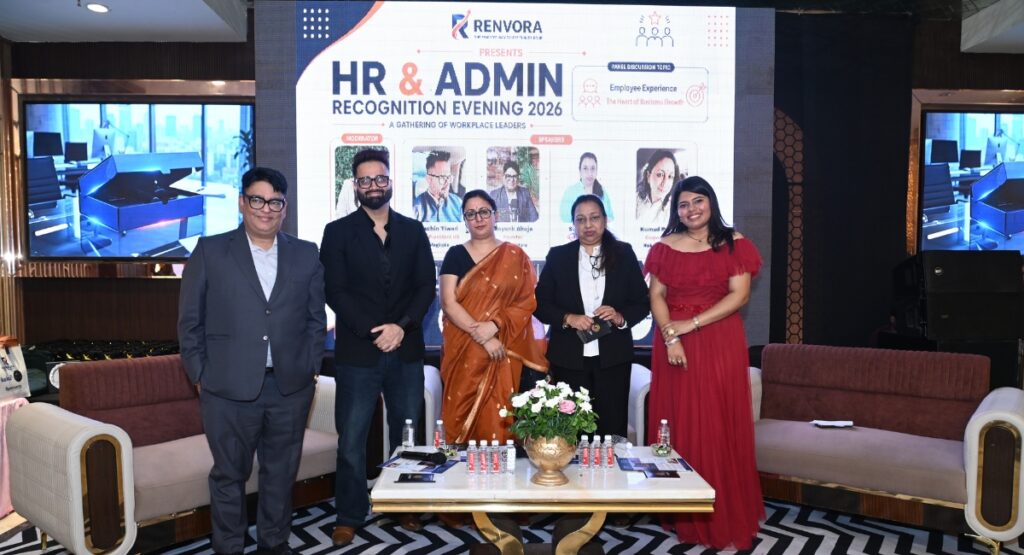
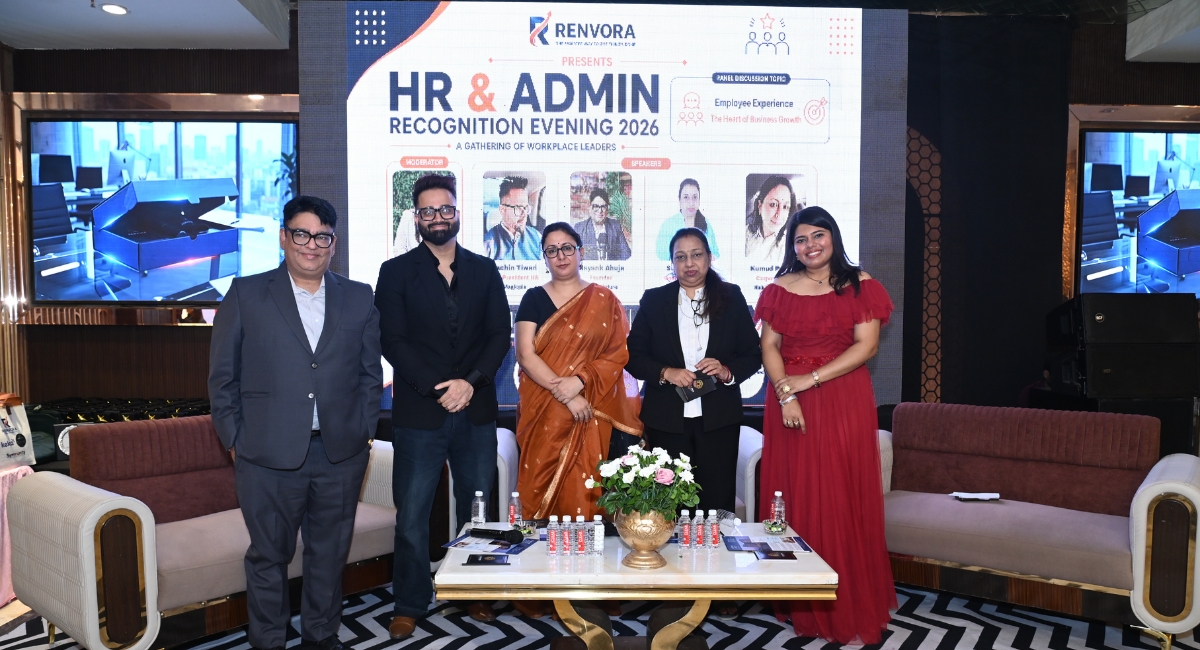

Renvora‘s HR & Admin Recognition Evening 2026 put employee experience at the centre of its conversations, not just its awards.
The event hosted a panel titled “Employee Experience: The Heart of Business Growth,” moderated by Meenakshi of Symmunity, the event’s Community Partner. The panellists were:
- Mayank Ahuja: Founder, HR by Nature
- Sachin Tiwari: Vice President, HR, Magicpin
- Sunanda Rao: Atal Innovation Mission
- Kumud Pandita: Corporate HR, Kak Hospitality
The discussion moved beyond employee experience itself, into how HR is transforming through shifting expectations, new technology, and changing mindsets.
Boardrooms and Leaders
Asked if employee experience deserves a seat in the boardroom or should stay with HR, Kumud was unequivocal that it belongs at the top table. Sachin, though, disagreed with the framing. In his view, boards are driven by business outcomes first, and experience only earns attention once it is tied to those outcomes. He said changing that perception is HR’s job, since the pitch to a board has to be “if this works, then business will work.“
Sunanda put the manager relationship at the centre of it all.
“Because HR comes second or third in the ladder, the first point of contact is the manager. If we can equip the managers to be more empathetic and to take off their crown that ‘oh I am the manager,’ to ‘I am the person who is the first POC,’ I think things will change,” she said, adding that most people leave companies because of managers, not culture or policy.
On learning, Sunanda made the same point in different words. She said the most valuable thing any organisation can offer an employee is a learning experience shaped around what that person actually wants, not a generic training calendar.
Mayank made the same case from the leadership side. “Start investing in training and development. That will enhance the employability of the people,” he said.
Kumud brought the conversation back to hybrid work, where distance often leaves employees feeling like they do not matter to the organisation. Her advice was blunt. “Ask people: what is the hardest part of their job?” she said, and then act on what they say.
On where HR technology fits in, Sachin made his sharpest point yet.
“Technology is not going to make HR more digital. It’s only going to make HR more human. Because if you use it right, then the human side of HR is going to have more time to solve for people,” Sachin explained.
Taken Together
What is interesting is that none of the panellists framed this as an HR problem to solve alone. Sunanda’s point about managers shedding their “crown” and Sachin’s point about boards only responding to business outcomes are two halves of the same complaint: HR keeps being asked to fix things it does not fully control. It cannot mandate empathy in a manager the way it mandates compliance training.
What it can do is build systems, performance reviews, promotion criteria, and manager scorecards that make good manager behaviour the path of least resistance rather than an act of individual goodwill.
That has a harder implication the panel did not spend much time on. If manager quality is this decisive, promoting managers on technical performance alone, still the default in most Indian companies, works against the outcome employers say they want.
The learning comments deserve a second look. Sunanda and Mayank are right that personalised, employee-led learning beats generic training, but that skips a real constraint: it is expensive to administer at scale, which is why companies default to the calendar being criticised. The gap is not intent; it is infrastructure, and closing it needs HR tech most Indian mid-sized companies have not budgeted for.
On hybrid work, Kumud’s instinct- ask people what is hardest about their job- is good advice but incomplete alone, as she stated herself. Asking is easy. Acting on inconvenient answers, the ones implying a manager needs replacing, is where organisations quietly stop.



