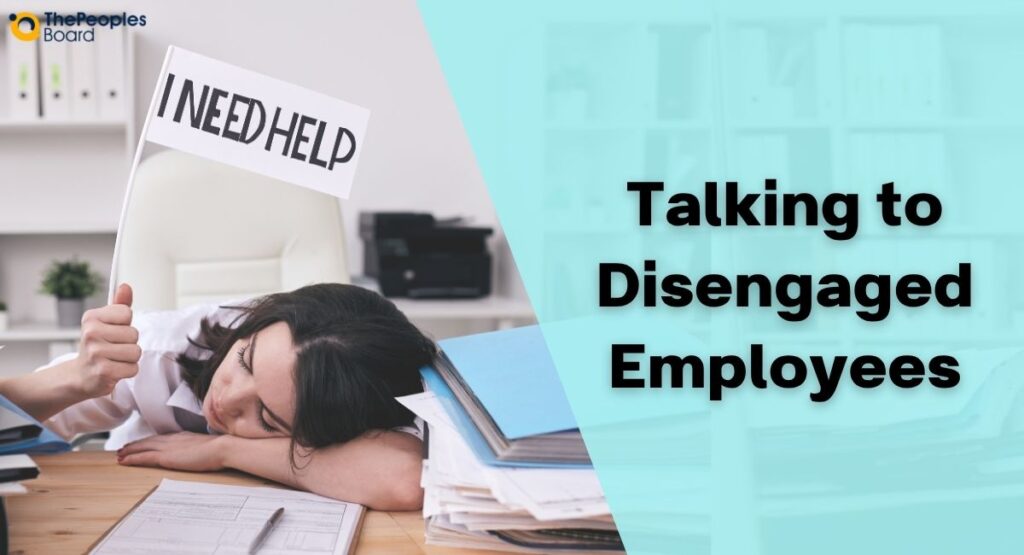

Employee engagement in India fell to 23% in 2025, its lowest level in four years, down from 30% in 2024, according to Gallup’s State of the Global Workplace 2026 report. Gallup’s research also finds that managers account for roughly 70% of the variance in team-level engagement, which means the manager conversation is usually the single largest lever available before disengagement turns into attrition or absconding.
Most managers avoid this conversation because it feels vague. There is no policy violation to point to, no missed deadline that clearly explains the change in behaviour. This guide sets out a structured way to open the conversation, a four-part script, and a follow-up cadence that keeps the intervention from being a one-time event.
Stage 1: What Disengagement Looks Like Before It Reaches HR
Disengagement rarely announces itself. It shows up as a set of small, easy-to-miss behavioural shifts, described in ThePeoplesBoard’s coverage of psychological safety and in interviews with HR leaders on workplace burnout. A good manager should remain on the lookout for certain signals that act as common indicators of a disengaged employee.
| Signal | What It Looks Like In Practice |
| Reduced voice | Stops raising concerns or ideas in meetings, even ones they previously cared about |
| Minimum viable effort | Completes tasks on time but stops volunteering for stretch work |
| Withdrawal from informal contact | Skips optional team conversations, avoids small talk, responds only when required |
| Flat or cynical tone | Shorter replies, more sarcasm, a shift to “just doing my job” language |
| Slower response times | Delays on non-urgent requests that used to get quick turnarounds |
Anjali Raghuvanshi, Chief People Officer, Randstad India & GCC, Senior Director – Business Innovation, has described this pattern in a conversation with ThePeoplesBoard, noting that emotional withdrawal often appears quietly before any measurable drop in output, and that employees may still complete tasks while investing far less enthusiasm or emotional energy in them. That gap between stable output and declining investment is exactly what makes disengagement hard to catch through performance data alone.
Why the Conversation Cannot Wait
Disengagement that goes unaddressed does not stay static. It tends to move toward one of two outcomes: a formal resignation, or an abrupt, unexplained exit. Randstad’s Workmonitor 2025 survey found that 60% of Indian respondents would leave a job without a good rapport with their manager, which places the manager relationship ahead of several other commonly cited reasons for quitting.
The cost of waiting is also measurable at the macro level. Gallup estimates that workplace disengagement costs the Indian economy close to $351 billion annually in lost productivity, equal to roughly 9% of GDP. None of that is recovered by a single well-run conversation, but the data does establish why catching disengagement early, rather than during an exit interview, is the more defensible use of a manager’s time.
Stage 2: Preparing for the Conversation
Once a disengaged employee is identified, do not jump straight into a conversation. Rather, look into the details surrounding their work and behaviour and gather the necessary information.
A disengagement conversation fails most often because it starts unprepared. Before scheduling it, a manager should confirm the following:
- Specific, dated examples. Vague impressions (“something feels off”) do not give the employee anything concrete to respond to. Two or three recent, factual observations work better than a general sense of concern.
- A private, unhurried setting. This conversation does not belong in a corridor, a group call, or the five minutes before a deadline.
- A check on personal assumptions. Confirm the behaviour is not explained by workload, a recent personal event, or a system or access issue before assuming motivation is the problem.
- An open outcome. The manager should walk in ready to listen, not to deliver a verdict. A conversation framed as a warning tends to accelerate the exact disengagement it is trying to prevent.
Stage 3: A Four-Part Framework for the Conversation
Heading into the conversation with an employee whom you suspect is disengaged, keep in mind to follow certain principles and steps. Though these can be adjusted based on your industry, your relationship with the employee, and other factors, the core principles should always be adhered to in order to engage in a truly meaningful conversation.
The following structure works across most disengagement scenarios. It does not require a script to read word-for-word, but each part should be covered in order.
| Step | Purpose | Sample Language |
| 1. Open Without Accusation | Signal the intent of the conversation is support, not discipline | “I wanted to check in because I’ve noticed a change over the last few weeks, and I’d rather ask directly than guess.” |
| 2. Share Specific Observations | Ground the conversation in fact, not interpretation | “In the last two team meetings, you haven’t shared updates unless asked directly, and that’s different from how you usually show up.” |
| 3. Ask Open-Ended Questions | Create space for the employee to name the actual cause | “What’s changed for you recently, at work or otherwise, that I should know about?” |
| 4. Co-Create Next Steps | Convert the conversation into a concrete, time-bound plan | “Based on what you’ve shared, here’s what I can change on my end. Can we check back in two weeks to see how it’s landed?” |
Step three is where most managers rush. Gallup’s Q12 research on engagement drivers identifies role clarity, recognition, and growth opportunities as the most common root causes of disengagement, so the open-ended question should probe those areas specifically rather than remain general.
Sample Scripts for Common Situations
For certain common employee disengagement scenarios, a manager can start the conversation using the following opening lines.
| Scenario | Opening Line For Managers to Use |
| Reduced participation in meetings | “I’ve noticed you’ve been quieter in our last few standups than usual. Is there something making it harder to speak up right now?” |
| Missed a deadline for the first time | “This isn’t like you, so before we talk about the deadline itself, I want to understand what got in the way.” |
| Passed over for a promotion or project | “I know the last round didn’t go the way you hoped. I’d like to hear how you’re feeling about it, and where you see your growth from here.” |
| Withdrawal after a reorganisation or leadership change | “A lot has shifted on the team recently, and I want to check how that’s landed for you specifically, not just the team as a whole.” |
| Consistently declining optional or stretch work | “You used to raise your hand for extra projects, and that’s changed recently. I’d like to understand why.” |
Each of these openings avoids assigning a cause before the employee has had a chance to explain it themselves, which keeps the conversation diagnostic rather than corrective.
What to Avoid Saying
Certain phrases, however well-intentioned, tend to shut down the conversation rather than open it. This can include:
- Comparing the employee to their past self in a way that sounds like judgment (“you used to care more about this”).
- Framing the conversation around loyalty or gratitude rather than facts.
- Delivering the observation in front of the team or over a group channel.
- Presenting a single meeting as a final warning rather than the start of a two-way conversation.
- Offering a generic fix, such as a team lunch or a one-time perk, in place of addressing the specific driver the employee names.
Stage 4: After the Conversation: Follow-Up Cadence
A single conversation rarely resolves disengagement on its own. A short, visible follow-up cadence signals that the manager’s commitment was genuine. As such, it remains imperative that a manager follows up after the main conversation to showcase their own investment in keeping the employee engaged.
| Timeframe | Action |
| Within 48 hours | Send a brief written summary of what was discussed and agreed, so both sides have the same record |
| 2 weeks | Short check-in focused only on the specific issue raised, not a general performance review |
| 30 days | Confirm whether the agreed changes have actually happened on the manager’s side, not just the employee’s |
| 60 to 90 days | Reassess whether the underlying pattern (participation, output, initiative) has shifted |
This cadence mirrors the approach recommended for managing an employee’s notice period, where regular, documented one-on-ones are treated as the manager’s main tool for catching problems early rather than after they have escalated.
When the Conversation Doesn’t Work
Not every disengagement conversation leads to visible change. If a second and third conversation surface the same pattern with no movement, the issue moves from a coaching conversation to a formal performance discussion, and HR should be looped in at that point rather than left to find out during an exit interview or an unexplained absence.
Escalating does not mean the earlier conversations failed. It means the organisation now has a documented, good-faith record of having tried the lower-friction option first, which matters both for the employee’s development file and for any formal process that follows.
In the End…
A disengagement conversation is rarely about a single incident. It is usually the visible edge of something that has been building for weeks, whether that is unclear role expectations, a stalled growth path, or a change the employee never got to process out loud. The manager’s job in that first conversation is not to fix all of it in one sitting. It is to ask a specific, honest question and actually listen to the answer.
The data on India’s declining engagement numbers makes one thing clear: the fix is not another survey or another perk. It is the manager showing up to the conversation prepared, specific, and willing to change something on their own end too. Employees rarely expect a manager to solve everything. They do expect to be asked directly, and to be believed when they answer.
FAQs
What are the early signs of a disengaged employee?
Common signs include reduced participation in meetings, declining interest in stretch assignments, slower response times, withdrawal from team interactions, and a noticeable shift in attitude or communication.
How should a manager start a conversation with a disengaged employee?
Managers should begin by sharing specific observations without assigning blame, ask open-ended questions, and focus on understanding the employee’s perspective rather than making assumptions.
What should managers avoid saying during a disengagement conversation?
Avoid judgmental comparisons, questioning loyalty, discussing the issue in public, issuing immediate warnings, or offering generic solutions without understanding the underlying cause.
How often should managers follow up after the initial conversation?
A good practice is to follow up within 48 hours, check in again after two weeks, review progress after 30 days, and reassess engagement within 60 to 90 days.
When should HR get involved in employee disengagement?
HR should be involved if repeated coaching conversations fail to improve the situation and the issue begins affecting performance or requires a formal performance management process.