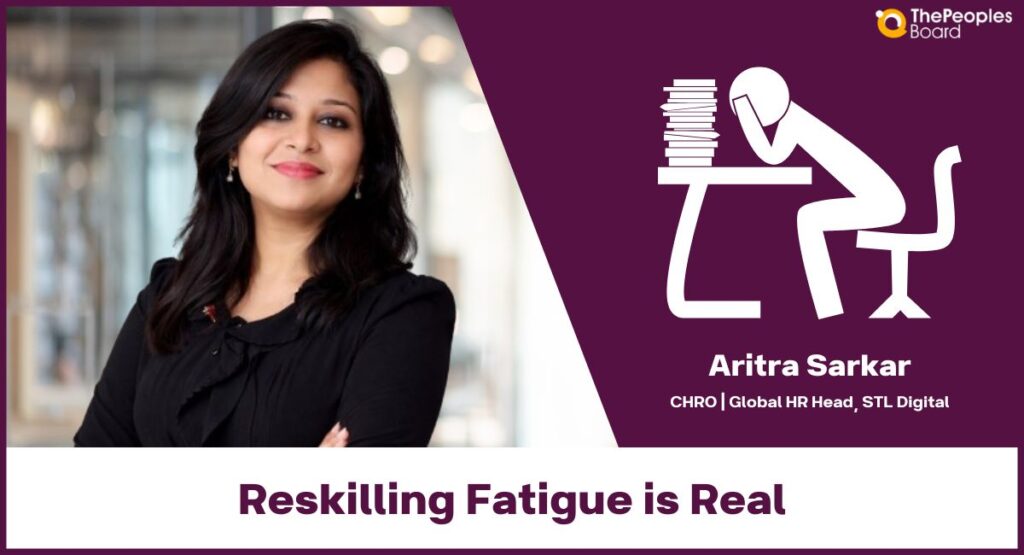
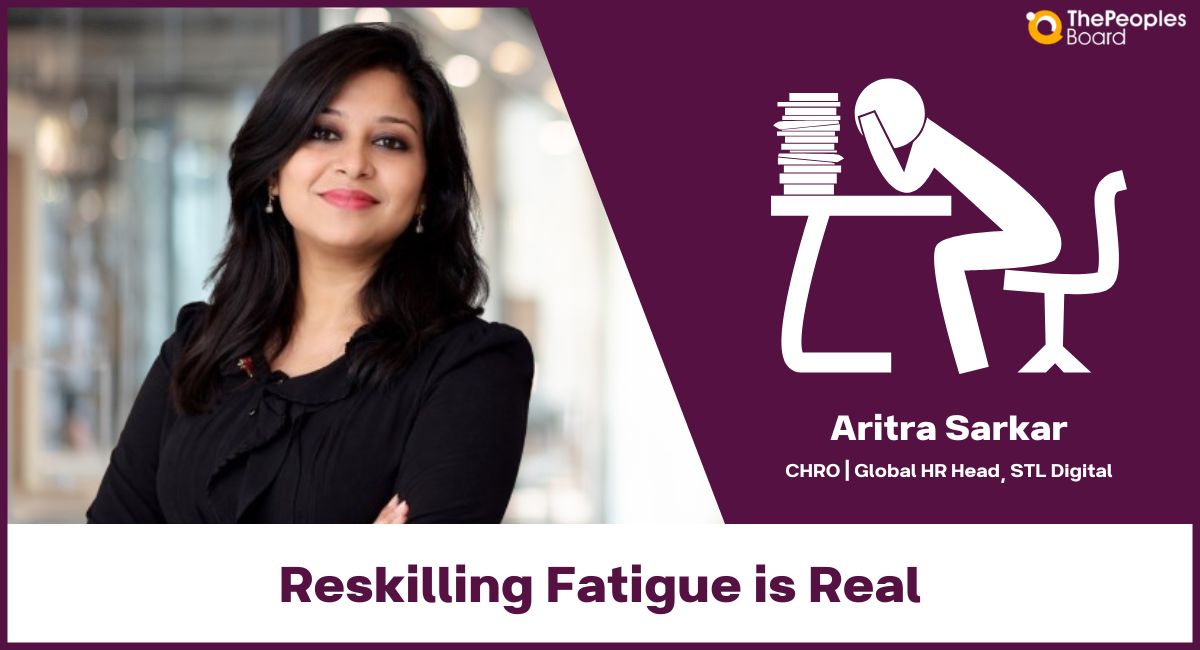

The narrative around upskilling tends to run in one direction. Learn faster, adapt sooner, stay relevant or risk being left behind. But somewhere between the mandatory certifications and the back-to-back platform rollouts, a quieter problem has taken hold: employees are exhausted by the very thing meant to future-proof them. Reskilling fatigue is no longer a fringe concern. It’s a measurable operational risk, and most organisations aren’t even tracking it until attrition forces the issue into view.
Few people are better placed to unpack this than Aritra Sarkar, CHRO and Global HR Head at STL Digital. Across her career, she’s built learning cultures inside fast-moving technology organisations, and she brings a clear-eyed view of where good intentions go wrong. In this conversation, she draws a sharp line between development that genuinely changes how someone works and learning piled on for its own sake.
TPB Team: The conversation around reskilling is often positive and future-focused. At what point does continuous learning start becoming a source of fatigue for employees?
Aritra: Learning becomes fatiguing the moment it shifts from being employee-driven to organizationally imposed — and especially when it competes directly with delivery targets rather than being embedded within them.
Over 40% of our industry-wide workforce is experiencing acute cognitive overload due to the compounding volume and velocity of modern learning demands. The tipping point typically arrives when three conditions converge: volume exceeds absorption capacity, relevance to the immediate role is unclear, and learning happens at the margins of an already full workday. When all three align, what was once a development opportunity becomes yet another stressor.
As leaders, we must treat this not just as a wellness issue but as a critical operational risk that threatens engagement, retention, and overall productivity.
TPB Team: Do you believe organisations today are expecting employees to learn too much, too quickly? Why or why not?
Candidly — yes, in most cases. Research indicates that the average employee can realistically dedicate only 24 minutes per week to formal learning.
Yet, while the velocity of technological disruption is undeniably real, organisations frequently make a critical error. We confuse a company-wide emergency with an individual’s actual ability to handle it. The result is a training overload— more courses, more mandatory certifications, more platforms — without a corresponding reduction in workload or a prioritisation framework that tells employees what actually matters.
While widespread skill gaps are evident, fewer than a third of organisations have actually redesigned workflows to make breathing room for development.
The reality we must face as HR leaders is simple: we cannot close a skill gap by layering learning on top of an unchanged job. True capability building requires us to stop treating learning as an add-on and start architecting the structural space required to achieve it.
TPB Team: With AI evolving rapidly, how can companies distinguish between necessary reskilling and learning overload?
The filter I consistently apply is this: does this learning change how an employee does their job in the next 6–18 months, or are we learning for learning’s sake? If the answer is the former, it’s necessary. If it’s speculative —”AI might affect your role someday” — it belongs in awareness programs, not mandatory curricula.
“Not every employee needs to become an AI practitioner. Every employee does need to understand how AI changes their decision-making context.”
We need to stop treating AI training as one-size-fits-all. Everyone needs the basics, some need the practical tools for their specific jobs, and only the tech experts need the heavy coding stuff. Shoving all of it down everyone’s throat is why employees are burnt out.
TPB Team: In your experience, what are the earliest signs that employees are experiencing reskilling fatigue?
The leading indicators tend to be behavioural before they become measurable.
In my experience, watch for: a significant drop in voluntary course enrollment even when interest exists, sarcasm or deflection in conversations about learning during team meetings, and an increase in “just tell me what I need to do” language, which signals an employee conserving cognitive energy.
From a data standpoint, three metrics tend to surface earliest: course completion rates plateauing or declining, time-to-completion stretching well beyond design estimates, and manager-reported disengagement clustering in teams with the highest mandatory learning loads.
L&D leaders across organisations don’t actively measure fatigue signals — which means most organisations are flying blind until attrition makes it visible.
TPB Team: How has the pressure to stay relevant changed the employee experience over the last few years, particularly for mid-career professionals?
For mid-career professionals — typically those 8–20 years into a career — this pressure has introduced a specific and underexplored form of identity anxiety. Their expertise, which they spent years building and which formed the foundation of their professional confidence, is now being implicitly (and sometimes explicitly) characterised as insufficient. That is deeply destabilising.
“We are asking experienced professionals to rebuild their identity at the same time we’re asking them to sustain their performance. That dual burden is not well understood.”
The majority of mid-career workers feel less secure in their jobs today than they did a few years ago, even though they have fantastic track records.
I recommend HR Leaders to stop treating training like a “fix” for a broken or outdated employee. Instead, frame it as a way to expand on the great foundation they already have. Words and attitude matter a lot here.
TPB Team: Many employees are balancing performance targets while simultaneously being asked to upskill. Is the current approach to learning realistic?
No, not as currently structured in most organisations. Asking employees to maintain 100% delivery output while absorbing new skills at speed is arithmetically impossible unless you either reduce the workload, build learning into the work itself, or accept lower quality on one dimension. Most organisations accept the last option by default, then wonder why learning doesn’t stick
The best companies don’t make employees pause their day to learn; they weave learning right into the daily routine. In fact, when companies actually protect and lock in time for employees to learn—rather than making them squeeze it into their busy schedules—employees are three times better at actually using those new skills on the job.
How should companies strategise —Short, quick tips or tutorials that pop up right while you are doing the actual task, co-workers helping and teaching each other naturally during regular project meetings or set hours for development that are locked into the calendar and cannot be cancelled or ignored for daily work.
TPB Team: What role do managers play in either reducing or increasing reskilling fatigue within teams?
Managers are, without exaggeration, the single most important variable in whether reskilling succeeds or fails at the team level. They control what actually happens to their direct reports’ calendars, psychological safety, and daily priorities — none of which HR or L&D fully controls.”A manager who says ‘learning is important but get your deliverables done first’ — and they mean it sincerely — will undo every learning culture initiative we build.”
When managers actively back their team’s growth, employees are over three times more likely to be highly motivated and twice as likely to stick around. Yet, fewer than 40% of managers actually get any training on how to coach their people. We spend a fortune on fancy software and online training platforms, but almost nothing on teaching managers how to actually help their teams learn.
TPB Team: Are organisations measuring learning success correctly, or have we become too focused on course completion and certifications?
We are overwhelmingly measuring activity rather than impact — and we know it. Course completions, certification badges, and hours logged are easy to capture and easy to report to management. They are also almost entirely disconnected from the outcomes learning is supposed to produce.
For decades, there has been a famous gold standard for measuring if training actually works. Yet, fewer than one in ten training teams actually check if a course changes how employees do their jobs, or if it helps the business make more money. We need to stop tracking simple clicks and start measuring what actually matters—even if it’s harder to do.
Instead of just checking if someone finished a training video tutorial, companies should measure these four things: How fast does an employee actually get good at the new skill? Are they still using what they learned two months after the class ended? Does their manager notice a positive change in how they work every day? Or did the training actually help the company hit its goals (like making fewer mistakes or increasing sales)?
None of these things are easy to measure, but they are the only numbers that actually mean anything.
TPB Team: How can HR and L&D teams make learning feel more meaningful rather than another item on an employee’s to-do list?
The answer lies in three shifts: from push to pull, from mandatory to meaningful, and from courses to context. Pull-based learning starts with employees having genuine clarity about their career trajectory and what skills close the gap. Without that, every learning nudge feels arbitrary. Meaningful learning is co-designed with employees, not deployed at them.
Nearly three-quarters of employees feel way more motivated when they have a say in what they learn. But the real magic happens when training is tied to a problem they are trying to solve at that exact moment. When people can immediately use what they learn, they want to learn. When they are forced to take a class just to tick a corporate box, all motivation disappears.
Companies need to stop handing out the same generic, one-size-fits-all training packets to everyone. Instead, they need to create personalised learning plans that give employees the exact tools they need, exactly when they need them for their specific jobs.
TPB Team: Do you think the fear of being left behind by technology is becoming a major workplace stress factor? How should organisations address this?
Absolutely — and it is underreported because employees are often reluctant to voice it for fear it signals weakness or vulnerability. But the data is clear. A major global study found that nearly half of all workers—about 43%—are worried that new technology will make their skills useless within the next five years. However, this fear isn’t hitting everyone the same way; it is heavily concentrated among specific groups of people who feel the most at risk.
“You can’t fix tech anxiety with more tech. The real cure is human: honest conversations, clear career goals, and managers who aren’t afraid to admit they are learning too.”
Organisations that address this well do three things: they communicate transparently about where automation is headed in their specific context (not industry abstractions), they share concrete examples of how employees have successfully transitioned, and they ensure leaders are visibly learning alongside their teams — not just sponsoring learning from above.
TPB Team: How should companies approach reskilling for employees who may feel intimidated by AI, automation, or digital transformation?
The starting point is not a course — it’s a conversation. Intimidation is an emotional state, and you cannot resolve it with a learning management system. The most effective interventions begin with psychological safety: creating structured spaces where employees can voice concerns without judgment, ask “basic” questions without embarrassment, and experiment with new tools at low stakes.
From a design standpoint, reverse mentoring programs — pairing digitally confident younger employees with experienced colleagues in a genuine two-way exchange — have shown strong results. The experienced employee gains digital fluency; the younger employee gains institutional knowledge. Everyone’s identity is affirmed.
This way, both people feel valued for what they already know. In fact, companies that use this kind of two-way mentoring get their teams to adopt new technology 40% faster than those that don’t.
If you want someone to feel comfortable being a beginner at something new, make sure you value them as an expert in what they already do best.
TPB Team: What changes do you believe are needed in corporate learning strategies to make continuous learning more sustainable?
Five structural changes stand out as most consequential:
- Stop adding new courses and start cutting down the options. Having thousands of online classes isn’t a badge of honour—it just completely overwhelms your employees. Pick the best ones and scrap the rest.
- Don’t wait for annual reviews to talk about growth. Bake learning goals right into daily projects and team assignments so development happens naturally while people work.
- Saying “you can learn whenever you have time” means it will never happen. You need to actually lock out dedicated, unmovable hours on the calendar for employees to focus on learning.
- Stop spending a fortune on fancy new software and start investing in your managers. Teaching managers how to coach and guide their teams pays off way more than any app or platform ever will.
- Don’t just check a box when a class ends. Check back in two or three months later to see if employees are actually using what they learned. If you don’t follow up, the training was a waste of time.
“The best way to train your team isn’t about how many classes they take—it’s about how easily and consistently they can actually use what they learned on the job.”
TPB Team: Can constant reskilling expectations affect employee engagement, retention, and well-being? How serious is this risk?
The risk is very serious — and it is already manifesting. The relationship is dose-dependent: moderate, well-supported development opportunities significantly improve engagement and retention. But beyond a threshold — particularly when learning is mandated, voluminous, and disconnected from work — the relationship inverts.
When employees are completely overwhelmed by required training, they are nearly three times more likely to burn out and twice as likely to be actively looking for a new job.
Shockingly, the people most likely to quit are your top performers in the most advanced roles—the exact people you cannot afford to lose. When learning feels like a heavy chore instead of a career boost, your best workers won’t stick around to see if things get better. They will take their talents and their exhaustion straight to a competitor.
TPB Team: Could you share an example of a successful employee-friendly reskilling initiative?
I am incredibly proud to have built my career in forward-thinking organisations that truly champion employee development. At STL Digital, we believe that the best upskilling is employee-driven. Our strategy is built on a simple promise: if you show the willingness to grow, we listen and provide the resources. Rather than forcing generic training, we map out what our people actually need and want for their specific roles, pairing their ambitions with world-class learning platforms.
This aligns perfectly with my previous experience at another esteemed organisation, where we leveraged the ‘NEXT Digital Platform.’ That initiative proved how powerful it is to simplify development—consolidating everything from deep technical coding to leadership training into a single, personalised dashboard so employees can focus on learning rather than navigating systems.
The retention and engagement outcomes have been measurably strong despite — or because of — the absence of a lock-in mechanism.
TPB Team: Looking ahead, how can organisations build a culture of learning without creating a culture of exhaustion?
The biggest difference that actually matters is whether employees learn because it’s who they are, or because it’s something they are forced to do. Companies that successfully build a real culture of learning succeed because they make learning a natural part of everyday work. It is woven into how they talk, how they reward people, and how jobs are designed. It is never treated as a separate, annoying chore that gets in the way of “real work.”
“The best companies don’t make you choose between doing your job and developing your skills. They realise that developing your skills is your job”
The ultimate goal isn’t to force employees to study all the time. It is to make learning such a natural part of the daily routine that people don’t even realise they are doing it.
To make this happen, HR leaders need to focus on four major promises —actually guard and budget dedicated hours for training on the company calendar so it doesn’t get swallowed up by daily deadlines, hold leaders accountable for showing everyone that they are actively learning and trying new things too, design roles so that learning a new skill is literally part of the job description, not an extra task piled on top of it & measure if the training program is actually working by looking at employee happiness and motivation, rather than just tracking how many people clicked “finish” on an online course.
When they do, learning stops feeling like an extra demand and just becomes a normal part of the job—which is exactly how companies win the race to keep the best talent.
In the End…
What emerges from this conversation is a reframing rather than a rejection. Aritra isn’t arguing against continuous learning. She’s arguing against the way most organisations have structured it, as an add-on that competes with delivery instead of being built into it. The fixes she points to are structural and unglamorous: protect time on the calendar, train managers to coach, measure whether skills actually get used months later, and design roles where learning is part of the job rather than a tax on it.
For Indian HR leaders watching their best performers burn out under the weight of well-meaning mandates, the takeaway is worth sitting with. The goal was never to make people learn more. It was to make learning feel less like a chore and more like the work itself.