
Walk into any TA conversation in India today, and AI dominates the agenda. Vendor decks promise autonomous hiring, recruiters speak of copilots that screen thousands of profiles in minutes, and SME HR heads quietly wonder whether they are falling behind. But strip away the noise, and a more layered reality emerges. AI has genuinely landed in some corners of Indian recruitment, particularly in sourcing, screening, and scheduling at enterprise scale. In other corners, it remains demo-ware. And in the middle sit thousands of mid-sized companies trying to figure out where to begin, what to buy, and how much of the marketing pitch will actually translate into ROI on their hiring funnel.
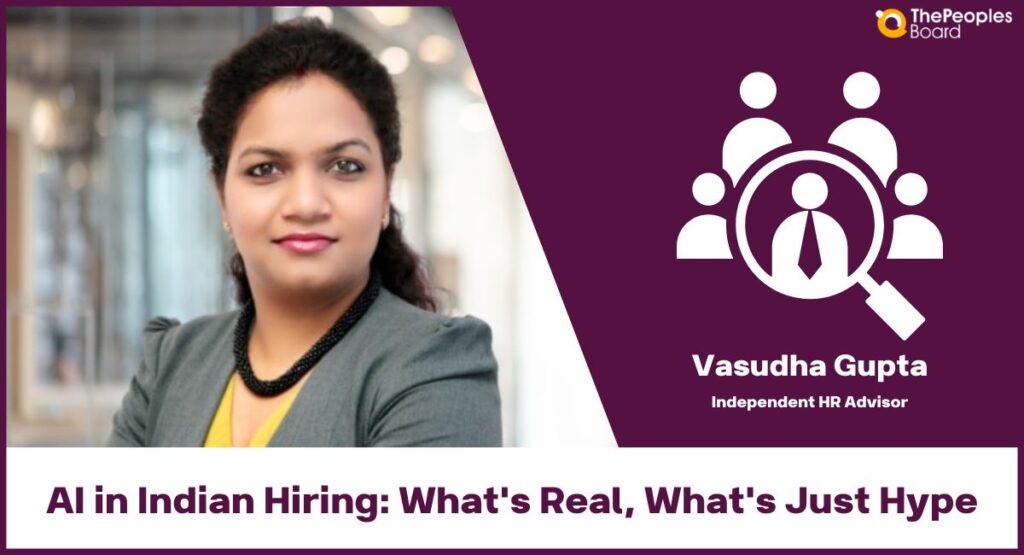
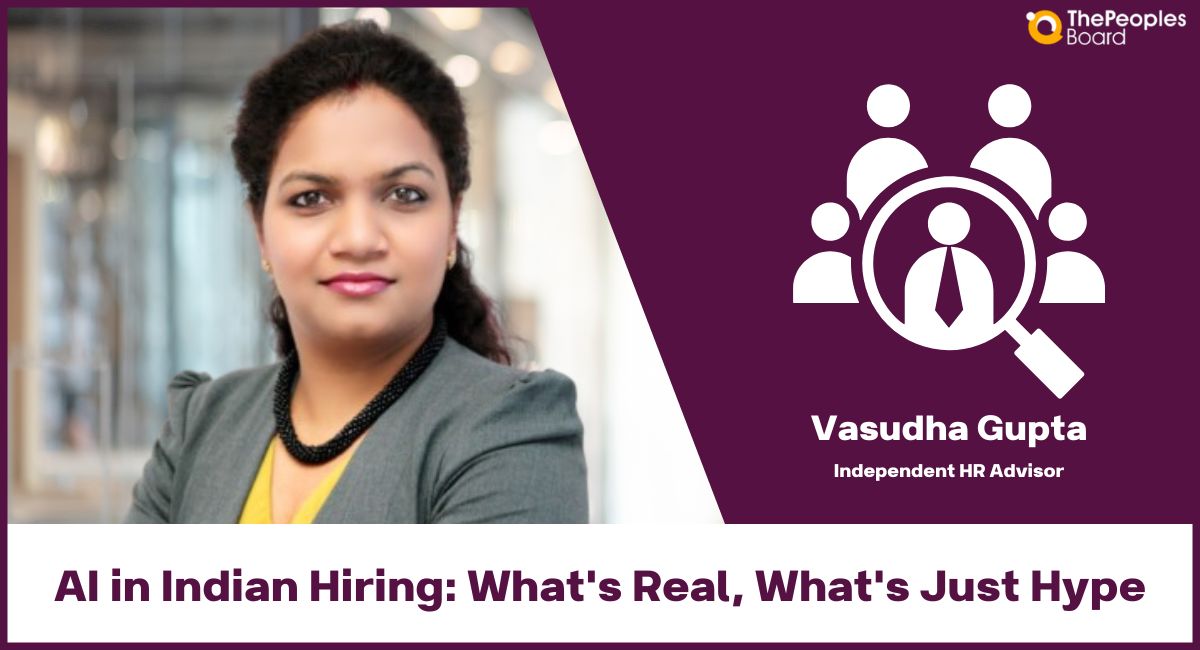
To cut through the hype, we spoke to Vasudha Gupta, a talent acquisition leader who has worked across enterprise retail and edtech, and has consulted with SMEs navigating AI adoption in hiring. In this conversation for TPB’s HR Voices, Vasudha unpacks what is genuinely working at scale, where the human still does the heavy lifting, why tools get bought with fanfare and shelved within months, and the one AI claim she finds most exaggerated. Her insights are particularly relevant for HR leaders at 50- to 500-employee Indian firms, who feel the AI pressure but lack the team, budget, or specialist to act on it with confidence.
TPB Team: Which AI capabilities in TA today are genuinely used at scale in India, and which are still demo-ware?
Vasudha: Screening candidates from a haystack, finding a skill match, plus scheduling interviews, is used heavily across organisations. Scores lead AI platforms like MOPID have paved a way to hire at scale, especially for enterprise retail firms. Wherein, for small to mid-size organisations, it is still challenging to understand at which level to integrate AI & what outcomes are expected and what level of monitoring is required.
TPB Team: Where does the human still do the heavy lifting that AI marketing decks claim is already handled by a TA team?
Vasudha: Role clarity, its priority is one of the key areas where TA teams still need to be hands-on. Cultural fitment is another area where the TA team needs to invest energy to find the most suitable candidates at the strategic level specifically.
Share an example of a company that implemented AI in TA and saw real results. What changed as expected, and what did not?
While consulting an edtech, AI implementation accelerated the speed of hiring. This resulted in improved efficiency & productivity of the TA team! The recruiters now have more bandwidth to brainstorm with hiring managers to identify the criticality of the role & strategise the hiring plan.
It helped in hiring fast, but the retention of real talent is still to be looked upon as cultural checks are still manual & hence biased
TPB Team: Now the flip side. A tool bought with fanfare that ended up shelved. What went wrong: the tool, the team, or the timing?
Vasudha: The purpose is missing! Identification of gaps in the system is missing! Before launching or integrating any new tool, it needs to undergo a thorough check like:
- Learning about gaps in the current system & choosing the goal
- Checking alternatives in the market (not every tool is meant to solve a problem)
- Running a demo internally with the team & checking the results if it improved productivity, efficiency or quality of delivery.
- If results align with the vision, training the team
- Choosing a timeline to integrate within the system to yield timely results
TPB Team: What does AI adoption in TA actually look like for a 50 to 500-employee Indian company today?
Vasudha: AI in TA secures a safe spot for startups & mid-sized organisations. It gives structure, purpose, with live metrics in place, which clears the ambiguity in relevant areas. It strengthens informed decision-making & assists key stakeholders to find gaps at pace & fix them at the earliest.
TPB Team: Is AI adoption in such companies limited to GenAI, or is there something more happening on the ground?
Vasudha: Adoption isn’t limited to GenAI, but GenAI is the gateway. The real shift happens when companies pair it with classic automation, predictive models, and domain-specific copilots—then wire it all to their data and core workflows. That’s where productivity gains turn into durable performance improvements
TPB Team: WhatsApp referrals and Excel trackers still run most Indian hiring. Will AI replace them, or will both keep working side by side?
Vasudha: AI has entered the big time in hiring across all industries. Right from sourcing profiles to screening & assessment, scheduling AI has taken over all tasks. Still, human intervention is required to validate data & use intelligence to identify the right fit that will eventually drop the attrition ratio and improve employee satisfaction
TPB Team: When an SME’s HR head asks for AI in hiring, what are they really trying to fix, and is AI actually the right fix?
Vasudha: SMEs with growing hiring volumes and lean HR teams want to reduce operational load and improve recruiter productivity. The AI hiring process gets a structure & standard interview questions helps in creating candidate scorecards for easy review purposes. This advances the hiring process with quicker turnaround & reduced team pressure
TPB Team: Which claim about AI in recruitment do you find the most exaggerated?
Vasudha: The most exaggerated claim is probably: “AI can identify the best candidate.”
That statement emphasises an incredibly messy human decision into a clean technology narrative.
And in real hiring environments — especially SMEs — “best candidate” is rarely objective.
TPB Team: Which AI hiring concerns, like bias or candidates gaming assessments, are showing up on the ground in India, and which ones are just imported Western fears?
Vasudha: Here are a few generic concerns raised by recruitment leaders across domains –
- AI-written resumes
- AI-assisted coding rounds
- Live ChatGPT prompting during interviews
- hidden second screens
- AI-generated behavioural answers
- proxy interviews
Western fears are such –
- Fear of AI replacing all recruiters — mostly exaggerated in India
- Fully autonomous hiring decisions
TPB Team: Is there a quiet, unglamorous use of AI in TA that you think is underrated?
Vasudha:
- Just quietly reducing operational leakage across the hiring funnel.
- It’s unglamorous, but this is where some of the highest real-world ROI exists.
TPB Team: What advice would you give an SME HR head who feels the AI pressure but has a lean team, limited budget, and no AI specialist?
Vasudha: Instead of asking: “How do we implement AI in hiring?”
Ask: “Where is my team repeatedly losing time, consistency, or visibility?”
That question leads to much better adoption decisions.
TPB Team: For recruiters worried about AI taking their jobs, what is the honest truth about what is at risk and what is not?
Vasudha: AI is not eliminating the power of recruitment but making it more efficient by using the right structure in the first place & improving quality with speed in action.
The AI-in-TA story in India is neither the revolution that the vendor pitches suggests, nor the false dawn that sceptics warn of. As Vasudha’s responses make clear, the real value is showing up in quiet, unglamorous places: reduced operational leakage in the hiring funnel, faster turnarounds for lean teams, and recruiters gaining bandwidth to think strategically rather than chase calendars. The headline-grabbing promises around bias-free hiring or fully autonomous decisions remain firmly in the marketing department for now.
For SME HR heads, the most useful shift may be changing the question itself. Instead of asking how to implement AI in hiring, ask where the team is repeatedly losing time, consistency, or visibility. That single reframe, more than any tool purchase, is what separates AI adopters who see durable gains from those who end up with shelf-ware and a sunk cost.