
We’re asking CHROs to drive 10-year change on a 5-year clock.
That’s not a metaphor. It’s arithmetic. The Josh Bersin Company’s landmark study analysing over 25,000 CHRO profiles, surveying nearly 200 current CHROs, and conducting 50+ face-to-face interviews found that average CHRO tenure has dropped from 6 years to 4.8 years. Meanwhile, 86% of those same CHROs say their role is changing “significantly” or “dramatically.”
Think about what that means. Organisations want their CHRO to lead AI transformation, redesign the workforce, rebuild culture post-merger, build leadership pipelines, and own skills in architecture. But the person they’re asking to do all of this will, on average, be gone before the second phase is complete.
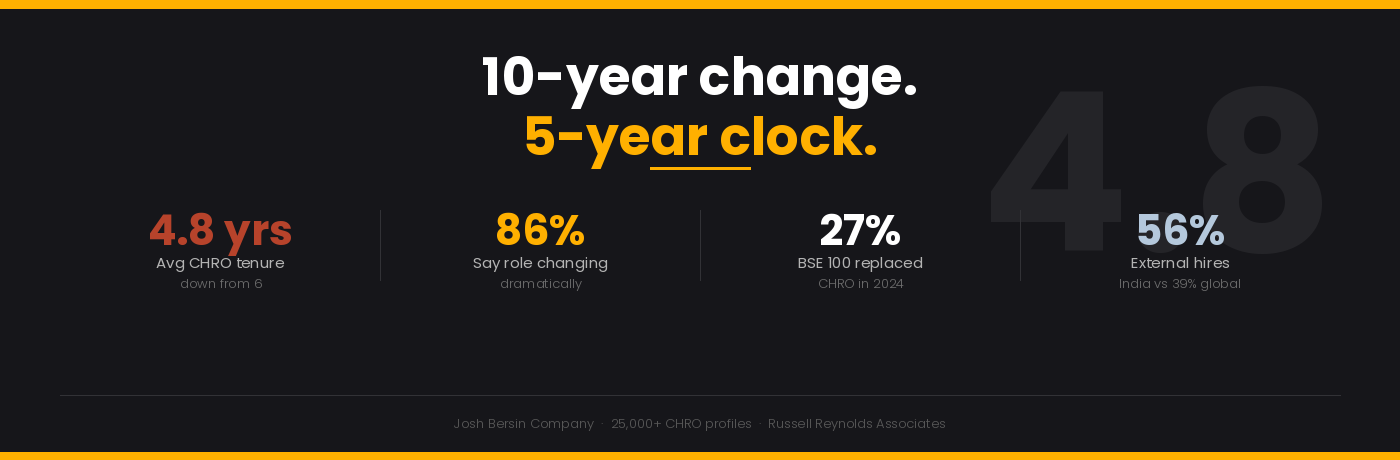
That’s the transformation paradox. And in India, where 27% of BSE 100 companies replaced their CHRO in 2024 alone, and more than half have changed jobs in the past 3.5 years, it’s not a theoretical concern. It’s the lived reality of HR leadership. As we established in the CHRO Leadership Lessons series, the CHRO role in India has crossed an inflexion point. But crossing it on a 4.8-year clock changes everything.
But paradoxes aren’t dead ends. They’re design constraints. And the Indian CHROs who are navigating this well aren’t ignoring the tension. They’re building around it.
The Five Paradoxes Defining the CHRO Role
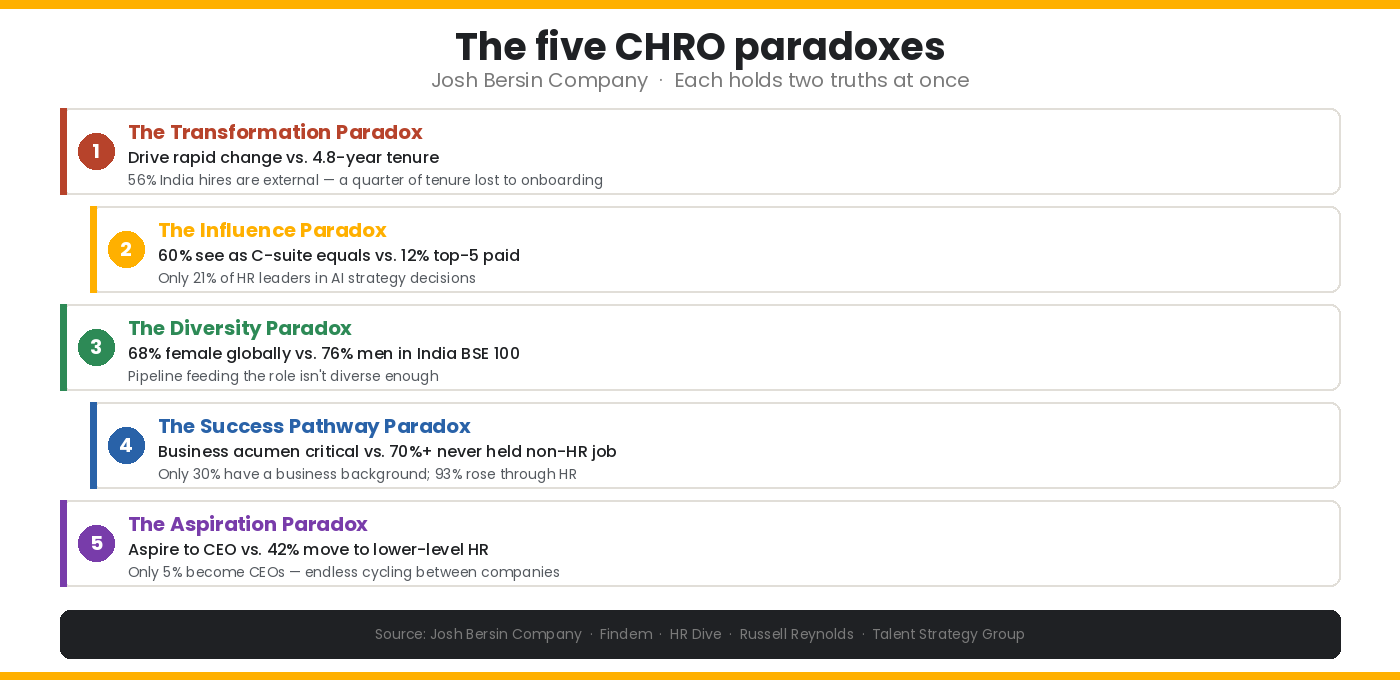
The Josh Bersin Company didn’t just identify one paradox. They found five interconnected tensions that define the CHRO role heading into 2026. Understanding all five is essential because solving one while ignoring the others doesn’t work.
1. The Transformation Paradox
CHROs are expected to be both agents of rapid, enterprise-wide change and stewards of lasting culture. But with tenure at 4.8 years, many don’t stay long enough to see the transformation fully embedded. The challenge, as Kathi Enderes, SVP of Research at Josh Bersin Company, put it: Can CHROs deliver AI-driven productivity fast enough to satisfy the C-suite, particularly if they don’t have CIO support or the right AI tools?
In India, this tension is amplified. 56% of BSE 100 CHRO appointments in 2024 were external hires compared with 39% globally. External CHROs typically need 6-12 months just to understand the culture they’ve been hired to transform. By the time they’re operating at full speed, a quarter of their tenure is already gone.
2. The Influence Paradox
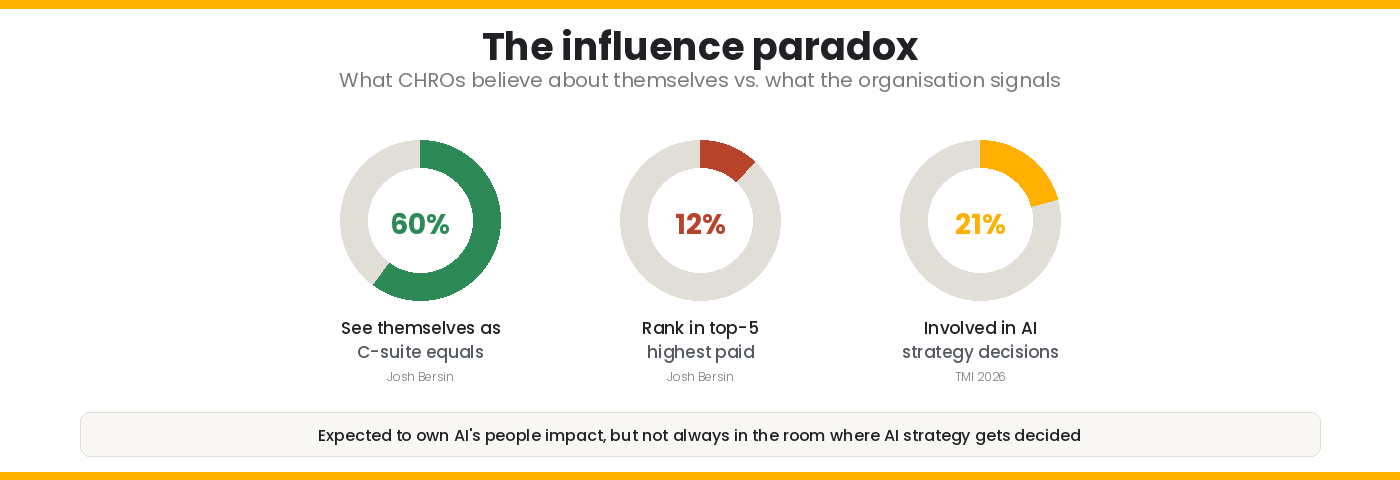
60% of CHROs see themselves as equal to other C-suite leaders. But only 12% rank among the top five highest-paid executives at their companies. That pay gap isn’t just about money; it’s a signal of where the board places HR relative to finance, technology, and operations.
TMI’s 2026 analysis adds a sharper edge: only 21% of HR leaders are closely involved in their company’s AI strategy decisions. So CHROs are expected to lead AI-driven workforce transformation, but aren’t always in the room where AI strategy gets decided. The CHROs who close this gap do so by bringing data, not opinion — leveraging people analytics and automation to redefine talent management in ways that make their business impact undeniable.
When I sat down with Asma Shaikh for ThePeoplesBoard’s video interview series, one thing that came through clearly was this tension between what HR is being asked to deliver and the actual decision-making authority it holds. The conversation kept circling back to a core question: Is Agentic AI taking humans out of HR, or is HR not being given a seat at the table where AI decisions are made? It’s the influence paradox playing out in real time — the CHRO is expected to own the people’s impact of AI, but isn’t always empowered to shape the AI strategy itself.
3. The Diversity Paradox
Globally, 80% of new CHRO appointments in Fortune 200 companies in 2024 were women, the highest proportion since tracking began. But in India, 76% of BSE 100 CHROs are men. And across the broader C-suite, ethnic and racial diversity progress remains slow and uneven everywhere.
The paradox: the CHRO role is becoming more gender-diverse at the top globally, but the pipeline feeding it isn’t. As we explored in a deep dive on leadership pipelines, women leave the pipeline mid-career, not because of insufficient flexibility, but because development investment, sponsorship, and visibility aren’t reaching them at the same rate.
4. The Success Pathway Paradox
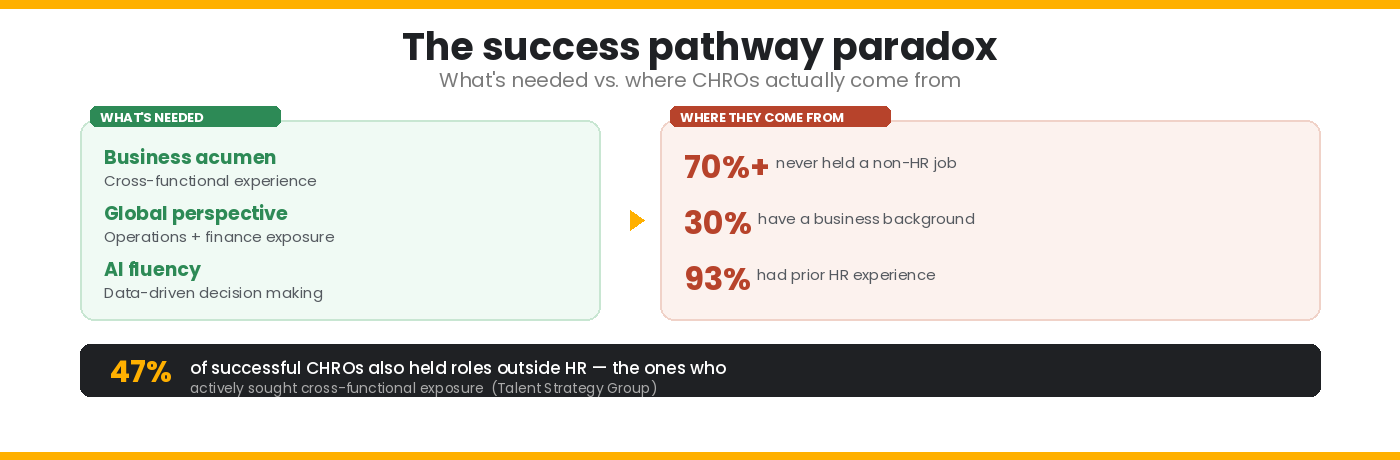
Business acumen, global perspective, and cross-functional experience are now critical for CHRO success. But most CHROs still rise through traditional HR pathways. More than 70% of CHROs have never held a non-HR job, according to Josh Bersin’s analysis. And only 30% have a business background.
The paradox: organisations want CHROs who think and act like business leaders, but the pipeline that produces them is overwhelmingly HR-deep. The Talent Strategy Group’s 2025 data confirms this 93% of Fortune 200 CHRO appointees had prior HR experience, and the most common route remains the HRBP track. Yet 47% had also held roles outside HR, suggesting that the CHROs who succeed are the ones who actively sought cross-functional exposure in operations, finance, or strategy.
This is exactly the tension that Priyam Agrawal described in her ThePeoplesBoard interview. The shift from people partner to profit owner requires a fundamentally different way of thinking about the HR career path. Her experience of moving from 14 years in HR to founding her own business revealed how differently you think about people’s decisions when business survival is at stake. That prospective commercial urgency combined with HR depth is precisely what the best CHRO roles now demand.
In India, the success pathway paradox is amplified by the GCC factor. Global Capability Centres such as Amazon, Google, and MetLife develop outstanding cross-functional HR leaders who are then hired into broader roles or promoted out of the India pipeline entirely. Indian CHROs who want to close the business acumen gap need to build it intentionally, because the system won’t build it for them.
5. The Aspiration Paradox
Here’s the paradox that doesn’t get enough attention. Many CHROs aspire to broader executive or advisory roles after their tenure. But the data tells a sobering story: 42% of CHROs move to lower-level HR positions after leaving the C-suite. And only 5% become CEOs.
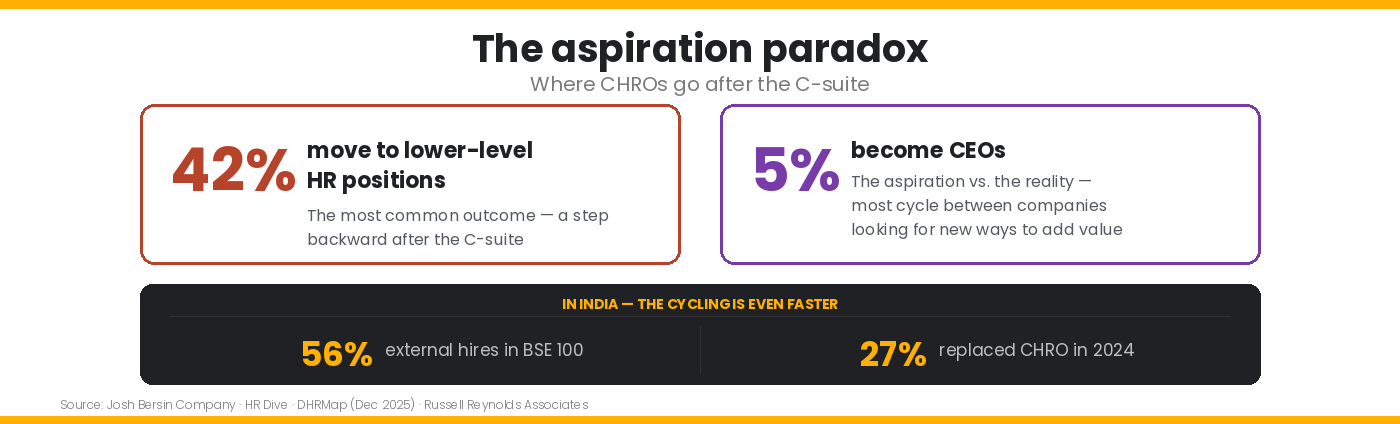
The aspiration paradox: CHROs see themselves as business transformation leaders (and increasingly, they are). But the post-CHRO career path doesn’t reflect that. Without a clear pathway to the CEO position, most CHROs move from company to company, looking for new ways to add value. Many now add titles like “Chief AI Enablement Officer” or “Chief Transformation Officer” to reflect the expanding scope, but these titles reveal ongoing uncertainty about what the CHRO role actually leads to.
In India, cycling is even faster. With 56% external hires and 27% annual turnover in BSE 100 companies, Indian CHROs are moving between organisations at a pace that makes long-term career planning difficult. The CHRO turnover rate in Fortune 200 companies hit 15.5% in 2024, a 36% increase year over year, with 30 new CHROs collectively overseeing more than 2 million employees and $1.5 trillion in annual revenue.
The aspiration gap is real. But it’s also an opportunity. As explored in leadership lessons, the CHROs who own the AI-culture intersection and demonstrate measurable business impact are building the case company by company for the CHRO-to-CEO pathway that the data says barely exists today.
How Indian CHROs Are Building Around the Paradox
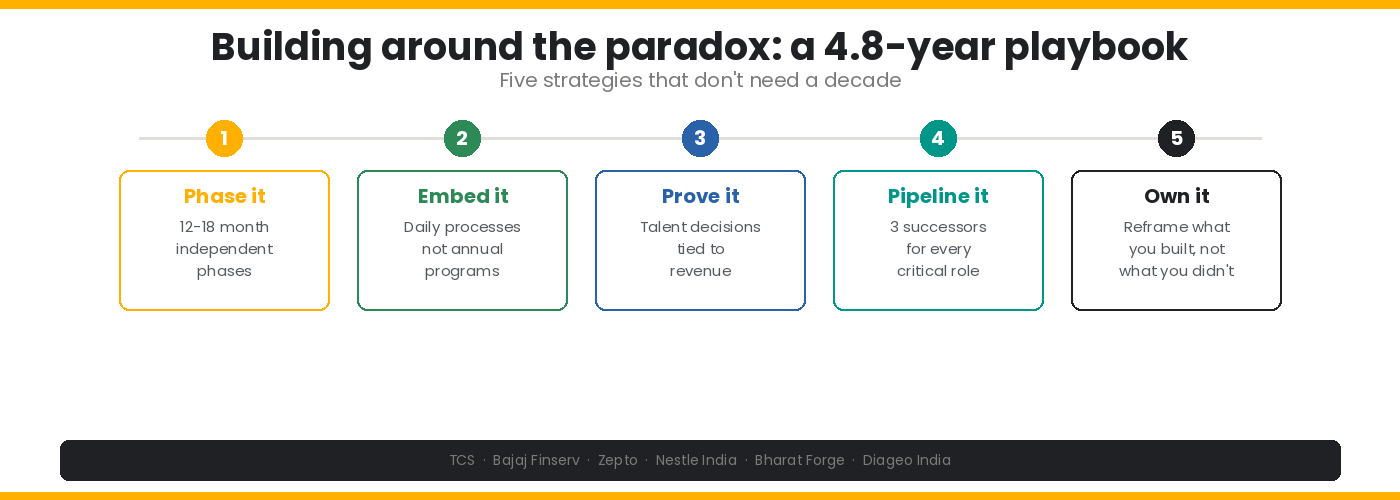
The paradoxes are real. But they’re not insurmountable. Here’s what the most effective Indian CHROs are doing to work within these constraints rather than against them.
-
Building Transformation in Phases, Not Master Plans
The smartest response to a 4.8-year tenure isn’t to build a 10-year transformation roadmap. It’s to design change in 12-18 month phases that each deliver measurable value independently. If the CHRO leaves after phase two, phase three doesn’t collapse because each phase was built to stand on its own.
TCS understood this when Sudeep Kunnumal took over as CHRO in October 2025. The transition worked because TCS doesn’t depend on any single leader for its talent infrastructure. Programs like “Leadership in the Digital Age” and “Aspire” operate as institutional capabilities, not personal initiatives.
-
Making Change Stick Before Moving On
Gartner’s 2026 research found that organisations embedding culture into day-to-day work see up to a 34% increase in employee performance. The CHROs who beat the tenure paradox don’t just launch initiatives; they institutionalise them. They build change into processes, not presentations. Into weekly habits, not annual programs.
This connects directly to Lesson 4 from the leadership lessons article at ThePeoplesBoard: routinise change rather than trying to inspire it. The CHRO who makes AI adoption boring and embedded leaves behind something that persists after they’re gone.
-
Earning Influence Through Business Impact, Not HR Activity
The influence paradox, being expected to lead transformation without always having the authority or compensation to match, doesn’t get solved by asking for a bigger seat. It gets solved by delivering measurable business outcomes.
Korn Ferry’s 2025 CHRO Survey of 756 HR leaders found that growth and market expansion have increased as a CHRO priority by 25% over the past two years. More than a third of CHROs now spend the majority of their time on transformation, not operations. The CHROs closing the influence gap are the ones who can draw a direct line from talent decisions to revenue outcomes, not just engagement scores.
-
Building the Pipeline That Outlasts You
The ultimate paradox response: build something that doesn’t need you. As we explored in What CHROs will do differently, the best Indian CHROs are building leadership pipelines at every organisational level, running quarterly reviews with board involvement, and using evidence-based assessment rather than subjective nine-box grids.
A CHRO with a 4.8-year tenure who builds a pipeline that produces three ready successors for every critical role has delivered more lasting value than one who stays 10 years and keeps the succession plan in their own head.
-
Owning the Narrative
The CHRO turnover rate in Fortune 200 companies hit 15.5% in 2024, a 36% increase year over year. Those 30 new CHROs collectively oversee more than 2 million employees and $1.5 trillion in annual revenue. The scale of change is enormous. But it also means that CHRO transitions are becoming normalised, not exceptional.
The CHROs who navigate this well aren’t apologising for short tenure. They’re reframing it: “In 4.5 years, I built a skills-first architecture, launched an AI reskilling programme that reached 12,000 employees, and delivered a 34% improvement in internal mobility. Here’s the playbook I’m leaving behind.” That’s a different story from “I didn’t finish the transformation.”
Why This Paradox Is Actually India’s Opportunity
Here’s the counterintuitive argument: India’s CHRO churn might actually be an advantage.
High turnover means fresh perspectives flowing through India’s top companies faster than in markets where CHROs sit for 7-8 years. The 56% external hire rate means Indian companies are actively importing best practices, cross-sector experience, and new frameworks. And the sheer scale of India’s corporate ecosystem, with Indian HR tech companies building AI-powered workforce tools and a median workforce age of 28, creates an environment where change adoption happens faster than in ageing Western markets.
The CHROs who recognise this aren’t victims of the paradox. They’re leveraging it. They know they have a 4.8-year window. So they focus, move fast, build institutional capability, and leave behind organisations that are stronger than they found them.
Bajaj Finserv promoting Anupam Sirbhaiya from within. Zepto brought in Sneha Arora with an explicit trust-building mandate. Nestlé India hired Nitu Bhushan with two decades of cross-sector experience. Bharat Forge promoting Srinivasu Malladi after 22+ years of HR leadership. Diageo India appointing Chinmay Sharma from GSK with a mandate to deepen culture and enable their people to do the best work of their careers. These aren’t paradox casualties. They’re organisations learning to work with the constraint, and TPB’s leadership coverage tracks this evolution closely.
The Real Question
The CHRO paradox won’t be resolved by extending tenure or increasing pay (though both would help). It will be resolved by CHROs who accept the constraint and design their impact around it.
4.8 years is enough time to redesign how work gets done. It’s enough time to build a pipeline that produces leaders. It’s enough time to embed AI into daily operations and make the culture strong enough to survive the next transition.
The question isn’t whether the paradox is fair. It isn’t. The question is: what are you going to build in the time you have?
For every CHRO currently navigating this tension, and for every HR professional building the skills to step into the role, the answer matters. Because the organisations that figure out how to give CHROs both the mandate and the runway will outperform the ones that keep cycling through leaders every four years, wondering why the culture never sticks.
The CHRO paradox is real. But paradoxes, by definition, hold two truths at once. The tenure is short. And the impact can still be lasting. The best Indian CHROs are proving that every day.
FAQs
What is the CHRO paradox?
The CHRO paradox refers to the tension between expanding mandates and shrinking tenure. The Josh Bersin Company found that 86% of CHROs say their role is changing dramatically, yet average tenure has dropped from 6 years to 4.8. CHROs are expected to drive long-term transformation AI adoption, culture redesign, leadership pipelines on a timeframe that may not allow them to see results fully embedded.
How many CHRO paradoxes are there?
The Josh Bersin Company identified five interconnected paradoxes: the Transformation Paradox (rapid change vs. short tenure), the Influence Paradox (strategic expectations vs. limited authority and pay), the Diversity Paradox (gender progress at the top vs. pipeline gaps below), the Success Pathway Paradox (business acumen needed vs. traditional HR-only career paths 70%+ have never held a non-HR job), and the Aspiration Paradox (CHROs aspire to broader roles, yet 42% move to lower-level HR positions and only 5% become CEOs).
Is the CHRO paradox worse in India?
In several ways, yes. Russell Reynolds Associates found that 56% of BSE 100 CHRO appointments in 2024 were external hires (vs. 39% globally), and 27% of companies replaced their CHRO that year, three times the global average. However, India’s high churn also brings advantages: faster adoption of fresh perspectives, cross-sector experience imports, and a young workforce that adapts quickly.
How can CHROs overcome the tenure paradox?
By designing transformation in 12-18 month phases (not 10-year master plans), institutionalising change into daily processes rather than depending on personal leadership, building leadership pipelines that outlast any single leader, earning influence through measurable business impact, and reframing their tenure narrative around what they built not what they didn’t finish.