
One CHRO told me something I can’t stop thinking about.
She said, “We spent months building a succession plan. Beautiful PowerPoint. Detailed competency maps. Nine-box grids filled in. Then the CEO leaves, and we hire from outside anyway.”
She wasn’t bitter about it. She was being precise. And her observation lands differently when you see the data behind it.
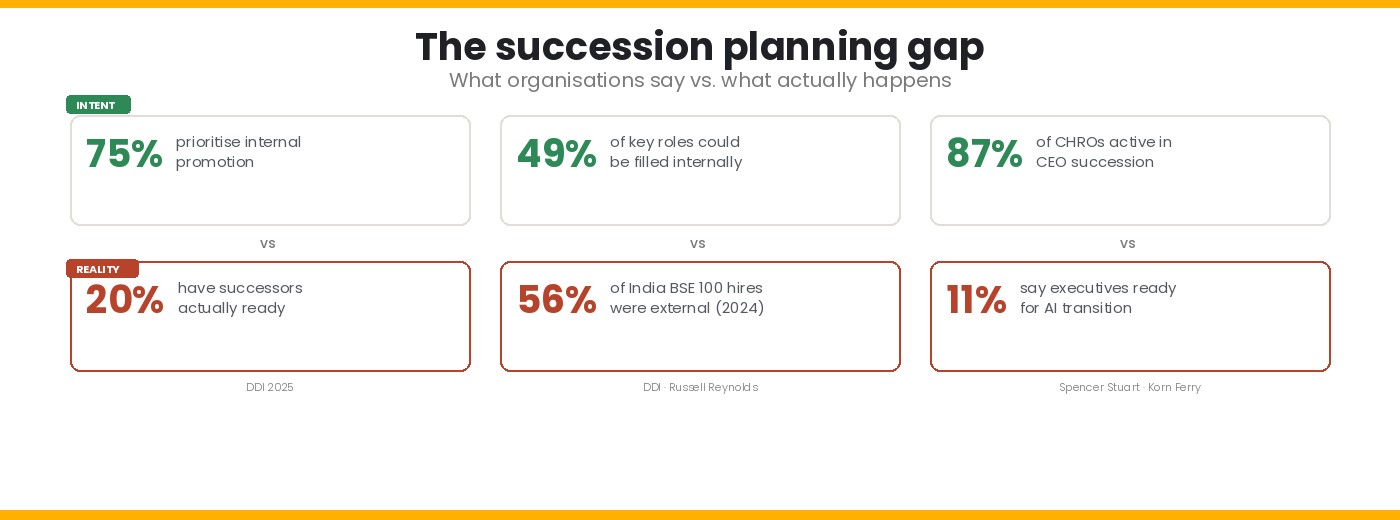
DDI’s 2025 Global Leadership Forecast, one of the largest leadership studies ever conducted, spanning 2,185 HR professionals and 10,796 leaders, found that 75% of organisations prioritise internal promotion, but only 20% of HR leaders have successors actually ready for critical roles. Just 49% of key positions could be filled internally if they opened today.
In India, the gap is sharper. Russell Reynolds Associates found that 56% of BSE 100 CHRO appointments in 2024 were external hires compared with 39% globally. More than half the CHROs in India’s top companies have changed jobs in the past 3.5 years. And as we explored earlier, 27% of BSE 100 companies appointed a new CHRO in 2024 alone, three times the global average.
The pipeline isn’t leaking. In many Indian organisations, it was never built to hold pressure in the first place.
But the best Indian CHROs are changing that. Here’s what they’re doing differently and why it matters for every HR professional thinking about the future of leadership in India.
The Leadership Pipeline Crisis India Can’t Afford to Ignore
The numbers are hard to argue with. 77% of organisations globally say they lack sufficient leadership depth at all levels, according to Exec’s 2025 research. SHRM’s 2025 CHRO Priorities report found that 37% of CHROs say developing succession plans is a significant challenge. And 42% of managers believe that internal talent development is neglected at their organisations, according to TalentLMS.
In India, the crisis has a specific texture. The ET HR Trends Report 2025 found that hiring in smaller cities jumped 21% year-on-year, overtaking metro hiring for the first time. A new generation of leaders with deep market insight and lower attrition risk is emerging from outside the traditional metro-dominated leadership pipeline. But succession processes at most Indian companies still define the talent pool by geography. Mumbai, Delhi, and Bangalore are missing a significant portion of India’s best leadership talent.
Korn Ferry’s 2026 Talent Acquisition Trends report, surveying 1,670+ global talent leaders, identified what they call the “leadership pipeline crisis on the horizon.” 43% of companies plan to replace roles with AI, targeting operations (58%) and entry-level positions (37%). The short-term savings look attractive. But cutting entry-level hires today means the leadership pipeline dries up tomorrow. There will be no mid-level managers in 2031 if there are no entry-level hires in 2026.
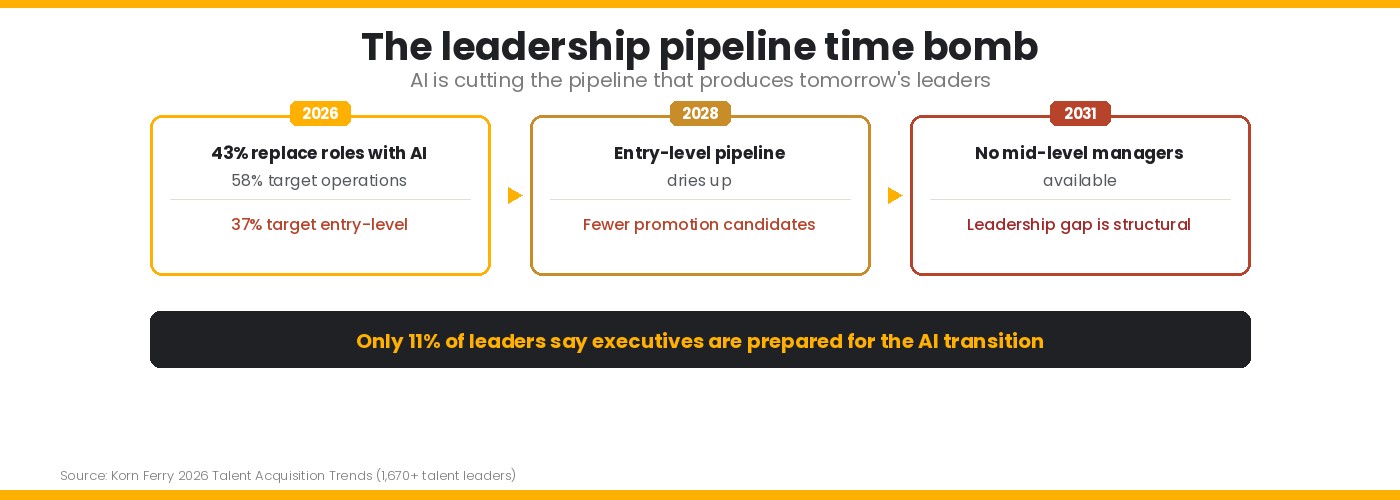
And here’s where it connects to the AI-driven change we have already explored: only 11% of leaders say their executives are well-prepared to lead through the AI transition (Korn Ferry). The very leaders who need to guide AI adoption aren’t being developed for it.
What the Best Indian CHROs Are Building Instead
The Indian CHROs who’ve moved beyond the annual succession review PowerPoint are doing five things that most organisations aren’t.
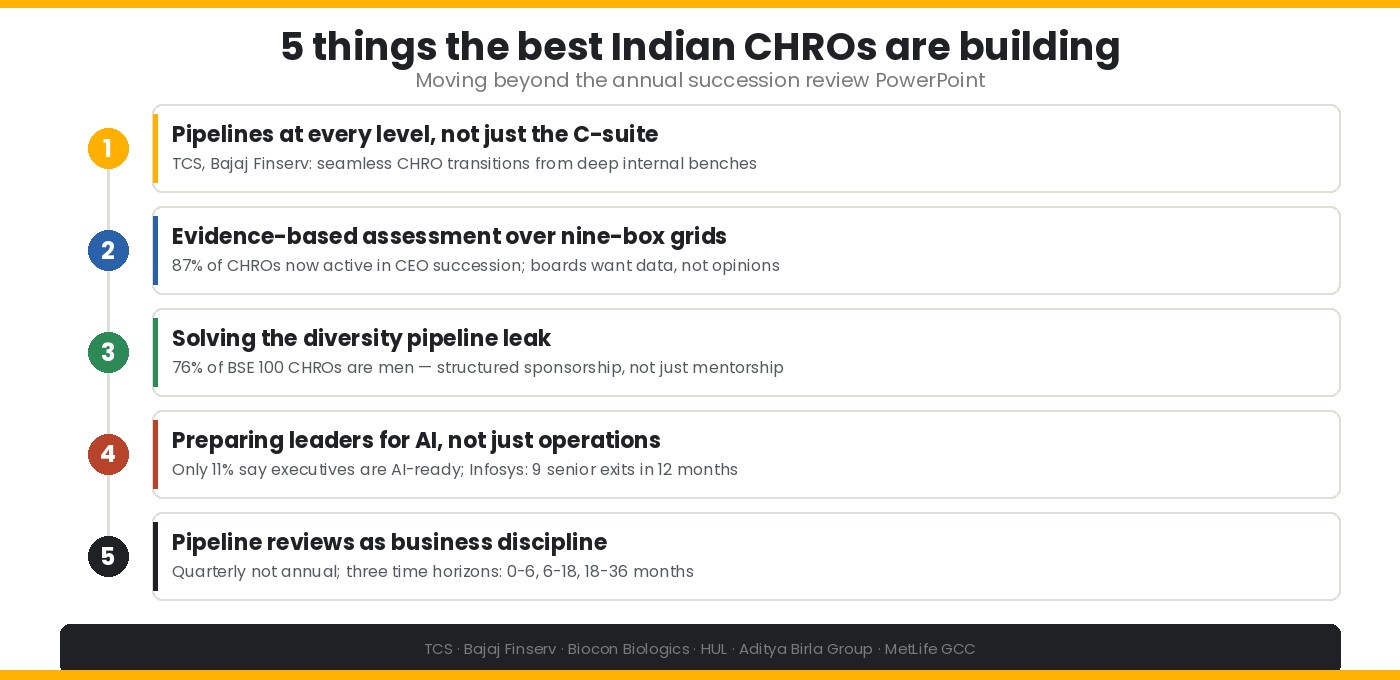
1. They’re Building Pipelines at Every Level, Not Just the C-Suite
Most succession plans in India cover the CEO and maybe two layers below. Everything else is improvised. The best CHROs are building depth across the entire organisation, from frontline managers to function heads.
TCS demonstrates this at scale. When Sudeep Kunnumal took over as CHRO in October 2025, it wasn’t a scramble. He was a 25-year TCS veteran who’d led HR for the BFSI vertical and spearheaded global talent integration. The transition was seamless precisely because TCS invests in leadership development programs like “Leadership in the Digital Age” and “Aspire” across all levels, not just the top.
Bajaj Finserv’s internal promotion of Anupam Sirbhaiya to Group CHRO tells the same story. Internal promotion works when there’s an actual pipeline behind it. People who’ve been given stretch assignments, cross-functional exposure, and the chance to demonstrate business judgment before the promotion happens.
DDI’s research shows that high-potential talent is 3.7 times more likely to leave without development. Indian CHROs who build pipelines only at the top lose their best mid-level people to organisations that invest earlier.
2. They’re Replacing Nine-Box Grids with Evidence-Based Assessment
The nine-box grid has been the default succession tool in Indian HR for decades. High performance plus high potential equals ready for promotion. The problem? It’s largely subjective. The manager’s assessment of “potential” often reflects visibility and rapport, not actual readiness.
The CHROs getting better results are shifting to data-driven assessment. Spencer Stuart’s research shows that 87% of CHROs today are active participants in CEO succession planning, a signal that boards increasingly see HR leaders as strategic stewards of enterprise leadership. But that trust depends on the CHRO bringing evidence, not opinion.
Boards are increasingly sceptical of soft indicators. They trust longitudinal performance data, evidence of success in stretch roles, and cross-functional mobility more than engagement survey scores or 360-degree averages. Indian CHROs at companies like Biocon Biologics, which appointed Deepak Dobriyal to run the end-to-end talent agenda, including succession planning, with nearly 30 years of experience, are building this muscle.
Understanding how people analytics and automation are redefining talent management is critical here. The tools exist. The gap is in leadership’s willingness to trust data over instinct.
3. They’re Solving the Diversity Pipeline Leak
India’s leadership pipeline has a structural diversity problem. Russell Reynolds Associates found that 76% of BSE 100 CHROs are men. And McKinsey’s 2025 India research found that only two-thirds of companies in India track gender inclusion metrics systematically. Of those that do, an even smaller proportion hold senior leadership accountable for outcomes.
The women who leave the pipeline mid-career aren’t primarily leaving because of insufficient flexible work options. They’re leaving because the development investment, the sponsorship, the stretch opportunities, and the leadership visibility aren’t reaching them at the same rate as their male peers.
Succession pools are often built informally, from the leaders who are most visible to decision-makers. Women and candidates from non-traditional backgrounds are frequently less visible, not because they’re performing less well, but because they’re less present in the informal networks where reputations are built.
The Deloitte India 2025 data adds another dimension: 57% of next-generation leaders in Indian family enterprises join before the age of 27. For family businesses specifically, succession planning carries additional complexity around professional management versus founder instinct.
The Indian CHROs making progress here are making pipeline diversity a measured, accountable outcome, not a declaration of intent. They’re structuring sponsorship (not just mentorship) for high-potential women, creating visibility opportunities that don’t depend on informal networks, and tracking pipeline diversity at every level, not just the board.
4. They’re Preparing Leaders for AI, Not Just Operations
The leadership pipeline crisis and the AI fluency gap we explored previously are the same problem. Future leaders need different capabilities than the ones that got current leaders promoted.
Only 11% of leaders say their executives are well-prepared to lead through the AI transition, per Korn Ferry’s 2026 research. And only 40% of leaders currently prioritise emotional intelligence, with just 20% focusing on employee engagement, a short-sighted trend that experts warn will backfire as disengaged teams underperform.
The Infosys succession question makes this tangible. CEO Salil Parekh’s term ends in March 2027. The Week reported in April 2026 that the internal bench has thinned: Mohit Joshi left to run Tech Mahindra, Ravi Kumar became CEO of Cognizant, CFO Nilanjan Roy resigned, the ninth senior exit in twelve months. The company that helped define India’s IT services industry may not have a clear internal successor for its top job.
That’s the pipeline crisis in a single case study. And it’s not unique to Infosys. Every Indian company investing in AI transformation while cutting entry-level roles and neglecting leadership development is building the same problem.
Indian CHROs at companies like HUL and Aditya Birla Group are taking a different approach, embedding AI readiness, adaptive leadership, and digital fluency into their development frameworks rather than treating them as add-on modules. The SHIFT framework from Accenture India (Skills, Human-led, Influence, Fortitude, Together) applies directly here.
5. They’re Making Pipeline Reviews a Business Discipline, Not an HR Ritual
SHRM’s 2026 research makes the case directly: 29% of CHROs report succession planning as a challenge. But the root cause isn’t complexity. It’s that succession planning operates as an annual HR review rather than an ongoing business discipline.
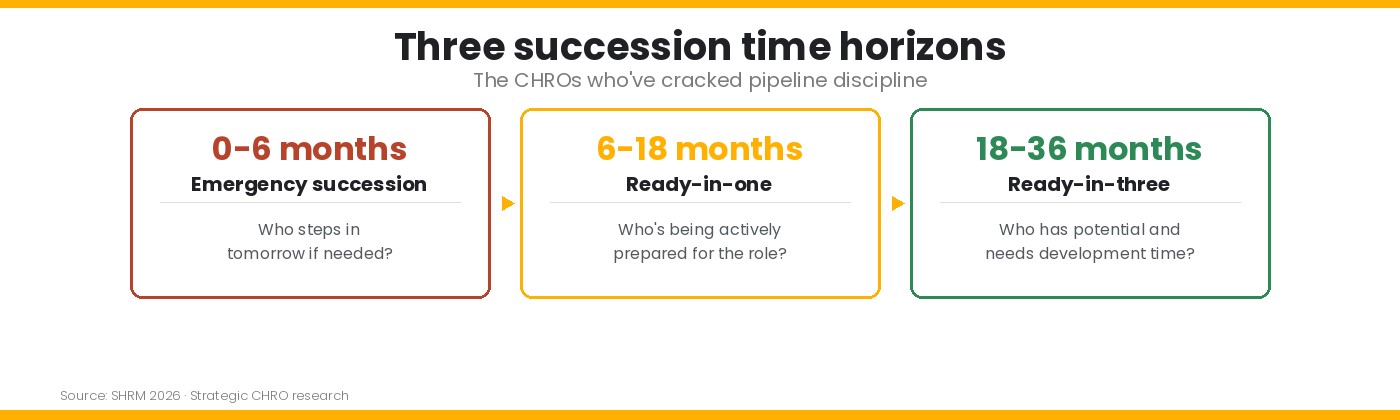
The CHROs who’ve cracked this are running pipeline reviews quarterly, not annually. They’re separating three distinct time horizons: emergency succession (0-6 months), ready-in-one (6-18 months), and ready-in-three (18-36 months). And they’re involving the CEO and board in the process, not presenting to them after the fact.
Ashish Srivastava, Managing Director of MetLife Global Capability Centre, shared his journey from CHRO to CEO at a recent India CHRO Forum session. His perspective: the most effective way for a CHRO to navigate succession is to establish a disciplined, evergreen process. If it’s ongoing and evidence-based, it makes the CHRO a trusted resource and a central resource, not just the person who fills out the grid once a year.
For HR professionals planning their own career path, this is an important signal. The ability to build and own a leadership pipeline, not just manage an annual talent review, is becoming one of the most valued CHRO capabilities. It’s the shift from people partner to profit owner that separates operational HR from strategic HR.
What Makes India’s Pipeline Challenge Different
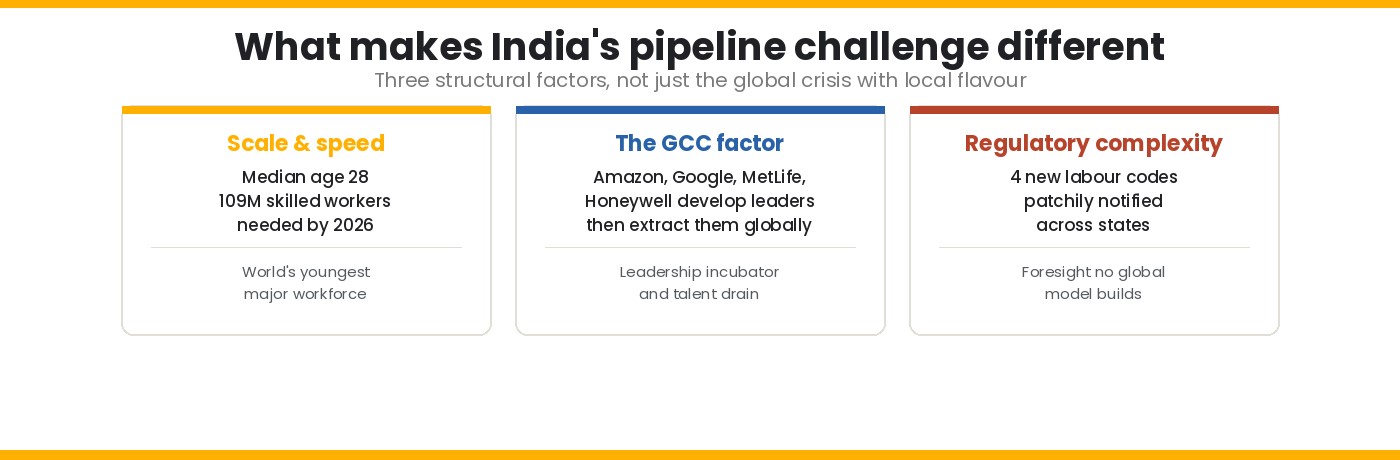
India’s leadership pipeline challenge isn’t a copy of the global one with a local flavour. Three factors make it structurally distinct.
Scale and speed
India has the world’s youngest major workforce (median age 28) and requires an estimated 109 million skilled workers across high-growth industries by 2026. The pipeline needs to produce leaders at a volume and velocity that Western succession models were never designed for.
The GCC factor
Global Capability Centres in India, such as Amazon, Google, MetLife, and Honeywell, are both a leadership incubator and a talent drain. They develop outstanding mid-level leaders, many of whom get hired away into Indian-founded companies or promoted into global roles that take them out of the India pipeline. Indian CHROs need to plan for this mobility, not just lament it.
Regulatory complexity
India’s four new labour codes remain patchily notified. Future leaders in India need regulatory foresight that leaders in other markets don’t. A succession plan that develops general management capability without building regulatory intelligence for a multi-state workforce is incomplete.
The Pipeline That Wins
The CHRO who told me about the beautiful PowerPoint succession plan wasn’t describing a failure of process. She was describing a failure of commitment.
Indian organisations that build leadership pipelines capable of surviving real transitions, not just planned retirements, share three characteristics. They invest in development at every level, not just the C-suite. They use evidence, not instinct, to identify and advance high-potential leaders. And they treat pipeline building as a business discipline with quarterly reviews, board involvement, and measurable outcomes, not an annual HR exercise.
The data says 77% of organisations lack sufficient leadership depth. The companies that close this gap in India over the next three years won’t be the ones with the best succession planning software. They’ll be the ones whose CHROs made leadership development personal, disciplined, and non-negotiable even when it was easier to hire from outside.
That’s the real leadership lesson. And it starts with the CHRO who’s willing to say: we built a beautiful plan, and it wasn’t enough. Now let’s build something that actually works.
FAQs
Why is leadership pipeline development a priority for Indian CHROs in 2026?
77% of organisations globally lack sufficient leadership depth across all levels. In India, the challenge is amplified by the world’s youngest major workforce, rapid AI-driven role evolution, and the fact that 56% of BSE 100 CHRO appointments in 2024 were external hires, indicating internal pipelines aren’t producing ready leaders at the rate organisations need them.
What’s wrong with traditional succession planning in India?
Most Indian organisations limit succession planning to the C-suite and rely on subjective nine-box grids. DDI’s 2025 research found that while 75% of organisations prioritise internal promotion, only 20% have successors actually ready for critical roles. Succession planning in India also tends to be an annual HR exercise rather than an ongoing business discipline with quarterly reviews and board accountability.
How are Indian companies building stronger leadership pipelines?
The best Indian CHROs are building pipelines at every organisational level (not just the top), replacing subjective grids with evidence-based assessment, solving the diversity pipeline leak through structured sponsorship, embedding AI readiness into leadership development, and running quarterly pipeline reviews with CEO and board involvement.
How does AI affect the leadership pipeline?
Korn Ferry’s 2026 research found that 43% of companies plan to replace roles with AI, with 37% targeting entry-level positions. This creates a long-term pipeline crisis: no entry-level hires today means no mid-level managers in five years. Meanwhile, only 11% of leaders say their executives are well-prepared to lead through the AI transition. CHROs need to develop AI-ready leaders while protecting the pipeline that produces them.
What makes India’s pipeline challenge unique?
Three factors: scale and speed (median age 28, 109 million skilled workers needed), the GCC talent drain (global companies developing and then extracting India’s best mid-level leaders), and regulatory complexity (four new labour codes requiring foresight that standard succession models don’t build).