
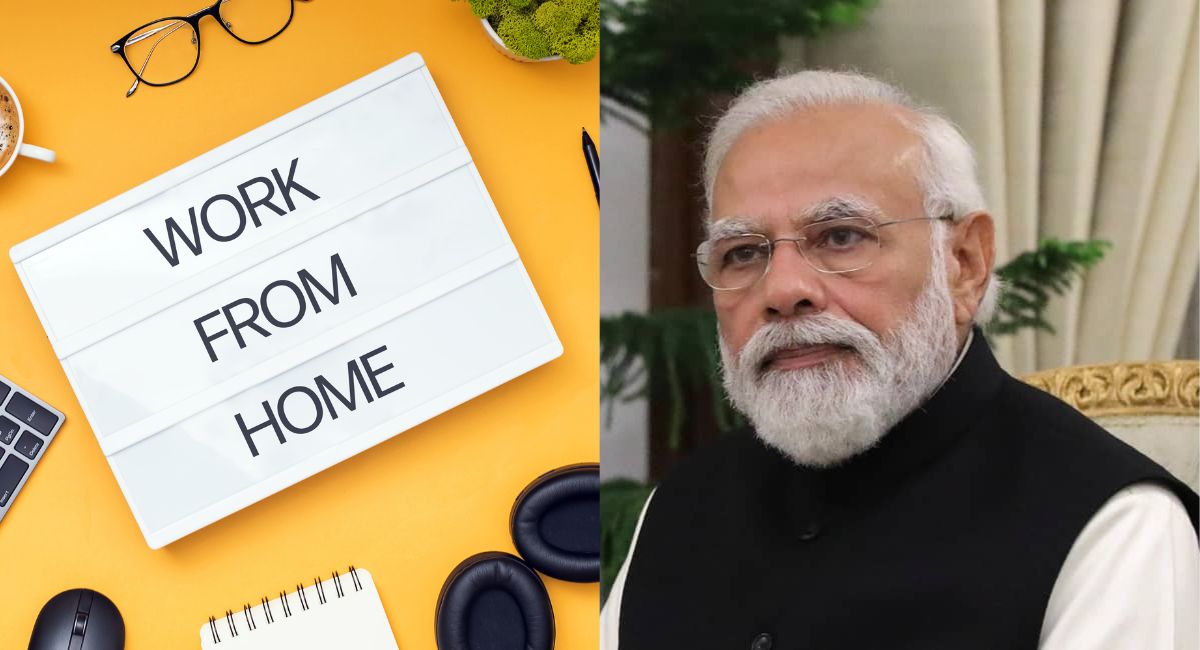

The second wave for WFH advocacy now has the support of Prime Minister Narendra Modi.
In his Hyderabad address, the Indian Prime Minister urged citizens to reduce consumption of foreign goods and shift to a WFH model wherever possible. Alternatively, he asked commuters to use public transport where possible, with metropolitan residents encouraged to take the metro.
Though one of the many requests made by PM Modi, WFH perhaps gained the most traction online, as employees and employers received it with mixed feelings. A large number of employees quickly showed their support, as many were already concerned about fuel prices, while others missed the flexibility that had become commonplace during COVID-19’s WFH era.
Though the circumstances in 2020 and 2026 are vastly different, both are global phenomena affecting day-to-day lives. While 2020 made travel difficult due to health concerns, 2026 is about wealth and resource scarcity.
Reasons Behind the Request
Prime Minister Narendra Modi’s push for fuel savings comes at a time when oil scarcity is a more imminent concern than anyone would like. India’s own petroleum reserves are low and certainly not enough to sustain the world’s largest population.
With the country pushing renewable energy over the past many years, India, unlike many other countries, is not concerned about an electricity shortage. Similarly, the push towards Piped Natural Gas (PNG), especially in dense metropolitan areas, has eased the need for LPG.
In other words, India’s current conditions make it convenient to use electricity, cook food, and stay at home. Though travelling every day is not fatal in the slightest, it certainly is burning money and fuel.
“Patriotism is not only about the willingness to sacrifice one’s life on the border. In these times, it is about living responsibly and fulfilling our duties to the nation in our daily lives,” Modi said.
The request to consume less fuel is, in today’s tense geopolitical situation, about ensuring that India has fuel for essential needs and for as long as possible. India is far from the first country to request this of its citizens, and Indians will be far from the first citizens to follow through.
During the Second World War, women in the US famously went without nylon stockings, despite prevailing modesty and fashion standards. The fabric itself was prioritised for parachute making, and women came up with creative solutions, including leg makeup.
Though the circumstances today are not that dire, it is hardly surprising that India’s government, with PM Modi at the helm, is urging to save a scarce resource before it truly becomes unattainable.
The Existing Infrastructure
Unlike 2020, most companies in India already have a WFH infrastructure in place. With only a few years since the end of the COVID-19-induced lockdown, India is well-versed in the idea and implementation of this unconventional model.
Moreover, in the past few years, many new options have emerged to make WFH far more convenient.
While 2020 saw most Indian companies relying on US-based platforms for working from home, 2026 has JioMeet and Zoho Meeting for those who want to establish a WFH framework that relies solely on Indian platforms.
Even as companies across India have pushed for a return to the office over the last couple of years, Indian employees have remained adamant about not letting the option disappear. And now, the option is becoming an advocated plan once more.
The Country’s Skewed Reality
In a country like India, WFH is not an option for most. Advocacy for this system may seem strong due to its popularity online, but the majority of workers in India work in industries that require physical presence.
India’s push for manufacturing has led a large number of its workforce to shift to line work. Similarly, the rise of platform-based gig workers has made travelling that much harder.
While most of the population of online platforms like LinkedIn can easily shift to a WFH model, that is far from the case for India’s actual population.
As per Tricontinental, at least 120 million workers, or 45% of India’s non-agricultural workforce, lost their jobs during the lockdown. In other words, India, even today, has a workforce that can’t truly shift to a “work from home” model.
Both blue and grey collar work in India could not truly transform to a WFH model in 2020, and the possibility remains unlikely even in 2026.
The Employer’s Dilemma
Even in white-collar jobs, employers have remained adamant about bringing back employees to the office. Managers, despite their differing priorities, are partial to working in the office rather than a team spread across different locations.
A primary reason for the lack of enthusiasm towards WFH is that companies are unable to truly impart their culture to their employees. A workplace, especially by modern standards and demands, is not just about work. However, in industries where WFH is well-suited to the actual work, it is the social part that suffers.
Additionally, many managers feel that welcoming and training a new employee or a fresher in a WFH setup is more impersonal than it should be. The screen between interactions serves as a barrier, making conversations more transactional than they should be.
Even some employees admit that the WFH model can make certain conversations far longer and lengthier than they need to be. Things that might have been discussed in minutes in the office can take up to an hour due to divided resources and communication methods.
Most importantly, for companies that value innovation, new conversations get stifled during remote conversations. While random talks in an office can lead to novel ideas, such conversations remain far too rare in remote work settings.
What the PM’s Words Really Mean
PM Modi’s words, at least in the latest address, were framed as a request.
Most professionals and leaders, though, agree that they should be taken as a warning sign. Given the tense geopolitical situation, the possibility that WFH may become mandatory, at least in some industries, is not that far-fetched.
As such, employers and managers should start preparing in case they truly do need to shift to a WFH model.
See what tasks require in-office presence and if there are possible tools that might serve as an alternative during a remote setting. Ask your team members about their thoughts on the existing and future models. For full-time office workers, is the hybrid model a possible solution that could help with future transitions?
The year 2020 proved that some changes are inevitable, especially when it comes to the collective good of society. Though the COVID-19 restrictions had come for an India that was unprepared and uncertain, the 2026 India is certainly capable, despite certain practical reservations.
Nonetheless, be ready for change, prioritise what is truly important, and hope that the WFH doesn’t really become a necessity.



