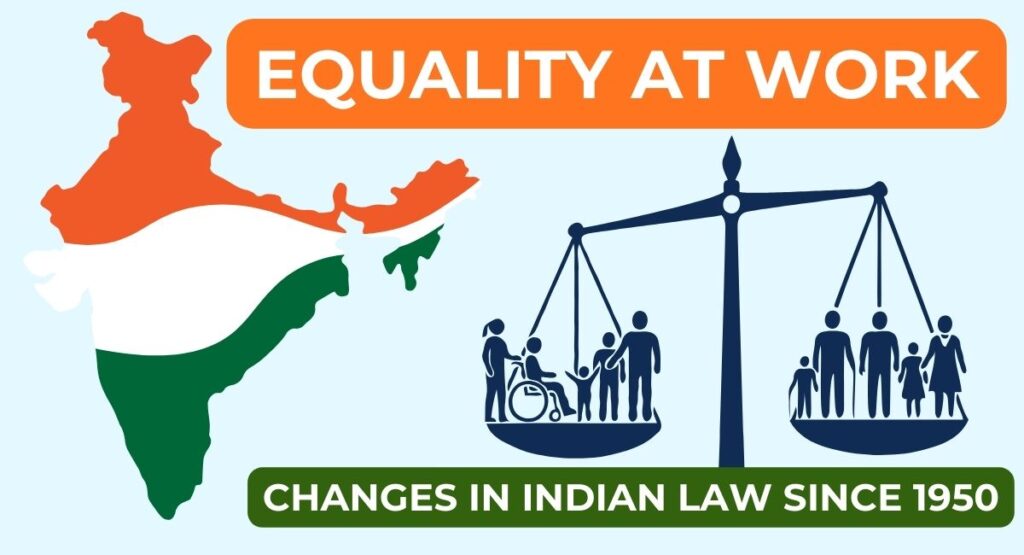

The story of colonial India is one rife with division based on caste, creed, colour, and religion. The sufferings borne by our ancestors were deep-rooted in the inequality that was far too common in the country at the time.
As such, when Indian lawmakers came together to draft the Constitution of India, equality was a key consideration in every decision. “EQUALITY of status and opportunity” is promised by the Preamble of the constitution and it is a sentiment that has echoed over the decades as bills are drafted and new laws are passed.
As India grew in size, in capability, and in opportunity, its laws have been adopted to ensure equality from both visible and invisible barriers. On this 76th Republic Day, let’s take a look at how far India’s laws have come since 1950 to ensure equality in the workplace.
Constitutional Foundations for Equality
Equality in the workplace is a right of every Indian citizen, promised in the country’s constitution many times over. The core foundation of the laws and policies that guarantee these rights revolves around key articles.
These articles are the crucial pillars around which India’s efforts for equality revolve and evolve. Fundamental to their language, these articles represent the spirit of free India, which thrives on equality and demands fair opportunity for all, irrespective of circumstances.
Article 14: Equality in Law
“The State shall not deny to any person equality before the law or the equal protection of the laws within the territory of India.”
Article 14 of the Indian Constitution is divided into two parts: Equality before the Law and Equal Protection of the Laws. Together, the two parts of this article guarantee that everyone is treated equally in the eyes of the law and that the law is applied equally to everyone. This particular article serves as the foundation of anti-discrimination laws.
Article 15: Prohibition of Discrimination
“The State shall not discriminate against any citizen on grounds only of religion, race, caste, sex, place of birth or any of them.”
Article 15 of the Indian Constitution mandates that no one can be discriminated against based on one’s religion, race, caste, sex, and/or place of birth. The article also emphasises that these factors cannot be used to bar anyone from public spaces, especially state-funded ones.
The article does allow special exceptions to be made to protect or benefit women and children. This includes maternity benefits or women-only hostels. Exceptions are also allowed for the advancement of socially and educationally backward classes of citizens, including the Scheduled Castes and the Scheduled Tribes, like reservations in government and educational institutions.
Article 16: Equality of Opportunity in Public Employment
“There shall be equality of opportunity for all citizens in matters relating to employment or appointment to any office under the State.”
Under Article 16, the Indian Constitution guarantees equality of opportunity in matters of public employment, grounded in the principles enshrined in Articles 14 and 15. In particular, the article focuses on job opportunities available in the public sphere likes government jobs. The article does not guarantee a job; it only offers a fair chance, and it is not applicable to private institutions.
Like Article 15, Article 16 allows for exceptions in specific cases. States may impose residence requirements for certain jobs, such as language or domicile requirements for specific state posts. Reservations for certain socio-economic classes and ethnic groups are also allowed. Religious institutions can also restrict appointments to persons of that religion.
Article 39, Section D: Equal Pay for Equal Work
“The State shall, in particular, direct its policy towards securing– (d) that there is equal pay for equal work for both men and women.”
Article 39(d) mandates that employees receive equal pay for equal work, regardless of gender. As it is part of the Directive Principles of State Policy, it is not directly enforceable in court. This directive has been a key piece of legislation to address the gender pay gap in India.
1950s–1970s: Early Legal Framework
The first two decades of India’s legal processes started by addressing inequality at the very basic levels of the country’s working population. The 1950s to 1970s were a time when India and the companies within it began to navigate a new path in a new republic, centred on individual freedom and dignity.
Addressing root-level inequalities and ensuring fairness for people, even in the vaguest sense, became imperative to create a framework that has since become the foundation for India’s ongoing drive for equity in all spheres of life.
The Protection of Civil Rights Act, 1955
“An Act to prescribe punishment for the [preaching and practice of “Untouchability”], for the enforcement of any disability arising therefrom and for matters connected therewith.”
The practice of Untouchability had emerged as a major point of contention even in colonised India, given how it stood against the very spirit of equality. As such, the Protection of Civil Rights Act of 1955 prohibits the enforcement of religious and/or social disabilities.
It also bans individuals and institutions from committing occupational discrimination by forcing someone to perform degrading or caste-based work. Social boycotts and the use of derogatory terms are also prohibited by this act.
It is this very act that enforces zero tolerance for caste-based discrimination in India. The law supports inclusive hiring, equal access, and dignity at work. Applicable across India, the act serves as the foundation for various DEI and anti-discrimination policies, reminding all that discrimination is not just unethical but also illegal.
The Maternity Benefit Act, 1961
“The Act regulates employment of women in certain establishments for a certain period before and after childbirth and provides for maternity and other benefits.”
A landmark piece of legislation, the Maternity Benefit Act of 1961, protects the employment, health, and dignity of working women during and after pregnancy. The act was instituted to ensure that women do not lose their jobs due to pregnancy, get paid maternity leave, and do not lose out on career opportunities.
As per the act, women are guaranteed 26 weeks of maternity leave for their first two children. From the third child onwards, they are entitled to maternity leave of at least 12 weeks. These leaves can be taken before and after delivery.
The law also allows 12 weeks of leave to adoptive mothers for children under the age of 3 and commissioning mothers (surrogacy).
A 2017 amendment allowed employers to allow new mothers to work from home after their maternity leave ends, if the nature of the work permits it. Organisations with 50 or more employees must provide crèche facilities.
The Equal Remuneration Act, 1976
“An act to provide for the payment of equal remuneration to men and women workers and for the prevention of discrimination, on the ground of sex, against women in the matter of employment and for matters connected therewith or incidental thereto.”
The Equal Remuneration Act of 1976 was implemented to bridge the gender pay gap in India. Historically, women were paid less than their male counterparts for the same amount of work. As such, this act bars both public and private institutions from paying different wages to employees of different genders for equal work.
Under the act, employers are also prohibited from discriminating against women in recruitment, promotion, training, and transfer. The act mandates that, in the event of a pay gap, employers cannot reduce wages; rather, they must increase the wages of the employee being paid less.
Reservation Policies
A carryover from the British Raj, the reservation system was implemented to provide opportunities in public employment for scheduled castes and scheduled tribes, and later for OBCs, under constitutional provisions. It also mandated opportunities for women, religious minorities, and underrepresented ethnic groups.
Articles 15(4), 16(4), and 46, along with Articles 330-342, were included in the very first draft of the Indian Constitution, effective 1950, to underscore that reservation is not a temporary favour but a constitutional responsibility.
Following the findings of the Second Backwards Classes Commission, or the Mandal Commission, in 1980, the concept of Other Backwards Classes (OBCs) was also established in 1990. Though the caste-based reservation system has long been a topic of contention in India, it has undoubtedly helped uplift many historically oppressed communities across the country.
Effective 1993, women were also assured 33% reservations in panchayati raj institutions and urban local bodies/municipalities. Many states have since increased this to 50% to provide women with more opportunities.
1980s–2000s: Expansion of Anti-Discrimination Framework
Growth, expansion, awareness, and individuality began to emerge in earnest in India between the 1980s and 2000s. The boom of IT, increasing globalisation, and a drive for awareness paved the way for people to speak up and demand what they were entitled to.
With people becoming more conscious of the world around them and the wounds of colonisation healing over, India became a place where people were rejecting unfair discrimination and demanding a workplace that provided for all.
The Scheduled Castes & Scheduled Tribes (Prevention of Atrocities) Act, 1989
“An Act to prevent the commission of offences of atrocities against the members of the Scheduled Castes and the Scheduled Tribes, to provide for Special Courts for the trial of such offences and for the relief and rehabilitation of the victims of such offences and for matters connected therewith or incidental thereto.”
Popularly known as the SC/ST Act, the Scheduled Castes & Scheduled Tribes (Prevention of Atrocities) Act of 1989 was enacted to prevent atrocities and hate crimes against the scheduled castes and scheduled tribes (SC/STs) in the country.
The Act lists various malicious acts of coercion, physical violence, humiliation, dignity violations, socio-economic oppression, and exploitation of power against members of the SC/STs as criminal offences.
The primary purpose of the Act was to stop the caste-based discrimination prevalent across India. Whether in the workplace or in public, treating members of SC/STs in an unfair/undignified manner is barred by law.
The National Commission for Women Act, 1990
“An Act to constitute a National Commission for Women and to provide for matters connected therewith or incidental thereto.”
The establishment of the National Commission for Women (NCW) under the National Commission for Women Act of 1990 marked India’s first step in recognising women’s issues as legal concerns rather than welfare issues.
The NCW was created to examine the existing laws affecting women and recommend suitable amendments and legislation to uplift women. The commission also has a duty to identify implementation gaps in laws affecting women.
Despite NCW’s limited enforcement powers, its establishment and functioning provided women with a much-needed voice. The commission aims to safeguard women in all walks of life, whether professional or personal, and remains a key player in India’s journey towards gender equality.
The Persons with Disabilities Act, 1995
“An Act to give effect to the Proclamation on the Full Participation and Equality of the People with Disabilities in the Asian and Pacific Region.” – in accordance with the Proclamation on the Full Participation and Equality of People with Disabilities in the Asian and Pacific Region in 1992.
Prior to the Persons with Disabilities Act, 1995, disability in India was considered a welfare issue rather than a rights issue. However, this particular act took the first steps in making the country a more accessible place for persons with disabilities (PwDs).
The act laid down definitions for various disabilities, recognised 7 categories of disabilities, focused on disability prevention & early detection, accessible education, employment inclusion, and protection against discrimination.
Though a foundational step, the Act did have its drawbacks, including a lack of focus on enforceable benefits. Proportionally weaker penalties for non-compliance, and limited recognition of disabilities.
Growth of Institutional Mechanisms
Between the 1980s and 2000s, various National Commissions were conceptualised and established to provide institutional monitoring and enforcement mechanisms for the laws in place in India.
The first SC/ST Commissioner was appointed in India in 1978, while the National Commission for Women (NCW) was institutionalised in 1990. In 2003, a separate National Commission for Scheduled Castes (NCSC) was established via the 89th Constitutional Amendment Act of 2003.
In 1995, with the implementation of the Persons with Disabilities (Equal Opportunities, Protection of Rights & Full Participation) Act, 1995, the Office of the Chief Commissioner for Persons with Disabilities was set up. However, it wasn’t formally established until the appointment of the first Chief Commissioner on September 1, 1998.
As of writing, the position of Chief Commissioner for Persons with Disabilities has been vacant since January 27, 2019, with Rajesh Aggarwal, IAS, Secretary, Department of Empowerment of Persons with Disabilities, Ministry of Social Justice and Empowerment, holding the additional responsibilities for the role.
2010s–2020s: Contemporary Legal Progress
The era of free expression, an unapologetic sense of self, and no tolerance for biases at any level is here. In contemporary times, laws have become more nuanced, addressing even the subtlest issues that can have the greatest impact.
With more than half a century since India became a republic, laws have been reevaluated to better represent the India of today. The fast-changing world has drastically shifted the very meaning of what a workplace is, and lawmakers are striving hard to ensure fairness in this brand-new India.
The Sexual Harassment of Women at Workplace Act, 2013
“An Act to provide protection against sexual harassment of women at workplace and for the prevention and redressal of complaints of sexual harassment and for matters connected therewith or incidental thereto.”
The Sexual Harassment of Women at Workplace (Prevention, Prohibition and Redressal) Act, 2013, or the POSH Act, is a landmark piece of legislation that provides women across India with much-needed protection in the workplace.
The act mandated the formation of Internal Complaints Committees (ICCs) and laid down the foundation of redressal structures. Through the POSH Act, female harassment in the workplace was elevated from being an HR issue to becoming a criminal action.
With this act in place, working women received a much-needed legal support to fight against unwanted physical advances, sexually-charged comments, lewd gestures, and even digital harassment.
The Rights of Persons with Disabilities Act, 2016
“An Act to give effect to the United Nations Convention on the Rights of Persons with Disabilities and for matters connected therewith or incidental thereto.”
The Rights of Persons with Disabilities (RPwD) Act of 2016 repealed the Persons with Disabilities Act, 1995, in order to align India’s measures for PwD inclusion with the United Nations Convention on the Rights of Persons with Disabilities, which India ratified in 2007.
The act defines the term “disability,” lists the rights and entitlements of affected parties, establishes authorities, and imposes penalties. These measures include a stronger stance on non-discrimination, reservations in education and employment, accessibility duties, and centralised certification.
Additionally, the RPwD Act mandates that every government establishment should reserve 4% of seats for PwDs. It also expanded the number of disability categories from 7 to 21, including physical, sensory, intellectual, psychosocial, neurological, and chronic conditions.
The Transgender Persons (Protection of Rights) Act, 2019
“An Act to provide for protection of rights of transgender persons and their welfare and for matters connected therewith and incidental thereto.”
In 2019, the Government of India passed the Transgender Persons (Protection of Rights) Act of 2019 to protect the rights and dignity of transgender persons. It ensures equal access to education, employment, healthcare, housing, and public services for transgender individuals.
The act lays down the definition of terms like trans men, trans women, intersex persons, and genderqueer persons. It also acknowledges persons with socio-cultural identities as kinner, hijra, aravani and jogta.
The gender identity of the person, as per this act, is acknowledged through self-perception rather than biological factors and/or medical procedures of the past/future.
Code on Wages, 2019
“An Act to amend and consolidate the laws relating to wages and bonus and matters connected therewith or incidental thereto.”
The Code on Wages, 2019, was implemented to provide fair pay, timely wages, and uniform wage standards across India. While earlier laws applied only to specific industries, this Code was created with the aim of universal application, offering consistent definitions and transparency in compensation.
In this code, the government introduced a national floor wage, mandated minimum wages for all (subject to location), and enshrined the concept of equal pay for equal work. The unification of multiple older laws under a single umbrella also eased compliance burdens.
Code on Social Security, 2020
“An Act to amend and consolidate the laws relating to social security with the goal to extend social security to all employees and workers, either in the organised or unorganised or any other sectors, and for matters connected therewith or incidental thereto.”
The government of India introduced the Code on Social Security, 2020, to provide social security benefits to employees from all walks of life. In particular, it lays down social security foundations for unorganised, gig, and platform workers.
The benefits addressed in the Code include Employees’ Provident Fund (EPF), Employees’ State Insurance (ESI), insurance, maternity benefits, gratuity, and health & disability coverage. The coverage has been expanded beyond just formal, salaried employees.
Labour Law Overhaul: Four New Labour Codes
In late 2025, the government of India introduced four new labour codes to consolidate existing labour laws and provide a truly comprehensive set of mandates for the country’s working population.
The four codes, Code on Wages, 2019, the Industrial Relations Code, 2020, the Code on Social Security, 2020, and the Occupational Safety, Health and Working Conditions Code, 2020, were created to benefit employees in various working sectors that have cropped up in India.
In particular, the codes established norms and definitions relevant to workers in unorganised sectors, as well as gig and platform workers. These new codes were created not only to address the needs of newer sectors but also to decrease the complexities of the existing labour law framework.
Structural & Social Challenges
Despite ongoing legal efforts to achieve workplace equality, India still faces many barriers to achieving professional equality. While some of the challenges are rooted in social conventions, others highlight the gaps between the ideas of the laws and their actual execution.
Persistent Caste & Gender Barriers
Despite measures like reservations and workplace safety protocols, gender and caste biases in hiring and promotion are still visible in many workplaces across India. A large part of this continued struggle is due to the ongoing social dynamics that put women and minorities at a disadvantage.
Informal Economy
A significant portion of India’s economy comprises the unorganised sector, where legal protections are not enforced with the same diligence as in the organised sector. As such, pay and benefit inequality, along with a lack of contract protections, leads to an unfair distribution of wealth in many workforces.
Implementation Gaps
Despite the spirit of the laws in the Indian constitution, their true intent is often beyond reach due to enforcement and compliance challenges in SMEs and micro firms. In particular, small industries in rural areas of the country find it hard to navigate the complex legal landscape, especially in the absence of qualified legal advisors.
In the End…
India is a country that thrives on its diversity. From the very first letter of the Indian constitution, the country’s legal framework emphasises the idea and importance of being united under a single umbrella.
Over the years, various laws have been enacted and even discarded to ensure equality for all in all spheres of life, including workplaces. The laws do not just criminalise discrimination but also provide processes to level the playing field.
Not all laws have been perfect, and not all future measures will be. However, beyond the laws, the Indian constitution urges people to believe in equality, act fairly, and reject discrimination. In workplaces, where every opportunity can lead to drastic changes in the standard of living, ensuring fairness is not just about legality but also morality.
Doubtless, India still has a long way to go to achieve true workplace equality. Policy recommendations, stronger enforcement, cultural transformations, and inclusive workplaces are becoming increasingly imperative by the day, but they can only be effective if each and every citizen also believes in “EQUALITY of status and opportunity.” After all, the Indian Constitution is meant for “WE, The People of India.”