
The International Labour Organisation (ILO) has released fresh global and regional estimates on the people who clean homes, cook meals, and care for children, older adults, and people with disabilities inside private households. Published on 27 October 2026, the statistical brief marks fifteen years since Convention No. 189 was adopted and offers the first full worldwide refresh of the figures since 2019.
The numbers draw on comparable household and labour force data from 140 countries. What follows is a straight read of the headline figures, the regional cuts, the wage and working-time gaps, and where India sits inside the picture.
The Global Headline Numbers
Two numbers anchor the brief, and both repay a second look. The global domestic workforce has grown in absolute terms, but its share of total employment has barely moved since 2019.
An estimated 80.0 million people aged 15 and over worked as domestic workers worldwide in 2025, up from 75.6 million in 2019, according to the ILO’s statistical brief. That rise of roughly 4.4 million workers sits inside a flat share of total employment: 2.2% of all employment and 4.4% of employees, essentially unchanged from 2019.
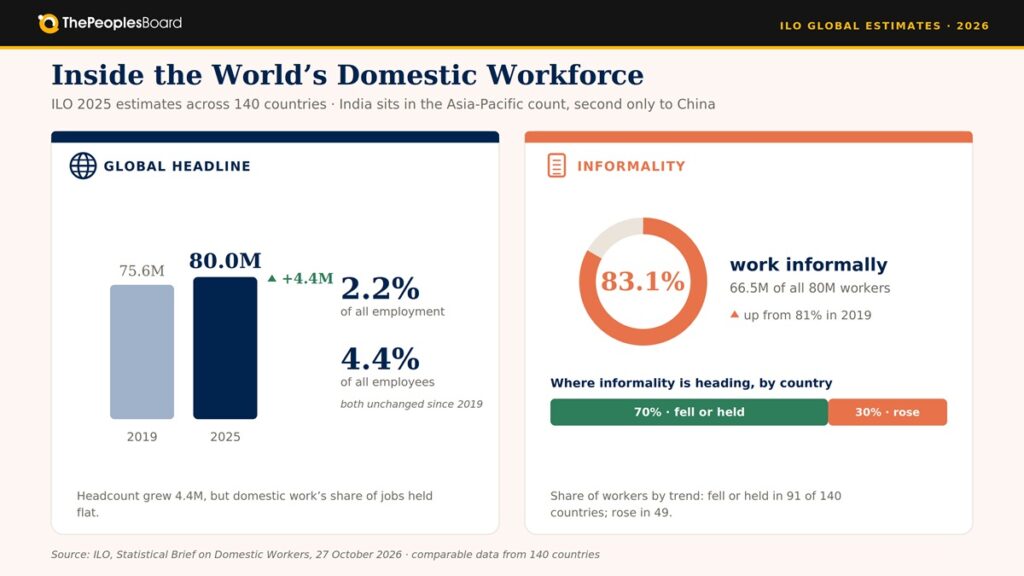
The ILO reads this pattern as broader employment growth in specific regions pulling the headcount up, rather than a structural expansion of domestic work as a share of jobs.
The Finer Details
To understand just how the domestic economy is working today, the ILO looked into various factors surrounding the industry. From geographical differences to gender-based splits, the study dives into how domestic workers are faring.
Where Domestic Workers Live: The Regional Split
The global total is heavily concentrated. The report breaks the 80 million down by region, and the distribution shapes nearly every other finding in the brief.
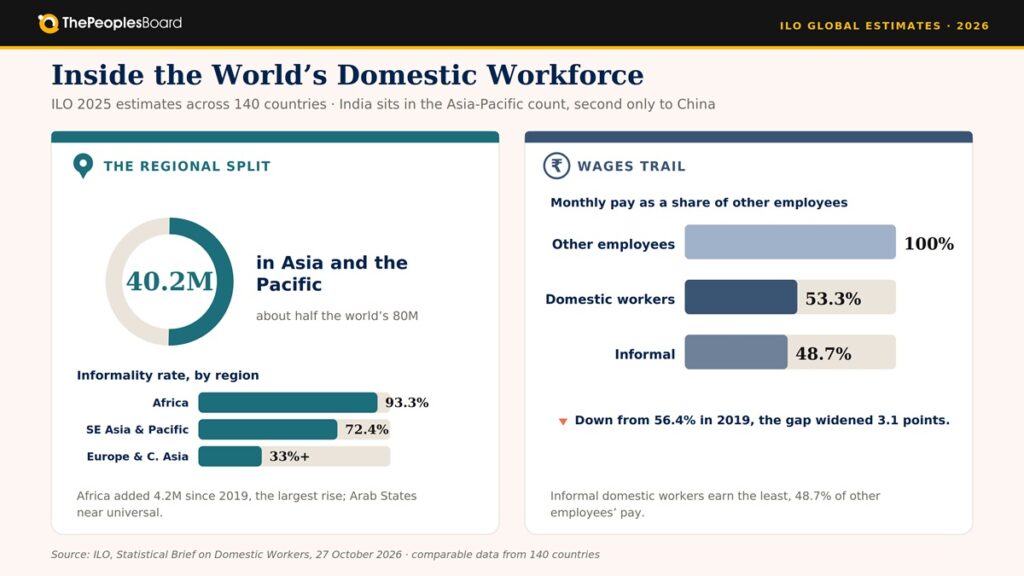
Asia and the Pacific accounts for 40.2 million domestic workers, roughly half of the global total. Africa recorded the largest absolute increase since 2019, adding 4.2 million workers to its domestic workforce. Europe and Central Asia post the lowest regional informality rate, though more than one in three domestic workers there still work informally.
| Region | Share or change | Informality rate |
| Asia and the Pacific | 40.2 million (~50% of global) | Southeast Asia & Pacific sub-region: 72.4% |
| Africa | +4.2 million since 2019 | 93.3% |
| Arab States | Smaller workforce | Near universal |
| Europe and Central Asia | Lowest regional rate | Above 33% |
| Americas | Most feminised broad region | Not disclosed in press summary |
Sources: ILO press release and statistical brief.
Informality: The 83.1% Figure
Informality is the single largest finding in the brief, and the direction of travel is mixed. The headline rate has risen, but the country-level pattern tells a more careful story.
Globally, 66.5 million domestic workers, or 83.1% of the total, were in informal employment in 2025, up from 81% in 2019. That means 5.1 million more informal domestic workers than six years earlier.
The country-level breakdown is less bleak. Informality declined or stayed stable in 91 of the 140 countries with comparable data, together accounting for nearly 70% of domestic workers worldwide. Informality rose in the remaining 49 countries, which hold about 30% of the global workforce.
In the ILO’s own reading, the global uptick reflects a composition effect: domestic workers are increasingly concentrated in high-informality countries, pulling the aggregate rate up even where many national rates are improving.
Wages Trail Further Behind
The wage figures are the clearest sign that progress on informality has not yet translated into pay parity. The gap between what domestic workers earn and what other employees take home has widened over the six-year gap between estimates.
Domestic workers earned 53.3% of the average monthly wage of other employees in 2025, down from 56.4% in 2019. Informal domestic workers fared worse, at 48.7%. The ILO notes that this does not mean wages have fallen in absolute terms.
In many countries, they have risen, but more slowly than wages for other employees, and the compositional weight of large low-wage workforces pulls the global average down. The widening gap puts domestic work among the most underpaid sectors in cross-industry wage benchmarks.
Working Hours Run Long
Hours of work extend the pay story. The brief finds that long weeks are not an outlier but a common feature of the sector, pointing to under-regulation of time as much as of wages.
Across the global workforce, 35.2% of domestic workers put in at least 49 hours per week. Of those, 14.6% work 60 hours or more. The ILO flags a parallel pattern at the other end of the distribution: domestic workers are also more likely than other employees to work very short hours, which the report links to underemployment and to work fragmented across several households.
Gender Still Defines the Sector
Who does domestic work, and under what conditions, remains sharply gendered. The 2025 estimates show the demographic shape of the sector has not shifted.
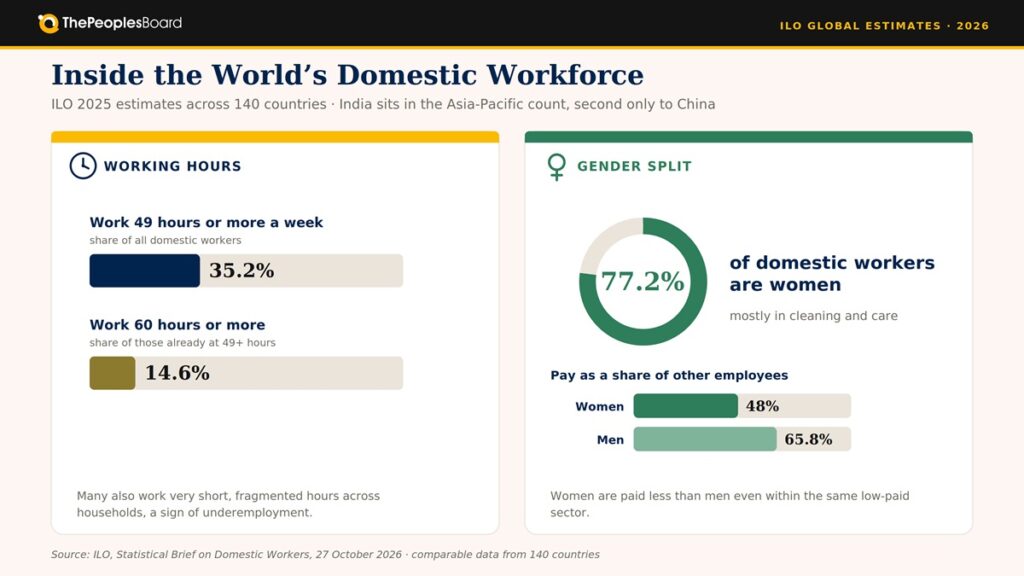
Women make up 77.2% of all domestic workers worldwide and are disproportionately concentrated in cleaning and direct-care occupations. The pay gap splits by gender too. Women domestic workers earn, on average, 48% of the monthly wages of other employees, while men domestic workers earn 65.8%.
India in the Picture
India sits inside the Asia and the Pacific count of 40.2 million, which includes the two largest national workforces in the region. Measuring the Indian figure precisely has long been difficult, and the brief does not resolve the gap between official and civil-society estimates.
India has the second-largest domestic workforce in Asia and the Pacific after China, as reflected in the ILO brief’s regional reporting. Inside India, estimates still vary widely: the NSSO’s 2012 figure of 3.9 million remains the official count, while the National Domestic Workers’ Movement places the number in the tens of millions. India voted in favour of Convention No. 189 but has not ratified it.
In the End…
The brief is a baseline, useful mostly if HR, policy, and business audiences sit with it directly rather than through secondary coverage.
Download the full statistical brief and open the ILOSTAT domestic-workers dashboard side by side when preparing any India care-economy, informal-sector, or gender-pay-gap document this quarter. Replace older 2019 figures in internal decks with the 2025 numbers, since the wage gap and informality rate have both moved and citing stale data will weaken any ask. CSR, supply-chain, and ESG teams whose scope touches household and care work should log the new baselines today, before Q4 reporting cycles close.
FAQs
How many domestic workers are there worldwide in 2025?
An estimated 80.0 million people worked as domestic workers worldwide in 2025, up from 75.6 million in 2019, per the ILO’s October 2026 brief.
What share of domestic workers are in informal employment?
66.5 million domestic workers, or 83.1% of the global total, were in informal employment in 2025, up from 81% in 2019.
Where does India sit in the ILO’s 2026 count?
India has the second-largest domestic workforce in Asia and the Pacific after China, inside the 40.2 million regional count. It voted for Convention No. 189 but has not ratified it.
How much do domestic workers earn compared to other employees?
Domestic workers earned 53.3% of other employees’ average monthly wage in 2025, down from 56.4% in 2019. Women earned 48%, men 65.8%.
What is ILO Convention No. 189?
Adopted in 2011, Convention No. 189 extends core labour rights to people working in private households. The 2026 brief marks its fifteenth anniversary.