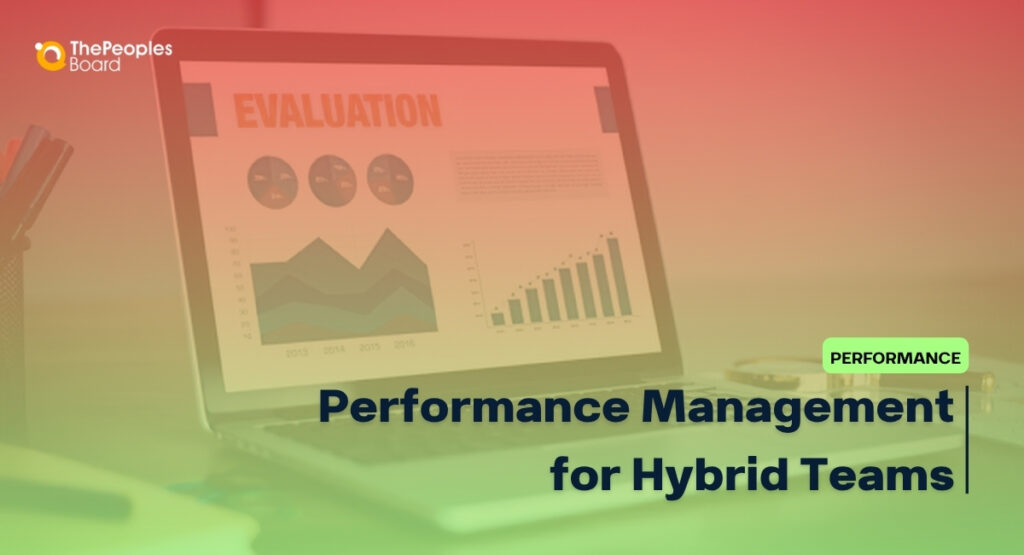

Hybrid work has broken the assumptions most Indian performance systems were built on. A manager who once tracked effort by who stayed late now manages people she sees two or three days a week, and the old cues- desk presence, hallway updates, visible busyness- don’t exist anymore. Objectives and Key Results were supposed to solve this by shifting the conversation from activity to outcomes, but most Indian companies still run OKRs on an annual clock built for a fully in-office team. That’s why the framework so often collapses into a spreadsheet nobody updates.
ADP’s People at Work 2025 survey found that 36% of Indian employees now work in a hybrid arrangement, yet hybrid workers report engagement at just 19%, behind the 21% seen among employees who work on-site daily. Something in the current setup is not translating flexibility into performance clarity. Fixing OKRs for distributed teams comes down to how often goals get set, how progress gets tracked, and who owns the conversation in between.
Why Annual OKR Cycles Fail Distributed Teams
An annual OKR cycle assumes a manager can course-correct informally between review periods, through desk visits and overheard conversations. Hybrid work removes most of those signals, so goals set in April can drift for months before anyone notices they no longer match what the business needs.
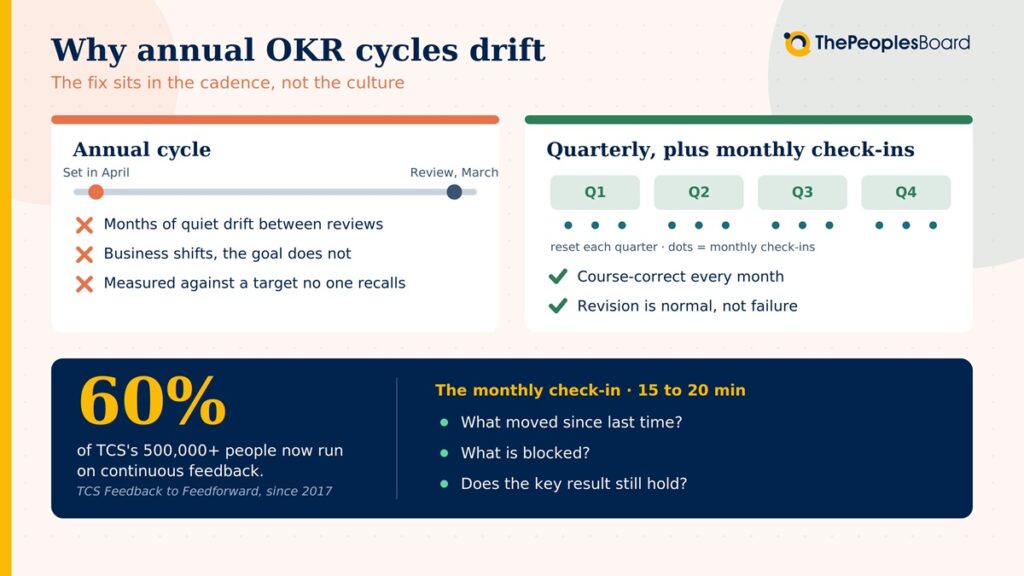
TCS addressed this directly. The company moved to a continuous feedback-based model in 2017, later formalised as Feedback to Feedforward, and close to 60% of its workforce of over half a million now runs on it rather than a single annual cycle. The logic transfers well beyond IT services. When a sales OKR tied to a product launch slips because the launch date moved, a hybrid team needs it rewritten within days. A review six months later just measures against a target nobody can accurately recall setting.
The fix sits in the structure of the cycle itself rather than in team culture. Moving from annual OKRs to quarterly cycles with a lightweight monthly check-in solves most of it, and revision needs to become a normal part of the process rather than an admission of failure.
Building OKRs That Survive Remote Weeks
Vague OKRs fail everywhere, but hybrid work makes the failure visible faster with no manager standing over a shoulder to clarify intent. A key result like “improve client satisfaction” means something different to every person reading it, and that ambiguity compounds across a quarter with fewer in-person moments to align interpretation.
Fixing this at the point of goal-setting comes down to a handful of habits that hold up on their own.
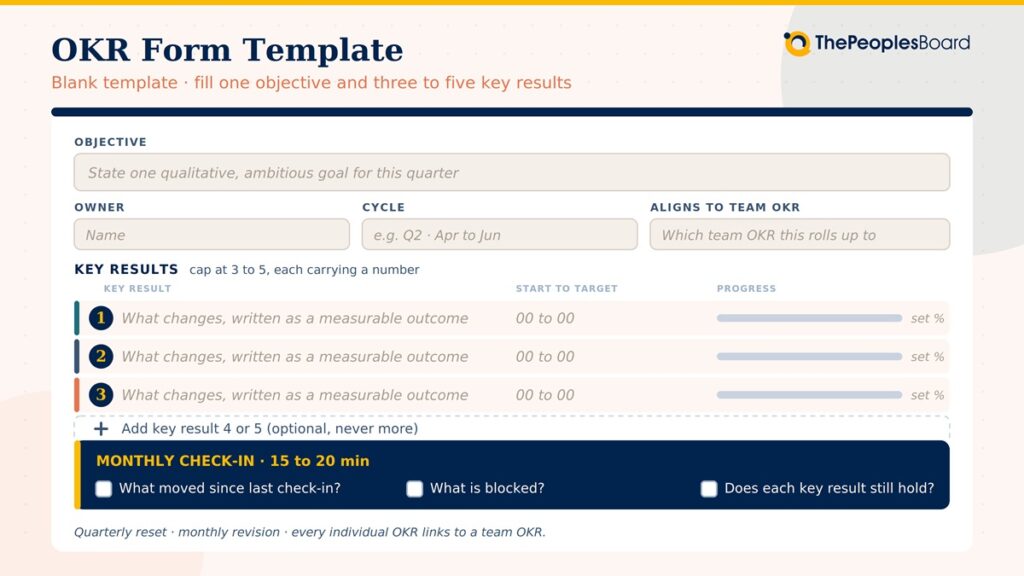
- Key results need a number attached to actually mean something. “Reduce average ticket resolution time from 48 to 30 hours” survives a remote quarter. “Improve resolution speed” gets reinterpreted by every person who reads it.
- Objectives capped at three to five key results travel better than sprawling scorecards, since distributed teams lose track of them faster with no shared whiteboard reinforcing them daily.
- Individual OKRs need an explicit line to team OKRs. Hybrid employees aren’t overhearing that connection in a morning standup, so it has to be written down somewhere they can see it.
Flipkart’s OKR rollout aimed for a state where every employee could write objectives linking directly to leadership goals, creating alignment without needing physical proximity to reinforce it. That’s the standard worth aiming for: an OKR that makes sense without a manager nearby to translate it.
Making the Check-In Do the Work a Desk Used to Do
A weekly or biweekly check-in is where hybrid performance management either works or quietly falls apart. It’s the substitute for course-correction that used to happen by accident in an office, and treating it as optional turns OKRs back into an annual paperwork exercise.
The strongest hybrid check-ins run 15 to 20 minutes and cover the same ground consistently: what moved since the last check-in, what’s blocked, and whether the key result still reflects reality. TPB’s guide to constructive feedback strategies covers keeping that conversation specific rather than a status recital, which matters more where tone carries less through a screen than in person.
Remote days shouldn’t mean fewer check-ins. Some Indian HR teams report that check-ins scheduled on remote days go longer and surface more, since neither party is rushing to the next meeting down the hall.
Rewriting the Manager’s Role in a Distributed Model
None of this works if managers are handed a new template and left to run it the old way. A manager trained to evaluate presence now has to evaluate outcomes he can’t always see directly, and that shift needs support.
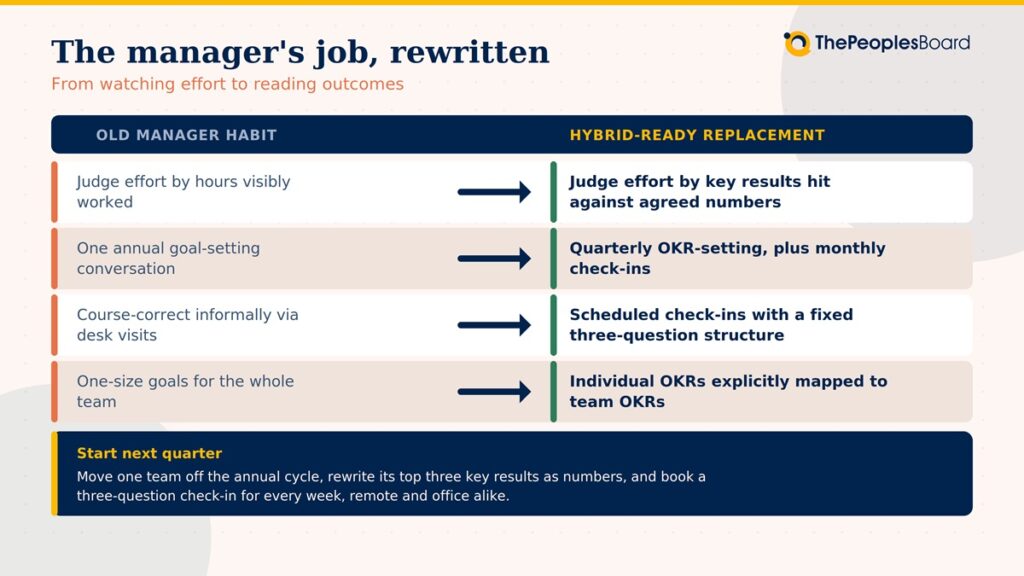
HR’s role is less about redesigning the OKR template and more about training managers to run this cadence consistently across office and remote days alike. TPB’s guide to setting SMART goals is a useful reference for managers writing key results under a quarterly model for the first time.
Companies expanding hybrid arrangements often bolt performance management on last, after leave and attendance policies are already settled, a pattern covered in TPB’s breakdown of hybrid work policy design. It shouldn’t be.
In the End…
Pick one team running on an annual OKR cycle and move it to quarterly, starting next quarter’s planning session. Rewrite its top three key results as specific numbers, and put a fixed three-question check-in on the calendar for every remote week as well as the office ones. The teams that get hybrid performance management right aren’t the ones with the fanciest OKR software. They’re the ones who treated the check-in itself as the real work.
FAQs
Why do annual OKRs struggle in hybrid teams?
Annual OKRs can become outdated as priorities change. Quarterly goals and regular check-ins allow teams to course-correct faster.
How often should hybrid teams review OKRs?
Teams should review progress at least monthly, with shorter weekly or biweekly check-ins for ongoing course correction.
What makes an OKR effective for a hybrid team?
Effective OKRs are specific, measurable and clearly linked to team goals, so employees understand expectations without constant in-person guidance.
What is the manager’s role in hybrid performance management?
Managers should focus on outcomes rather than visible activity, while using regular check-ins to identify blockers and adjust goals.
Should companies use different OKRs for remote and office days?
No. Performance expectations should remain consistent regardless of where employees work.