


The world’s largest annual workforce sentiment study for 2026 is out, and the figures for India break in two directions at once. Indian employees lead their global peers on AI adoption at work and sit higher than most Asia-Pacific markets on job security, yet they also log the heaviest unpaid work week on record for any country in the survey.
ADP Research’s People at Work 2026 report puts hard numbers behind each of these claims, drawing on the Global Workforce Survey, which polled more than 39,000 adult workers across 36 markets in 2025.
The Survey Behind The Numbers
ADP’s People at Work report has been published annually since 2020, and the 2026 edition keeps the same core methodology. The sample covers knowledge workers, skilled task workers and repetitive task workers across industries, firm sizes and work arrangements, which lets ADP cut the data by job type rather than only by country.
Fieldwork for the 2026 edition was carried out in 2025, so the responses reflect a labour market where AI adoption had already gone mainstream and most economies had moved past the post-pandemic churn. The full report lives at the ADP Research publication page.
How Many Workers Feel Their Jobs Are Safe
The single most-quoted global figure from the 2026 edition is 22%. That’s the share of workers who strongly agree their job is safe from being eliminated, and no country in the survey hit a majority on this question.
Confidence varies sharply by market, and even the top-ranked countries still have fewer than four in ten employees feeling safe. The spread between the highest and lowest market is wider than seven-fold.
| Market | Workers Strongly Agreeing Their Job Is Safe |
| Nigeria (highest) | 38% |
| India | 30% |
| United States | 28% |
| United Kingdom | 25% |
| Singapore | 15% |
| Japan (lowest) | 5% |
| APAC average | 18% |
| Global average | 22% |
India’s Job Security Picture
India ranks third globally on job security sentiment and first in Asia-Pacific. The 30% confidence figure sits 12 points above the APAC average and 8 points above the global number, as reported in the ADP India press release on the first chapter of the report.
The same India dataset also shows a wide internal gap. The confidence score depends heavily on the kind of work being done, and the breakdown by work type explains most of the variation.
By Work Type
Within India, confidence in job security tracks closely with how exposed the role is to automation. Knowledge workers sit well above skilled task workers and repetitive task workers on this measure, and the gap inside the country is wider than the gap between India and the APAC average.
- Knowledge workers: 37% confident
- Skilled task workers: 18% confident
- Repetitive task workers: 17% confident
The 20-point internal spread is one of the sharpest work-type splits anywhere in the report.
Engagement And Retention Multipliers
The report attaches specific multipliers to the engagement benefit of feeling secure at work. Those multipliers move the issue from a wellbeing conversation into a retention conversation that finance leaders can read directly.
Workers who agree their job is safe are 6x more likely to be fully engaged and 2x more likely to stay with their current employer. That 6x multiplier is one of the cleanest leading indicators in the data for HR teams tracking employee engagement metrics quarter on quarter. Workers who fear losing their jobs, by contrast, show up as less engaged, more stressed, less productive and more likely to be job-hunting.
AI Use At Work
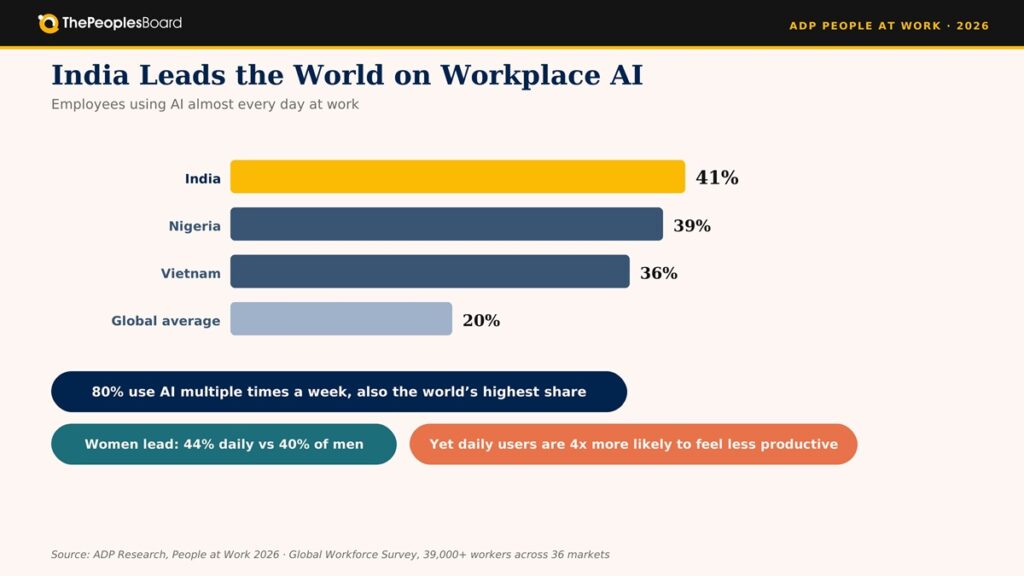
AI has moved from pilot to routine inside the ADP data. Globally, half of all workers surveyed use AI at least multiple times a week, and 20% use it nearly every day.
India sits well above both averages across almost every cut, which is why ADP has flagged India as a global leader in workplace AI adoption. The artificial intelligence in HR glossary entry gives the workplace frame these adoption numbers plug into.
India’s Numbers By Demographic
The India cuts in the report split the workforce by age, gender and company size. The direction of travel is consistent across every slice, with younger workers and women using AI the most.
- 80% of Indian employees use AI multiple times a week, the highest share globally
- 41% of Indian employees use AI almost daily, also the highest share globally
- 43% of Indians aged 18-39 use AI almost daily
- 44% of Indian women use AI nearly every day at work, compared to 40% of Indian men
- 31% of Indian employees believe AI will positively affect their job responsibilities in the coming year, placing India second after Nigeria
Nigeria clocks 39% daily use and Vietnam 36%, so India’s 41% figure holds the top spot on the global table by a visible margin.
The Productivity Paradox
Daily AI use and feeling more productive don’t track together in the ADP data. The engagement effect is positive, but the self-reported productivity signal moves the other way.
30% of daily AI users say they are fully engaged at work, compared to 14% of non-users. In the same cut, daily AI users are 4x more likely than non-users to feel less productive. ADP’s reading is that AI is pushing employees into strategic work that’s harder to measure, which can make an engaged user feel less effective even when output quality rises.
Unpaid Work Hours: The Indian Outlier
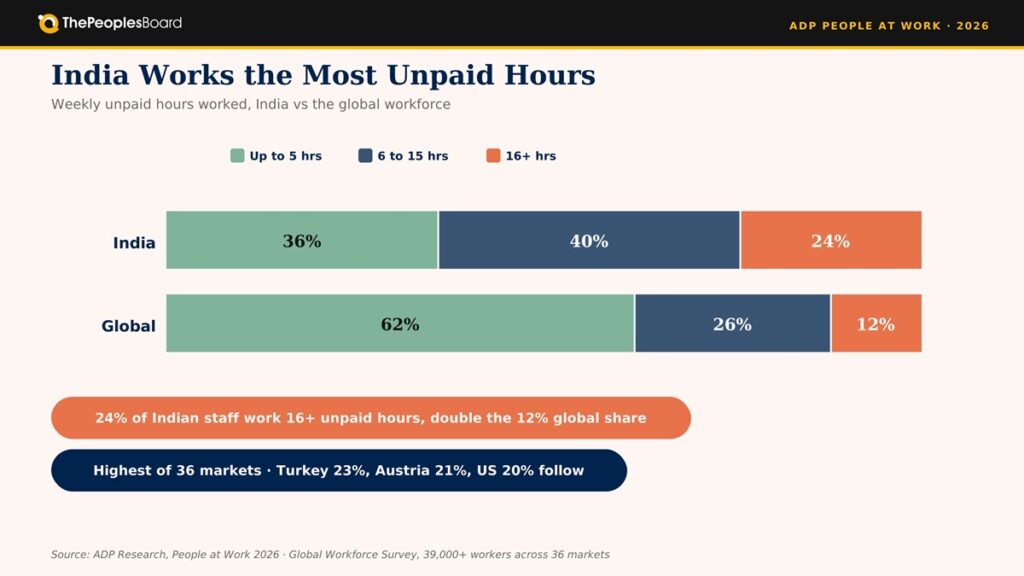
Unpaid overtime shows up in every market covered by the report, but the Indian numbers sit visibly apart from the rest of the dataset. 24% of Indian employees work 16 or more unpaid hours each week, the highest share among the 36 markets surveyed, and another 40% put in 6 to 15 unpaid hours a week.
The global distribution runs lower across every band.
| Weekly Unpaid Hours | Share Of Global Workforce |
| Up to 5 hours | 62% |
| 6 to 15 hours | 26% |
| 16 or more hours | 12% |
The 12% global figure for 16+ unpaid hours is exactly half of India’s 24%. Turkey is next at 23%, followed by Austria at 21% and the United States at 20%.
Unpaid work also climbs with seniority. Globally, 50% of senior managers and executives put in at least 6 unpaid hours a week, and 20% of executives log 16 or more unpaid hours. Remote employees top the work-arrangement cut, with 35% logging 6 to 15 unpaid hours and 13% logging 16 or more.
In The End…
The 2026 figures give Indian HR teams a sharper read on three fronts at the same time. The workforce is simultaneously the world’s most active AI user, one of the more confident on job security in Asia-Pacific, and the heaviest on unpaid work by a visible margin.
A practical next step is to map internal numbers against ADP’s benchmarks on the three variables that matter most: job security sentiment, AI usage frequency and unpaid hours. The engagement and retention multipliers already inside the report give a quick way to size the business case for whichever gap shows up largest, and upskilling and reskilling programs tied to the AI numbers remain the lever with the shortest payback cycle.
FAQs
What is ADP’s People at Work 2026 report based on?
A survey of over 39,000 workers across 36 countries, conducted in 2025. It covers different job types, industries and company sizes.
How does India rank on job security globally?
India ranks third, with 30% of workers feeling their job is safe. Only Nigeria (38%) and the US (28%) rank higher. The global average is 22%.
How does AI adoption in India compare to the rest of the world?
India leads the world. 80% of Indian employees use AI multiple times a week, and 41% use it almost daily, higher than any other country.
What is the productivity paradox in the ADP data?
Daily AI users feel more engaged but also 4x more likely to feel less productive. AI is pushing them into strategic work that’s harder to measure.
Why does India stand out on unpaid work hours?
24% of Indian employees work 16 or more unpaid hours a week, the highest in the world and double the global average of 12%.
What’s the business case for improving job security sentiment?
Workers who feel secure are 6x more likely to be fully engaged and 2x more likely to stay with their employer.