


A new Gartner AI Jobs forecast released on 10 November 2026 at the firm’s IT Symposium/Xpo in Barcelona puts hard numbers on what AI will do to the global workforce over the next four years. The projection runs to 2030 and breaks the impact down by industry, by share of workers directly affected, and by the daily pace at which roles will shift from 2028 onward.
These are the figures HR teams in India will be asked about as boards, business leaders, and candidates look for a reference point. The numbers that follow come straight from the firm’s release and underlying research, with industry splits, year-on-year detail, and the India comparison set side by side.
Gartner AI Jobs Forecast: The Headline Numbers
Gartner’s central projection is a global net increase of 1.7 million jobs attributable to AI by 2030. This is on top of 10.6 million new jobs created and 8.9 million jobs removed globally over the same period. More than 435 million workers worldwide need to adapt to changing roles and responsibilities.
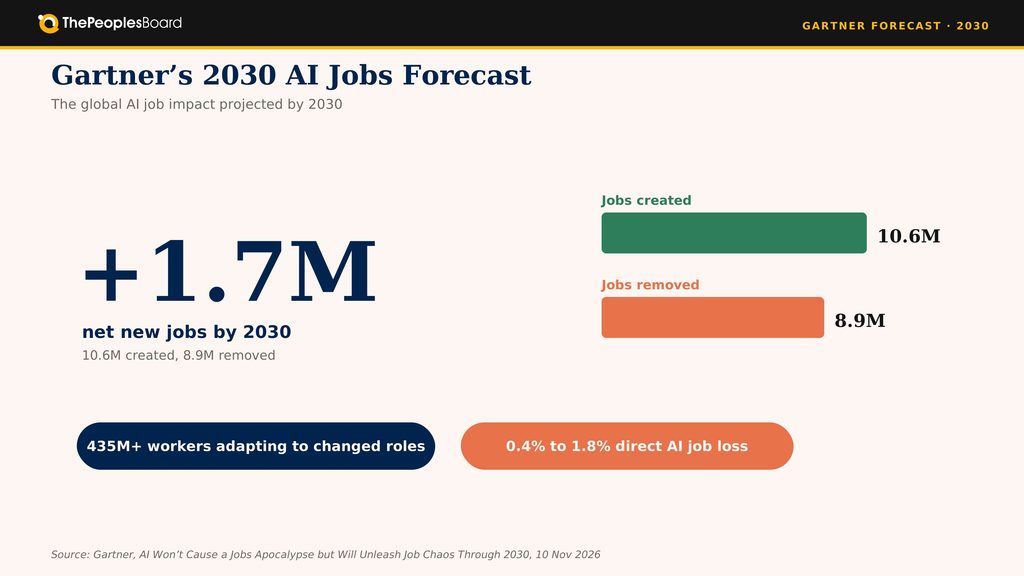
Gartner’s release, tied to its report titled “AI Won’t Cause a Jobs Apocalypse, but Will Unleash Job Chaos Through 2030,” puts the direct job-loss rate at between 0.4% and 1.8% of the global workforce by 2030.
| Metric | Figure by 2030 |
| New jobs created globally | 10.6 million |
| Jobs removed globally | 8.9 million |
| Net increase | 1.7 million |
| Workers adapting to new roles | 435 million+ |
| Direct AI-driven job-loss range | 0.4% to 1.8% of workforce |
Helen Poitevin, Distinguished VP Analyst at Gartner, said at the Barcelona event: “Organisations most advanced in AI execution view AI not as a replacement for labour, but as a catalyst to reinvent operations and rebalance workforce and technology capabilities to compete in changing markets.“
Industry-by-Industry Breakdown
Gartner’s data shows the net gain is heavily concentrated in one sector, and the asset-intensive economy accounts for the biggest absolute numbers on both sides of the ledger. The firm breaks the global impact into three categories, each with a sharply different outlook.
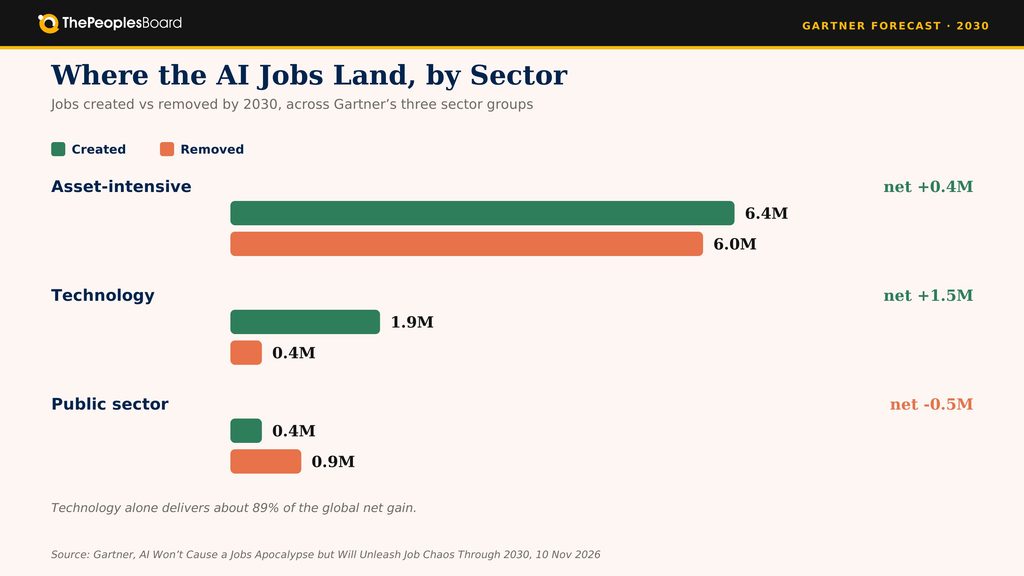
The technology sector delivers a net 1.5 million jobs, which is roughly 89% of the global net gain, even as nearly 70% of its workforce sits highly exposed to AI. The public sector is the only one that will end 2030 in deficit, with losses of 0.9 million against gains of 0.4 million, leading to a net decrease of 0.5 million jobs. Asset-intensive industries, which deal in physical products or deliver services within capital-intensive infrastructure, account for the largest share of jobs globally and the largest absolute numbers on both sides of the ledger.
Poitevin cautioned against generalising from one sector to another: “AI job impacts are unevenly distributed across geographies, job functions and industries. The worst mistake that a business and IT executive can make is to apply lessons from one industry or role to another.“
Our coverage of India’s AI readiness explores the gap in deployment confidence behind these numbers.
What’s Already Happened in 2026
Gartner quantifies 2026 as a baseline, which matters because the 2030 forecast is anchored to where things stand now. The firm’s 2026 numbers draw a line under the gap between jobs that are lost and jobs that simply never got created.
In 2026, business executives deferred creating and hiring for 1.3 million positions globally, while 2.2 million jobs were lost and 1.6 million were created.
John Lovelock, Distinguished VP Analyst and Chief of Research at Gartner, drew the distinction: “Deferred jobs are not the same as lost jobs. They simply aren’t created.“
By 2030, Gartner projects 5 million people worldwide will have experienced delayed hiring as executives postpone creating new positions. The inflexion point where AI flips into net job creation sits in 2028, which is where the bulk of the 1.7 million gain builds up. This mirrors the signal Nasscom president Rajesh Nambiar flagged earlier in 2026, when he warned that India’s 1.5 million annual computer science graduates face a tighter entry-level market as AI automates coding and testing tasks.
The Daily Pace From 2028
Once the inflexion arrives in 2028, the volume of role change per day gets large and continuous. Gartner’s modelling frames this as the “jobs chaos” phase, where re-skilling and role redesign become near-daily workforce events rather than one-time programmes.
Gartner projects that from 2028, 150,000 jobs globally will evolve through upskilling every day, and a further 70,000 jobs daily will need to be rewritten, reworked, and redesigned. Added up, roughly 32 million roles a year will be reconfigured, redesigned, or fused from 2028 onwards.
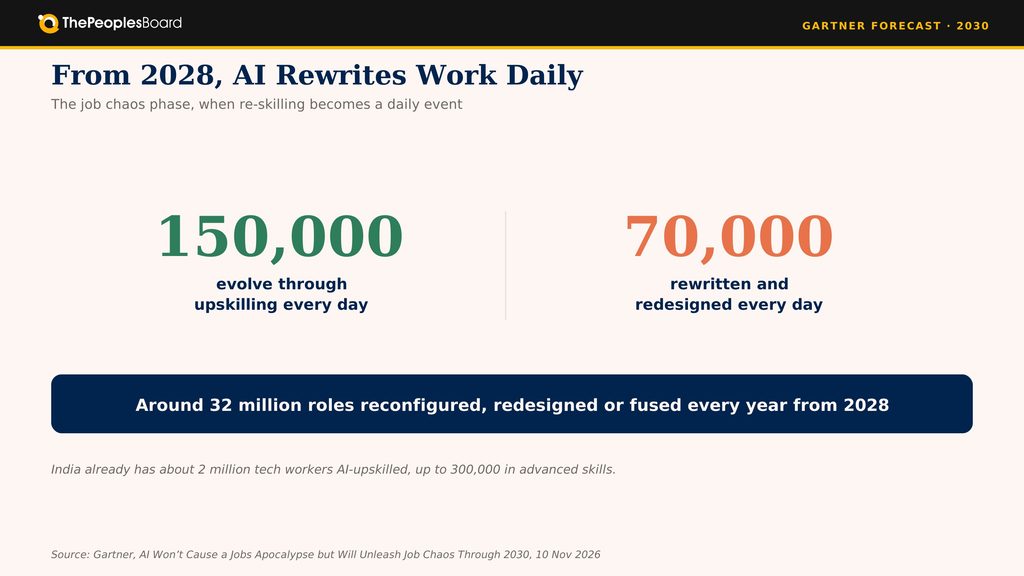
India’s AI-skilled workforce, which grew 14-fold between 2016 and 2023, reframes what “upskilling programme” needs to mean operationally at this pace. Nasscom already reports that over 20 lakh of the country’s 59.5 lakh tech employees have been upskilled in AI, with up to 3 lakh in advanced AI skills, as noted in its FY26 strategic review.
How the India Numbers Compare
Setting Gartner’s global projections against India’s own workforce data gives the forecast weight for HR leaders here. The scale of the Indian tech workforce means even the lower end of Gartner’s exposure bands translates into very large absolute numbers of affected workers.
| Metric | Gartner Global (by 2030) | India Tech Sector (FY26) |
| Tech sector jobs created | 1.9 million | Net 135,000 added in FY26 |
| Tech sector total workforce | Not specified | 5.95 million (Nasscom) |
| AI upskilled workers | Part of 435 million adapting | ~2 million already upskilled |
| Advanced AI skills | Not specified | Up to 300,000 |
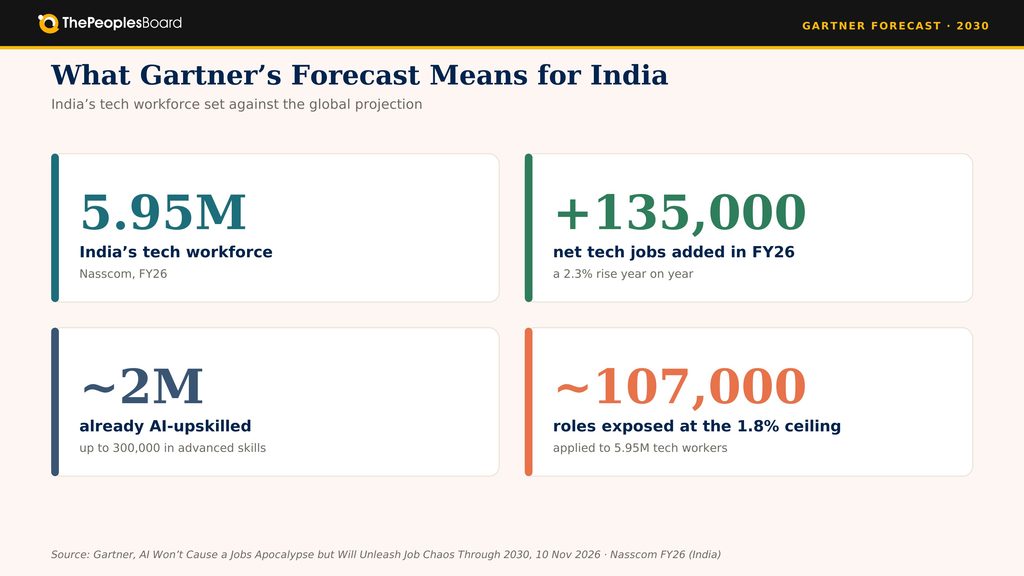
Apply Gartner’s 1.8% tech-sector job-loss ceiling to India’s 5.95 million tech headcount, and the arithmetic points to roughly 107,000 direct roles. NASSCOM’s FY26 net addition of 135,000 jobs, a 2.3% year-on-year rise, suggests the hiring engine is still net-positive but at thin margins, which matches Gartner’s pattern of deferred rather than lost roles. For a deeper read on where India’s workforce readiness sits in this cycle, see our report from the India AI Impact Summit 2026.
In the End…
Gartner’s forecast sets up milestones that CHROs, workforce planners, and TA leads can benchmark against each quarter. Keep these on the dashboard and compare internal workforce data against the global projections as each refresh lands.
- 2026 baseline: 1.3 million deferred hires, 2.2 million jobs lost, 1.6 million created worldwide
- 2028 inflexion: AI shifts into net job creation globally
- 2028 onwards: 150,000 jobs per day evolving through upskilling, 70,000 per day redesigned
- 2030 endpoint: 1.7 million net jobs added, 435 million workers in changed roles, 0.4% to 1.8% direct job-loss range
Map your own workforce’s AI exposure against Gartner’s 0.4% to 1.8% band, log deferred hires separately from attrition, and set a review cadence that catches the next Gartner revision at its Barcelona and London symposia cycles in 2027.