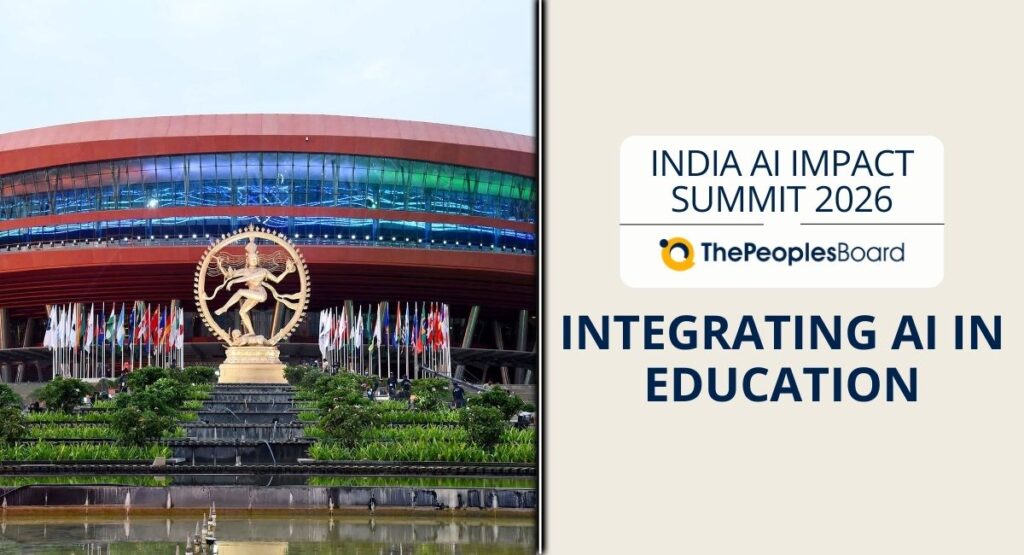
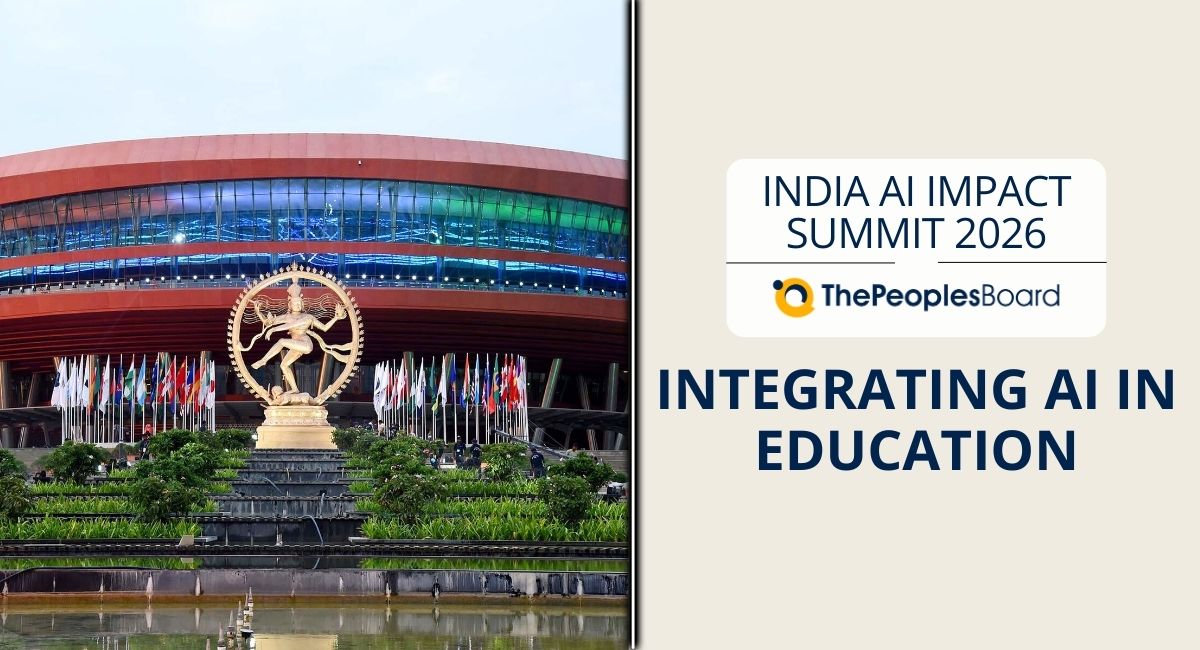

As AI continues to dig deeper into every industry, the need to integrate it into the education system feels real. Thus, there couldn’t be a better way to start discussions at the India AI Impact Summit 2026. On the first day of the summit, the need for including AI in the curriculum was discussed by a panel of Ashish Kulkarni, Manish Kumar, Narayanan Ramaswamy, and Shankar Maruwada.
The session titled AI and the Future of Skilling: Strengthening Human Capital and Transforming Higher Education Institutions explored how learning is the key need of the hour to prepare the future workforce better.
When AI started entering the workforce as an automator, debates poured over social media about the risks of job loss. However, irrespective of every question, it entered well into all the industries
Commenting on the role of the educators in pushing a new idea into the market, Professor MS Vijay Kumar, MIT’s Education Innovation Movement said, “As educators, we don’t predict future, we make it possible for other to realise it.”
Sharing an example, he said that in 1999, MIT decided to venture into the space of distance education, especially for those areas where the institution hadn’t penetrated yet. However, back then, the only way which could have made it possible was to share photos of what MIT was doing. “That’s the art of scaling.”
Further adding to it, Ashish Kulkarni, Indian Institute of Creative Technologies and National Chairman, said that the use of AI has penetrated deep into the entertainment industry also. From script writing to video editing, there isn’t a function in the industry which is not influenced by AI, but according to him, the real challenge is that today, AI isn’t a part of the foundational courses
“Education really has to keep pace with this. You need to know what AI has given as output is correct enough to be put out there for the public,” he added.
According to him, foundational skills are important. He also suggested that for kids to be able to better use AI in the future of storytelling, they need to be taught the grammar of the same 5th or 6th standard onwards
Commenting on the rapidness of change, Ashish Kulkarni said, “Even in higher studies, every curriculum has to be different as what you learn in the first semester isn’t going to be relevant in the final semester.”
Explaining the challenges and also why education needs to ramp up, Manish Kumar, Managing Director & Chief Executive Officer, former MD and CEO of NSDC, said, “Industry has accelerated of late, but at a great speed. So today we are in the era of Industry 4.0, whereas education is still in the 1.0 era. Of course, efforts are being made, including the National Education Policy of India, which is far more forward-looking than its predecessor, and trying to adapt. But I guess one of the challenges that comes is the desire for predictability and the desire for stability within the educational system, and the fear among people about how much change you can really adapt to, so therefore, there is a lack there quite obviously.”
He suggested that it is important to be aware that the industry is moving forward and cannot be stopped. And, with AI, it is really going to gain momentum.
Concluding the session, Shankar Maruwada, Co-founder and CEO of EkStep Foundation, said, “When problems go non-linearly, solutions can’t go linearly. For a vast country like India, you need to build Digital Public Infrastructure (DPI). You can’t train kids for jobs which may not even exist now. But we can always address the several bottlenecks which people from across the country are facing.”
Sharing an example, he said that if one can get pizza around, why can’t he access jobs?
“With AI, the only gap is motivation. But going forward, this will be the norm. We can’t prepare our children. The market will ask for specific skills at a certain time, and then, we can give them basic capabilities. We need to trust that the market will innovate to meet the industrial needs. By finishing that and providing skilling,” he added.