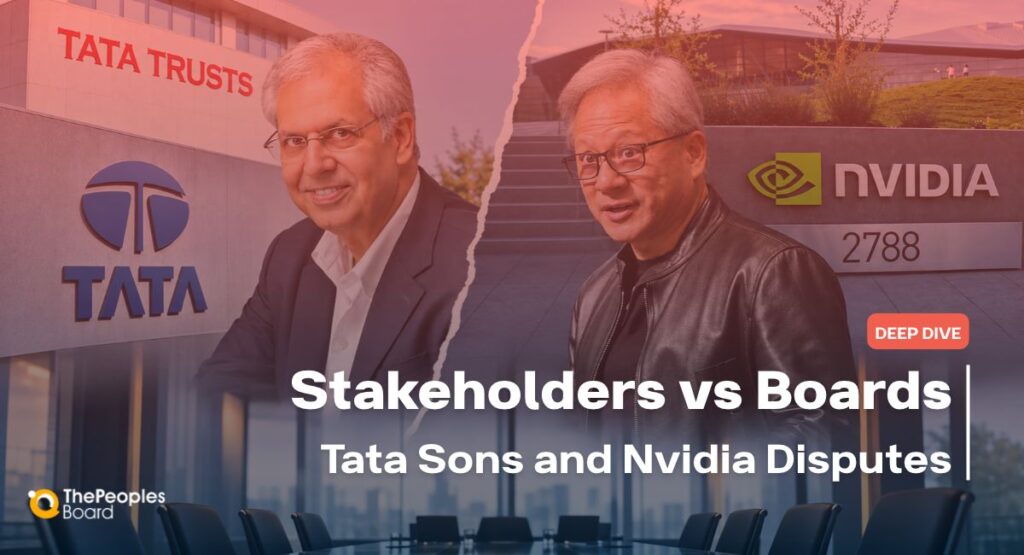

Tata Sons, one of the biggest employers in India, has been embroiled in a leadership crisis for well over a few months. Discussion on just who will sit in as the Chairman of the company has been in the headlines without stop and with good reason.
Halfway across the world, Nvidia’s leadership scandal has been fast but no less impactful. The fallout from CEO Jensen Huang’s alleged affair with Alice Huang led to his resignation and reappointment all within 11 days.
At the core of both cases are disagreements between the company’s stakeholders and its board. While the divide is more obvious in the Tata Sons case, the Nvidia case holds much more nuance, with both political and diplomatic connotations.
For many leaders, the two cases also bring up two interesting questions: How much influence should stakeholders have over leadership decisions? and just where should boards draw the line to protect their independence?
Tata Sons: When a Major Shareholder Challenges the Board
The core issue started in August 2026 when N. Chandrasekaran expressed his desire to step down as Chairman of Tata Sons. With his term scheduled to end February 20, 2027, the board accepted his decision and started planning a handover.
For the handover purpose, a committee was set up to find a successor. However, at the annual general meeting on 18 August, the two main Trusts couldn’t jointly nominate a director. Additionally, the Maharashtra Charity Commissioner barred the Sir Ratan Tata Trust from holding trustee meetings while a case ran before it.
The lack of a clear successor became an issue when the RBI rejected the company’s bid to surrender the NBFC registration. With possible turbulent times in sight, the board met again in September 2026, and a discussion began on the possible reappointment of Chandrasekaran as the Chairman.
Four voted for it. One against. However, that single voter’s identity has put a question mark on the future of the group’s leadership.
The One Very Important Vote
The one vote against Chandrasekaran’s appointment came from Noel Tata.
However, it’s the role that he holds on the board that gives credence to his opposition.
The rules of the Tata Sons board indicate that any consequential decisions, such as appointing a chairman, need the support of a majority of the directors the Trusts have nominated. Noel Tata is one of two directors appointed by Tata Trusts, which holds two-thirds of the stakes in the company.
Venu Srinivasan, the other appointed director, voted for the reappointment. Noel Tata voted against it. The board treated this as a tie can be broken by the casting vote of Harish Manwani, who chaired the meeting.
Tata Trusts did not agree with this decision, claiming that Chandrasekaran’s reappointment is not legal given the lack of a “majority” vote of its appointed directors. Ready to move to the Bombay High Court, Tata Trusts, as of writing, remains adamant in its assertion that a casting vote cannot replace the affirmative votes required for such a crucial decision.
Nvidia: The Leadership Debate in Turmoil
The case surrounding Jensen Huang’s position as the CEO of Nvidia is significantly different and with a different kind of nuance.
On November 12, 2026, headlines announced how Jensen Huang was having an affair with a businesswoman from Singapore called Alice Huang (no relation). Alice Huang was accused of possibly acting as a spy for China and illegally sending China chips worth $7 billion.
Within hours of the scandal breaking, Jensen Huang was also linked with two other women. Not soon after, on November 12, 2026, Jensen Huang submitted his resignation as CEO. However, this was only the start of the story.
Following Huang’s exit, many of the company’s employees expressed a desire to see him back in the CEO role, stating that he had led Nvidia to unimaginable heights and provided more job security than most.
A Controversial Return
On November 17, 2026, Nvidia’s board released a statement in which it asserted that there was no plan to reinstate Huang.
Six days later, Huang was back as CEO, addressing the company and determined to raise morale.
Bear in mind, both Huang and Nvidia are still in the woods when it comes to the possible threats to national security that might have arisen due to Alice Huang’s involvement with the Nvidia CEO.
On December 1, 2026, Jensen Huang is scheduled to appear before three House committees for closed-door interviews. The following day, on December 2, 2026, Tim Teter, Nvidia’s general counsel, will face the three committees as well. Jensen Huang will also appear in front of the US Senate Banking Committee in a public hearing on December 3, 2026.
A Financial Concern
When the Nvidia Scandal first became public, the company’s stock naturally took a hit. Its valuation went lower when Huang announced his resignation. The dip was perhaps the least surprising thing to come out of this scandal, but it certainly would have mattered a lot to the company’s financial investors.
By November 20, 2026, Nvidia’s stocks had fallen approximately 32.7% from their November 6, 2026, closing price.
Huang’s return to the company on November 23, 2026, raised Nvidia’s stocks by an impressive 31.48%, adding about a trillion dollars to the company’s valuation. This was then followed by a dip and, as of writing, the company’s stock value is still about 20% lower than its November 6, 2026, valuation.
Notably, one of the investors in Nvidia is the US President Donald Trump, though the White House maintains that the President’s financial portfolio is managed by third party investors. Additionally, Nvidia and Jensen Huang have been one of the key pieces in the AI economy that Donald Trump has been advocating for some time.
The US President has been a vocal supporter of Huang since the news of the affairs hit the headlines. That said, Huang rejected the idea that Trump was the sole reason behind his return during a meeting on November 24, 2026.
What Do These Cases Reveal About Corporate Governance?
The Tata Sons and Nvidia cases have raised many questions about how corporate governance works. What makes these cases even more interesting is just how big the two companies are. With thousands of employees under their banner, any changes at the top level will not only impact thousands but will likely shake up the economies of their respective countries as well.
Shareholder Interests
Tata Sons demonstrates how major shareholders can challenge board decisions through their ownership rights. Nvidia raises questions about how financially and or politically interested stakeholders can influence leadership discussions outside formal board structures.
Like any business, even big names like Tata and Nvidia are answerable to those who back them financially. Their boards may be more independent than most when it comes to a company’s operations, but for the big decisions, stakeholders remain crucial.
Board Independence
According to many, boards need the freedom to make leadership decisions based on the company’s long-term interests, without undue pressure from shareholders or other influential stakeholders. However, as seen in both cases, financial investors often become involved in key decisions during turbulent times if the company’s valuation or operations might seem in jeopardy.
Leadership Continuity
Both cases highlight the importance of defined decision-making processes, succession planning and contingency arrangements when leadership transitions become contentious. The lack of succession planning was one of the key reasons why Tata Sons considered the reappointment of Chandrasekaran was their inability to select a clear successor in August 2026.
Even when a company feels secure in its existing leadership structure, being prepared for contingencies can help in navigating turbulent times.
Transparency
Boards must be able to explain how and why major leadership decisions are made. Clear communication can help prevent uncertainty among investors, employees and other stakeholders.
Especially in the case of the Tata Sons case, the dilemma surrounding the reappointment is about the ambiguity of the casting vote. Without proper transparency and discussions, boardroom discussions can indeed escalate to courtroom debates.
In the End…
So, who should wield more power in case of such important discussions? Like both the highlighted cases, the answer is full of nuances.
Both the board and the stakeholders have a genuine interest in seeing the company succeed. However, without clear governance in place, the idea of what the path to success looks like can differ.
Consider the Nvidia case, where the hasty reappointment has raised more than one eyebrow, especially with the actual culpability of both the company and CEO still in murky waters. As for Tata Sons, many remain split on what side to take simply because of ambiguous wordings.
Effective corporate governance requires a balance between stakeholder accountability and independent board decision-making. To mitigate situations where the two might be in conflict, it should be clear beforehand just how much power each party can wield and in which situations.
FAQs
What triggered the Tata Sons leadership dispute?
N. Chandrasekaran expressed his intent to step down in August 2026, but the search committee couldn’t find a successor, partly because the two main Trusts couldn’t jointly nominate a director. When the RBI rejected Tata Sons’ bid to surrender its NBFC registration, the board moved to reappoint him instead.
Why is the vote on Chandrasekaran’s reappointment contested?
Tata Sons’ rules require major decisions like a Chairman appointment to have majority support from directors nominated by Tata Trusts. The two Trust-nominated directors split (Venu Srinivasan for, Noel Tata against), and the board used a casting vote to break the tie. Tata Trusts argues a casting vote can’t substitute for the required majority.
What happened in the Nvidia case?
CEO Jensen Huang resigned on November 12, 2026, after allegations of an affair with Alice Huang, who was accused of acting as a spy for China. Despite the board stating on November 17 it had no plans to reinstate him, Huang was back as CEO by November 23.
How did markets and politics shape Nvidia’s reversal?
Nvidia’s stock fell about 32.7% between November 6 and November 20, then jumped 31.48% on Huang’s return, adding roughly a trillion dollars in valuation. US President Donald Trump, a vocal supporter and an Nvidia investor through third-party-managed funds, publicly backed Huang throughout, though Huang denied Trump was the sole reason for his return.
What do both cases reveal about corporate governance?
They expose the tension between stakeholder influence and board independence. Clear rules on shareholder voting rights, succession planning, and transparency around decision-making processes are what prevent boardroom disputes from escalating into courtroom battles or market shocks.