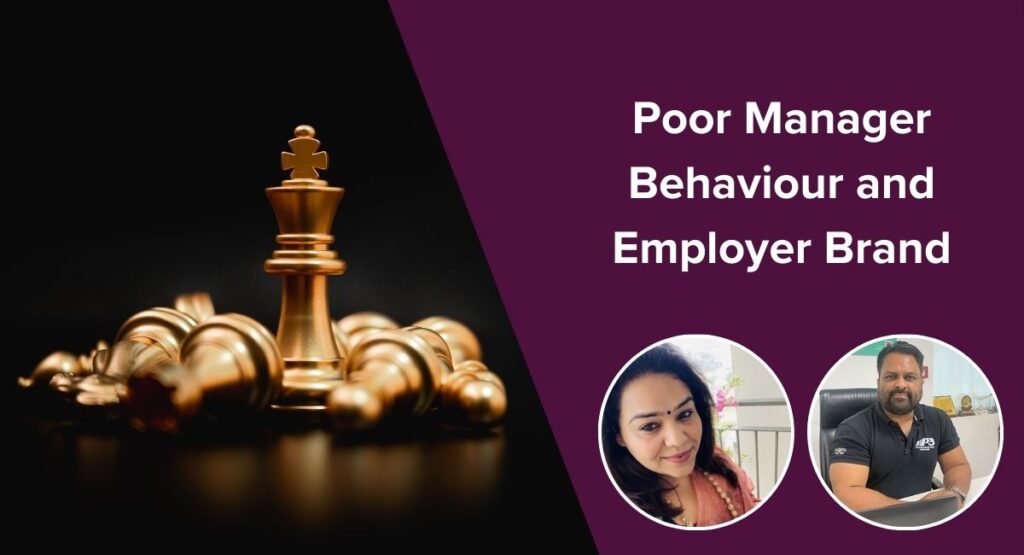


Anyone who has worked in the corporate world for more than a few days will tell you one thing: the employer brand in their mind is shaped more by everyday experiences than big sweeping gestures.
Among all team members who leave an impact on employees, managers play the most crucial role in shaping perceptions. How they manage their team and expectations is reflected in interactions between colleagues, making manager behaviour a critical part of the employer brand.
As such, when a manager behaves poorly, the damage it causes builds quietly but compounds over time. A manager’s one-time mistake may have little or no impact on employees’ perceptions. But when it becomes a pattern, such behaviour, combined with what the leadership does about it, says more about a company than any company policy or promises.
Why Managers Matter More Than Policies
No matter how idealistic policies on paper are, an employee’s true experience in the workplace is determined by their everyday experience. Managers play a critical role in translating the intended company culture into reality.
However, when translation fails due to poor managerial behaviour, it can have a direct impact on factors such as engagement, retention, and advocacy.
“It’s an old saying, people don’t leave organisations, they leave bad managers, and that’s the crux of employee longevity and engagement,” Pooja Bhaita, Human Resources Business Consultant, Trainer & Mentor, explains.
Pooja elaborated how “the key ingredient is learning from a manager and self-progression. When that is missing, the employee gets demoralised and unproductive.”
Indeed, when poor managerial behaviour persists, employees begin to feel disenchanted with the company’s promised policies and culture. Their trust declines along with their psychological safety and overall morale.
What Poor Manager Behaviour Looks Like (Often Normalised)
Most of the poor managerial traits that count as “silent costs” to the overall employer brand are often actions that might seem small in the broader scheme of things. This often leads to such behaviour being normalised, at the cost of employee experience and employer brand.
Some of the most common normalised managerial traits that shouldn’t be accepted include:
Favouritism
Within an office, favouritism does not mean that a manager is not allowed to feel partial towards one person over another. However, when it starts to impact their decision-making, that is when favouritism rears its ugly head.
Shubhankar Malakar, Head of HR (Bhiwadi Campus) at Tenneco, said that a company/team may be plagued with favouritism when “most of the promotions/ increments/ transfers are happening on a relation-based basis and likely not based on merit and performance data.”
Talking about signs of poor manager behaviour, Shubhankar emphasised that favouritism becomes persistent when “managers are more focused on their personal goals rather than company goals.”
Micromanagement and Inconsistency
Any employee might start to feel exhausted when they feel as if their every action is being scrutinised. The actions might start as a way to enhance team supervision, but when they begin to interfere with an employee’s basic decision-making, they become micromanagement.
On the other hand, employees can also feel frustrated when they think their managers are inconsistent in their decision-making. Changing details based on their thought process and expecting employees to follow along can severely undermine morale.
Communication Barriers
From being unempathetic to an employee’s concerns to publicly criticising them, when managers do not take care in choosing their words or in how they say it, employees can feel immensely disrespected and undervalued.
Despite a mismatch in thought, managers should understand that their position entails a certain level of recognition and responsibility. Rather than dismissing such actions as an extension of a manager’s “management style,” impress the importance of empathetic communication and constructive criticism.
Holistic View/ Helicopter View
How a manager looks at the work pattern and the generated output can heavily impact their management style. According to Shubhankar, “the manager should look at the organisation from the top so that they can see every detail on the micro level to take concrete actions.”
“For example,” Shubhankar elaborates, “if a team mate resigns every year before the annual increment cycle, and we are giving additional increments to retain him, instead of taking proactive action on succession planning, it creates negative branding of the organisation. This creates a culture where anybody can get a super increment after resignation and not by pay for performance.”
Ignoring Employee Capacity
When a manager chases deadlines and outputs over employee well-being, team cohesiveness declines rapidly. While results are important, they should not come at the cost of an employee’s mental health, physical limits, and emotional boundaries.
As such, ignoring burnout, overworking teams, and unclear expectations might seem like a “can-do” attitude, but it is not sustainable in the long run for both the employee and the company.
The Ripple Effect on Employer Brand
When poor managerial behaviours persist, internal dissatisfaction becomes external reputation damage. Especially in this day and age, where one can share their thoughts with the touch of their fingers, employee reviews, word-of-mouth, and social media narratives carry a lot of weight that can easily make or break a brand.
“The people are brand ambassadors of any organisation. Toxic managers lead to bad work cultures, and this leads to a negative image for the organisation,” Pooja highlighted.
In fact, a negative brand image that points to poor managerial behaviour can affect candidate perceptions even before the interview stage.
Pooja explains this phenomenon through an example in which “a candidate looking at job opportunities may refrain from applying or taking up opportunities with the company based on the manager that he/she may work with in future.”
The Talent and Business Cost
Having talked about how poor managerial behaviour can impact an employer brand negatively, one must also understand why and how this impacts a company. Due to a negative perception of the company, both the talent pool and business outcomes can face a downward trajectory.
The Talent Factor
The first impacts of poor managerial behaviour and an employer brand become visible in a company’s talent pipeline. Both existing and potential employees start to feel disenchanted, and the ripples from this begin to affect other business verticals.
- Higher attrition and replacement costs: Poor managerial behaviour not only increases employee exits but also makes it harder to convert potential candidates into new joiners.
- Shrinking quality of applicant pools: When a company gains an image of tolerating poor managerial behaviour, many candidates hesitate in even taking the first step, which is to apply for a job. This gives recruiters a much smaller talent pool to explore.
- Candidates opting out mid-stage: Some candidates might indeed start participating in the hiring process. However, midway through, seeing a bad image of the company online can make them step back, leading to wasted resources and efforts.
The Business Angle
Slowly but surely, managerial issues and poor employer brand can start impacting the company’s overall performance. As a direct result of workforce changes, performance can decline, leading to financial losses.
- Loss of high performers and future leaders: With increased attrition, the company loses high performers who do not align with existing workplace practices. This can have a severe impact on the company’s succession planning initiatives.
- Reduced innovation and collaboration: Not only does poor managerial behaviour lead to the loss of talent, but it also discourages employees from voicing ideas they believe might not be accepted by their managers.
- Increased management load: Due to an increase in workplace relationship issues and public relations crises, departments like HR, legal, and PR end up working more than necessary.
- Impact on customer experience and brand credibility: When a company loses its face as an employer, it also creates a negative impression on existing and potential customers. Despite the differences in their definitions, a company’s employer brand and business reputation often go hand in hand.
Why Organisations Often Miss the Warning Signs
Given the severe impact that poor managerial behaviour can have on the workforce, employer brand, and overall reputation, one might wonder why such traits still persist in companies.
Shubhankar points out that if “top management is too busy to achieve short-term business results, they tend to give more focus on business and operation, which can affect a quarter’s business results if an employee leaves.”
An over-reliance on engagement scores without context and a lack of upward feedback and psychological safety can also lead poor managerial traits to slip under the radar. When a company starts to evaluate a manager’s performance by output and not people impact, the leadership might miss out on details that truly matter.
Additionally, as per Shubhankar, “fast change of global vision and objective, and sometimes ambiguous and untransparent plans, cause fast replacement of top leadership, consequently less focus on regional/local decisions.” This can ultimately lead to the middle management remaining unchecked on a consistent basis.
Rebuilding Employer Brand
When faced with employer brand setbacks owing to poor manager behaviour, the very first step should indeed be to address the core issue, rather than focusing solely on public damage control. This can be done by:
- Setting clear expectations for people leadership
- Embedding manager capability into employer brand strategy
- Using 360-degree feedback and skip-level conversations
- Holding managers accountable through performance and rewards
Even the smallest of these steps shows the employees that their managers also have certain standards to maintain. It is also imperative to provide a safe space for employees to voice their opinions about their leaders, no matter how controversial.
HR and leadership, in particular, have a significant role to play in ensuring that employees are provided the positive culture they were promised. Rather than just following the letter of the policies, keep their spirit values in mind to foster a positive environment.
Provide managers with coaching, feedback, and empathy skills to help them keep up with evolving workplace expectations. The leadership also needs to act as an example by modelling the respectful and transparent behaviour that they want their managers to exhibit.
In the End…
Companies need to understand that fixing manager behaviour is not just a soft issue. It is an imperative brand investment that should be treated similarly to any other financial investment. After all, a manager’s behaviour can echo through the company, impacting employees, performance, and results alike.
Through due vigilance, policy enforcement, and consistent feedback systems, companies can gain a long-term advantage by building a cohesive team based on true respect and open communication.
Even the most grand marketing initiatives and cultural policies cannot change the entrenched management problems unless the company’s leadership and HR crack down on poor managerial practices. Showcasing that your company is willing to rectify its mistakes and holds everyone accountable, no matter their designation, can resolve the cracks in your employer brand far better than any other public promises.