
Change management is one of those phrases that gets tossed around in boardrooms and strategy decks with remarkable ease. Every transformation memo promises a structured rollout, and every town hall reassures employees that leadership is committed to the journey. Yet walk into most Indian organisations six months in, and the picture rarely matches the promise. Teams are confused, middle managers are exhausted, and the change itself has quietly slipped off the priority list.
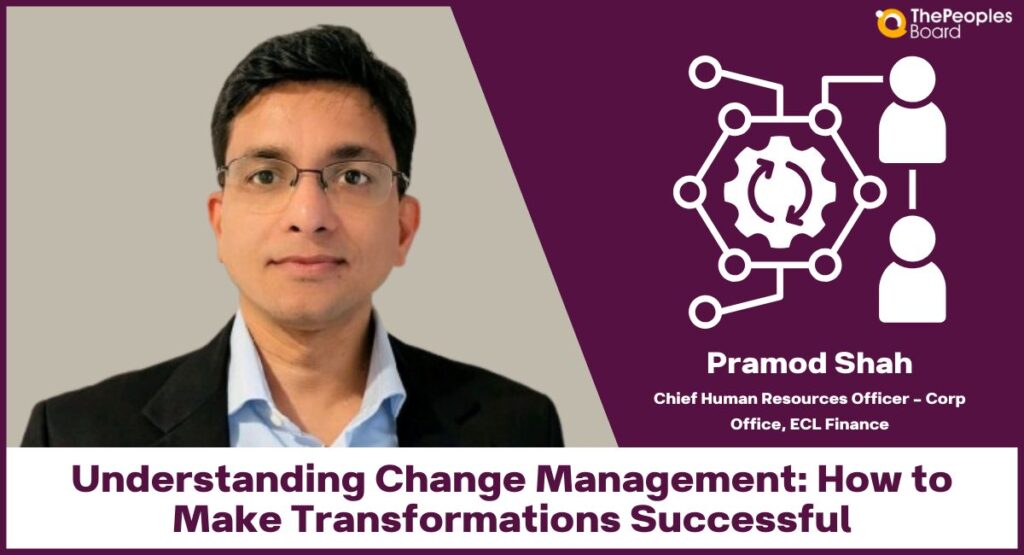
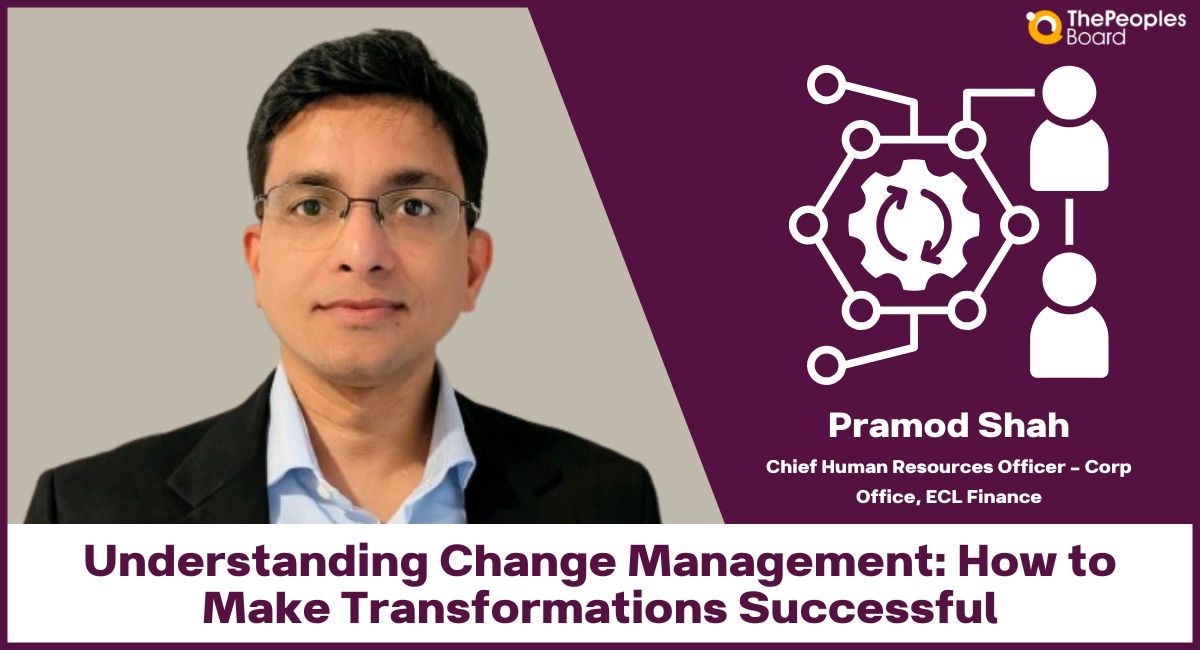
To understand why so many transformations falter, we spoke with Pramod Shah, Chief Human Resources Officer – Corp Office at ECL Finance, with deep experience across IT services and BFSI. From revisiting Lewin’s classic unfreeze-change-refreeze model to calling out the “frozen middle” that quietly derails well-intentioned programmes, Pramod unpacks what truly separates successful change management from theatre, with candour rooted in Indian workplace realities.
TPB Team: Change management is often discussed but rarely done well. From your experience, what does truly successful change management look like?
Pramod: Change management becomes a strategy exercise and mostly stays within the walls of the Boardroom. Successful change management needs inclusion of Junior, Mid and Senior Management throughout the cycle. It is only the equality and clear division of work that makes change management move from the boardroom to the floor. The role of a mid-management is most critical.
TPB Team: You’ve worked across IT services and the BFSI sector. How has your understanding of change management evolved across these sectors
Pramod: Change management as a process remains the same; however, nuances such as dependency on external markets are slightly higher in IT versus BFSI. Pace of change is much faster in IT vs BFSI; however, the compliance focus in BFSI makes it difficult for BFSI to make change successful. I find IT services have more autonomy vs a very well-regulated BFSI.
TPB Team: What does “change readiness” mean to you, and how do you assess whether an organisation is truly ready before you begin?
Pramod: Change readiness is like having a blueprint before the execution. Readiness can only be measured by how committed all stakeholders are to the outcomes that change might bring. It is not so much about whether one wants to make a change; it’s about how keen you are to see the outcomes.
TPB Team: When an organisation is about to undergo a major transformation, what are the first three things a change leader must do?
Pramod: 1. Measure its impact over the short and long term
2. Talent mapping (whether to have an in-house team vs an external org dev exercise) and
3. Culture readiness of the org (openness to challenge the status quo)
TPB Team: What role should leadership play during a transformation, and where do leaders most commonly fail their people during change?
Pramod: Leadership plays a very critical role as they are expected to strategise and also monitor execution. Their beliefs and values have to be aligned with the organisation. I have seen many leaders not open to talk about what the change project is. It’s like stating compensation is confidential, but it never is. So it’s important to know that what one is trying to hide, at times, people are sceptical about the intentions. Openness to share vision and putting accountability on everyone makes change successful.
TPB Team: What are some key steps to follow for an effective change management process?
Pramod: It takes me back to the most basic but most effective change management theory of Lewin. Unfreeze, change and refreeze. I have seen every change management falling in these 3 steps. Mostly, Refreeze being ignored the most.
TPB Team: Resistance to change is inevitable. How do you distinguish between resistance that signals a genuine problem with the change, and resistance that’s simply fear of the unfamiliar?
Pramod: It is a combination of a lot of aspects related to fear. Resistance to a genuine problem can be sorted by logic and objectives. It can be addressed through vision and mission. Resistance to unfamiliar needs more of an assurance and is psychological. Well-oiled communication can help them accept it.
TPB Team: Middle management is often called the “frozen middle” in change programmes; supportive in meetings but resistant in practice. How do you address that?
Pramod: Absolutely agree with this view. Because it is viewed as lose-lose and never a win-win if it is not handled well. They carry a responsibility of giving a construct to the vision. They face heat from both directions and hence, should be part of the core team and leaders who need more visibility.
TPB Team: What’s the single biggest reason change initiatives lose momentum midway, and how do you prevent it?
Pramod: It’s similar to enrolling for a gym membership. Lots of enthusiasm at the beginning, but falls because it’s not a habit, but a visual performance. It’s only when muscles start to pain, and the mind starts giving up, that true commitment gets tested. Momentum needs fuel of commitment and rigour.
TPB Team: Indian organisations often have deeply ingrained hierarchies and legacy cultures. How does that shape the way you approach change management differently here compared to, say, a global MNC context? Any examples?
Pramod: MNCs bring a lot of wealth of experience in managing various cultures. Culture plays a critical role in change management. Indian org tries to separate each level (sr., mid, and junior) and that opens up cracks amongst all. Flat structures have always worked.
TPB Team: What’s one change initiative from your career that didn’t go as planned, and what did it teach you about the process?
Pramod: I was a bio student, and I wanted to do a PhD in bio. I realised that I didn’t keep my plan B ready. It didn’t go as per plan, and I had to change my profession completely. It taught me to keep Plan B handy at all points in time for everything.
TPB Team: For HR leaders in India who are stepping into a change management role for the first time, what’s the most important thing you’d want them to know?
Pramod: Begin with the end in mind. Have Plan A and B handy at all points in time. Embrace the grey. Change management will never be black and white.
Change, as Pramod reminds us, is rarely black and white, and pretending otherwise is where most organisations go wrong. It is not a slide in a boardroom deck; it is a messy, human process that demands openness, accountability, and the humility to admit when Plan A isn’t working.
The fundamentals remain the same across sectors: include your people, trust your middle managers, communicate with intent, and never ignore the refreeze. For HR leaders stepping into this space, the brief is simple but not easy: begin with the end in mind, keep Plan B handy, and learn to embrace the grey.