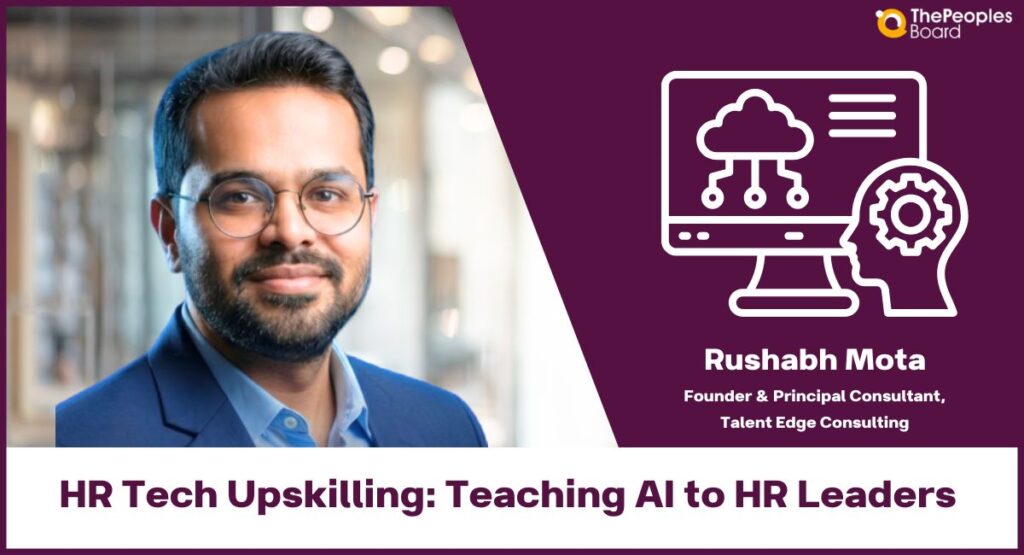
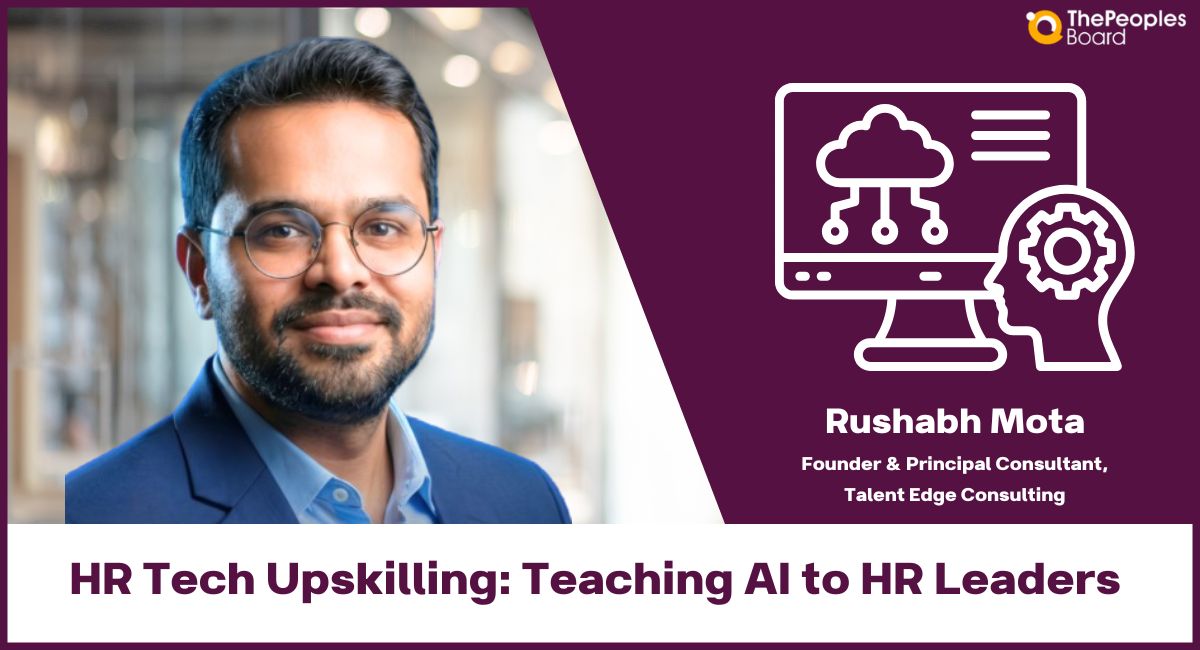

Most HR leaders in India can tell you what artificial intelligence is. Far fewer can show you what they actually did with it last week. That gap, between awareness and practice, is where Rushabh Mota spends most of his working hours. As Founder and Principal Consultant of Talent Edge Consulting, alongside a range of freelance advisory roles, he helps organisations across pharma, FMCG, engineering, and retail GCCs move past the webinar-and-LinkedIn-bio stage of AI adoption and into real workflow change.
His view is refreshingly direct. AI in HR isn’t a technology problem to be handed off to IT, he argues, but a process design problem that happens to use technology, and the people who understand HR processes best are HR leaders themselves. In this conversation, Mota unpacks what AI literacy actually means for an HR leader, why upskilling programmes so often stall, how adoption differs across industries, and the single most useful experiment any HR professional can run this week.
TPB Team: You work closely with organisations on HR technology advisory. How AI-ready are most HR leaders in India today?
Rushabh: Honest answer: Most are not ready, but most are also not as far behind as they think.
What I see across my clients—across pharma, FMCG, engineering, and retail GCC—is a split. There’s a small group of HR leaders who are genuinely experimenting. They’re building agents, testing tools in their workflows, and asking sharp questions. Then there’s a much larger group that has attended a webinar, added “AI enthusiast” to their LinkedIn bio, and done nothing else.
The gap isn’t knowledge. It’s practice. Most HR leaders in India can tell you what AI is. Very few can show you what they did with it in the last few weeks.
That said, I’m more optimistic than I was 18 months ago. The questions being asked have gotten better. We’ve moved from “will AI replace HR?” to “which of my processes should I start with?” That’s progress.
TPB Team: Why should HR leaders learn about AI when there is already an IT team to handle it?
Rushabh: Because IT will build you what you ask for. They will not know what to ask for on your behalf.
This is the mistake I see repeatedly. HR outsources the thinking to IT, IT deploys a tool, and six months later, no one is using it because it doesn’t map to how HR actually works. No one asked the right questions at the design stage. That’s not an IT failure. That’s an HR failure.
AI in HR isn’t a technology problem. It’s a process design problem that happens to use technology. The people who understand HR processes are HR leaders. They need to be in the room — not as approvers, but as co-designers.
Also, if you’re not AI-literate, you can’t evaluate what’s being built for you. You can’t push back. You can’t ask the right questions. You become dependent. And dependency, in a function that’s trying to earn strategic credibility, is a problem.
TPB Team: What is the biggest misconception HR professionals have about AI when they first encounter it?
Rushabh: That it needs to be perfect before it’s useful.
HR professionals are trained for precision—job descriptions, policies, and legal compliance. That instinct is valuable. But it leads people to reject AI tools the moment they produce one wrong answer, one awkward sentence, one output that needs editing.
The right mental model isn’t “AI does the job.” It’s “AI does a draft, and I improve it.” If editing a draft takes you 10 minutes instead of writing from scratch, taking 45, that’s a win—even if the draft needed work.
The second misconception, which I see more among senior HR leaders: that AI is an employee tool and not a leadership tool. I’ve worked with CHROs who are enthusiastically deploying AI for their teams while personally never using it. That creates a credibility problem and a blind spot. You can’t lead what you haven’t experienced.
TPB Team: Where do most companies go wrong when they try to upskill their HR teams on AI?
Rushabh: Three places, consistently.
They start with tools instead of use cases. They show people a demo of ChatGPT or Copilot and call it training. People leave impressed but with no idea what to do on Monday morning. Training needs to start with the work—specific, real HR tasks—and then show how AI fits into that work.
They treat it as a one-time event. A half-day workshop and a certificate, done. AI literacy isn’t a training moment. It’s a practice that needs to be built into how the team works week over week. The companies getting real adoption are the ones building small habits—a prompt library, a shared use case log, and 15 minutes of experimentation in team meetings.
And they ignore the managers. Individual contributors pick up tools fast when they’re curious. But if the manager doesn’t use AI, doesn’t ask about it, doesn’t reward experimentation, the curiosity dies. Upskilling programs that skip the manager layer almost always stall.
TPB Team: Is there a difference in how HR leaders across industries approach AI adoption? What have you observed?
Rushabh: Yes, and it’s more pronounced than I expected.
Tech and SaaS HR teams move fast. They’re already in an AI-native environment culturally. They try things, they break things, they iterate. Governance comes later, sometimes too late—but they’re moving.
FMCG and pharma are more methodical. There’s more concern about compliance, data privacy, and what happens if something goes wrong. These aren’t unreasonable concerns. But they can become excuses for inaction if they’re not managed carefully.
Manufacturing and engineering construction are the most interesting cases. On paper, these sectors look like laggards. In practice, some of the most creative AI-in-HR work I’ve seen has come from ops-heavy organisations where the pressure to do more with less is most acute. Necessity, in this case, is pushing adoption faster than enthusiasm.
The one consistent variable across all industries: if the CHRO is personally curious and hands-on, the organisation moves. If the CHRO delegates AI to a subordinate and waits for a report, it stalls.
TPB Team: What does AI literacy actually mean for an HR leader, and where should they start?
Rushabh: AI literacy for an HR leader means three things. Understanding what AI can and can’t do reliably. Knowing how to describe your problem to an AI tool well enough to get useful output. And being able to evaluate the output critically rather than accepting it at face value.
That’s it. You don’t need to understand large language models. You don’t need to code. You need to be a sharp enough user to tell good output from bad output, and to know when AI is confidently wrong.
Where to start: pick one task you do weekly that involves writing or summarising. Draft a job description. Summarise a survey report. Write a performance improvement plan template. Do it with AI once. See what it produces. Edit it. Track how long it took versus your usual approach.
That single experiment, done honestly, teaches more than most AI workshops.
TPB Team: Can you walk us through what a practical AI upskilling program for an HR team looks like?
Rushabh: What I’ve built and deployed for clients looks roughly like this:
Start with a diagnostic. What are the 10 highest-effort, lowest-judgment tasks in this HR team’s week? That’s your use case list. Don’t guess — map actual work.
Then run a short, sharp immersion. Not a full day. Three to four hours, hands-on, using real tasks from that use case list. No slides about the history of AI. Just this: Here’s the problem, here’s how you’d prompt for it, here’s what came back, here’s how to improve it. Repeat.
Follow that with a 30-day sprint. Each week, the team tries one use case in their actual work. Not a simulation. Real work. Someone documents what worked and what didn’t. That becomes the team’s prompt library.
At week 6 or 8, a review. What’s being used consistently? What was tried once and abandoned? Why? That conversation reveals more about organisational readiness than any survey.
The whole thing takes two months. It’s not glamorous. It works.
TPB Team: How do you make AI training feel relevant and non-threatening to HR professionals who are not naturally tech-oriented?
Rushabh: You stop calling it AI training.
When I frame a session as “AI training,” people come in defensively. They’re expecting to feel lost, to be judged for not knowing things, to sit through jargon. Half the anxiety is in the framing.
When I frame the same session as “let’s look at how you spend your time and see if we can reclaim some of it,” the room is completely different. People lean in. Everyone has a task they hate doing. Everyone has work they’re behind on.
The other thing that matters: start with a quick win. In the first 20 minutes, get everyone to produce something useful — a draft, a framework, a summary — using AI. Something they would have spent an hour on. When a 52-year-old HR business partner who swore she wasn’t “good with tech” produces a solid interview guide in 8 minutes, her relationship with AI changes in that moment. Permanently.
The threat narrative fades when people feel capable. The sequence matters: experience first, theory second.
TPB Team: Can AI adoption within the HR function happen without the CHRO or HR head actively driving it?
Rushabh: It can start without them. It cannot scale without them.
I’ve seen smart, motivated HR professionals build real AI workflows quietly, under the radar. They automate their own work. They share prompts with curious colleagues. They create small pockets of adoption. That’s valuable, and I encourage it.
But when it hits the team boundary — when it requires budget, policy change, system access, or visibility — it stops. Every time. Without senior sponsorship, AI adoption in HR stays a personal productivity hack. It never becomes an organisational capability.
The CHRO doesn’t need to be the most technically capable person in the room. They need to be visibly curious, they need to ask for it in team meetings, and they need to protect the people who are experimenting from the organisational immune response that will inevitably try to shut down anything that changes the status quo.
That’s the role. It’s not technical. It’s cultural.
TPB Team: Which HR processes — hiring, performance, or learning — should HR leaders focus on first when starting their AI journey?
Rushabh: Start where the volume is highest, and the stakes for error are lowest.
For most HR teams, that’s content generation: job descriptions, communication templates, policy drafts, training material outlines. These are high-effort and time-consuming, and a wrong AI output has low consequences—you edit it before it goes anywhere.
Recruitment screening is a good use case. High volume, consistent criteria, and a clear feedback loop on quality. AI can dramatically reduce the time from application to shortlist. But this one needs governance thinking upfront—structured criteria, bias checks, and clear human decision points. This is provided you don’t have a good ATS.
Performance management is where most people want to start because it’s top-of-mind. I’d argue it’s actually where you should go third, once your team has developed some AI judgment. Performance is high stakes, emotionally sensitive, and legally consequential. Using AI there without having built the ability to critically evaluate AI output is a risk.
The sequence: generate, then screen, then evaluate. Build the muscle gradually.
TPB Team: How do you measure whether an AI upskilling initiative has actually worked?
Rushabh: I look at three things. Not by training completion rates. Not by satisfaction scores. Not by the number of people who attended the workshop.
Tool usage after 60 days. Is AI still showing up in how people work, or did it disappear after week two? Adoption data — even informal self-reported data — tells you more than any post-training survey.
Task-level time savings. Pick three tasks from your use case list and measure before and after. Not anecdotally—actually track it for a few weeks. If there’s no measurable change in how long those tasks take, the training didn’t stick.
The quality of questions being asked. This is harder to measure but easy to observe. When the conversation in team meetings shifts from “Should we use AI?” to “How do we handle AI output that’s inconsistent across managers?”— that’s a sign that people are past the surface level. That’s real literacy.
TPB Team: Many HR leaders worry AI will replace parts of their role. How do you address that fear?
Rushabh: I don’t dismiss it. Some parts of HR roles will be automated. Pretending otherwise isn’t reassuring — it’s dishonest, and HR leaders can tell.
What I tell them: the parts of your role most at risk are the parts that were never your strongest contribution anyway. Form-filling, report generation, scheduling, first-level policy queries — these will be automated, and most HR professionals privately admit they don’t love doing them.
What isn’t going anywhere: judgment in complex situations, trust relationships with business leaders, the ability to read an organisation’s culture and name what’s actually going wrong, and the capacity to design interventions that fit a specific context. AI is remarkably bad at all of these.
The real risk isn’t AI replacing you. The real risk is being replaced by someone who uses AI well. That’s a different problem, and it has a different solution: build the capability now, while there’s still runway.
Anxiety is a reasonable response to uncertainty. But it’s not a strategy.
TPB Team: What is one thing every HR leader should do in the next six months to move forward on AI readiness?
Rushabh: Pick one HR process. One. Redesign it with AI as a component — not as the whole solution, but as a step in the workflow. Actually deploy it. Learn from what breaks.
Not a pilot. Not a proof of concept. Not a working group. Something that goes live and touches real work.
The organisations that will be ahead in three years aren’t the ones that ran the most workshops. They’re the ones that built the most reps — small experiments, quickly executed, honestly evaluated, and iterated on.
Six months is enough time to do that meaningfully if you start this week. It’s also exactly enough time to have very productive planning conversations that produce nothing.
The choice is fairly straightforward.
What comes through across the conversation is a consistent rejection of theatre in favour of practice. Rushabh’s prescription isn’t more workshops or another certificate on the wall, but small, honest experiments built into the rhythm of real work, protected and modelled by a CHRO who is visibly curious rather than quietly delegating. His warning is equally blunt: the risk isn’t AI replacing HR professionals, but HR professionals being replaced by peers who use AI well.
For HR leaders weighing where to begin, Rushabh’s closing challenge is hard to argue with. Pick one process, redesign it with AI as a step, and put it into live use, because six months is enough time to build something meaningful or enough time to plan endlessly and produce nothing.