
Somewhere between the 200th and the 800th employee, almost every fast-scaling Indian company runs into the same quiet realisation. The HR setup that helped the founders hire the first hundred people, fix culture issues over a coffee, and write policies on the fly has started to creak. Hiring quality varies across teams; managers interpret the same value differently; employees in one business unit get a very different experience from those in another; and the HR team spends most of its day putting out fires it did not start. Nothing has broken dramatically. Things just feel heavier than they should.
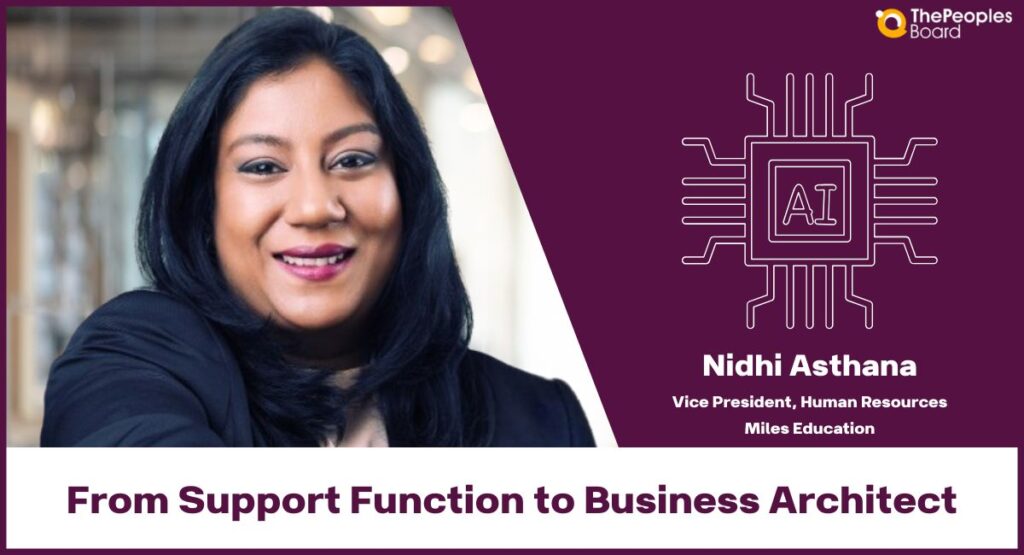
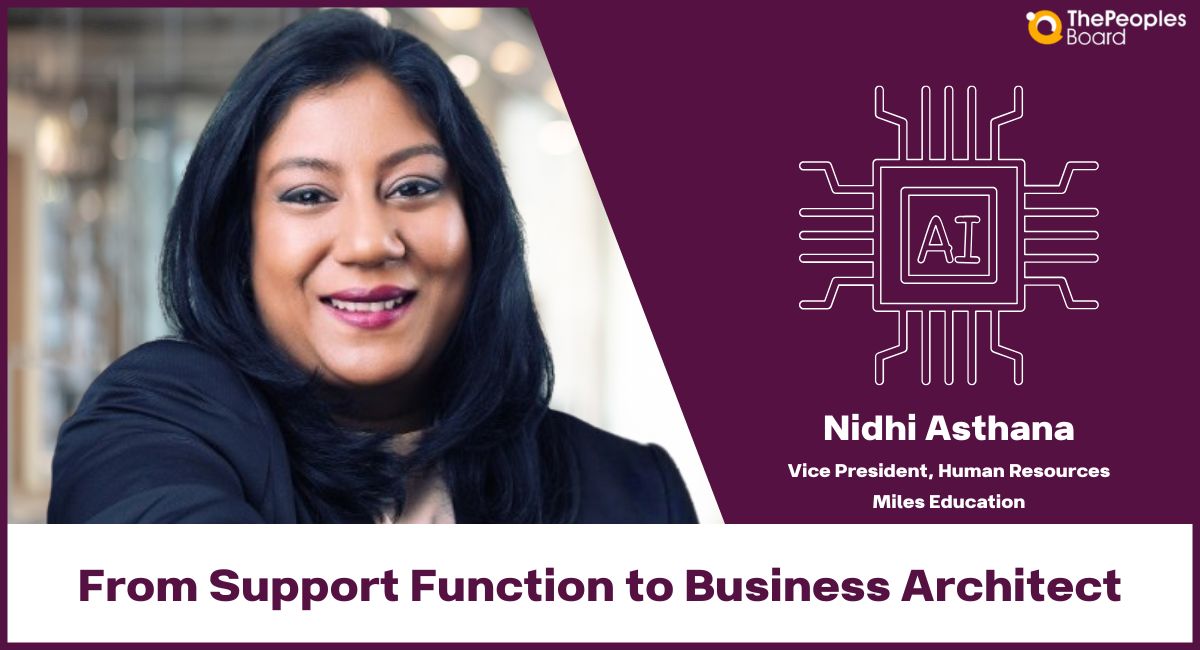
In this written interview, Nidhi Asthana, Vice President Human Resources for Miles Education, unpacks what that moment really signals, and why the answer is rarely “hire more HR people.” She makes the case for HR as a business architect, a function that designs how a company grows rather than one that simply reacts to growth.
TPB Team: What does the phrase “HR as a business architect” actually mean to you?
Nidhi: To me, “HR as a business architect” means HR is no longer just enabling the business — it is actively shaping how the business grows, scales, and sustains itself.
Traditionally, HR was seen as a support function focused on hiring, policies, compliance, and employee management. While those fundamentals remain important, today’s business environment demands something far more strategic. Modern HR must help design the organisation itself — its structure, leadership capability, workforce strategy, decision-making models, and culture.
A business architect looks at how all the moving parts of an organisation come together to drive outcomes. HR today sits at the center of that intersection because every business challenge eventually becomes a people challenge — whether it is scaling teams, retaining capability, building leadership pipelines, managing change, or improving execution.
For me, HR becomes a true business architect when it stops reacting to growth and starts designing for it proactively.
TPB Team: What does it really take for HR to move from a support function to a business architect?
Nidhi: The shift begins with mindset before it reflects in structure.
HR cannot become strategic by simply changing titles or introducing new frameworks. It becomes strategic when it develops a deep understanding of how the business operates, grows, and creates value.
That means HR leaders must understand revenue drivers, productivity, operational realities, customer expectations, and business risk with the same seriousness as finance or operations leaders.
The second shift is moving from process ownership to outcome ownership. Traditional HR often measures activity — number of hires, training hours, policy compliance. Business-oriented HR measures impact — quality of talent, leadership effectiveness, retention of critical capability, productivity improvement, and organisational readiness for scale.
Finally, HR must build credibility through problem-solving. Business leaders invite HR into strategic conversations when HR consistently helps solve real organisational challenges rather than only managing people processes.
The future of HR lies in becoming commercially aware, analytically strong, operationally credible, and deeply human at the same time.
TPB Team: At what point does a company’s first HR setup start working against its growth?
Nidhi: Most early-stage HR models are designed for speed, flexibility, and immediate execution. That works well in the early growth phase, but eventually the same informality starts creating operational strain.
The tipping point usually begins when companies scale beyond founder-led decision-making but continue operating through informal structures and tribal knowledge.
At that stage, inconsistency starts showing up everywhere — hiring quality varies across teams, managers interpret culture differently, employee experience becomes uneven, and decision-making becomes dependent on individuals instead of systems.
One of the clearest signals is when the organisation starts relying heavily on “hero managers” to hold things together operationally. That is often a sign that processes, accountability, and organisational design have not matured alongside business growth.
What helped the company grow initially can quietly become the very thing limiting its next phase of scale.
TPB Team: What are the earliest warning signs that an HR operating model is quietly breaking?
Nidhi: The earliest signs are usually subtle rather than dramatic.
You start seeing increased operational friction — managers escalate routine people decisions because accountability is unclear, employees receive inconsistent experiences across teams, and HR spends most of its time reacting instead of enabling long-term capability.
Another major indicator is inconsistency at scale. Hiring continues, but quality declines. High performers begin disengaging. Leadership bandwidth becomes stretched. Teams operate differently despite being part of the same organisation.
Data also starts revealing patterns. Offer-to-join ratios weaken, regrettable attrition increases, onboarding effectiveness drops, and employee concerns become concentrated around specific leadership pockets.
In most organisations, HR models do not fail suddenly. They weaken gradually through fragmentation, inconsistency, and reactive decision-making.
TPB Team: Which traditional HR roles are losing relevance inside fast-scaling Indian companies today?
Nidhi: The roles losing relevance are largely those built around repetitive coordination and transactional execution.
Administrative-heavy HR roles, manual reporting functions, purely policy-driven generalist roles, and coordination-focused recruitment structures are increasingly being automated or redesigned through technology.
However, this does not mean HR itself is becoming less important. In fact, the opposite is true.
What is changing is the expectation from HR professionals. Businesses today need HR leaders who can interpret workforce data, influence organisational decisions, manage transformation, improve leadership capability, and design scalable systems.
The value is shifting from administration to insight.
The HR professionals who will remain highly relevant are the ones who combine business understanding, analytical thinking, operational execution, and human judgment.
TPB Team: What new HR roles are emerging as essential for companies scaling past 500 people?
Nidhi: As organisations scale, complexity increases exponentially. That complexity is creating demand for more specialised and strategic HR capabilities.
Roles in workforce planning, people analytics, organisational design, leadership development, talent intelligence, employee experience, and change management are becoming increasingly critical.
We are also seeing the emergence of HR operations and automation specialists who focus on simplifying workflows and improving scalability through technology.
At the leadership level, the strategic HRBP role is evolving significantly. The strongest HRBPs today operate almost like internal business consultants — helping leaders navigate organisation structure, capability gaps, succession planning, productivity challenges, and growth readiness.
As companies grow larger, HR naturally evolves from people administration into organisational engineering.
TPB Team: How should HR team structures evolve as headcount moves from 100 to 1000?
Nidhi: At around 100 employees, agility matters more than specialisation. HR teams at that stage are usually generalist-heavy and closely connected to founders and business leaders.
As organisations move toward 300–500 employees, the need for clearer functional ownership begins emerging. Recruitment, HR operations, employee relations, learning, and business partnering gradually evolve into more distinct capabilities.
By the time organisations approach 1000 employees, HR structures typically need a more mature operating model — strategic HR business partners aligned to business units, centres of excellence for specialised domains, and a strong operations backbone enabled through technology and automation.
However, scaling HR should never mean simply adding more HR headcount.
The real objective is building an organisation where managers are capable enough to own people decisions effectively while HR focuses on capability, culture, structure, and long-term organisational effectiveness.
The best HR teams at scale are not the biggest ones. They are the ones who create clarity, consistency, and leadership capability across the business.
TPB Team: What is the right ratio of HR staff to employees during rapid scale-up?
Nidhi: There is no universally perfect ratio because organisational complexity matters far more than absolute headcount.
A technology-led company with strong systems, mature managers, and high automation may operate effectively with a much leaner HR structure than a geographically distributed or operations-heavy organisation.
That said, many scaling companies operate effectively within a broad range of approximately 1 HR professional for every 60 to 100 employees.
But the more important question is not “How many HR people do we need?” It is “How scalable is our organisation design?”
If managers lack capability, processes remain fragmented, and systems are heavily manual, even a large HR team will struggle to keep up with scale.
Strong operating models reduce dependency on HR without reducing employee effectiveness.
TPB Team: Where do most HR leaders go wrong when redesigning their function?
Nidhi: One of the biggest mistakes is redesigning HR around trends rather than business realities.
Many organisations adopt sophisticated HR structures, terminology, or frameworks because they appear modern, without first understanding whether those models actually solve their operational challenges.
Another common mistake is focusing excessively on structure while underestimating behaviour. Reporting lines and new systems do not automatically improve decision-making, leadership quality, or accountability.
Some HR transformations also fail because they become overly process-heavy. In fast-growing environments especially, complexity can slow execution faster than lack of process.
The strongest HR redesigns are usually the simplest ones — the ones that reduce friction, improve clarity, strengthen leadership capability, and help the business move faster without losing alignment.
TPB Team: Which HR processes are genuinely ready for AI, and which still need human judgment?
Nidhi: AI is already proving highly effective in areas involving repetitive workflows, pattern recognition, large-scale data processing, and administrative efficiency.
Functions like candidate sourcing, interview scheduling, onboarding workflows, workforce analytics, policy assistance, employee query management, and learning recommendations are increasingly becoming AI-enabled.
However, the deeply human aspects of HR still require judgment, empathy, and contextual understanding.
Leadership assessment, succession planning, conflict resolution, performance conversations, organisational change, coaching, culture-building, and sensitive employee situations cannot be reduced to automation alone.
The future is not about AI replacing HR. It is about AI removing transactional burden so HR professionals can spend more time on strategic thinking, leadership partnership, and human-centred decision-making.
TPB Team: How do you reskill traditional HR professionals for this new operating model?
Nidhi: Reskilling starts with redefining identity.
HR professionals who continue seeing themselves primarily as policy managers or process coordinators will struggle in the future operating model.
The modern HR skill set requires four major capabilities — business acumen, analytical thinking, consulting capability, and technology fluency.
HR professionals must understand how businesses make money, how organisation design impacts productivity, how workforce data can drive decisions, and how to influence leaders through insight rather than hierarchy.
Cross-functional exposure is also extremely valuable. Some of the strongest HR leaders are those who understand operational realities beyond HR itself.
The future HR professional must be commercially aware enough to understand business pressure, analytically confident enough to interpret patterns, and emotionally intelligent enough to manage people complexity.
TPB Team: How should HR measure its own contribution to business outcomes?
Nidhi: HR must move beyond measuring activity and begin measuring organisational impact.
Traditional metrics like hiring numbers, training hours, or policy completion rates only tell part of the story. The more important question is whether HR interventions are improving business performance.
For example:
- Are high-performing employees staying longer?
- Are new hires becoming productive faster?
- Is leadership capability improving?
- Are managers driving stronger team outcomes?
- Is the organisation becoming more adaptable as it scales?
The most effective HR metrics are the ones business leaders actually care about — productivity, capability strength, succession readiness, retention of critical talent, speed of execution, and organisational resilience.
When HR metrics begin influencing business strategy rather than simply reporting HR activity, the function truly becomes strategic.
TPB Team: What advice would you give an HR leader starting this redesign tomorrow?
Nidhi: Start with the business, not with HR.
The purpose of redesigning HR is not to modernise the function cosmetically. It is to remove organisational friction and build a company that can scale sustainably.
Spend time understanding where the business is slowing down — decision-making gaps, leadership bottlenecks, hiring inconsistency, capability shortages, manager dependency, or execution breakdowns.
Simplify wherever possible. Many organisations do not suffer from lack of policy; they suffer from lack of clarity, accountability, and managerial capability.
Invest early in leadership development, systems, workforce planning, and organisational capability because these become foundational during scale.
Most importantly, remember that HR’s long-term value will not come from process ownership alone. It will come from helping organisations become faster, stronger, more adaptable, and more resilient as they grow.
If there is one thread running through Nidhi’s responses, it is that scale exposes everything an HR operating model has avoided fixing. Inconsistent manager capability, fragmented processes, activity-led metrics, and structures built on tribal knowledge all hold up reasonably well in the early years, and then quietly become the ceiling that a company keeps hitting its head against.
The shift she describes is not cosmetic. It is the move from owning HR processes to owning organisational outcomes, from measuring effort to measuring impact, and from designing for today’s headcount to designing for the company the business is trying to become. For HR leaders staring at a redesign in the months ahead, the starting point is not a new org chart or a new tech stack. It is a harder, more useful question about where the business is actually slowing down, and what the function will need to look like to help it move again.