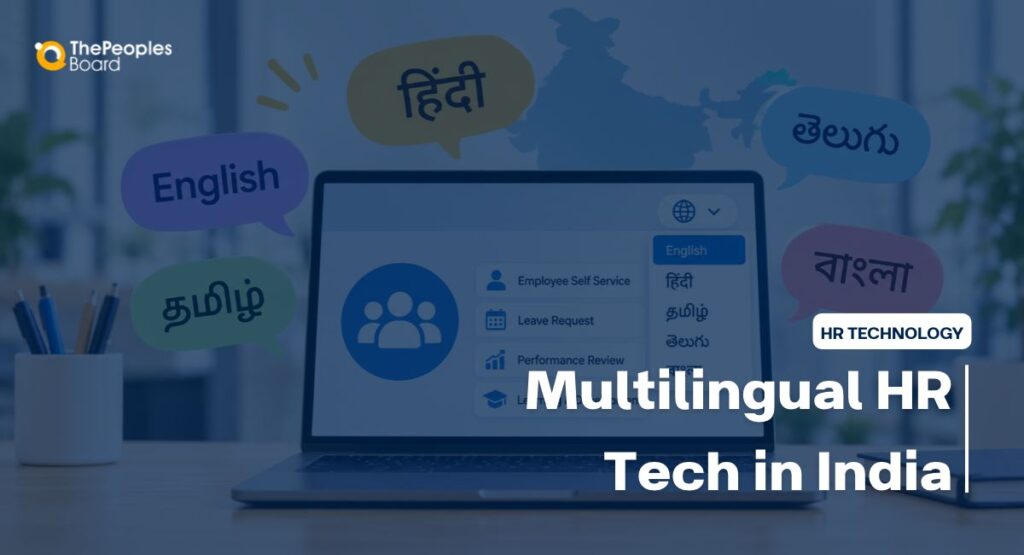
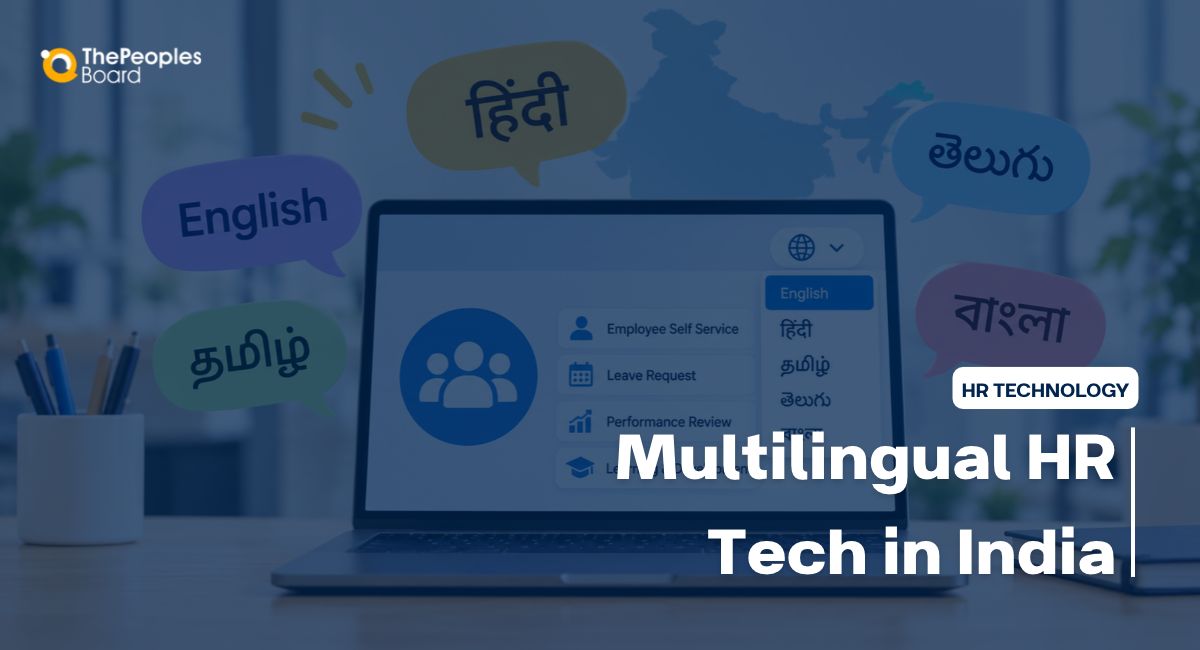

The average Indian enterprise rolls out an HRMS that speaks fluent English and little else. The average Indian employee does not. As such, HR technology in India keeps running into the same problem: the people it is built to serve often can’t read it.
As per the 2011 Census, India has 22 scheduled languages and 99 non-scheduled ones spoken by at least 10,000 people each. Scheduled-language speakers account for roughly 97% of the population.
English is the mother tongue of fewer than 260,000 Indians. While India’s workforce reflects that reality, the HR tech decks rarely do.
The problem isn’t a shortage of software. It’s the mismatch between the language the software ships in and the language in which policies, consent and pay slips land for the person using them.
Why English-First HR Tech Falls Short
India’s workforce is split across work tiers that look nothing alike in terms of language access.
White-collar roles in IT, consulting, and financial services operate in English by default, though few call the language its mother tongue. Manufacturing shop floors, warehouses, last-mile delivery, retail, security and construction often use English at negligible rates.
As such, any HR system that treats English as the norm leaves most of the country’s workers unsupported.
A per Ministry of Labour & Employment’s eShram portal, there are more than 30.98 crore unorganised workers as of August 2025. NITI Aayog projects that India’s gig workforce will expand to 23.5 million by 2029-30, with retail, sales and transportation leading the composition.
Most of these workers need frictionless access to onboarding, payroll, leave, grievance channels and safety training. And yet, such features are usually available in English or Hindi, leaving behind many other languages.
| Language tier in Indian HR tech | Typical coverage | Workforce reality |
| English only | Default in most global HRMS deployments | Covers a thin white-collar slice |
| English + Hindi | Common in India-native platforms | Leaves Tamil, Telugu, Bengali, Marathi and others gapped |
| English + Hindi + 2 to 3 regional languages | Enterprise rollouts with deliberate design | Fits most pan-India operations reasonably well |
| English + 10+ Indian languages with script and voice | Rare, largely public sector | Matches Census and eShram reality |
TPB’s reporting on mother-tongue influence bias at work has laid out how linguistic assumptions quietly shape hiring, performance review and even informal networks. The same assumptions carry into tech procurement and cost far more than they look like they will.
Where the Friction Shows Up Across the Workforce
Different tiers of the Indian workforce experience the language gap in different ways. The design response has to match that, not land as one monolithic translation layer.
Frontline and Blue-Collar Deployments
Language friction bites hardest at this tier, and the return on fixing it is also the clearest. A warehouse worker in Bhiwandi, a delivery rider in Jaipur, a nurse’s aide in Kochi: each is expected to clock in, mark attendance, raise complaints and consume safety training through an app built in a language they often read slowly, if at all.
Companies solving for this have moved beyond text. Delhivery’s Abhayam programme for over a lakh frontline workers uses voice and pictorial prompts in regional languages. Zomato, Swiggy and Urban Company deliver rider-side instructions through audio and vernacular push notifications rather than long English SOPs. The payoff shows up in the numbers: digital onboarding completion rates rise once the medium matches the mother tongue, and 30-day attrition tends to drop.
White-Collar and Managerial Tiers
English fluency isn’t the full story even here. Managers in tier-two and tier-three cities, first-time people managers promoted from the floor, and functional specialists in regional offices still prefer policy documents, POSH training and ethics modules in a language they’re comfortable with. A compliance module read in a second language is rarely one absorbed, and the quiet cost shows up as rework when something goes wrong.
Gig and Platform Workers
Gig workers sit outside traditional HR tech entirely. Their touchpoints are the platform app, WhatsApp groups and support chatbots. Finance Minister Nirmala Sitharaman recently asked public sector banks to revise HR policies so that the branch staff speak the local language, and the same principle holds for every rider, driver and seller-facing interface. If the worker can’t read the dispute flow, the dispute doesn’t get filed.
The Vendor Response and What’s Still Missing
India-native HR tech has moved further on this than most global suites. Darwinbox supports a multi-language framework covering Hindi, Bengali, Tamil and several non-Indian languages. Keka offers regional-language self-service interfaces. PeopleStrong, greytHR and HROne have added vernacular support for payslips, leave requests and attendance.
Public infrastructure is accelerating too: MeitY’s Bhashini platform covers all 22 scheduled languages and has been integrated into eShram and other government systems, giving vendors an open API backbone.
Despite the efforts, there are still gaps that should be kept in mind. Voice-first interaction in low-resource languages like Maithili, Santali or Bodo remains thin. Statutory documents (Form 16, offer letters, policy PDFs) often render cleanly only in English and Hindi, with regional-script output still patchy.
AI-powered HR chatbots are improving in Hindi and the big southern languages, but intent detection drops sharply when workers mix languages, which they do constantly. The open question is whether the AI-first HR stack now being built in India is being designed for the top of the pyramid or the whole pyramid.
Compliance and Consent in a Language the Employee Actually Reads
The Digital Personal Data Protection Act, 2023 requires that notices for processing personal data be made available in English and any of the 22 scheduled languages at the data principal’s option. HR tech routinely collects sensitive personal data (biometrics, bank details, health declarations, performance ratings), and the law effectively sets a language floor that most current deployments don’t clear.
State-level mandates add another layer. Karnataka, Tamil Nadu and Maharashtra each require certain workplace notices in the regional language. A platform that can push a policy update in English but can’t generate the Marathi version in time fails a compliance test, not just a UX one. Balancing global HR standardisation with Indian localisation sits at the heart of this question for multinationals operating in the country.
In the End…
The multilingual HR tech question in India isn’t about adding a dropdown. It’s a procurement, design and compliance question that deserves asking before the vendor contract is signed, not after the first all-hands email goes out in a language half the workforce can’t follow.
Before shortlisting any HRMS, HR teams would do well to map their own workforce’s primary and secondary languages by tier, location and role. Vendor demos should be stress-tested in at least two Indian languages beyond Hindi, with attention to script rendering in offer letters, pay slips and consent notices. And every rollout plan should carry a named owner for the vernacular layer, not treat it as a post-launch backlog item. The workforce has always been multilingual. It’s the technology that has some catching up to do.
FAQs
Why isn’t English-only HR tech enough for India?
Fewer than 260,000 Indians have English as their mother tongue, while scheduled-language speakers cover 97% of the population. Manufacturing, delivery, retail and construction run on negligible English, so an English-default HRMS leaves most workers without real access to core features.
Where does the language gap hit hardest?
Frontline and blue-collar deployments. Delhivery, Zomato, Swiggy and Urban Company have moved to voice prompts and vernacular audio notifications, with onboarding completion rising and 30-day attrition falling as a result.
What does the DPDP Act, 2023 require on language?
Notices for processing personal data must be available in English and any of the 22 scheduled languages at the employee’s option. Karnataka, Tamil Nadu and Maharashtra add further regional-language workplace notice requirements.
Have Indian HR tech vendors solved the multilingual problem?
Partly. Darwinbox, Keka, PeopleStrong, greytHR and HROne offer vernacular support for payslips and leave, and MeitY’s Bhashini platform covers all 22 scheduled languages. Voice-first interaction in low-resource languages, regional-script statutory documents, and code-mixed chatbot queries remain weak spots.
What should HR teams check before signing an HRMS contract?
Map workforce languages by tier and location before shortlisting. Stress-test demos in at least two Indian languages beyond Hindi, with attention to script rendering in offer letters, payslips and consent notices. Assign a named owner for the vernacular layer in the rollout plan.