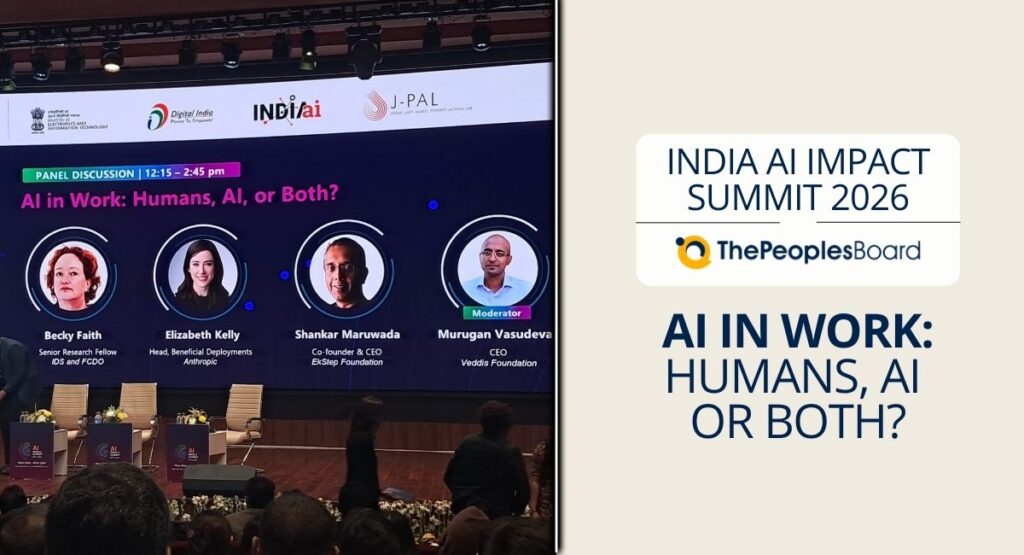
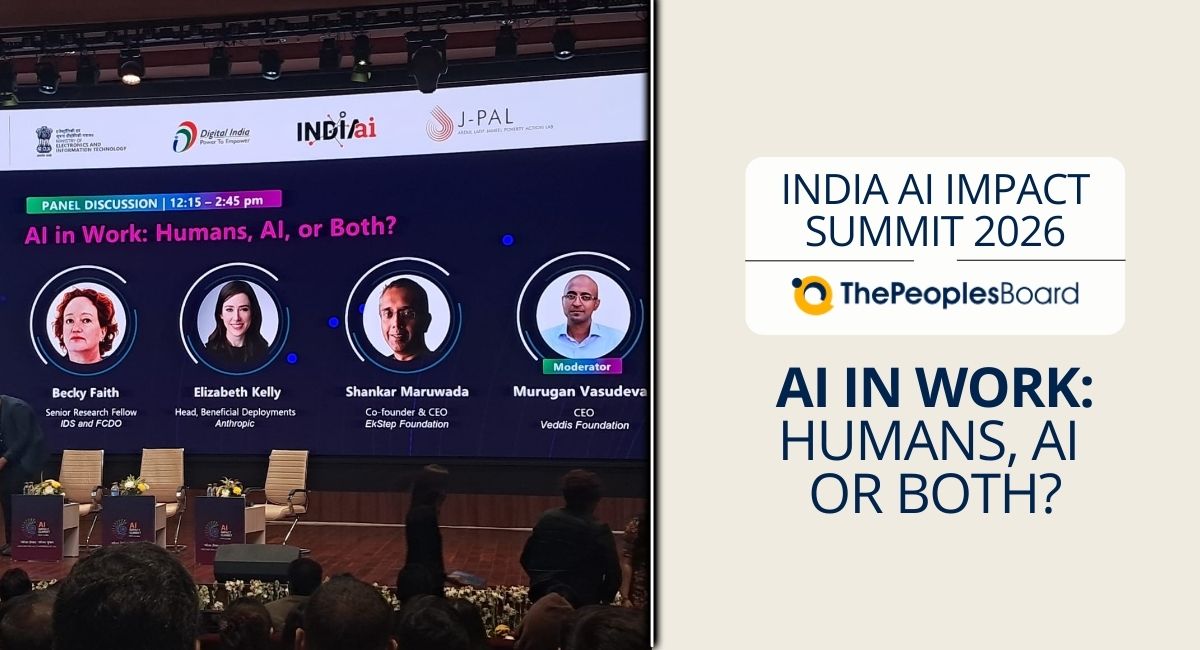

Is AI in work meant to automate processes or merely support those involved in the process? This was the key question discussed during the “AI in Work: Humans, AI, or Both?” session in the India AI Impact Summit 2026
The session began with an interactive speech by David Yanagizawa-Drott, Professor of Economics at the University of Zurich. “Do we automate or do we augment?” he asked the audience, referring to the AI use in their own companies. In his session, Yanagizawa-Drott focused on one particular point:
Data is the key to measuring how AI should and shouldn’t be used.
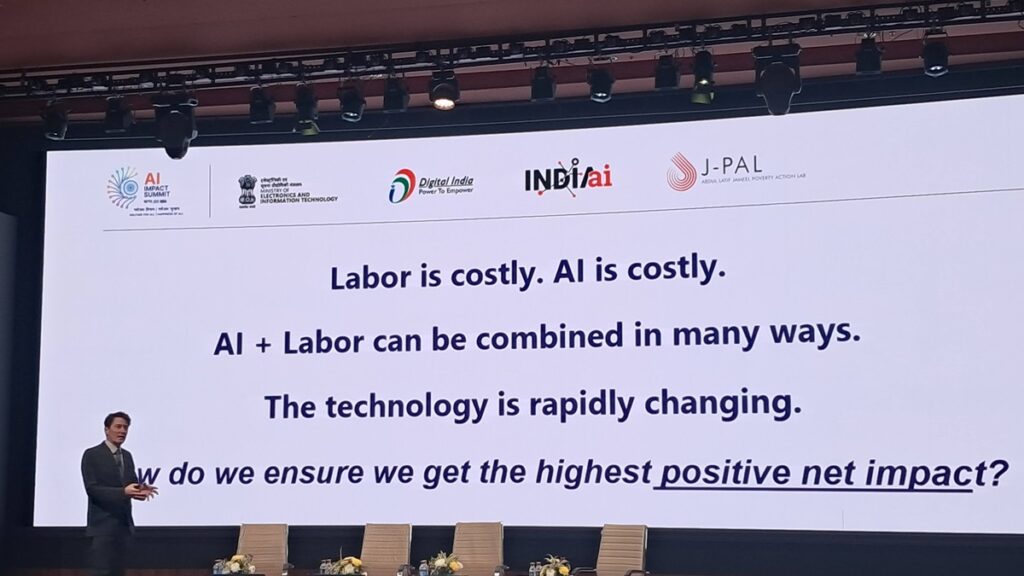
Giving his audience a variety of scenarios, he emphasised that the choice of AI adoption, automation, and augmentation depends on the results each generates. These results, he explained, can change depending on the industry, people, and geographies.
In the panel discussion that followed, moderated by Murugan Vasudevan of Veddis, these topics were further explored with examples from ongoing use in India.
Shankar Maruwada of the EkStep Foundation highlighted how Amul is using AI to help thousands of female cow farmers. With AI, these cow farmers can now better care for their cows’ health, especially when a cow falls sick, thereby elevating their income and livelihood.
Anthropic’s Elizabeth Kelly added that even in the world of coding, things are being built by AI in record time, labelling the process as a paradigm shift. Dr Becky Faith from the Institute of Development Studies (IDS) and FCDO did add that, within the communities she has worked in, AI adoption is still being resisted by many community workers, particularly those in the older age bracket.
AI’s Effect on India’s Productivity
The panel also discussed how AI is affecting India’s productivity. As per Maruwada, India has progressed from its past as a “low productivity society” thanks to computers and IT. He believes that now, there are more options for being productive thanks to AI. He believes we will see new types of services emerge and be created as AI integrates further into society.
Kelly also noted that Anthropic’s research showed that while India is second in total AI usage, it ranks 101 globally in AI per capita use. She found it interesting that 45% of AI use in India is in computer-based mathematical tasks, and that the country has also seen the greatest efficiency gains with AI.
Furthermore, the panel agreed that, for the informal economy, AI can open doors to skill development and improve livelihoods. With AI, designing needs to be done keeping inclusion, equity, and diversity in mind, said Maruwada. Dr Faith added that AI evaluations are important for transparency, trust, benefit, and answers.