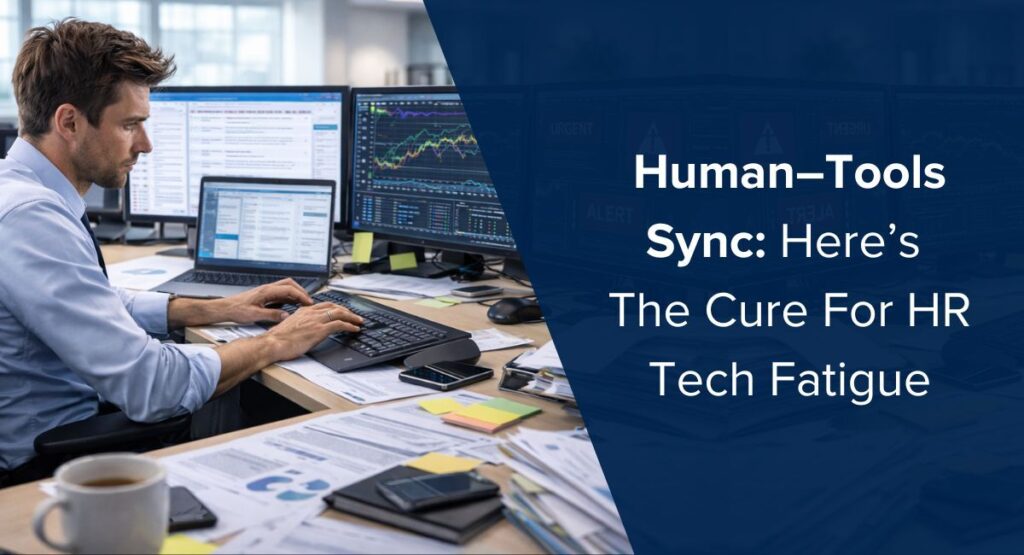


- For HR professionals, this fatigue shows up as endless dashboards, alerts, integrations that don’t fully integrate, and reporting that still needs manual correction.
- In HR processes, employees need to feel that the technology HR introduces is there to make their work easier, not to monitor every move.
In the age of AI, it is needless to say that HR and tech go hand in hand. With the globalisation of the workforce, HR tools have become necessary evils that silently crept into the workplaces.
However, a PeopleStrong study found that only 46% of organisations have achieved clear business value by adopting HR tech products, which means more than half of the companies are struggling to extract tangible value from their HR tech investments.
Let’s Rewind And Play
The need for a well-integrated HR tech system was felt majorly when the world shut down overnight due to the COVID-19 lockdown. It is not that remote workforces were not being managed before the pandemic. But people didn’t question ‘biometric’.
But just over a night with the announcement of the nationwide lockdown, HR became multi-functional and managing the workforce became equivalent to caregiving. From hiring remotely to managing oxygen cylinders in a different city for the employees and their families, HR probably never felt overburdened with such additional tasks.
That’s when the need for remote systems for automated management of the workforce (at least with the repeated tasks) to the greatest possible extent was felt. India saw a boom in HR tech startups like never before. The companies which existed started growing, while some new ones came up, citing the crisis as a business opportunity.
This was the beginning of the HR tech revolution in India, since when tech became synonymous with workforce management. Today, from learning to attendance management, every process of HR is covered by tech.
But do heavy investments in HR tech deliver?
Probably not. At least that’s what the PeopleStrong study indicates. If more than 50% of the companies are struggling to extract tangible value from their HR tech investments, then it is probably time to question the utility of investing in multiple apps, each dedicated to a specific use.
For an analytical answer, it will probably be interesting to watch how people react and engage with these tools. A LinkedIn newsletter titled People Over Perks by Leapsome reported that, as per Harvard Business Review, workers switch between apps 1,200 times per day, losing nearly four hours of focus every week.
Aligning with this, Forbes’ contributory author Bryan Robinson wrote that as a part of his work published in the magazine in 2023, some employees he spoke with reported that app switching is sucking productivity instead of boosting it.
He coined this as ‘digital tool fatigue’, which undermines team collaboration, employee well-being and productivity. “They said they needed tools that don’t just focus on to-dos and deadlines but also define and prioritise the tasks that will drive the most impact for their companies,” he wrote.
Research Gate has defined digital fatigue as a condition arising from prolonged engagement with digital tools, which significantly affects employee productivity and well-being. The fatigue is characterised by cognitive and emotional exhaustion resulting from excessive digital engagement.
How does it affect HR and employees?
The idea behind introducing HR tech and other digital tools into the workforce was to automate processes and reduce the load of repetitive tasks. But too much of anything causes toxicity. So is the case with HR tech.
Per the Research Gate report, with increased app switching, focus slowly turns into autopilot. Energy drops, procrastination increases, mistakes keep repeating, and work becomes full of errors. Eventually, people feel exhausted, lose alertness, and have to start all over again. People lose enthusiasm for work and getting through the day, and increasing disengagement with work.
This happens even with HR tech tools when employees and HR teams are forced to operate within an overcrowded ecosystem of platforms such as HRMS, ATS, LMS, engagement apps, performance tools, collaboration software, and now AI copilots.
For HR professionals, this fatigue shows up as endless dashboards, alerts, integrations that don’t fully integrate, and reporting that still needs manual correction. For employees, it appears as multiple logins, repeated data entry, inconsistent interfaces, and unclear ownership of tasks.
How to overcome this?
Though digital fatigue is commonly discussed across HR forums today, it is tricky to find a way to deal with it, given the acceleration of automated processes. Let’s take a look at what could be the possible ways to reduce stress:
- To start with, the baby step should be to simplify. The simpler the algorithms, the more feasible the processes. Fewer but well-integrated systems reduce mental load far more effectively than feature-rich but disconnected ones.
- Next comes human-centred workflow design. Technology should follow how employees actually work, not how vendors design demos. Recently, in an interaction with ThePeoplesBoard, Grafton Recruitment’s Executive Director, Maya Nair, said, “The future of work is not a competition between humans and machines but a collaboration that leverages the strengths of both.”
- Digital fatigue often comes from uncertainty and misuse. When employees understand why a tool exists and how it improves their work, resistance and exhaustion decline significantly.
Maintaining human-digital collaboration
Most of the studies referred to above indicate that information overload reverses productivity. Ideal advice for HR leaders should be to maintain a sync between humans and tech, as reflected in a recent Indeed study. The study found that nearly 97% HR leaders anticipate that by 2027, the nature of work will be shaped by humans working alongside AI rather than engaging with it only intermittently.
At the end of the day, human-tools sync really comes down to trust. In HR processes, employees need to feel that the technology HR introduces is there to make their work easier, not to monitor every move. When people understand how their data is being used, how AI supports decisions, and where human judgment still matters, they’re far more likely to embrace these tools instead of resisting them.
For HR teams, the goal isn’t to keep piling on more platforms, dashboards, or apps. It’s about creating a tech ecosystem that quietly supports work, streamlines processes, and reduces unnecessary friction. Fewer, well-integrated tools, smarter workflows, and simpler interfaces make a huge difference.